On GitHub, ossrs/srs has picked up 29.4k stars, Backend, C++. SRS is a simple, high-performance, AI-driven real-time media server supporting RTMP, WebRTC, HLS, HTTP-FLV, HTTP-TS, SRT, MPEG-DASH, and GB28181, with codec support for H.264, H.265, AV1, VP9, AAC, Opus, and G.711.
Snapshot summary built from the project's own GitHub metadata — there's no written TopGit review yet. The page will update automatically when a full review is published.
WHY NO REVIEW YET
TopGit writes full reviews for the most-starred, most-requested repositories. This page is a snapshot until then — see the READ ME tab for the original README in full.
SRS/8.0 (Free) is a simple, high-performance, AI-driven real-time media server.
It supports RTMP, WebRTC, HLS, HTTP-FLV, SRT, MPEG-DASH, and GB28181 on Linux and macOS across
x86_64, ARMv7, AArch64, Apple M1, RISC-V, LoongArch, and MIPS architectures, and natively on
Windows x64. Supported codecs include
H.264, H.265, AV1, VP9, AAC, Opus, and G.711. See the complete list of features.
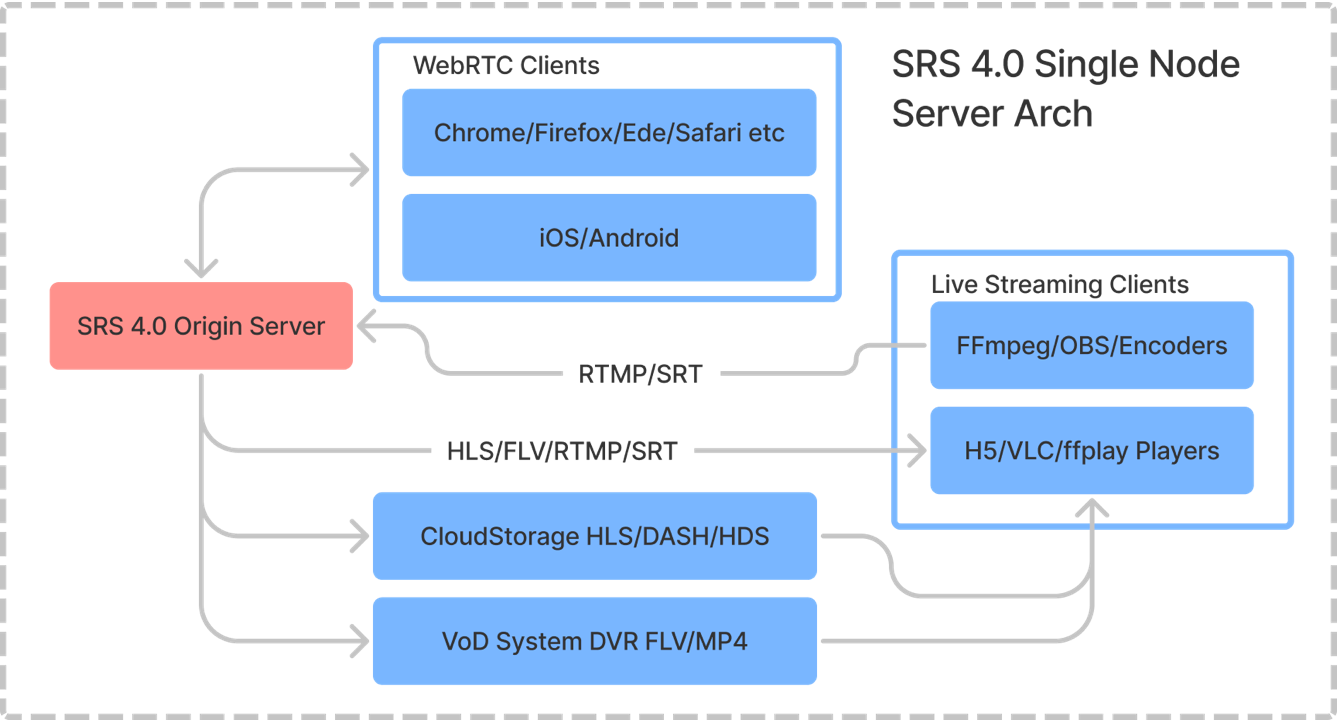
Note: For more details on the single-node architecture for SRS, please visit the following link.
SRS is licenced under MIT, and some third-party libraries are
distributed under their licenses.
Usage
Please check the Getting Started guide in English
or Chinese. We highly recommend using SRS with docker:
Alternatively, stream by OBS using the following configuration:
Service: Custom
Server: rtmp://localhost/live
Stream Key: livestream
Play the following streams using media players:
To play an RTMP stream with URL rtmp://localhost/live/livestream on VLC player, open the player, go to Media > Open Network Stream, enter the URL and click Play.
You can play HTTP-FLV stream URL http://localhost:8080/live/livestream.flv on a webpage using the srs-player, an HTML5-based player.
Use srs-player for playing HLS stream with URL http://localhost:8080/live/livestream.m3u8.
If you'd like to use WebRTC, convert RTMP to WebRTC, or convert WebRTC to RTMP, please check out
the wiki documentation in either English or
Chinese.
To learn more about RTMP, HLS, HTTP-FLV, SRT, MPEG-DASH, WebRTC protocols, clustering,
HTTP API, DVR, and transcoding, please check the documents in English
or Chinese.
AI Agent
I recommend to use AI to understand and maintain your SRS, please follow the wiki
AI Agent for details.
Contributing
The maintainers, and contributors are listed here. The maintainers
who made significant contributions and maintained parts of SRS are listed below, ranked by the number of commits:
Winlin: Founder of the project, focusing on ST and Issues/PR. Responsible for architecture and maintenance.
XiaoZhihong: Concentrates on WebRTC/QUIC and SRT, with expertise in network QoS. Contributed to ARM on ST and was the original contributor for WebRTC.
ChenHaibo: Specializes in GB28181 and HTTP API, contributing to patches for FFmpeg with WHIP.
ZhangJunqin: Focused on H.265, Prometheus Exporter, and API module.
XiaLixin: Specializes in GB28181, with expertise in live streaming and WebRTC.
Jacob Su: Jacob Su has contributed to various modules of SRS.
ShiWei: Specializes in SRT and H.265, maintaining SRT and FLV patches for FFmpeg. An expert in codecs and FFmpeg.
ChenGuanghua: Focused on WebRTC/QoS and introduced the Asan toolchain to SRS.
LiPeng: Concentrates on WebRTC and contributes to memory management and smart pointers.
ZhaoWenjie: One of the earliest contributors, focusing on HDS. Has expertise in client technology.
WuPengqiang: Focused on H.265, initially contributed to the FFmpeg module in SRS for transcoding AAC with OPUS for WebRTC.
A huge THANK YOU goes out to:
All the contributors of SRS.
All the friends of SRS who gave big support.
Genes, Mabbott, and Michael Talyanksy for making and sharing State Threads.
We're really thankful to everyone in the community for helping us find bugs and improve the project.
To stay in touch and keep helping our community, please check out this guide.
Of course, financial support is very important to us, so we can build the website and use AI tools to
maintain the community. Please visit OpenCollective to become
a backer or sponsor.
LICENSE
SRS is licenced under MIT, and some third-party libraries are
distributed under their licenses.
The most recent commit recorded on ossrs/srs was 16 days ago, based on the GitHub push timestamp. The repository has 5.7k forks — one of the better signals of community interest.
How many stars does ossrs/srs have?
ossrs/srs has 29.4k GitHub stars — refresh the page for the live number, or check github.com/ossrs/srs. TopGit mirrors GitHub's count but does not claim minute-by-minute accuracy.
What language is ossrs/srs written in?
ossrs/srs is written primarily in C++. GitHub's language field is based on the largest share of bytes in the default branch.
What license does ossrs/srs use?
ossrs/srs is released under the MIT license. Always verify the LICENSE file directly on GitHub for the authoritative terms — license strings can be edited out of sync with a project's actual stance.
The project maintains a homepage at https://ossrs.io. The README tab on this page also usually contains screenshots and a quickstart.
Where do I read more about ossrs/srs?
This TopGit page is a snapshot — the READ ME tab shows the project's own README content (links stripped, images preserved). The GitHub repository at github.com/ossrs/srs is the definitive source.
Read full README in the tab above.
Curious whether srs is right for you?
Let ChatGPT, Claude, or Perplexity look into it — click below and see what AI actually says about srs.

 /srs