PaddlePaddle/ERNIE is a Python project with 7.7k stars in the AI Tools space. The official repository for ERNIE 4.5 and ERNIEKit – its industrial-grade development toolkit based on PaddlePaddle.
Snapshot summary built from the project's own GitHub metadata — there's no written TopGit review yet. The page will update automatically when a full review is published.
WHY NO REVIEW YET
TopGit writes full reviews for the most-starred, most-requested repositories. This page is a snapshot until then — see the READ ME tab for the original README in full.
📑 Blog | 📚 Cookbook | 📑 Paper | 🛠️ Training | ⚡️ Deploy
📣 Recent updates
[2025-11] 🔥 Released ERNIEKit v1.5:
New Features
[ERNIE-4.5-VL-28B-A3B-Thinking] Supports SFT training and function call training for ERNIE-4.5-VL-28B-A3B-Thinking (https://huggingface.co/baidu/ERNIE-4.5-VL-28B-A3B-Thinking).
[2025-10] 🔥 Released ERNIEKit v1.4:
New Features
VL Model Training: Support SFT for PaddleOCR-VL-0.9B model. More details in PaddleOCR-VL-0.9B SFT.
Dataflow : Support padding-free startegy.
Packing data within a batch into a sequence to avoid padding, thereby reducing GPU memory usage and accelerating training.
[2025-09] 🔥 Released ERNIEKit v1.3:
New Features
[ERNIE-4.5-21B-A3B-Thinking] Supports SFT training and function call training for ERNIE-4.5-21B-A3B-Thinking (https://huggingface.co/baidu/ERNIE-4.5-21B-A3B-Thinking).
Bug Fixes:
[VL Model Training] Optimization of multimodal video data processing speed (#1266).
[2025-09] 🔥 Released ERNIEKit v1.2:
New Features
[WebUI] Added support for training and conversation functionalities with ERNIE 28b/424b VL models.
[VL Model Training] Introduced support for query-response format in training data.
[VL Model Training] Fix lora 128k training bug (#1234)
[2025-09] 🔥 Released ERNIEKit v1.1: ERNIEKit now supports SFT/LoRA for ERNIE-4.5-VL series.
[2025-06] 🔥 Released ERNIEKit v1.0: We're excited to announce ERNIEKit v1.0, the most powerful and efficient toolkit yet for developing with the latest ERNIE models!
Introduction to ERNIE 4.5
We introduce ERNIE 4.5, a new family of large-scale multimodal models comprising 10 distinct variants. The model family consist of Mixture-of-Experts (MoE) models with 47B and 3B active parameters, with the largest model having 424B total parameters, as well as a 0.3B dense model. For the MoE architecture, we propose a novel heterogeneous modality structure, which supports parameter sharing across modalities while also allowing dedicated parameters for each individual modality. This MoE architecture has the advantage to enhance multimodal understanding without compromising, and even improving, performance on text-related tasks. All of our models are trained with optimal efficiency using the PaddlePaddle deep learning framework, which also enables high-performance inference and streamlined deployment for them. We achieve 47% Model FLOPs Utilization (MFU) in our largest ERNIE 4.5 language model pre-training. Experimental results show that our models achieve state-of-the-art performance across multiple text and multimodal benchmarks, especially in instruction following, world knowledge memorization, visual understanding and multimodal reasoning. All models are publicly accessible under Apache 2.0 to support future research and development in the field. Additionally, we open source the development toolkits for ERNIE 4.5, featuring industrial-grade capabilities, resource-efficient training and inference workflows, and multi-hardware compatibility.
ERNIE 4.5
ERNIE 4.5 Models
Model Information
Model Category
Model
Input Modality
Output Modality
Context Window
Large Language Models (LLMs)
ERNIE-4.5-300B-A47B-Base
Text
Text
128K
ERNIE-4.5-300B-A47B
ERNIE-4.5-21B-A3B-Base
ERNIE-4.5-21B-A3B
Vision-Language Models (VLMs)
ERNIE-4.5-VL-424B-A47B-Base
Text/Image/Video
Text
ERNIE-4.5-VL-424B-A47B
ERNIE-4.5-VL-28B-A3B-Base
ERNIE-4.5-VL-28B-A3B
Dense Models
ERNIE-4.5-0.3B-Base
Text
Text
ERNIE-4.5-0.3B
Note: All models (including pre-trained weights and inference code) have been released on 🤗Hugging Face, and AI Studio. Check our blog for more details.
Highlights
Our model family is characterized by three key innovations:
Multimodal Heterogeneous MoE Pre-Training: Our models are jointly trained on both textual and visual modalities to better capture the nuances of multimodal information and improve performance on tasks involving text understanding and generation, image understanding, and cross-modal reasoning. To achieve this without one modality hindering the learning of another, we designed a heterogeneous MoE structure, incorporated modality-isolated routing, and employed router orthogonal loss and multimodal token-balanced loss. These architectural choices ensure that both modalities are effectively represented, allowing for mutual reinforcement during training.
Scaling-Efficient Infrastructure: We propose a novel heterogeneous hybrid parallelism and hierarchical load balancing strategy for efficient training of ERNIE 4.5 models. By using intra-node expert parallelism, memory-efficient pipeline scheduling, FP8 mixed-precision training and finegrained recomputation methods, we achieve remarkable pre-training throughput. For inference, we propose multi-expert parallel collaboration method and convolutional code quantization algorithm to achieve 4-bit/2-bit lossless quantization. Furthermore, we introduce PD disaggregation with dynamic role switching for effective resource utilization to enhance inference performance for ERNIE 4.5 MoE models. Built on PaddlePaddle, ERNIE 4.5 delivers high-performance inference across a wide range of hardware platforms.
Modality-Specific Post-Training: To meet the diverse requirements of real-world applications, we fine-tuned variants of the pre-trained model for specific modalities. Our LLMs are optimized for general-purpose language understanding and generation. The VLMs focuses on visuallanguage understanding and supports both thinking and non-thinking modes. Each model employed a combination of Supervised Fine-tuning (SFT), Direct Preference Optimization (DPO) or a modified reinforcement learning method named Unified Preference Optimization (UPO) for post-training.
Performance and Benchmark Results
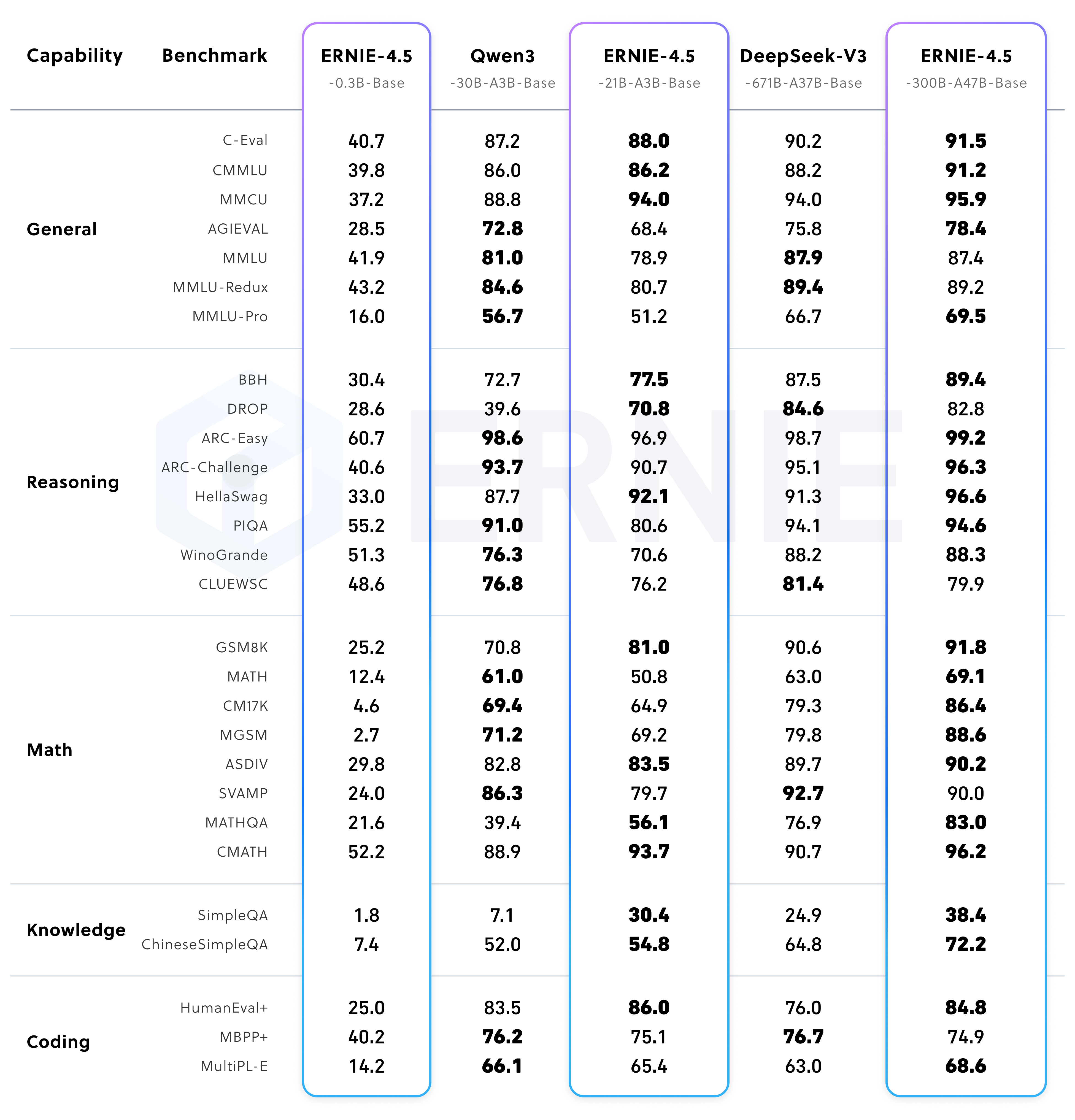
ERNIE-4.5-300B-A47B-Base surpasses DeepSeek-V3-671B-A37B-Base on 22 out of 28 benchmarks, demonstrating leading performance across all major capability categories. This underscores the substantial improvements in generalization, reasoning, and knowledge-intensive tasks brought about by scaling up the ERNIE-4.5-Base model relative to other state-of-the-art large models. With a total parameter size of 21B (approximately 70% that of Qwen3-30B), ERNIE-4.5-21B-A3B-Base outperforms Qwen3-30B-A3B-Base on several math and reasoning benchmarks, including BBH and CMATH. ERNIE-4.5-21B-A3B-Base remains highly competitive given its significantly smaller model size, demonstrating notable parameter efficiency and favorable performance trade-offs.
ERNIE-4.5-300B-A47B, the post trained model, demonstrates significant strengths in instruction following and knowledge tasks, as evidenced by the state-of-the-art scores on benchmarks such as IFEval, Multi-IF, SimpleQA, and ChineseSimpleQA. The lightweight model ERNIE-4.5-21B-A3B achieves competitive performance compared to Qwen3-30B-A3B, despite having approximately 30% fewer total parameters.
In the non-thinking mode, ERNIE-4.5-VL exhibits outstanding proficiency in visual perception, document and chart understanding, and visual knowledge, performing strongly across a range of established benchmarks. Under the thinking mode, ERNIE-4.5-VL not only demonstrates enhanced reasoning abilities compared to the non-thinking mode, but also retains the strong perception capabilities of the latter. ERNIE-4.5-VL-424B-A47B delivers consistently strong results across the full multimodal evaluation suite. Its thinking mode provides a distinct advantage on reasoning-centric tasks, narrowing or even surpassing the gap to OpenAI-o1 on challenging benchmarks such as MathVista, MMMU, and VisualPuzzle, while maintaining competitive performance on perception-focused datasets like CV-Bench and RealWorldQA. The lightweight vision-language model ERNIE-4.5-VL-28B-A3B achieves competitive or even superior performance compared to Qwen2.5-VL-7B and Qwen2.5-VL-32B across most benchmarks, despite using significantly fewer activation parameters. Notably, our lightweight model also supports both thinking and non-thinking modes, offering functionalities consistent with ERNIE-4.5-VL-424B-A47B.
Performace of ERNIE-4.5 pre-trained models
Performance of post-trained model ERNIE-4.5-300B-A47B
Performance of post-trained model ERNIE-4.5-21B-A3B
Performance of post-trained multimodal models in thinking mode
Performance of post-trained multimodal models in non-thinking mode
Model Development
ERNIE 4.5 models are trained and deployed for inference using the PaddlePaddle framework. The full workflow of training, compression, and inference for ERNIE 4.5 is supported through the ERNIEKit and FastDeploy toolkit. The table below details the feature matrix of the ERNIE 4.5 model family for training and inference.
Model
Training
Inference
ERNIE-4.5-300B-A47B-Base
SFT/SFT-LoRA/DPO/DPO-LoRA
BF16 / W4A16C16 / W8A16C16 / FP8
ERNIE-4.5-300B-A47B
SFT/SFT-LoRA/DPO/DPO-LoRA/QAT
BF16 / W4A16C16 / W8A16C16 / W4A8C8 / FP8 / 2Bits
ERNIE-4.5-21B-A3B-Base
SFT/SFT-LoRA/DPO/DPO-LoRA
BF16 / W4A16C16 / W8A16C16 / FP8
ERNIE-4.5-21B-A3B
SFT/SFT-LoRA/DPO/DPO-LoRA
BF16 / W4A16C16 / W8A16C16 / FP8
ERNIE-4.5-VL-424B-A47B-Base
Coming Soon
BF16 / W4A16C16 / W8A16C16 / FP8
ERNIE-4.5-VL-424B-A47B
Coming Soon
BF16 / W4A16C16 / W8A16C16 / FP8
ERNIE-4.5-VL-28B-A3B-Base
Coming Soon
BF16 / W4A16C16 / W8A16C16 / FP8
ERNIE-4.5-VL-28B-A3B
Coming Soon
BF16 / W4A16C16 / W8A16C16 / FP8
ERNIE-4.5-0.3B-Base
SFT/SFT-LoRA/DPO/DPO-LoRA
BF16 / W8A16C16 / FP8
ERNIE-4.5-0.3B
SFT/SFT-LoRA/DPO/DPO-LoRA
BF16 / W8A16C16 / FP8
Note: For different ERNIE 4.5 model, we provide diverse quantization schemes using the notation WxAxCx, where: W indicates weight precision, A indicates activation precision, C indicates KV Cache precision, x represents numerical precision.
ERNIEKit: ERNIE Development Toolkit Based on PaddlePaddle
ERNIEKit is an industrial-grade training and compression development toolkit for ERNIE models based on PaddlePaddle, offering full-cycle development support for the ERNIE 4.5 model family. Key capabilities include:
High-performance pre-training implementation
Full-parameter supervised fine-tuning (SFT)
Direct Preference Optimization (DPO)
Parameter-efficient fine-tuning and alignment (SFT-LoRA/DPO-LoRA)
Quantization-Aware Training (QAT)
Post-Training Quantization (PTQ) [WIP]
Minimum hardware requirements for training each model are documented here.
Quick Start
When you install ERNIEKit successfully, you can start training ERNIE 4.5 models with the following command:
# download model from huggingface
huggingface-cli download baidu/ERNIE-4.5-0.3B-Paddle --local-dir baidu/ERNIE-4.5-0.3B-Paddle
# 8K Sequence Length, SFT
erniekit train examples/configs/ERNIE-4.5-0.3B/sft/run_sft_8k.yaml
For detailed guides on installation, CLI usage, WebUI, multi-node training, and advanced features, please refer to ERNIEKit Training Document.
For detailed guides on High-performance pre-training, please refer to Pre-Training Document.
FastDeploy:High-performance Inference and Deployment Toolkit for LLMs and VLMs Based on PaddlePaddle
FastDeploy is an inference and deployment toolkit for large language models and visual language models, developed based on PaddlePaddle. It delivers production-ready, easy-to-use multi-hardware deployment solutions with multi-level load-balanced PD disaggregation, comprehensive quantization format support, OpenAI API server and vLLM compatible etc.
For installation please refer to FastDeploy.
Offline Inference
from fastdeploy import LLM, SamplingParams

prompt = "Write me a poem about large language model."
sampling_params = SamplingParams(temperature=0.8, top_p=0.95)

llm = LLM(model="baidu/ERNIE-4.5-0.3B-Paddle", max_model_len=32768)

outputs = llm.generate(prompt, sampling_params)
How does PaddlePaddle/ERNIE compare to other AI Tools projects?
PaddlePaddle/ERNIE is tracked by TopGit in the AI Tools category, with 7.7k GitHub stars and written in Python. Browse the AI Tools topic page on TopGit to compare it against similar projects by stars and activity.
How many stars does PaddlePaddle/ERNIE have?
PaddlePaddle/ERNIE has 7.7k GitHub stars — refresh the page for the live number, or check github.com/PaddlePaddle/ERNIE. TopGit mirrors GitHub's count but does not claim minute-by-minute accuracy.
Is PaddlePaddle/ERNIE open source?
Yes — PaddlePaddle/ERNIE ships under the Apache-2.0 license, which makes its source code freely readable (and, depending on license terms, forkable and reusable). Source: github.com/PaddlePaddle/ERNIE.
What else is in the AI Tools space?
PaddlePaddle/ERNIE is tracked by TopGit under the AI Tools category, alongside 6 GitHub-tagged topics. Trending and Topics pages list peer repositories of comparable stars and language.
What is PaddlePaddle/ERNIE?
PaddlePaddle/ERNIE (PaddlePaddle/ERNIE) is a Python project on GitHub. From the project's own README: The official repository for ERNIE 4.5 and ERNIEKit – its industrial-grade development toolkit based on PaddlePaddle.
Where can I see PaddlePaddle/ERNIE in action?
The project maintains a homepage at https://ernie.baidu.com. The README tab on this page also usually contains screenshots and a quickstart.
Where do I read more about PaddlePaddle/ERNIE?
This TopGit page is a snapshot — the READ ME tab shows the project's own README content (links stripped, images preserved). The GitHub repository at github.com/PaddlePaddle/ERNIE is the definitive source.
Read full README in the tab above.
Want a second opinion on ERNIE?
Ask an AI that can read this page — one click and you get its take on ERNIE.
 /ERNIE