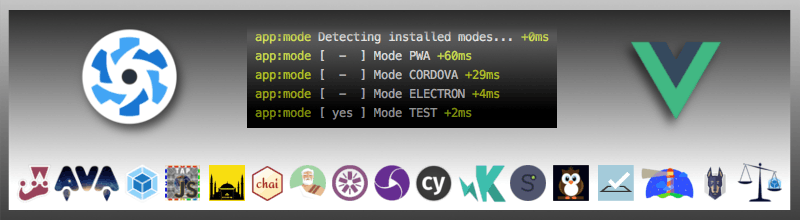
As a developer tool, quasarframework/quasar-testing has picked up 184 stars on GitHub (TypeScript). Testing Harness App Extensions for the Quasar Framework 2.0+
Snapshot summary built from the project's own GitHub metadata — there's no written TopGit review yet. The page will update automatically when a full review is published.
WHY NO REVIEW YET
TopGit writes full reviews for the most-starred, most-requested repositories. This page is a snapshot until then — see the READ ME tab for the original README in full.
This is the monorepo for integrating the test-runner of your choice into your Quasar app.
You can install multiple pre-rigged testing harnesses (test runners) to your Quasar application, each one will:
install the harness NPM package into your project;
scaffold necessary configuration files;
add script commands which expose some functionality of the respective harness.
App Extensions (such as these testing harnesses) only work with Quasar CLI, not by directly installing packages via a package manager. Use quasar ext add ... or the installation step won't be executed and configuration files won't be copied over.
Testing is not in and of itself hard. The most complicated part is setting up the testing harness. The trick lies in knowing what to test. If you are new to testing, it is absolutely imperative that you familiarize yourself with some of the concepts and patterns. There are some links for further reading at the end of this document page.
The Test Driven Design approach will help you to write better (and fewer) tests. Even though it may seem like it slows you down to some degree, this habit pays its dividends on the long term drastically reducing the number of public bugs and the project maintenance effort. Think of tests like insurance for your code that always pays out. On the other hand, not everything is worth being tested, or is worth being tested only at an higher level (eg. using an E2E tests instead of unit tests).
REMEMBER
Test the functionality, not the function
Table of contents
Donations
Installation
Removal
Reset
Upgrade
Provided App Extensions
Unit testing
Vitest
E2E testing
Cypress
Playwright
Quality Auditing (OUTDATED, not migrated to Qv2 yet)
Roadmap
Contributing
License
Donations
The Quasar team spend a considerable amount of time studying, coding and maintaining App Extensions (AE) which save literally thousands of developers hours, days or weeks of work.
Does your business or personal projects depend on these App Extensions? How much time did we save you until now? Consider donating to help us maintain them and allow us to create new ones!
Installation
You can add test harnesses with an "a-la-carte" approach: check each harness documentation for its installation command.
You can add multiple harnesses and even use them into your continuous integration pipelines.
Removal
You can remove a testing harness running:
$ quasar ext remove @quasar/testing-unit-vitest
This will remove the associated NPM package and run the Quasar App Extensions uninstall hook.
If not done into the AE uninstall hook, the removal won't delete test or configuration files.
Reset
If you mess up your configuration and need to reset, or just want to check out if there has been any changes into new versions configuration, you should run:
$ quasar ext add @quasar/testing-unit-vitest
Be careful though, this will overwrite ALL existing files (including configurations) if you allow it to. Make sure to have some kind of version control in place before proceeding. This operation will also upgrade the NPM package and its dependencies.
To prevent installing new or updated dependencies, you should run:
$ quasar ext invoke @quasar/testing-unit-vitest
Upgrade
You can upgrade a testing harness and its dependencies by updating its related NPM package.
This won't change existing test or configuration files.
Upgrade to a new major version with NPM
When upgrading between major versions, since there are major changes, we suggest you to remove and re-add the AE, to obtain latest configuration files too.
Ensure your source control is clean before proceeding, then answer (y) and "Overwrite all" when prompted to overwrite existing files and individually git diff all changes manually to check out which changes you want to keep and which you want to revert.
Cypress and Playwright both cover Chrome-based browsers (Chrome, Edge, Electron) and Firefox. For Safari, Playwright has native Webkit support and Cypress has experimental support. For Cordova/Capacitor apps consider webdriver.io.
Cypress
Check out Cypress AE documentation
Playwright
Check out Playwright AE documentation
Quality Auditing (OUTDATED, not migrated to Qv2 yet)
$ quasar ext add @quasar/testing-quality
Auditing the quality of your app is something you want to do before you go in production. Depending on your perspective, quality can mean many things. So we have put together a few tools that we think can help you have a qualitatively better project.
The Lighthouse tool can help you identify issues with your PWA app, but only if you serve the built version of your project. If you use it a lot, consider installing it globally.
Snyk is a tool for identifying node modules that have security implications. Running this regularly will keep you alerted to issues that may be stemming from repositories you use.
Node License Finder (nlf) is a free tool you can use to catalog all the licenses of the hundreds of open-source projects you are using in your project.
Further Reading
Books
Testing Vue.js Applications by Edd Yerburgh, the author of the @vue/test-utils repo
Free Vue Testing Handbook
Tutorials
Introduction to TDD
Overview of JavaScript testing 2020
Documentation
@vue/test-utils
cypress
lighthouse
snyk
nlf
chai
istanbul
Contributing
Contributions to this repository are highly desirable, see the Contribution Guidelines for more details.
Please note: project coordination takes place on the Discord server.
How does quasarframework/quasar-testing compare to other Developer Tools projects?
quasarframework/quasar-testing is tracked by TopGit in the Developer Tools category, with 184 GitHub stars and written in TypeScript. Browse the Developer Tools topic page on TopGit to compare it against similar projects by stars and activity.
Is quasarframework/quasar-testing open source?
Yes — quasarframework/quasar-testing ships under the MIT license, which makes its source code freely readable (and, depending on license terms, forkable and reusable). Source: github.com/quasarframework/quasar-testing.
What else is in the Developer Tools space?
quasarframework/quasar-testing is tracked by TopGit under the Developer Tools category, alongside 9 GitHub-tagged topics. Trending and Topics pages list peer repositories of comparable stars and language.
What is quasarframework/quasar-testing?
quasarframework/quasar-testing (quasarframework/quasar-testing) is a TypeScript project on GitHub. From the project's own README: Testing Harness App Extensions for the Quasar Framework 2.0+
Where do I read more about quasarframework/quasar-testing?
This TopGit page is a snapshot — the READ ME tab shows the project's own README content (links stripped, images preserved). The GitHub repository at github.com/quasarframework/quasar-testing is the definitive source.
Why is quasarframework/quasar-testing categorized under Developer Tools?
TopGit places quasarframework/quasar-testing in the Developer Tools category based on its GitHub topics and description (tagged: "cypress", "e2e-testing", "integration-testing"). Categories are assigned from real repository metadata, not editorial guesswork.
Read full README in the tab above.
Want a second opinion on quasar-testing?
Ask an AI that can read this page — one click and you get its take on quasar-testing.

 /quasar-testing