1.3k GitHub stars and counting — rigtorp/SPSCQueue is a C++ project TopGit is tracking across repositories on the platform. A bounded single-producer single-consumer wait-free and lock-free queue written in C++20
Snapshot summary built from the project's own GitHub metadata — there's no written TopGit review yet. The page will update automatically when a full review is published.
WHY NO REVIEW YET
TopGit writes full reviews for the most-starred, most-requested repositories. This page is a snapshot until then — see the READ ME tab for the original README in full.
A single-header, wait-free single-producer single-consumer queue written in
C++20.
Why choose SPSCQueue:
Fast under real workloads: leads all tested queues in bounded throughput
(219.3 Mops/s) with 86–91 ns warm round-trip latency (faster than
boost::lockfree::spsc_queue, folly::ProducerConsumerQueue,
moodycamel::ReaderWriterQueue, dro::SPSCQueue, and DPDK rte_ring).
No artificial type or capacity restrictions: supports
non-default-constructible and immovable types, arbitrary non-power-of-two
capacities, custom allocators (including allocate_at_least), and zero-copy
consumption (front()/pop(), try_consume()).
Drop-in and rigorously verified: single header with no external
dependencies, 100% MC/DC test coverage, and bounded RC11 weak-memory
verification with GenMC.
Example
The producer sends 100 integers. The consumer adds them and prints 5050:
rigtorp::SPSCQueue<int> queue(16);
constexpr int count = 100;

auto consumer = std::thread([&] {
  int sum = 0;
  for (int i = 0; i < count; ++i) {
    int value;
    while (!queue.try_pop(value)) {
      std::this_thread::yield();
    }
    sum += value;
  }
  std::cout << sum << '\n';
});

for (int i = 1; i <= count; ++i) {
  queue.push(i);
}

consumer.join();
See SPSCQueueExample.cpp for the full example.
Use try_consume to process an item in place, without copying or moving it:
SPSCQueue<int> q(1);
q.push(42);
if (q.try_consume([](int &value) { std::cout << value << std::endl; })) {
  // The item has been destroyed and removed from the queue.
}
Usage
Use one producer thread to add items and one consumer thread to remove them.
These threads can run at the same time. Stop all access before you destroy the
queue.
T must have a destructor that does not throw. The queue cannot be copied or
moved. C++20 constraints reject operations that the element type does not support.
SPSCQueue<T, Allocator>(capacity, allocator)
Allocate storage. The allocator argument is optional. Zero capacity becomes one.
emplace(args...)
Construct an item in place. Spin while full.
push(value)
Copy or move an item into the queue. Spin while full.
try_emplace(args...), try_push(value)
Add an item. Return false if full, without copying or moving the arguments.
try_pop(value)
Assign the front item to value, then remove it. Return false if empty;
leave value unchanged.
try_consume(fn)
Call fn with a reference to the front item, then remove it. Return false
if empty; do not call fn.
front()
Return a pointer to the front item, or nullptr if empty.
pop()
Remove the front item. First call front() and check for a non-null pointer.
size(), empty()
Read the queue state from any thread. Results can become stale during
concurrent use. Frequent polling reduces queue performance.
capacity()
Return the actual capacity. This value does not change.
Successful try_ operations return true. They do not wait for data or space.
try_pop uses move assignment if available, or copy assignment otherwise.
try_consume supports items that cannot be copied or moved.
A pointer from front() is valid until that item is removed or the queue is
destroyed. Do not remove the item between front() and pop(). A callback must
not consume from the same queue, destroy it, or use the item after removal.
If construction throws, no item is added. If assignment or a callback throws,
the item stays in the queue. These operations can still change their arguments
or the item. Retrying a callback can repeat its effects.
Any thread can call size(), empty(), or capacity() while the queue is alive.
size() and empty() do not give a consistent snapshot during concurrent use.
Use try_ operations to check whether an item was added or removed.
The allocator controls storage only, not element construction or destruction.
It can increase capacity through allocate_at_least. Excessive requested
capacities are reduced to leave room for internal storage; allocation can fail.
See SPSCQueue.h for full type requirements and
exception contracts.
Huge page support
In addition to supporting custom allocation through the standard custom
allocator interface this
library also supports standard proposal P0401R3 Providing size feedback in the
Allocator
interface.
This allows convenient use of huge
pages
without wasting any allocated space. Size feedback is used when the allocator
provides allocate_at_least.
The library currently doesn't include a huge page allocator since the APIs for
allocating huge pages are platform dependent and handling of huge page size and
NUMA awareness is application specific.
Below is an example huge page allocator for Linux:
See src/SPSCQueueExampleHugepages.cpp for the full example on how to use huge
pages on Linux.
Implementation
The underlying implementation is based on a ring
buffer.
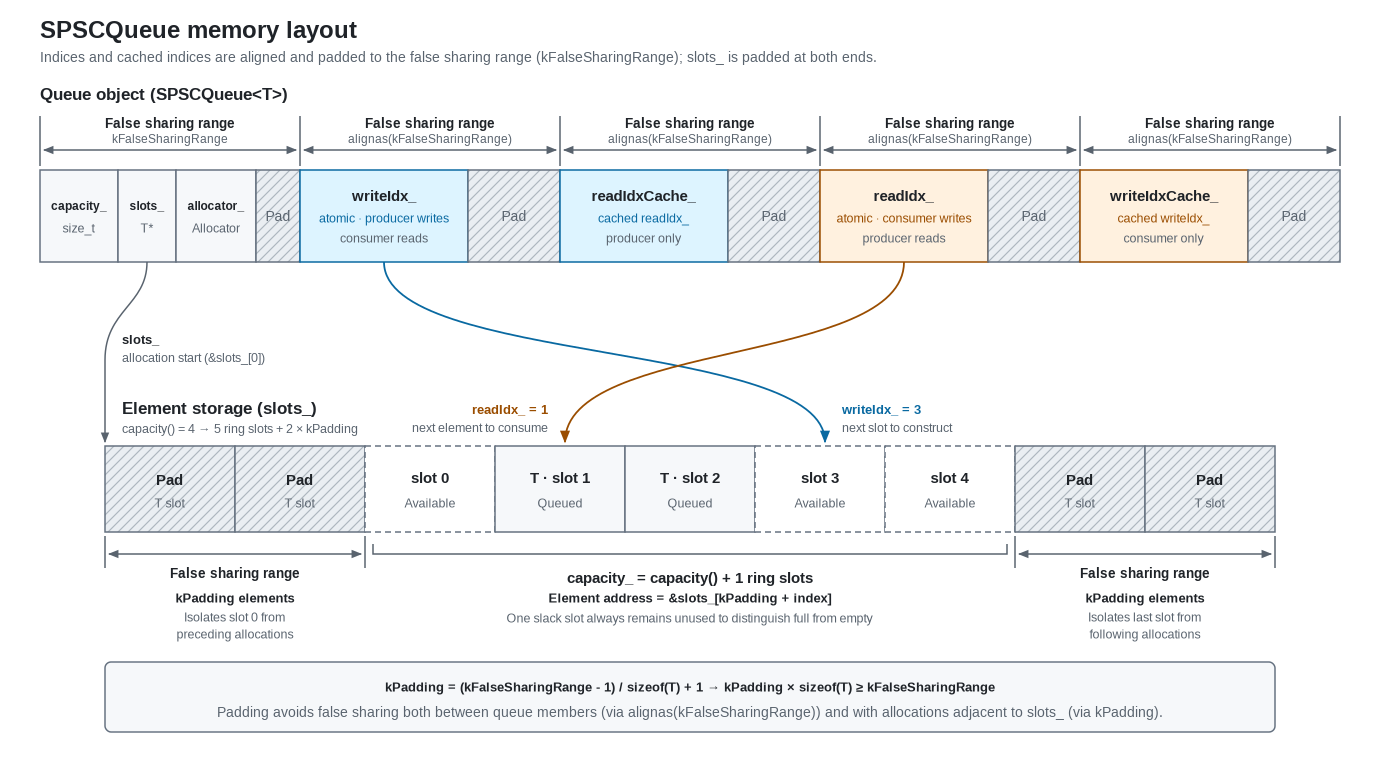
Care has been taken to make sure to avoid any issues with false
sharing. The head and tail indices
are aligned and padded to the false sharing range (cache line size).
Additionally the slots buffer is padded with the false sharing range at the
beginning and end, this prevents false sharing with any adjacent allocations.
This implementation has higher throughput than a typical concurrent ring buffer
by locally caching the head and tail indices in the writer and reader
respectively. The caching increases throughput by reducing the amount of cache
coherency traffic.
To understand how that works first consider a read operation in absence of
caching: the head index (read index) needs to be updated and thus that cache
line is loaded into the L1 cache in exclusive state. The tail (write index)
needs to be read in order to check that the queue is not empty and is thus
loaded into the L1 cache in shared state. Since a queue write operation needs to
read the head index it's likely that a write operation requires some cache
coherency traffic to bring the head index cache line back into exclusive state.
In the worst case there will be one cache line transition from shared to
exclusive for every read and write operation.
Next consider a queue reader that caches the tail index: if the cached tail
index indicates that the queue is empty, then load the tail index into the
cached tail index. If the queue was non-empty multiple read operations up until
the cached tail index can complete without stealing the writer's tail index
cache line's exclusive state. Cache coherency traffic is therefore reduced. An
analogous argument can be made for the queue write operation.
This implementation allows for arbitrary non-power of two capacities, instead
allocating a extra queue slot to indicate full queue. If you don't want to waste
storage for a extra queue slot you should use a different implementation.
References:
Intel. Avoiding and Identifying False Sharing Among Threads.
Wikipedia. Ring buffer.
Wikipedia. False sharing.
Testing
Testing lock-free algorithms is hard. This repository combines several
verification layers:
A single-threaded test verifies functionality, edge cases, and that item
constructors and destructors are invoked correctly.
A multi-threaded fuzz test verifies that all items are enqueued and dequeued
correctly under heavy contention.
Full Modified Condition/Decision Coverage (MC/DC) is enforced on
include/rigtorp/SPSCQueue.h via GCC's -fcondition-coverage and gcov
(cmake --preset coverage && cmake --build --preset coverage && ctest --preset coverage).
Bounded weak-memory verification under RC11 using
GenMC checks concurrent publication and
reclamation ordering (nix develop path:./verification/genmc --command python3 verification/genmc/run.py).
See verification/genmc/README.md for details.
Comparison
Queue
Non-default-constructible T
Immovable T
Zero-copy consumer
Blocking / try_ APIs
Arbitrary (non-pow2) capacity
Custom allocator (allocate_at_least)
Batch API
rigtorp::SPSCQueue
Yes
Yes
front()/pop(), try_consume()
Blocking push, try_ both
Yes
Yes (incl. allocate_at_least)
No
folly::ProducerConsumerQueue
Yes
Yes
frontPtr()/popFront()
try_ only
Yes
No
No
boost::lockfree::spsc_queue
No
No
consume_one(), consume_all()
try_ only
Yes
Yes
Yes (push/pop range, consume_all)
moodycamel::ReaderWriterQueue
Yes (emplace/peek/pop)
Yes (emplace/peek/pop)
peek()/pop()
Allocates or try_ (Blocking* adds wait)
Rounded up (blocks)
No
No
dro::SPSCQueue
No
No
No
Both
Yes
Yes
No
atomic_queue::AtomicQueueB
No (lock-free atomic + NIL)
No
No
Both
Rounded up to pow2
Yes
No
atomic_queue::AtomicQueueB2
No
No
No
Both
Rounded up to pow2
Yes
No
DPDK rte_ring (SP/SC)
No (C void* / 4B POD)
No
No
try_ only
Rounded up to pow2
Memzone / rte_ring_init
Yes (*_bulk, *_burst)
Benchmarks
SPSCQueueBenchmark interleaves all queues in a Latin-square order across
multiple trials and reports the median for four workloads using int items:
Bounded throughput (Mops/s): 50M operations on a 65,536-entry queue.
This is the primary throughput metric: real queues run under backpressure
where producer and consumer repeatedly catch up, wrap around, and exchange
cache lines, rather than simply buffering millions of items uncontested.
Decoupled throughput (Mops/s): 2M operations on a 2M-entry queue.
Measures uncontended per-operation overhead when the ring is large enough
that producer and consumer rarely stall on each other.
Warm latency (ns RTT): 2M round trips between 2 threads via 2 queues.
Measures best-case ping-pong handoff latency with queue metadata hot in CPU
caches, isolating atomic synchronization and false-sharing overhead.
Cold latency (ns RTT): round trips striped across 262,144 queue pairs.
Evicts queue state from CPU caches between accesses, measuring how compact
and cache-friendly the queue layout is under bursty or many-queue workloads.
To build and run the benchmark with all optional comparison queues using Nix:
Peizhao Ou and Brian Demsky. 2018.
Towards Understanding the Costs of Avoiding Out-of-Thin-Air Results.
OOPSLA.
Thibaut Carpentier. 2018.
Synchronisation de données inter-processus dans les applications audio temps réel : qu’est-ce qui débloque ?.
JIM, pp. 35–44.
Jörg Christian Kirchhof. 2022.
Model-Driven Development, Deployment, and Analysis of Internet of Things Applications.
Doctoral thesis.
Clément Allain. 2025.
Verification of fine-grained concurrent OCaml 5 algorithms using separation logic.
Doctoral thesis.
Ziye Xie et al. 2026.
Toward Accurate and Accessible Markerless Neuronavigation.
Preprint, version 1.
How does rigtorp/SPSCQueue compare to other Backend projects?
rigtorp/SPSCQueue is tracked by TopGit in the Backend category, with 1.3k GitHub stars and written in C++. Browse the Backend topic page on TopGit to compare it against similar projects by stars and activity.
Is rigtorp/SPSCQueue open source?
Yes — rigtorp/SPSCQueue ships under the MIT license, which makes its source code freely readable (and, depending on license terms, forkable and reusable). Source: github.com/rigtorp/SPSCQueue.
What else is in the Backend space?
rigtorp/SPSCQueue is tracked by TopGit under the Backend category, alongside 8 GitHub-tagged topics. Trending and Topics pages list peer repositories of comparable stars and language.
What is rigtorp/SPSCQueue?
rigtorp/SPSCQueue (rigtorp/SPSCQueue) is a C++ project on GitHub. From the project's own README: A bounded single-producer single-consumer wait-free and lock-free queue written in C++20
Where do I read more about rigtorp/SPSCQueue?
This TopGit page is a snapshot — the READ ME tab shows the project's own README content (links stripped, images preserved). The GitHub repository at github.com/rigtorp/SPSCQueue is the definitive source.
Why is rigtorp/SPSCQueue categorized under Backend?
TopGit places rigtorp/SPSCQueue in the Backend category based on its GitHub topics and description (tagged: "concurrency", "concurrent-data-structure", "cpp"). Categories are assigned from real repository metadata, not editorial guesswork.
Read full README in the tab above.
Is SPSCQueue worth your time?
ChatGPT, Claude and Perplexity can all read this page. Ask one of them what it makes of SPSCQueue.

 /SPSCQueue