Indexed by TopGit from live GitHub metadata: santinic/audiblez has 8.2k stars, written primarily in Python. Generate audiobooks from e-books
Snapshot summary built from the project's own GitHub metadata — there's no written TopGit review yet. The page will update automatically when a full review is published.
WHY NO REVIEW YET
TopGit writes full reviews for the most-starred, most-requested repositories. This page is a snapshot until then — see the READ ME tab for the original README in full.
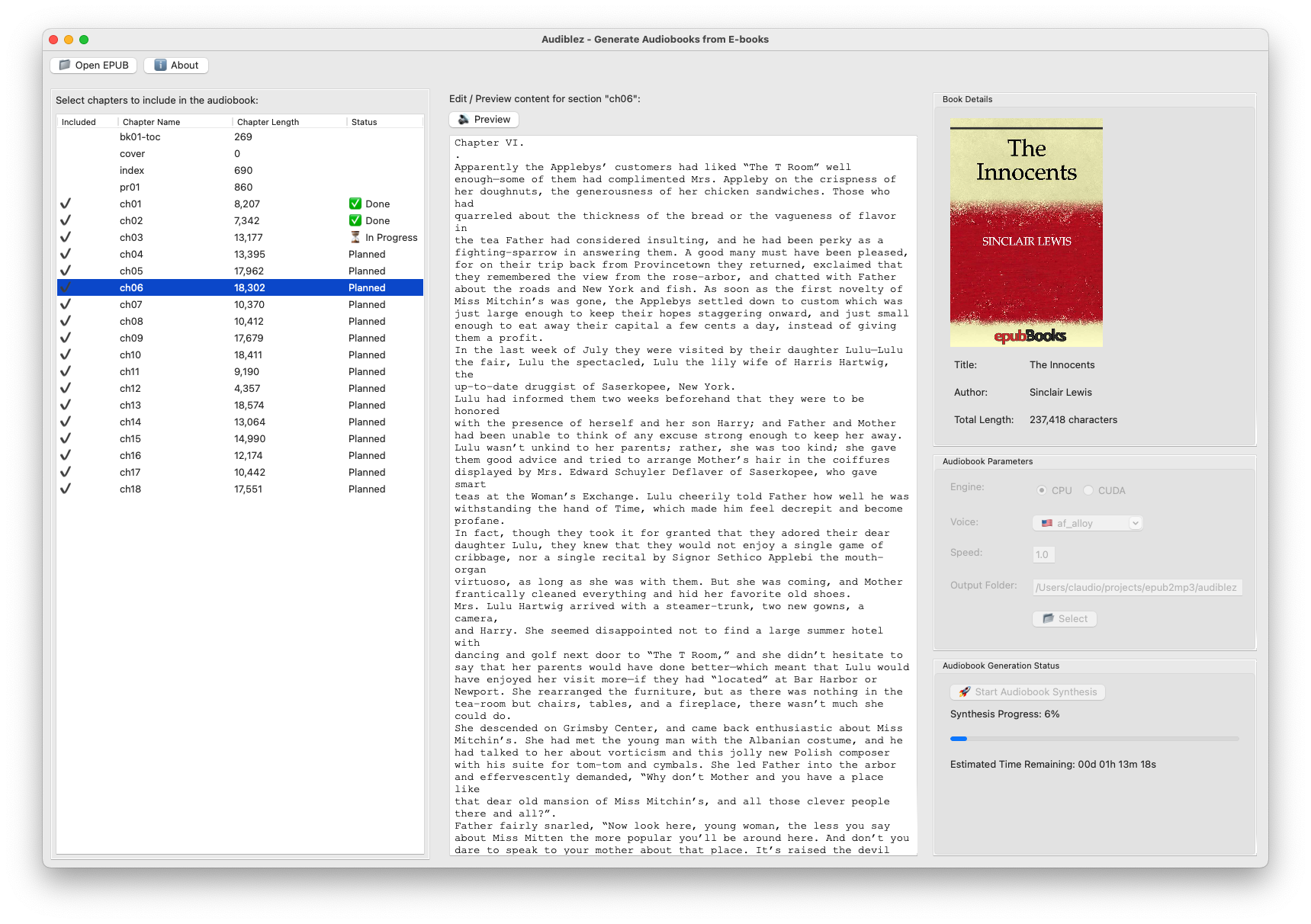
v4 Now with Graphical interface, CUDA support, and many languages!
Audiblez generates .m4b audiobooks from regular .epub e-books,
using Kokoro's high-quality speech synthesis.
Kokoro-82M is a recently published text-to-speech model with just 82M params and very natural sounding output.
It's released under Apache licence and it was trained on < 100 hours of audio.
It currently supports these languages: 🇺🇸 🇬🇧 🇪🇸 🇫🇷 🇮🇳 🇮🇹 🇯🇵 🇧🇷 🇨🇳
On a Google Colab's T4 GPU via Cuda, it takes about 5 minutes to convert "Animal's Farm" by Orwell (which is about 160,000 characters) to audiobook, at a rate of about 600 characters per second.
On my M2 MacBook Pro, on CPU, it takes about 1 hour, at a rate of about 60 characters per second.
How to install the Command Line tool
If you have Python 3 on your computer, you can install it with pip.
You also need espeak-ng and ffmpeg installed on your machine:
brew install ffmpeg espeak-ng                       # on Mac 🍏
pip install audiblez
Then you can convert an .epub directly with:
audiblez book.epub -v af_sky
It will first create a bunch of book_chapter_1.wav, book_chapter_2.wav, etc. files in the same directory,
and at the end it will produce a book.m4b file with the whole book you can listen with VLC or any
audiobook player.
It will only produce the .m4b file if you have ffmpeg installed on your machine.
How to run the GUI
The GUI is a simple graphical interface to use audiblez.
You need some extra dependencies to run the GUI:
sudo apt install ffmpeg espeak-ng
sudo apt install libgtk-3-dev        # just for Ubuntu/Debian 🐧, Windows/Mac don't need this

pip install audiblez pillow wxpython
Then you can run the GUI with:
audiblez-ui
How to run on Windows
After many trials, on Windows we recommend to install audiblez in a Python venv:
Open a Windows terminal
Create anew folder: mkdir audiblez
Enter the folder: cd audiblez
Create a venv: python -m venv venv
Activate the venv: .\venv\Scripts\Activate.ps1
Install the dependencies: pip install audiblez pillow wxpython
Now you can run audiblez or audiblez-ui
For Cuda support, you need to install Pytorch accordingly: https://pytorch.org/get-started/locally/
Speed
By default the audio is generated using a normal speed, but you can make it up to twice slower or faster by specifying a speed argument between 0.5 to 2.0:
audiblez book.epub -v af_sky -s 1.5
Supported Voices
Use -v option to specify the voice to use. Available voices are listed here.
The first letter is the language code and the second is the gender of the speaker e.g. im_nicola is an italian male voice.
For more detaila about voice quality, check this document: Kokoro-82M voices
How to run on GPU
By default, audiblez runs on CPU. If you pass the option --cuda it will try to use the Cuda device via Torch.
Check out this example: Audiblez running on a Google Colab Notebook with Cuda .
We don't currently support Apple Silicon, as there is not yet a Kokoro implementation in MLX. As soon as it will be available, we will support it.
Manually pick chapters to convert
Sometimes you want to manually select which chapters/sections in the e-book to read out loud.
To do so, you can use --pick to interactively choose the chapters to convert (without running the GUI).
Help page
For all the options available, you can check the help page audiblez --help:
usage: audiblez [-h] [-v VOICE] [-p] [-s SPEED] [-c] [-o FOLDER] epub_file_path

positional arguments:
  epub_file_path        Path to the epub file

options:
  -h, --help            show this help message and exit
  -v VOICE, --voice VOICE
                        Choose narrating voice: a, b, e, f, h, i, j, p, z
  -p, --pick            Interactively select which chapters to read in the audiobook
  -s SPEED, --speed SPEED
                        Set speed from 0.5 to 2.0
  -c, --cuda            Use GPU via Cuda in Torch if available
  -o FOLDER, --output FOLDER
                        Output folder for the audiobook and temporary files

example:
  audiblez book.epub -l en-us -v af_sky

to use the GUI, run:
  audiblez-ui
Author
by Claudio Santini in 2025, distributed under MIT licence.
Related Article: Audiblez v4: Generate Audiobooks from E-books
No homepage URL was recorded for santinic/audiblez in TopGit's last sync. The README tab above frequently contains screenshots and demo links, or check the repository description on GitHub.
Is santinic/audiblez open source?
Yes — santinic/audiblez ships under the MIT license, which makes its source code freely readable (and, depending on license terms, forkable and reusable). Source: github.com/santinic/audiblez.
What else is in the Backend space?
santinic/audiblez is tracked by TopGit under the Backend category, alongside 5 GitHub-tagged topics. Trending and Topics pages list peer repositories of comparable stars and language.
What is santinic/audiblez?
santinic/audiblez (santinic/audiblez) is a Python project on GitHub. From the project's own README: Generate audiobooks from e-books
What license does santinic/audiblez use?
santinic/audiblez is released under the MIT license. Always verify the LICENSE file directly on GitHub for the authoritative terms — license strings can be edited out of sync with a project's actual stance.
Where do I read more about santinic/audiblez?
This TopGit page is a snapshot — the READ ME tab shows the project's own README content (links stripped, images preserved). The GitHub repository at github.com/santinic/audiblez is the definitive source.
Why is santinic/audiblez categorized under Backend?
TopGit places santinic/audiblez in the Backend category based on its GitHub topics and description (tagged: "audiobooks", "epub", "kokoro"). Categories are assigned from real repository metadata, not editorial guesswork.
Read full README in the tab above.
Curious whether audiblez is right for you?
Let ChatGPT, Claude, or Perplexity look into it — click below and see what AI actually says about audiblez.
 /audiblez