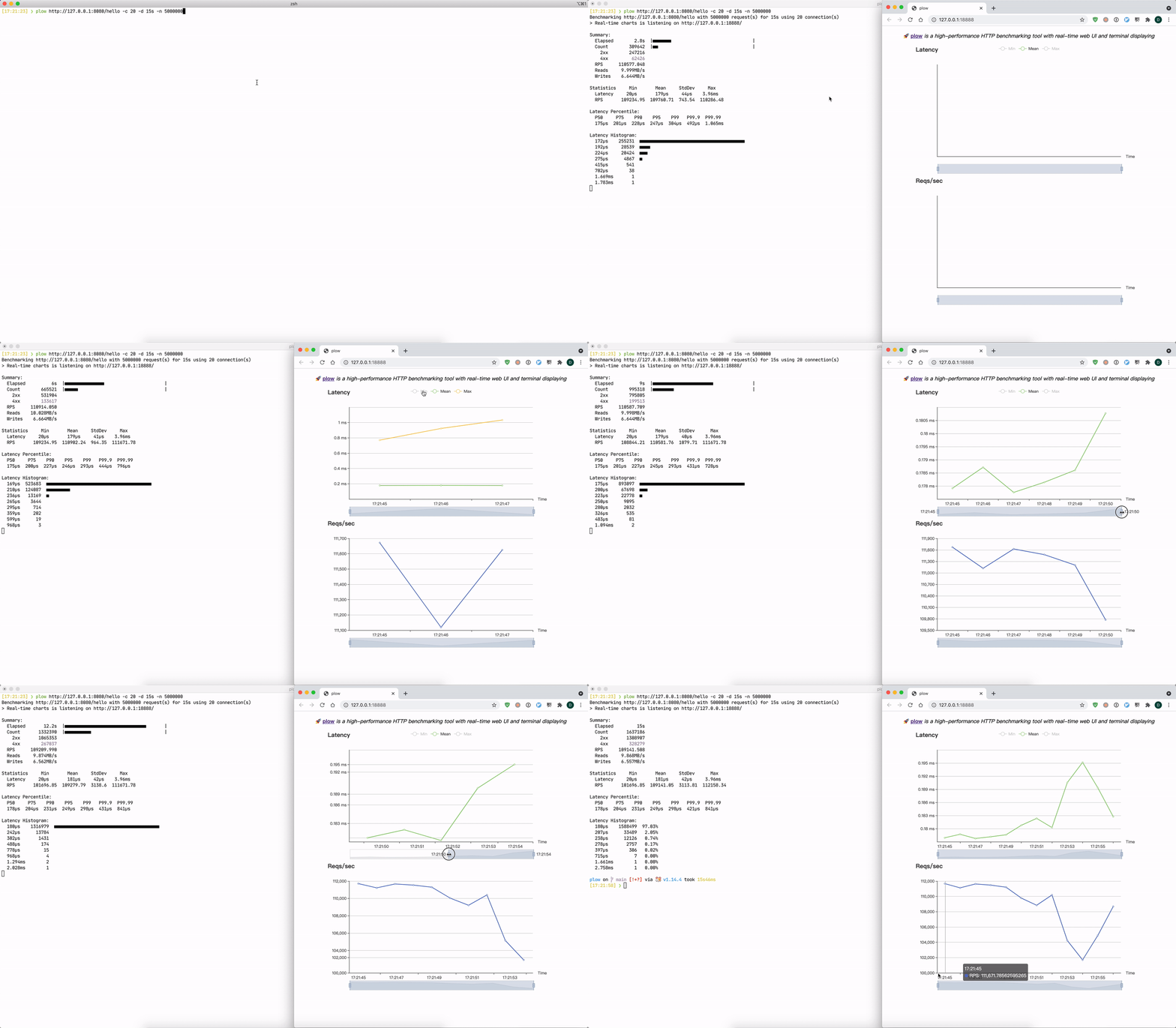
six-ddc/plow is one of the developer-focused repositories TopGit tracks, currently at 4.5k stars, written primarily in Go. A high-performance HTTP benchmarking tool that includes a real-time web UI and terminal display
Snapshot summary built from the project's own GitHub metadata — there's no written TopGit review yet. The page will update automatically when a full review is published.
WHY NO REVIEW YET
TopGit writes full reviews for the most-starred, most-requested repositories. This page is a snapshot until then — see the READ ME tab for the original README in full.
Plow is an HTTP(S) benchmarking tool, written in Golang. It uses
excellent fasthttp instead of Go's default
net/http due to its lightning fast performance.
Plow runs at a specified connections(option -c) concurrently and real-time records a summary statistics, histogram
of execution time and calculates percentiles to display on Web UI and terminal. It can run for a set duration(
option -d), for a fixed number of requests(option -n), or until Ctrl-C interrupted.
The implementation of real-time computing Histograms and Quantiles using stream-based algorithms inspired
by prometheus with low memory and CPU bounds. so it's almost no
additional performance overhead for benchmarking.
Binary and image distributions are available through the releases
assets page.
Via Go
go install github.com/six-ddc/plow@latest
Via Homebrew
# brew update
brew install plow
Via Docker
docker run --rm --net=host ghcr.io/six-ddc/plow
# docker run --rm -p 18888:18888 ghcr.io/six-ddc/plow
Usage
Options
usage: plow [<flags>] <url>

A high-performance HTTP benchmarking tool with real-time web UI and terminal displaying

Examples:

  plow http://127.0.0.1:8080/ -c 20 -n 100000
  plow https://httpbin.org/post -c 20 -d 5m --body @file.json -T 'application/json' -m POST

Flags:
      --help                     Show context-sensitive help.
  -c, --concurrency=1            Number of connections to run concurrently
      --rate=infinity            Number of requests per time unit, examples: --rate 50 --rate 10/ms
      --ramp-up=-1               Concurrently will increase pre seconds
  -n, --requests=-1              Number of requests to run
  -d, --duration=DURATION        Duration of test, examples: -d 10s -d 3m
  -i, --interval=200ms           Print snapshot result every interval, use 0 to print once at the end
      --seconds                  Use seconds as time unit to print
      --json                     Print snapshot result as JSON
      --trace                    Trace latency of request phases: DNS, Connect, TLS, Write, Wait(TTFB), Read
  -b, --body=BODY                HTTP request body, if body starts with '@' the rest will be considered a file's path from which to read the actual body content
      --stream                   Specify whether to stream file specified by '--body @file' using chunked encoding or to read into memory
  -m, --method="GET"             HTTP method
  -H, --header=K:V ...           Custom HTTP headers
      --host=HOST                Host header
  -T, --content=CONTENT          Content-Type header
      --cert=CERT                Path to the client's TLS Certificate
      --key=KEY                  Path to the client's TLS Certificate Private Key
  -k, --insecure                 Controls whether a client verifies the server's certificate chain and host name
      --listen=":18888"          Listen addr to serve Web UI
      --timeout=DURATION         Timeout for each http request
      --dial-timeout=DURATION    Timeout for dial addr
      --req-timeout=DURATION     Timeout for full request writing
      --resp-timeout=DURATION    Timeout for full response reading
      --socks5=ip:port           Socks5 proxy
      --http-proxy=username:password@ip:port
                                 Set HTTP proxy
      --auto-open-browser        Specify whether auto open browser to show web charts
      --[no-]clean               Clean the histogram bar once its finished. Default is true
      --output-errors=OUTPUT-ERRORS
                                 Output errors to file
      --summary                  Only print the summary without realtime reports
      --unix-socket=UNIX-SOCKET  Unix domain socket path to use for connection
      --version                  Show application version.

  Flags default values also read from env PLOW_SOME_FLAG, such as PLOW_TIMEOUT=5s equals to --timeout=5s

Args:
  <url>  Request url
Examples
Basic usage:
plow http://127.0.0.1:8080/ -c 20 -n 10000 -d 10s
POST a json file:
plow https://httpbin.org/post -c 20 --body @file.json -T 'application/json' -m POST
DNS, Connect and TLS are only measured when a new connection is established, so their counts are the number of connections.
Write is the time of writing the request, Wait is the time from the request written to the first response byte (TTFB), Read is the time of reading the rest of the response.
When a proxy is used (--socks5 or HTTP(S)_PROXY env), the whole proxy dialing is measured as Connect.
The mean latency of each phase per second is also shown in the Web charts.
Bash/ZSH Shell Completion
# Add the statement to their bash_profile (or equivalent):
eval "$(plow --completion-script-bash)"
# Or for ZSH
eval "$(plow --completion-script-zsh)"
The most recent commit recorded on six-ddc/plow was 6 months ago, based on the GitHub push timestamp. The repository has 154 forks — one of the better signals of community interest.
Is six-ddc/plow open source?
Yes — six-ddc/plow ships under the Apache-2.0 license, which makes its source code freely readable (and, depending on license terms, forkable and reusable). Source: github.com/six-ddc/plow.
What license does six-ddc/plow use?
six-ddc/plow is released under the Apache-2.0 license. Always verify the LICENSE file directly on GitHub for the authoritative terms — license strings can be edited out of sync with a project's actual stance.
What topics is six-ddc/plow associated with?
GitHub's repository topics for six-ddc/plow: "apachebench", "cli", "http", "load", "load-testing", "performance", "realtime", "visualization", "wrk". TopGit's editorial category is Developer Tools.
Where can I see six-ddc/plow in action?
The project maintains a homepage at https://deepwiki.com/six-ddc/plow. The README tab on this page also usually contains screenshots and a quickstart.
Where do I read more about six-ddc/plow?
This TopGit page is a snapshot — the READ ME tab shows the project's own README content (links stripped, images preserved). The GitHub repository at github.com/six-ddc/plow is the definitive source.
Read full README in the tab above.
Still deciding about plow?
One click hands the question to an AI along with this page — see what it says about plow.

 /plow