17.4k GitHub stars and counting — source-foundry/Hack is a Shell project TopGit is tracking across repositories on the platform. A typeface designed for source code
Snapshot summary built from the project's own GitHub metadata — there's no written TopGit review yet. The page will update automatically when a full review is published.
WHY NO REVIEW YET
TopGit writes full reviews for the most-starred, most-requested repositories. This page is a snapshot until then — see the READ ME tab for the original README in full.
Don't like the development noise from the repository but want to keep up with changes? Check out our gitter Hack channel. Have a quick question that doesn't require an issue report? Drop by our gitter Help channel and ask away.
A typeface designed for source code
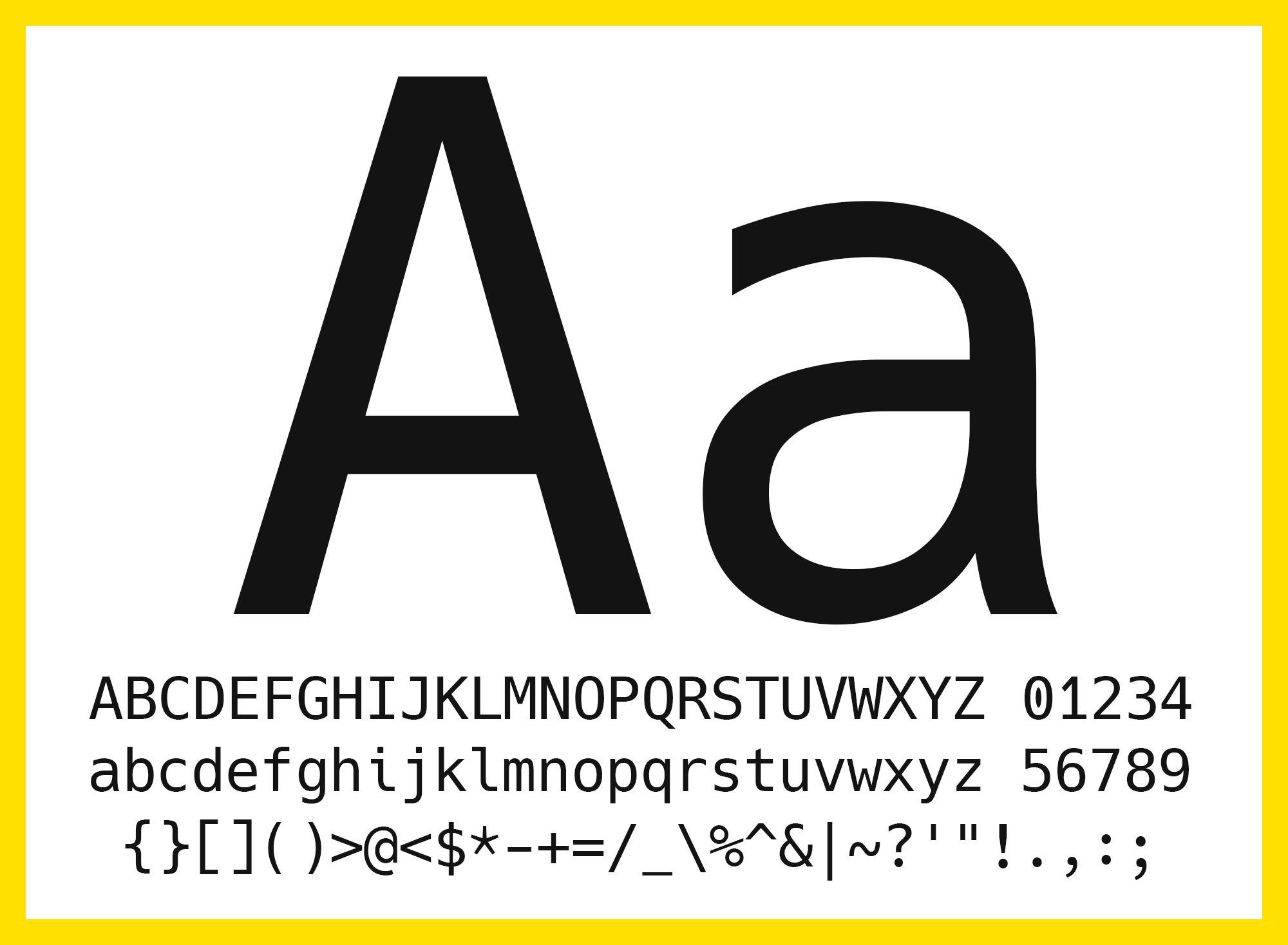
Hack is designed to be a workhorse typeface for source code. It has deep roots in the free, open source typeface community and expands upon the contributions of the Bitstream Vera & DejaVu projects. The large x-height + wide aperture + low contrast design make it legible at commonly used source code text sizes with a sweet spot that runs in the 8 - 14 range. The full set of changes to the upstream source are available in the changelog.
The project is in active development, and we welcome your input and contributions. You may view our design objectives and instructions on how to contribute in CONTRIBUTING.md.
Frequently asked questions are answered in our FAQ.
Contents
Features
Quick installation
Package manager installation
Web font usage
Additional tools for font customization
Resources
Contributing
Build tools
Acknowledgments
License
Specimen
Overview of features
Typeface Name: Hack
Category: Monospaced
Character set support: ASCII, Latin-1, Latin Extended A, Greek, Cyrillic
Powerline Support: Yes, included by default
Included Styles: Regular, Bold, Italic, Bold Italic
Quick installation
NOTE ON FONT UPDATESIf you are updating your version of Hack, be sure to remove the previously installed version and clear your font cache first to avoid conflicts that can lead to platform-specific rendering errors. Many platforms/distros offer package managers that automate this process. We release a Windows installer to automate the install/update process on the Windows platform. See below for additional details.
Linux
Download the latest version of Hack.
Extract the files from the archive (.zip).
Copy the font files to either your system font folder (often /usr/share/fonts/) or user font folder (often ~/.local/share/fonts/ or /usr/local/share/fonts).
Copy the font configuration file in config/fontconfig/ to either the system font configuration folder (often /etc/fonts/conf.d/) or the font user folder (often ~/.config/fontconfig/conf.d)
Clear and regenerate your font cache and indexes with the following command:
$ fc-cache -f -v
You can confirm that the fonts are installed with the following command:
$ fc-list | grep "Hack"
Some Linux users may find that font rendering is improved on their distro with these instructions.
macOS
Download the latest version of Hack.
Extract the files from the archive (.zip) and click to open them.
Follow the instructions from your operating system.
Enjoy!
Windows
The Hack Windows Installer simplifies installation on the Windows platform. The tool guides you through the installation process and addresses some common rendering issues that occur with font installs/updates on the Windows platform. This tool is the recommended installation approach for Windows users.
Chrome/ChromeOS
To use with Secure Shell,
edit the following fields in Options:
We highly recommend the convenience of a community developed package manager or other auto-updating utility if this is available on your platform. While the package manager releases may be a bit delayed relative to the repository releases, the packages distributed through these package managers were designed to tune and automate font installs and updates on your system.
We are aware of Hack support in the following package managers (with associated package names):
For installation issues with Hack packages, please contact the package maintainer directly.
Web font usage
Hack is available in the woff and woff2 web font formats. Bold and italic styles are included by default and work out-of-the-box via the <strong> and <em> tags.
Hack is available through the jsDelivr and cdnjs CDN services:
The following snippets provide examples of Hack web font use through the jsDelivr CDN. Adjust the URL paths to those provided by cdnjs (click the link above to find the appropriate URL) to switch to the cdnjs CDN.
1. Add Hack to HTML
Include one of the following in the <head> section of your HTML file:
See the WEBFONT_USAGE.md documentation for additional details, including instructions on how to download, host, and serve the web fonts on your web server.
Additional tools for Hack font customization
Customize your build with alternate glyph styles
The alt-hack library includes a (growing) collection of alternate glyph styles that can be used to customize your Hack fonts. Don't like the default zero style? Swap out the UFO design source with a slashed zero or dotted zero and build new fonts that work better for you.
We welcome contributions of new alternate glyph styles in the alt-hack repository. Design something new that works well with rest of the typeface and submit a pull request to the alt-hack repository so that others can use it in their custom builds.
Detailed build instructions are available on the alt-hack repository README.md. Font renaming instructions to support side-by-side installs with upstream Hack are available below.
Line spacing adjustments
font-line is a tool that modifies the default line spacing used in the Hack design (20% UPM).
The following gist installs font-line and modifies line spacing for all desktop font files contained in the same directory:
linespace.sh (download .zip)
Install modified and unmodified versions of Hack on the same system
If you modify the upstream Hack source or the released font binaries and would like to install your modified fonts on the same system with the Hack fonts as released here, you can use the fontname.py Python script to define a new font name in the binary files. For example, you can install Hack on your platform along with a 15% UPM line spacing adjusted version as Hack Fifteen. Modify default glyphs with those in our alt-hack repository or design your own and define your creation with any name that you'd like. Following installation, your renamed fonts should show under the name that you define with the script so that you can switch between any of them as you need.
Usage details and examples are provided on the fontname.py repository README.
Resources
Full specimen
Changelog
Project website
Contributors
Contributing
We welcome contributions to Hack! Please review our CONTRIBUTING.md document for details.
Built With
Hack is built with the following free, open source projects:
Font Bakery - post-compilation modifications
fontmake - UFO to ttf compilation
fontTools - OpenType table read/write
font-v - font version string editor
ink - stream editor for text file templating
OpenFV - open specification for semantic typeface versioning
sfnt2woff_zopfli - ttf to woff web font compilation
ttfautohint - ttf instruction sets
uni - Unicode code point search
ufodiff - UFO source diffs
ufoLib - UFO source file reads/writes/testing
ufolint - UFO source file linting for CI testing
woff2 - ttf to woff2 web font compilation
Acknowledgments
We would like to acknowledge and thank the jsDelivr and cdnjs teams for their support of the Hack project through their free web font CDN services. We greatly appreciate the tremendous support of open source software development by the Semaphore CI team. Their free CI testing service and rapid, excellent technical support have been tremendous assets for our project. Lastly, a huge thanks go out to all of those who do the unrecognized work to get Hack out there to users so that it is easy to access, install, upgrade, and use. There are redistribution package managers, review committee members, testers, and others across platforms/distros/applications who perform this thankless work and often go unrecognized. Your efforts are much appreciated.
The font binaries are released under a license that permits unlimited print, desktop, web, and software embedding use for commercial and non-commercial applications.
See LICENSE.md for the full texts of the licenses.
The most recent commit recorded on source-foundry/Hack was 4.0 years ago, based on the GitHub push timestamp. The repository has 656 forks — one of the better signals of community interest.
How many stars does source-foundry/Hack have?
source-foundry/Hack has 17.4k GitHub stars — refresh the page for the live number, or check github.com/source-foundry/Hack. TopGit mirrors GitHub's count but does not claim minute-by-minute accuracy.
What language is source-foundry/Hack written in?
source-foundry/Hack is written primarily in Shell. GitHub's language field is based on the largest share of bytes in the default branch.
What topics is source-foundry/Hack associated with?
GitHub's repository topics for source-foundry/Hack: "developer", "developer-tools", "font", "hack", "ttf", "typeface", "web-fonts". TopGit's editorial category is open-source.
Where do I read more about source-foundry/Hack?
This TopGit page is a snapshot — the READ ME tab shows the project's own README content (links stripped, images preserved). The GitHub repository at github.com/source-foundry/Hack is the definitive source.
Read full README in the tab above.
Curious whether Hack is right for you?
Let ChatGPT, Claude, or Perplexity look into it — click below and see what AI actually says about Hack.

 /Hack