Indexed by TopGit from live GitHub metadata: vmware-archive/kubewatch has 2.4k stars, written primarily in Go. Watch k8s events and trigger Handlers
Snapshot summary built from the project's own GitHub metadata — there's no written TopGit review yet. The page will update automatically when a full review is published.
WHY NO REVIEW YET
TopGit writes full reviews for the most-starred, most-requested repositories. This page is a snapshot until then — see the READ ME tab for the original README in full.
WARNING: Kubewatch is no longer actively maintained by VMware.
VMware has made the difficult decision to stop driving this project and therefore we will no longer actively respond to issues or pull requests. The project will be externally maintained in the following fork: https://github.com/robusta-dev/kubewatch
Thank You.
kubewatch is a Kubernetes watcher that currently publishes notification to available collaboration hubs/notification channels. Run it in your k8s cluster, and you will get event notifications through webhooks.
Usage
$ kubewatch -h

Kubewatch: A watcher for Kubernetes

kubewatch is a Kubernetes watcher that publishes notifications
to Slack/hipchat/mattermost/flock channels. It watches the cluster
for resource changes and notifies them through webhooks.

supported webhooks:
 - slack
 - hipchat
 - mattermost
 - flock
 - webhook
 - smtp

Usage:
  kubewatch [flags]
  kubewatch [command]

Available Commands:
  config      modify kubewatch configuration
  resource    manage resources to be watched
  version     print version

Flags:
  -h, --help   help for kubewatch

Use "kubewatch [command] --help" for more information about a command.
Install
Cluster Installation
Using helm:
When you have helm installed in your cluster, use the following setup:
In order to run kubewatch in a Kubernetes cluster quickly, the easiest way is for you to create a ConfigMap to hold kubewatch configuration.
An example is provided at kubewatch-configmap.yaml, do not forget to update your own slack channel and token parameters. Alternatively, you could use secrets.
Create k8s configmap:
$ kubectl create -f kubewatch-configmap.yaml
Create the Pod directly, or create your own deployment:
$ kubectl create -f kubewatch.yaml
A kubewatch container will be created along with kubectl sidecar container in order to reach the API server.
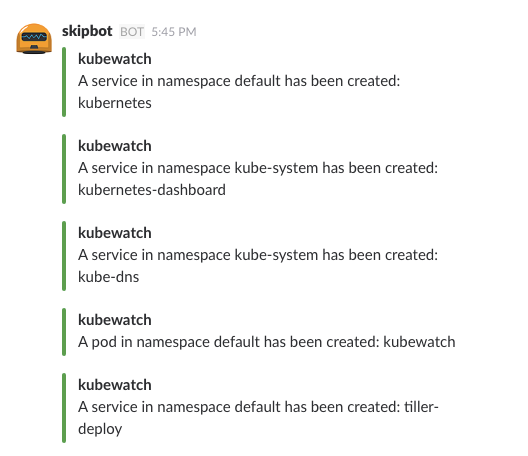
Once the Pod is running, you will start seeing Kubernetes events in your configured Slack channel. Here is a screenshot:
To modify what notifications you get, update the kubewatch ConfigMap and turn on and off (true/false) resources:
Kubernetes Engine clusters running versions 1.6 or higher introduced Role-Based Access Control (RBAC). We can create ServiceAccount for it to work with RBAC.
Kubewatch supports config command for configuration. Config file will be saved at $HOME/.kubewatch.yaml
$ kubewatch config -h

config command allows admin setup his own configuration for running kubewatch

Usage:
  kubewatch config [flags]
  kubewatch config [command]

Available Commands:
  add         add webhook config to .kubewatch.yaml
  test        test handler config present in .kubewatch.yaml
  view        view .kubewatch.yaml

Flags:
  -h, --help   help for config

Use "kubewatch config [command] --help" for more information about a command.
Example:
slack:
Create a slack Bot
Edit the Bot to customize its name, icon and retrieve the API token (it starts with xoxb-).
Invite the Bot into your channel by typing: /invite @name_of_your_bot in the Slack message area.
Add Api token to kubewatch config using the following steps
To test the handler config by send test messages use the following command.
$ kubewatch config test -h

Tests handler configs present in .kubewatch.yaml by sending test messages

Usage:
  kubewatch config test [flags]

Flags:
  -h, --help   help for test
Example:
$ kubewatch config test

Testing Handler configs from .kubewatch.yaml
2019/06/03 12:29:23 Message successfully sent to channel ABCD at 1559545162.000100
Viewing config
To view the entire config file $HOME/.kubewatch.yaml use the following command.
To manage the resources being watched, use the following command, changes will be saved to $HOME/.kubewatch.yaml.
$ kubewatch resource -h

manage resources to be watched

Usage:
  kubewatch resource [flags]
  kubewatch resource [command]

Available Commands:
  add         adds specific resources to be watched
  remove      remove specific resources being watched

Flags:
      --clusterrole   watch for cluster roles
      --cm            watch for plain configmaps
      --deploy        watch for deployments
      --ds            watch for daemonsets
  -h, --help          help for resource
      --ing           watch for ingresses
      --job           watch for jobs
      --node          watch for Nodes
      --ns            watch for namespaces
      --po            watch for pods
      --pv            watch for persistent volumes
      --rc            watch for replication controllers
      --rs            watch for replicasets
      --sa            watch for service accounts
      --secret        watch for plain secrets
      --svc           watch for services

Use "kubewatch resource [command] --help" for more information about a command.
Add/Remove resource:
$ kubewatch resource add -h

adds specific resources to be watched

Usage:
  kubewatch resource add [flags]

Flags:
  -h, --help   help for add

Global Flags:
      --clusterrole   watch for cluster roles
      --cm            watch for plain configmaps
      --deploy        watch for deployments
      --ds            watch for daemonsets
      --ing           watch for ingresses
      --job           watch for jobs
      --node          watch for Nodes
      --ns            watch for namespaces
      --po            watch for pods
      --pv            watch for persistent volumes
      --rc            watch for replication controllers
      --rs            watch for replicasets
      --sa            watch for service accounts
      --secret        watch for plain secrets
      --svc           watch for services
Example:
# rc, po and svc will be watched
$ kubewatch resource add --rc --po --svc

# rc, po and svc will be stopped from being watched
$ kubewatch resource remove --rc --po --svc
Build
Using go
Clone the repository anywhere:
$ git clone https://github.com/bitnami-labs/kubewatch.git
$ cd kubewatch
$ go build
or
You can also use the Makefile directly:
$ make build
Prerequisites
You need to have Go (v1.5 or later) installed. Make sure to set $GOPATH
Using Docker
$ make docker-image
$ docker images
REPOSITORY          TAG                 IMAGE ID            CREATED              SIZE
kubewatch           latest              919896d3cd90        3 minutes ago       27.9MB
Prerequisites
you need to have docker installed.
Contribution
Refer to the contribution guidelines to get started.
How active is development on vmware-archive/kubewatch?
The most recent commit recorded on vmware-archive/kubewatch was 4.2 years ago, based on the GitHub push timestamp. The repository has 433 forks — one of the better signals of community interest.
How does vmware-archive/kubewatch compare to other Backend projects?
vmware-archive/kubewatch is tracked by TopGit in the Backend category, with 2.4k GitHub stars and written in Go. Browse the Backend topic page on TopGit to compare it against similar projects by stars and activity.
How many stars does vmware-archive/kubewatch have?
vmware-archive/kubewatch has 2.4k GitHub stars — refresh the page for the live number, or check github.com/vmware-archive/kubewatch. TopGit mirrors GitHub's count but does not claim minute-by-minute accuracy.
Is vmware-archive/kubewatch open source?
Yes — vmware-archive/kubewatch ships under the Apache-2.0 license, which makes its source code freely readable (and, depending on license terms, forkable and reusable). Source: github.com/vmware-archive/kubewatch.
What is vmware-archive/kubewatch?
vmware-archive/kubewatch (vmware-archive/kubewatch) is a Go project on GitHub. From the project's own README: Watch k8s events and trigger Handlers
Where do I read more about vmware-archive/kubewatch?
This TopGit page is a snapshot — the READ ME tab shows the project's own README content (links stripped, images preserved). The GitHub repository at github.com/vmware-archive/kubewatch is the definitive source.
Read full README in the tab above.
Is kubewatch worth your time?
ChatGPT, Claude and Perplexity can all read this page. Ask one of them what it makes of kubewatch.

 /kubewatch