Indexed by TopGit from live GitHub metadata: vmware-archive/octant has 6.2k stars, written primarily in Go. Highly extensible platform for developers to better understand the complexity of Kubernetes clusters.
Snapshot summary built from the project's own GitHub metadata — there's no written TopGit review yet. The page will update automatically when a full review is published.
WHY NO REVIEW YET
TopGit writes full reviews for the most-starred, most-requested repositories. This page is a snapshot until then — see the READ ME tab for the original README in full.
VMware has ended active development of this project, this repository will no longer be updated.
A highly extensible platform for developers to better understand the complexity of Kubernetes clusters.
Octant is a tool for developers to understand how applications run on a Kubernetes cluster. It aims to be part of the developer's toolkit for gaining insight and approaching complexity found in Kubernetes. Octant offers a combination of introspective tooling, cluster navigation, and object management along with a plugin system to further extend its capabilities.
Features
Resource Viewer
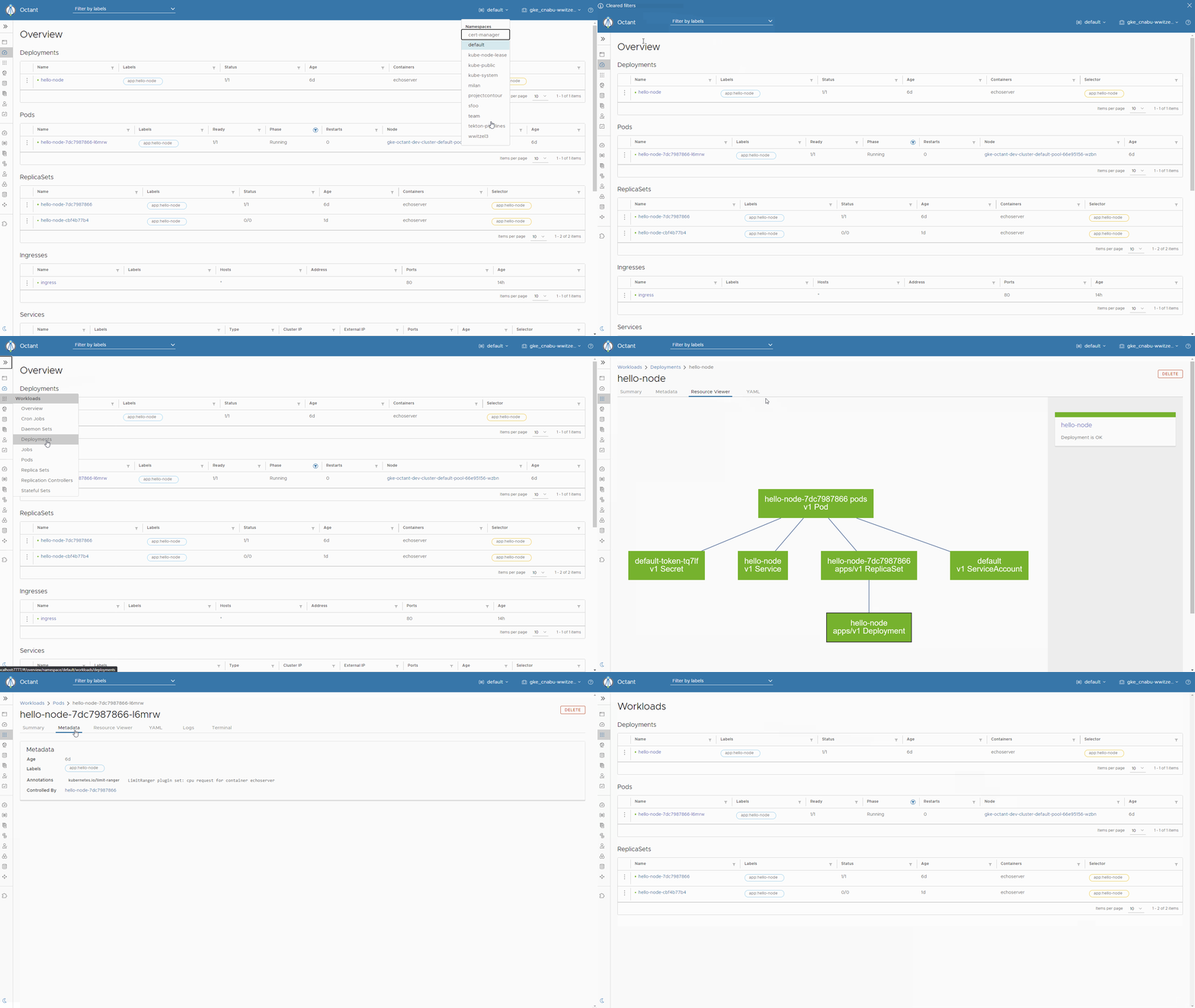
Graphically visualize relationships between objects in a Kubernetes cluster. The status of individual objects are represented by color to show workload performance.
Summary View
Consolidated status and configuration information in a single page aggregated from output typically found using multiple kubectl commands.
Port Forward
Forward a local port to a running pod with a single button for debugging applications and even port forward multiple pods across namespaces.
Log Stream
View log streams of pod and container activity for troubleshooting or monitoring without holding multiple terminals open.
Label Filter
Organize workloads with label filtering for inspecting clusters with a high volume of objects in a namespace.
Cluster Navigation
Easily change between namespaces or contexts across different clusters. Multiple kubeconfig files are also supported.
Plugin System
Highly extensible plugin system for users to provide additional functionality through gRPC. Plugin authors can add components on top of existing views.
Usage
Installation
Package (Linux only)
Download the .deb or .rpm from the releases page.
Install with either dpkg -i or rpm -i respectively.
Windows
Chocolatey
Install using chocolatey with the following one-liner:
choco install octant --confirm
Scoop
Add the extras bucket.
scoop bucket add extras
Install using scoop.
scoop install octant
macOS
Homebrew
Install using Homebrew with the following one-liner:
brew install octant
Download a Pre-built Binary (Linux, macOS, Windows)
Open the releases page from a browser and download the latest tarball or zip file.
Extract the tarball or zip where X.Y is the release version:
$ tar -xzvf ~/Downloads/octant_0.X.Y_Linux-64bit.tar.gz
octant_0.X.Y_Linux-64bit/README.md
octant_0.X.Y_Linux-64bit/octant
Verify it runs:
$ ./octant_0.X.Y_Linux-64bit/octant version
Nightly Builds
Nightly builds of Octant are available for download.
Please note that nightly builds maybe less stable than our tagged releases and are intended to allow early access to
preview upcoming features and for plugin authors who want access to the latest plugin APIs.
Browse nightly builds
Getting Started
Before starting Octant, make sure you have access to a healthy cluster. If kubectl is installed, test using kubectl cluster-info.
Start running Octant:
$ octant
Octant should immediately launch your default web browser on 127.0.0.1:7777.
Octant uses the default web browser on the system to act as the UI client. In the future Octant will ship with a UI.
For setting extra configuration such as what kubeconfig or context to use at startup, refer to the documentation.
Supported Versions
Octant versions follow Semantic Versioning where a given version number represents MAJOR.MINOR.PATCH.
Patch releases address bug fixes, regressions, and small enhancements.
Minor releases contain security fixes, API changes, and significant enhancements such as UI changes or new components.
Major releases contain breaking changes that are not guaranteed to be backwards compatible. Octant versions before 1.0 should not be considered stable and API may change between minor releases.
Supported Version Skew
Version of Octant are compiled against a version of client-go.
Octant follows an n±1 policy for versions of Kubernetes similar to kubectl. For example, Octant 0.16.0 uses the Kubernetes 1.19 client. So version 0.16.0 can be used with Kubernetes 1.18, 1.19, and 1.20.
Plugins
Plugins are a core part of Octant in the Kubernetes ecosystem. A plugin can read objects and allows users to add components to Octant's views.
An example plugin can be found in cmd/octant-sample-plugin and installed to the default plugin path with go run build.go install-test-plugin.
Some plugins can be found on GitHub in the #octant-plugin topic (tag).
Documentation for plugin components can be found in the Plugins section of the documentation.
Discussion
Feature requests, bug reports, and enhancements are welcome. Contributors, maintainers, and users are encouraged to collaborate through these communication channels:
Kubernetes Slack in the #octant channel
Twitter
Google group
GitHub issues
Contributing
Contributors will need to sign a DCO (Developer Certificate of Origin) with all changes. We also ask that a changelog entry is included with your pull request. Details are described in our contributing documentation.
See our hacking guide for getting your development environment setup.
See our roadmap for tentative features in a 1.0 release.
License
Octant is available under the Apache License, Version 2.0
How active is development on vmware-archive/octant?
The most recent commit recorded on vmware-archive/octant was 3.8 years ago, based on the GitHub push timestamp. The repository has 484 forks — one of the better signals of community interest.
Is vmware-archive/octant open source?
Yes — vmware-archive/octant ships under the Apache-2.0 license, which makes its source code freely readable (and, depending on license terms, forkable and reusable). Source: github.com/vmware-archive/octant.
What license does vmware-archive/octant use?
vmware-archive/octant is released under the Apache-2.0 license. Always verify the LICENSE file directly on GitHub for the authoritative terms — license strings can be edited out of sync with a project's actual stance.
What topics is vmware-archive/octant associated with?
GitHub's repository topics for vmware-archive/octant: "go", "golang", "kubernetes", "kubernetes-clusters", "octant". TopGit's editorial category is Backend.
Where can I see vmware-archive/octant in action?
The project maintains a homepage at https://octant.dev. The README tab on this page also usually contains screenshots and a quickstart.
Where do I read more about vmware-archive/octant?
This TopGit page is a snapshot — the READ ME tab shows the project's own README content (links stripped, images preserved). The GitHub repository at github.com/vmware-archive/octant is the definitive source.
Read full README in the tab above.
Still deciding about octant?
One click hands the question to an AI along with this page — see what it says about octant.

 /octant