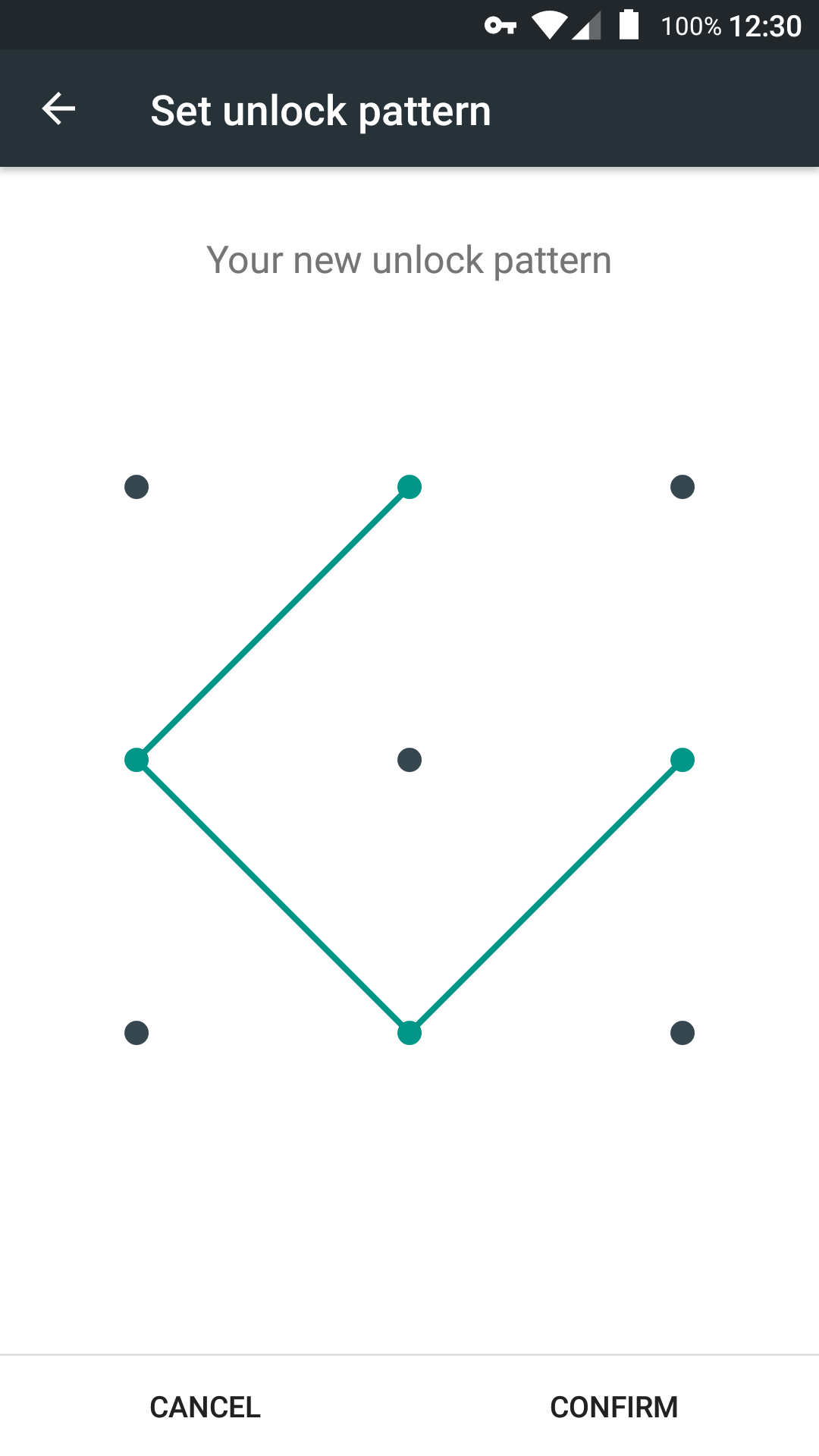
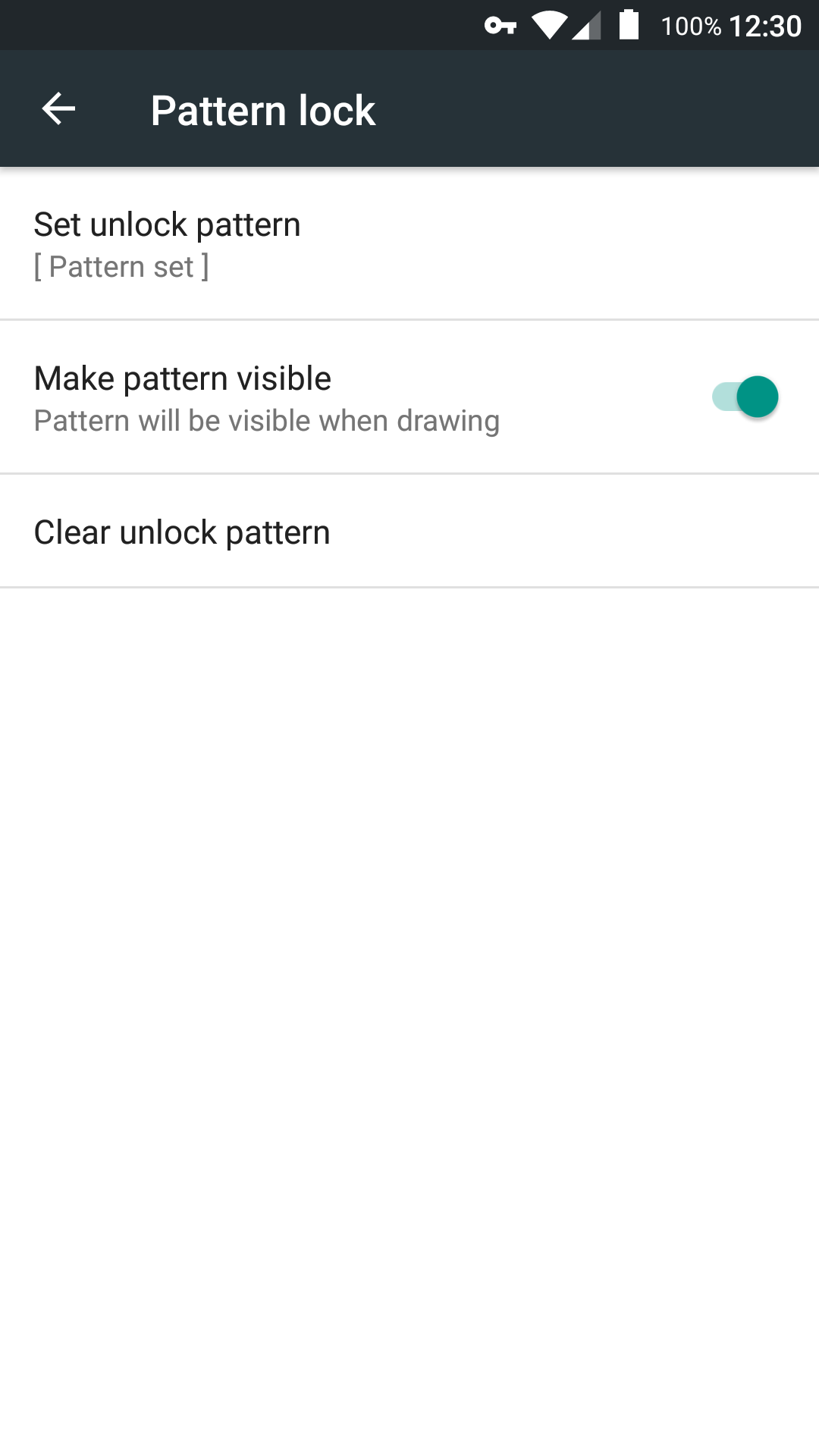
Snapshot of zhanghai/PatternLock: 678★, Java, Mobile. Material Design Pattern Lock with auth flow implementation
Snapshot summary built from the project's own GitHub metadata — there's no written TopGit review yet. The page will update automatically when a full review is published.
WHY NO REVIEW YET
TopGit writes full reviews for the most-starred, most-requested repositories. This page is a snapshot until then — see the READ ME tab for the original README in full.
A Material Design Pattern Lock library with auth flow implementation.
Why PatterLock?
Battle-tested framework implementation with necessary modifications.
Supports XML attributes for customization.
Supports variable MxN pattern size.
Provides a drop-in implementation of the boilerplate create-and-confirm / verify flow, the same as the framework Settings app.
Provides a detailed example of integration in sample app source, e.g. implementing protected UI, theme switching.
Preview
Sample APK
Design
This library aims to provide the basic but extensible building blocks for implementing pattern lock mechanism in an Android app. So the common usage will be extending the base Activity classes provided and overriding methods according to your need.
This library also aims to be elegant. Code taken from AOSP was slightly refactored and renamed to be clear, and the PatternView now utilizes the Android resource system for customization.
This library added support for variable pattern sizes, so that you can use pattern sizes other than framework's hard-coded 3x3 setup by setting app:pl_rowCount and app:pl_columnCount.
Here are some detailed usage documentation, and you can always refer to the sample app source for a working implementation.
Styling
First of all, you need to include the default styling in your theme, by adding:
<item name="patternViewStyle">@style/PatternView</item>
<!-- Or PatternView.Light, or your own style extending these two or not. -->
Or you can utilize the resource overriding trick by copying the layout/base_pattern_activity.xml from the library source to your application source, and modify it there (for instance PatternView attributes). Changes will override the original layout in this library.
Available PatternView attributes are, as in attrs.xml:
<declare-styleable name="PatternView">
    <!-- Defines the row count of the pattern. -->
    <attr name="pl_rowCount" format="integer" />
    <!-- Defines the column count of the pattern. -->
    <attr name="pl_columnCount" format="integer" />
    <!-- Defines the aspect to use when drawing PatternView. -->
    <attr name="pl_aspect">
        <!-- Square; the default value. -->
        <enum name="square" value="0" />
        <enum name="lock_width" value="1" />
        <enum name="lock_height" value="2" />
    </attr>
    <!-- Defines the regular pattern color. -->
    <attr name="pl_regularColor" format="color|reference" />
    <!-- Defines the error color. -->
    <attr name="pl_errorColor" format="color|reference" />
    <!-- Defines the success color. -->
    <attr name="pl_successColor" format="color|reference"/>
</declare-styleable>
As stated above, the common usage will be extending or checking result instead of giving Intent extras, because the actions to perform generally requires a Context or even a Activity, in which a simple callback can be difficult or even leaking Activity instances.
Set pattern activity example:
public class SampleSetPatternActivity extends SetPatternActivity {

    @Override
    protected void onSetPattern(List<PatternView.Cell> pattern) {
        String patternSha1 = PatternUtils.patternToSha1String(pattern);
        // TODO: Save patternSha1 in SharedPreferences.
    }
}
Confirm pattern activity example:
public class SampleConfirmPatternActivity extends ConfirmPatternActivity {

    @Override
    protected boolean isStealthModeEnabled() {
        // TODO: Return the value from SharedPreferences.
        return false;
    }

    @Override
    protected boolean isPatternCorrect(List<PatternView.Cell> pattern) {
        // TODO: Get saved pattern sha1.
        String patternSha1 = null;
        return TextUtils.equals(PatternUtils.patternToSha1String(pattern), patternSha1);
    }

    @Override
    protected void onForgotPassword() {

        startActivity(new Intent(this, YourResetPatternActivity.class));

        // Finish with RESULT_FORGOT_PASSWORD.
        super.onForgotPassword();
    }
}
Note that protected fields inherited from BasePatternActivity, such as mMessageText and mPatternView, are also there ready for your customization.
You can check out the sample app's PatternLockActivity for implementing a pattern-locked Activity.
PatternLock or LockPattern?
The original view in AOSP is named LockPatternView, however I believe it is named so because it displays the (screen lock) pattern, instead of the pattern as a lock. Since this library is to provide the pattern as a locking mechanism, I'd prefer naming it PatternLock, and for simplicity, the view is renamed to PatternView.
Differences with android-lockpattern
I know there is already a library named android-lockpattern, and I tried it for a whole day before I started writing this "yet another".
So here are the major differences.
That project is prefixing its resources using alp_42447968, while this project is prefixing its resources using pl, and I prefer simplicity to that "security".
That project provides a bunch of mechanisms and extras for its Activity (and with some private methods :( ), none of which I found suitable for my use case, while this project provides a bunch of methods to override to meet your need.
That project has a demo but it is close-sourced, while this project provides an open source sample application with a working pattern lock mechanism implementation.
Legacy version
There was a legacy version of this library with Android Design (Holo) appearance and native Activity. If you still want that version, checkout this.
License
Copyright 2015 Zhang Hai

Licensed under the Apache License, Version 2.0 (the "License");
you may not use this file except in compliance with the License.
You may obtain a copy of the License at

   http://www.apache.org/licenses/LICENSE-2.0

Unless required by applicable law or agreed to in writing, software
distributed under the License is distributed on an "AS IS" BASIS,
WITHOUT WARRANTIES OR CONDITIONS OF ANY KIND, either express or implied.
See the License for the specific language governing permissions and
limitations under the License.
No homepage URL was recorded for zhanghai/PatternLock in TopGit's last sync. The README tab above frequently contains screenshots and demo links, or check the repository description on GitHub.
How does zhanghai/PatternLock compare to other Mobile projects?
zhanghai/PatternLock is tracked by TopGit in the Mobile category, with 678 GitHub stars and written in Java. Browse the Mobile topic page on TopGit to compare it against similar projects by stars and activity.
How many stars does zhanghai/PatternLock have?
zhanghai/PatternLock has 678 GitHub stars — refresh the page for the live number, or check github.com/zhanghai/PatternLock. TopGit mirrors GitHub's count but does not claim minute-by-minute accuracy.
Is zhanghai/PatternLock open source?
TopGit's metadata for zhanghai/PatternLock does not record a license. Most public repositories on GitHub ARE open source, but the exact terms vary — verify by opening the LICENSE file directly.
What else is in the Mobile space?
zhanghai/PatternLock is tracked by TopGit under the Mobile category, alongside 4 GitHub-tagged topics. Trending and Topics pages list peer repositories of comparable stars and language.
What is zhanghai/PatternLock?
zhanghai/PatternLock (zhanghai/PatternLock) is a Java project on GitHub. From the project's own README: Material Design Pattern Lock with auth flow implementation
Where do I read more about zhanghai/PatternLock?
This TopGit page is a snapshot — the READ ME tab shows the project's own README content (links stripped, images preserved). The GitHub repository at github.com/zhanghai/PatternLock is the definitive source.
Read full README in the tab above.
Is PatternLock worth your time?
ChatGPT, Claude and Perplexity can all read this page. Ask one of them what it makes of PatternLock.
 /PatternLock