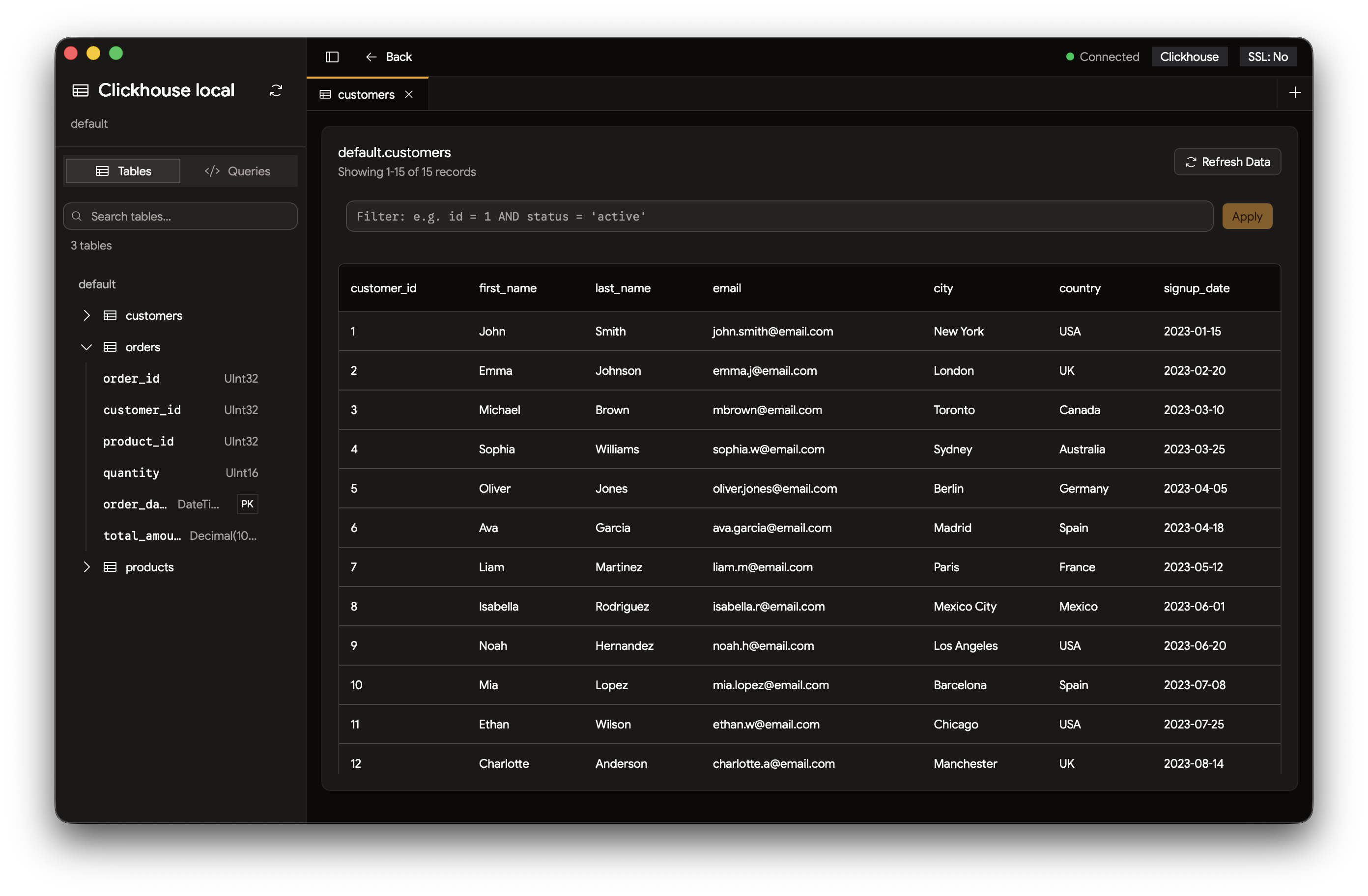
amalshaji/dbcooper là dự án Data trên GitHub, viết chủ yếu bằng TypeScript, với 457 sao. A database client for PostgreSQL, SQLite, Redis, and ClickHouse, built with Tauri, React, and TypeScript.
Tóm tắt dựng từ metadata GitHub của chính dự án — chưa có bài review TopGit. Trang sẽ tự động cập nhật khi bài review đầy đủ được xuất bản.
VÌ SAO CHƯA CÓ REVIEW
TopGit viết bài đầy đủ cho repo có nhiều sao nhất và được yêu cầu nhiều nhất. Trang này là snapshot trong thời gian chờ — xem README gốc ở tab READ ME.
A database client for PostgreSQL, MySQL, MariaDB, MongoDB, SQLite, DuckDB, Redis, ClickHouse, and Cloudflare D1, built with Tauri, React, and TypeScript.
Stable macOS releases are signed and notarized by Apple, so they can be installed
and opened normally without bypassing Gatekeeper.
Features
Check out the full list of features on our documentation site.
Docker databases
From the Connections screen, DBcooper can:
Create PostgreSQL 17, MySQL 8.4, MariaDB 11.4, MongoDB 7.0, Redis 7, or ClickHouse 25.8 in a Docker container and save a ready-to-use connection.
Link a compatible PostgreSQL, MySQL, MariaDB, MongoDB, Redis, or ClickHouse container that already exists in the current Docker context, including Docker Compose services.
Copy the complete connection string for a Docker-managed connection.
Stop and restart the linked container from the connection menu.
Databases created by DBcooper use a persistent named volume. Quitting DBcooper
stops the container without removing the container or its data, and opening the
connection starts it again. Deleting a connection also preserves Docker data
unless you explicitly choose to remove it.
Linking an existing container requires its database port to be published to the
host. DBcooper reads standard image environment variables, including Docker
secret-style *_FILE values, and lets you review the detected connection fields
before saving.
FAQ
Find answers to common questions on our documentation site.
# Install dependencies
bun install

# Run in development mode
bun run tauri dev

# After changing icon.png or src-tauri/macos/AppIcon.png
# regenerate every platform icon and the macOS asset catalog
bun run icons

# Build for production
bun run tauri build

# Test D1 against a disposable local Wrangler database
bun run test:d1-local
MCP server for external agents
DBcooper includes an opt-in, token-authenticated MCP server for external coding agents. See docs/mcp.md for setup and curl examples.
Cloudflare D1
To create a D1 connection:
Open the Cloudflare dashboard Account home, find the account, open its menu, and choose Copy account ID. See Cloudflare's Account ID guide.
Go to My Profile → API Tokens → Create Token → Create Custom Token. Under permissions, choose Account → D1 → Read for browsing and querying, or Edit if DBcooper should edit rows or create tables. Scope the token to the account from step 1. See Cloudflare's API token guide.
Create the token and copy its secret immediately. Cloudflare shows the secret only once, so store it securely.
In New Connection, choose Cloudflare D1, enter the Account ID and token, select Load databases, then choose a database from the list.
The in-app connection form links to the same Cloudflare D1 setup guide.
D1 connections use Cloudflare's HTTPS API directly and do not support SSH tunnels. Cloudflare applies a global API limit of 1,200 requests per five minutes per user; DBcooper surfaces rate-limit responses and does not automatically replay D1 requests. Because the API transports results as JSON, integers outside JavaScript's safe integer range may lose precision when displayed.
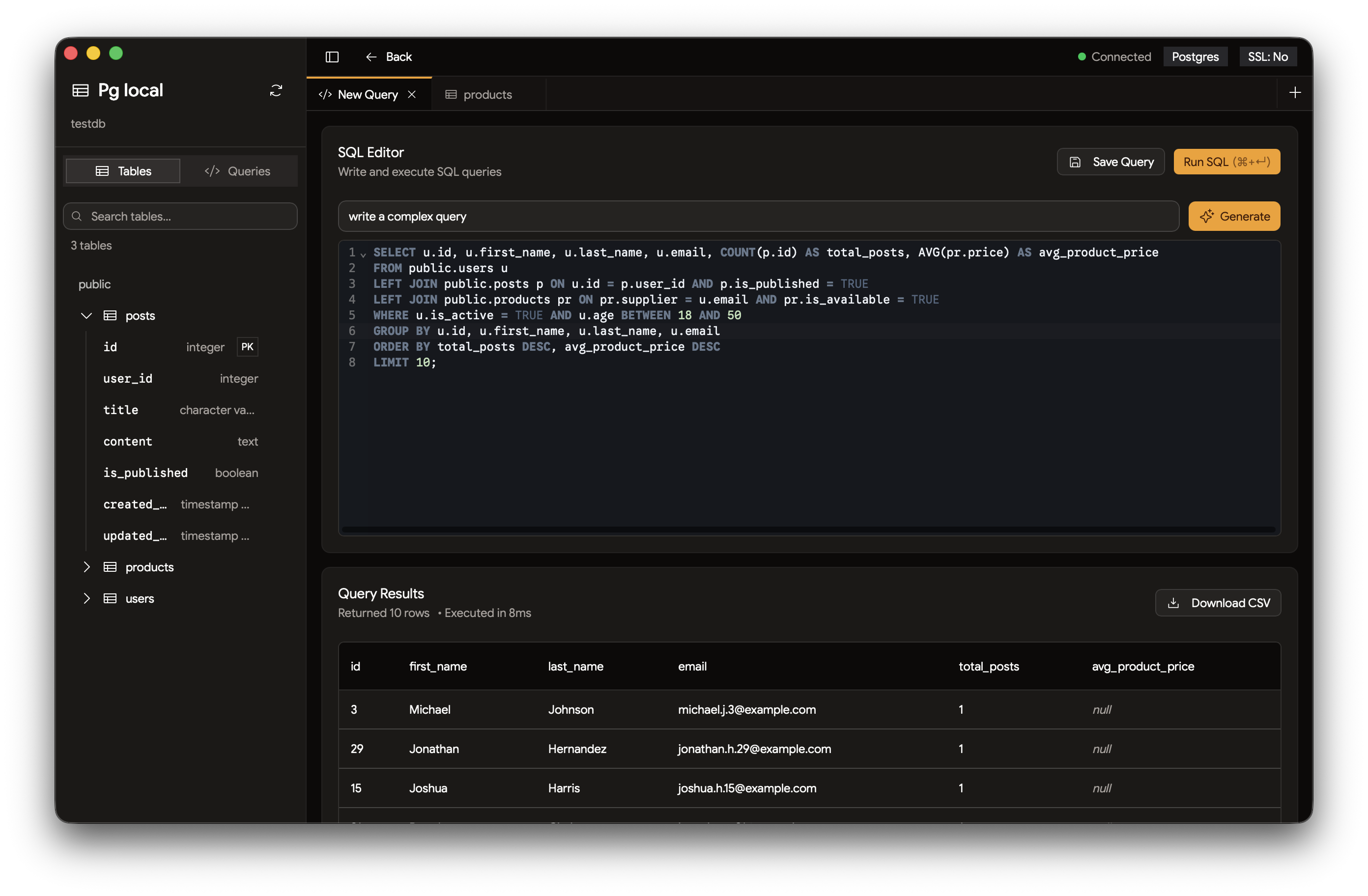
AI SQL Generation
To use AI-powered SQL generation:
Go to Settings (gear icon) and choose an AI provider:
OpenAI-compatible API: configure an API key, endpoint, and model.
Claude Code, Codex CLI, or opencode: DBcooper uses your local CLI install and existing login.
In the Query Editor, you'll see an instruction input above the SQL editor:
Type a natural language description (e.g., "show all users with posts from last week")
Click Generate or press Enter
Review the generated SQL before running it
The AI receives your instruction, existing editor SQL, and selected table/column schema metadata for accurate query generation.
Building
The app is configured to build for macOS ARM (Apple Silicon). The build process:
Creates optimized production bundles
Signs the app with a Developer ID certificate and submits it to Apple for notarization
Staples the notarization ticket to the app bundle
Generates signed updater artifacts
Releases
Releases are automated via GitHub Actions. To publish a new version:
Update version in src-tauri/tauri.conf.json
Prepare the release notes in RELEASE_NOTES.md
Open a focused PR, add the release label, and wait for all checks to pass
Merge the PR into main
Confirm GitHub Actions created the version tag at the release merge commit and built a draft release
Replace the draft's generic body with RELEASE_NOTES.md
Validate the DMG, updater archive, signature, and latest.json, then smoke-test installation and the in-app update from the previous stable version on a clean supported Mac
Publish the draft and verify the Homebrew cask update and a fresh installation or upgrade
Canary releases
Every commit merged into main publishes a signed canary after the test suite
passes. Canary versions use the next patch version with a build suffix, such as
v0.0.64-canary.142.
Canary updates are disabled by default. To receive them, open Settings and enable
Canary updates. Disable the setting to return to the stable channel; if the
installed canary is newer than the latest stable release, DBcooper will wait for
the next newer stable release instead of downgrading.
Required Secrets
Set these in your GitHub repository settings:
APPLE_CERTIFICATE - Base64-encoded Developer ID Application certificate (.p12)
APPLE_CERTIFICATE_PASSWORD - Password for the certificate archive
APPLE_ID - Apple ID used to submit the app for notarization
APPLE_PASSWORD - App-specific password for the Apple ID
APPLE_TEAM_ID - Apple Developer team identifier
TAURI_SIGNING_PRIVATE_KEY - Contents of the Tauri updater signing key file
TAURI_SIGNING_PRIVATE_KEY_PASSWORD - Password for the updater signing key
amalshaji/dbcooper có 457 sao GitHub — tải lại trang để xem số mới nhất, hoặc xem trực tiếp github.com/amalshaji/dbcooper. TopGit phản chiếu số sao của GitHub nhưng không cam kết đến từng phút.
amalshaji/dbcooper có phải mã nguồn mở không?
Có — amalshaji/dbcooper phát hành theo license MIT, nghĩa là mã nguồn mở để đọc, fork và (tùy license) tái sử dụng. Mã: github.com/amalshaji/dbcooper.
amalshaji/dbcooper còn đang phát triển không?
Commit gần nhất trên amalshaji/dbcooper là 20 ngày trước (theo timestamp GitHub). Repo có 31 fork — một chỉ báo về mức độ quan tâm của cộng đồng.
amalshaji/dbcooper dùng license gì?
amalshaji/dbcooper phát hành theo license MIT. Nên mở file LICENSE trên GitHub để xác nhận — license metadata đôi khi lệch với thực tế dự án.
amalshaji/dbcooper là gì?
amalshaji/dbcooper (amalshaji/dbcooper) là dự án TypeScript trên GitHub. Theo mô tả gốc: A database client for PostgreSQL, SQLite, Redis, and ClickHouse, built with Tauri, React, and TypeScript.
amalshaji/dbcooper viết bằng ngôn ngữ gì?
amalshaji/dbcooper chủ yếu viết bằng TypeScript. Trường "language" của GitHub dựa trên phần lớn byte ở nhánh mặc định.
Cùng nhóm Data còn repo nào?
amalshaji/dbcooper thuộc nhóm Data trên TopGit, cùng 7 topic GitHub. Trang Trending và Topics liệt kê các repo cùng số sao và cùng ngôn ngữ để so sánh.
Đọc thêm về amalshaji/dbcooper ở đâu?
Trang TopGit này là một snapshot — tab "Readme" hiển thị nguyên văn README của repo (đã bỏ link, giữ ảnh). Repo GitHub ở github.com/amalshaji/dbcooper là nguồn chính thức.
Đọc đầy đủ README ở tab phía trên.
dbcooper có đáng để bạn bỏ thời gian?
ChatGPT, Claude và Perplexity đều đọc được trang này. Hỏi thử xem họ nghĩ gì về dbcooper.

 /dbcooper