Một mục phía máy chủ trong kho dữ liệu GitHub của TopGit: hibiken/asynq, 13.6k sao, nhóm Backend, Go. Simple, reliable, and efficient distributed task queue in Go
Tóm tắt dựng từ metadata GitHub của chính dự án — chưa có bài review TopGit. Trang sẽ tự động cập nhật khi bài review đầy đủ được xuất bản.
VÌ SAO CHƯA CÓ REVIEW
TopGit viết bài đầy đủ cho repo có nhiều sao nhất và được yêu cầu nhiều nhất. Trang này là snapshot trong thời gian chờ — xem README gốc ở tab READ ME.
Simple, reliable & efficient distributed task queue in Go
Asynq is a Go library for queueing tasks and processing them asynchronously with workers. It's backed by Redis and is designed to be scalable yet easy to get started.
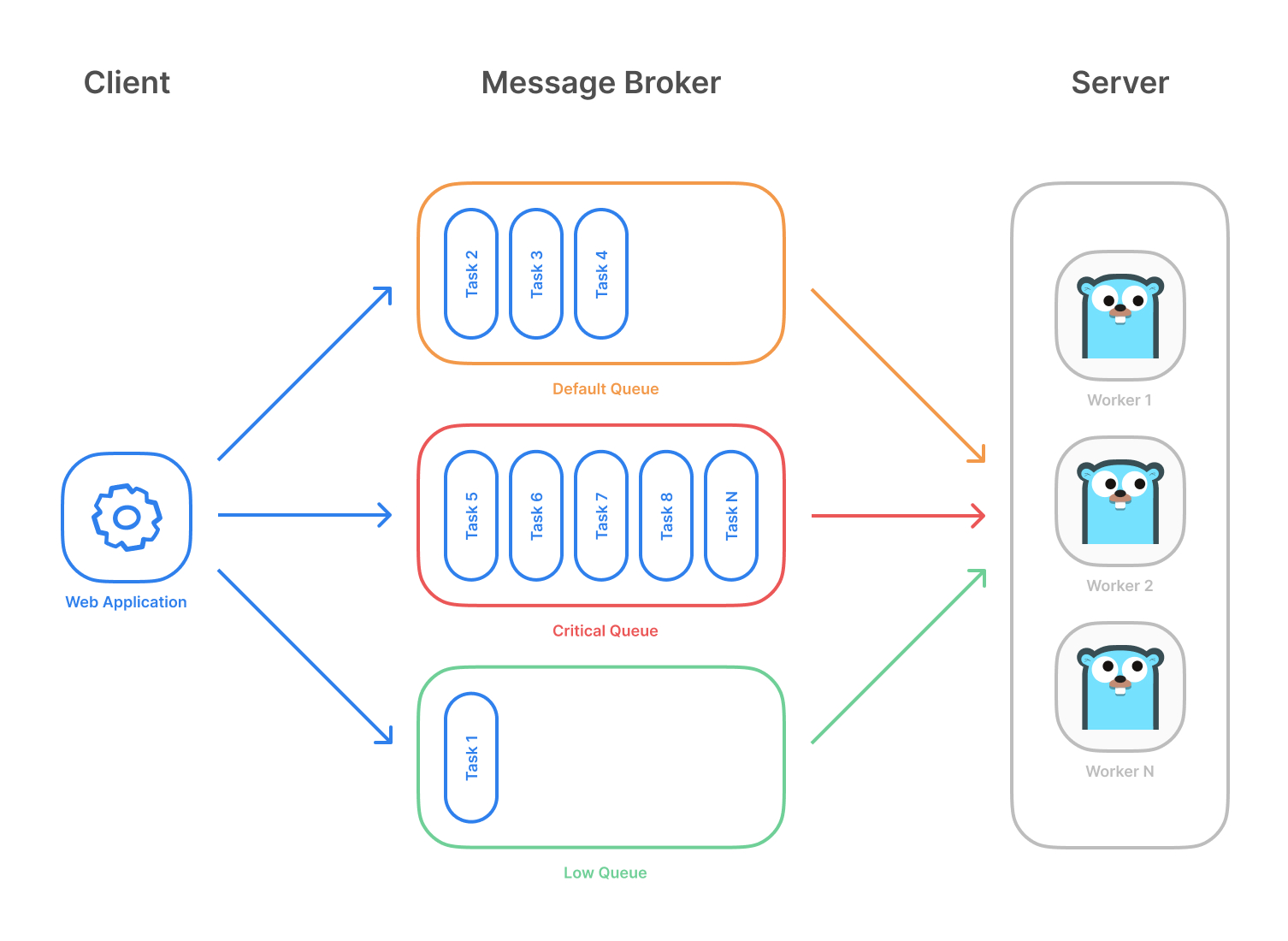
Highlevel overview of how Asynq works:
Client puts tasks on a queue
Server pulls tasks off queues and starts a worker goroutine for each task
Tasks are processed concurrently by multiple workers
Task queues are used as a mechanism to distribute work across multiple machines. A system can consist of multiple worker servers and brokers, giving way to high availability and horizontal scaling.
Example use case
Features
Guaranteed at least one execution of a task
Scheduling of tasks
Retries of failed tasks
Automatic recovery of tasks in the event of a worker crash
Weighted priority queues
Strict priority queues
Low latency to add a task since writes are fast in Redis
De-duplication of tasks using unique option
Allow timeout and deadline per task
Allow aggregating group of tasks to batch multiple successive operations
Flexible handler interface with support for middlewares
Ability to pause queue to stop processing tasks from the queue
Periodic Tasks
Support Redis Sentinels for high availability
Integration with Prometheus to collect and visualize queue metrics
Web UI to inspect and remote-control queues and tasks
CLI to inspect and remote-control queues and tasks
Stability and Compatibility
Status: The library relatively stable and is currently undergoing moderate development with less frequent breaking API changes.
☝️ Important Note: Current major version is zero (v0.x.x) to accommodate rapid development and fast iteration while getting early feedback from users (feedback on APIs are appreciated!). The public API could change without a major version update before v1.0.0 release.
Redis Cluster Compatibility
Some of the lua scripts in this library may not be compatible with Redis Cluster.
Sponsoring
If you are using this package in production, please consider sponsoring the project to show your support!
Quickstart
Make sure you have Go installed (download). The last two Go versions are supported (See https://go.dev/dl).
Initialize your project by creating a folder and then running go mod init github.com/your/repo (learn more) inside the folder. Then install Asynq library with the go get command:
go get -u github.com/hibiken/asynq
Make sure you're running a Redis server locally or from a Docker container. Version 4.0 or higher is required.
Next, write a package that encapsulates task creation and task handling.
package tasks

import (
    "context"
    "encoding/json"
    "fmt"
    "log"
    "time"
    "github.com/hibiken/asynq"
)

// A list of task types.
const (
    TypeEmailDelivery   = "email:deliver"
    TypeImageResize     = "image:resize"
)

type EmailDeliveryPayload struct {
    UserID     int
    TemplateID string
}

type ImageResizePayload struct {
    SourceURL string
}

//----------------------------------------------
// Write a function NewXXXTask to create a task.
// A task consists of a type and a payload.
//----------------------------------------------

func NewEmailDeliveryTask(userID int, tmplID string) (*asynq.Task, error) {
    payload, err := json.Marshal(EmailDeliveryPayload{UserID: userID, TemplateID: tmplID})
    if err != nil {
        return nil, err
    }
    return asynq.NewTask(TypeEmailDelivery, payload), nil
}

func NewImageResizeTask(src string) (*asynq.Task, error) {
    payload, err := json.Marshal(ImageResizePayload{SourceURL: src})
    if err != nil {
        return nil, err
    }
    // task options can be passed to NewTask, which can be overridden at enqueue time.
    return asynq.NewTask(TypeImageResize, payload, asynq.MaxRetry(5), asynq.Timeout(20 * time.Minute)), nil
}

//---------------------------------------------------------------
// Write a function HandleXXXTask to handle the input task.
// Note that it satisfies the asynq.HandlerFunc interface.
//
// Handler doesn't need to be a function. You can define a type
// that satisfies asynq.Handler interface. See examples below.
//---------------------------------------------------------------

func HandleEmailDeliveryTask(ctx context.Context, t *asynq.Task) error {
    var p EmailDeliveryPayload
    if err := json.Unmarshal(t.Payload(), &p); err != nil {
        return fmt.Errorf("json.Unmarshal failed: %v: %w", err, asynq.SkipRetry)
    }
    log.Printf("Sending Email to User: user_id=%d, template_id=%s", p.UserID, p.TemplateID)
    // Email delivery code ...
    return nil
}

// ImageProcessor implements asynq.Handler interface.
type ImageProcessor struct {
    // ... fields for struct
}

func (processor *ImageProcessor) ProcessTask(ctx context.Context, t *asynq.Task) error {
    var p ImageResizePayload
    if err := json.Unmarshal(t.Payload(), &p); err != nil {
        return fmt.Errorf("json.Unmarshal failed: %v: %w", err, asynq.SkipRetry)
    }
    log.Printf("Resizing image: src=%s", p.SourceURL)
    // Image resizing code ...
    return nil
}

func NewImageProcessor() *ImageProcessor {
	return &ImageProcessor{}
}
In your application code, import the above package and use Client to put tasks on queues.
package main

import (
    "log"
    "time"

    "github.com/hibiken/asynq"
    "your/app/package/tasks"
)

const redisAddr = "127.0.0.1:6379"

func main() {
    client := asynq.NewClient(asynq.RedisClientOpt{Addr: redisAddr})
    defer client.Close()

    // ------------------------------------------------------
    // Example 1: Enqueue task to be processed immediately.
    //            Use (*Client).Enqueue method.
    // ------------------------------------------------------

    task, err := tasks.NewEmailDeliveryTask(42, "some:template:id")
    if err != nil {
        log.Fatalf("could not create task: %v", err)
    }
    info, err := client.Enqueue(task)
    if err != nil {
        log.Fatalf("could not enqueue task: %v", err)
    }
    log.Printf("enqueued task: id=%s queue=%s", info.ID, info.Queue)


    // ------------------------------------------------------------
    // Example 2: Schedule task to be processed in the future.
    //            Use ProcessIn or ProcessAt option.
    // ------------------------------------------------------------

    info, err = client.Enqueue(task, asynq.ProcessIn(24*time.Hour))
    if err != nil {
        log.Fatalf("could not schedule task: %v", err)
    }
    log.Printf("enqueued task: id=%s queue=%s", info.ID, info.Queue)


    // ----------------------------------------------------------------------------
    // Example 3: Set other options to tune task processing behavior.
    //            Options include MaxRetry, Queue, Timeout, Deadline, Unique etc.
    // ----------------------------------------------------------------------------

    task, err = tasks.NewImageResizeTask("https://example.com/myassets/image.jpg")
    if err != nil {
        log.Fatalf("could not create task: %v", err)
    }
    info, err = client.Enqueue(task, asynq.MaxRetry(10), asynq.Timeout(3 * time.Minute))
    if err != nil {
        log.Fatalf("could not enqueue task: %v", err)
    }
    log.Printf("enqueued task: id=%s queue=%s", info.ID, info.Queue)
}
Next, start a worker server to process these tasks in the background. To start the background workers, use Server and provide your Handler to process the tasks.
You can optionally use ServeMux to create a handler, just as you would with net/http Handler.
package main

import (
    "log"

    "github.com/hibiken/asynq"
    "your/app/package/tasks"
)

const redisAddr = "127.0.0.1:6379"

func main() {
    srv := asynq.NewServer(
        asynq.RedisClientOpt{Addr: redisAddr},
        asynq.Config{
            // Specify how many concurrent workers to use
            Concurrency: 10,
            // Optionally specify multiple queues with different priority.
            Queues: map[string]int{
                "critical": 6,
                "default":  3,
                "low":      1,
            },
            // See the godoc for other configuration options
        },
    )

    // mux maps a type to a handler
    mux := asynq.NewServeMux()
    mux.HandleFunc(tasks.TypeEmailDelivery, tasks.HandleEmailDeliveryTask)
    mux.Handle(tasks.TypeImageResize, tasks.NewImageProcessor())
    // ...register other handlers...

    if err := srv.Run(mux); err != nil {
        log.Fatalf("could not run server: %v", err)
    }
}
For a more detailed walk-through of the library, see our Getting Started guide.
To learn more about asynq features and APIs, see the package godoc.
Web UI
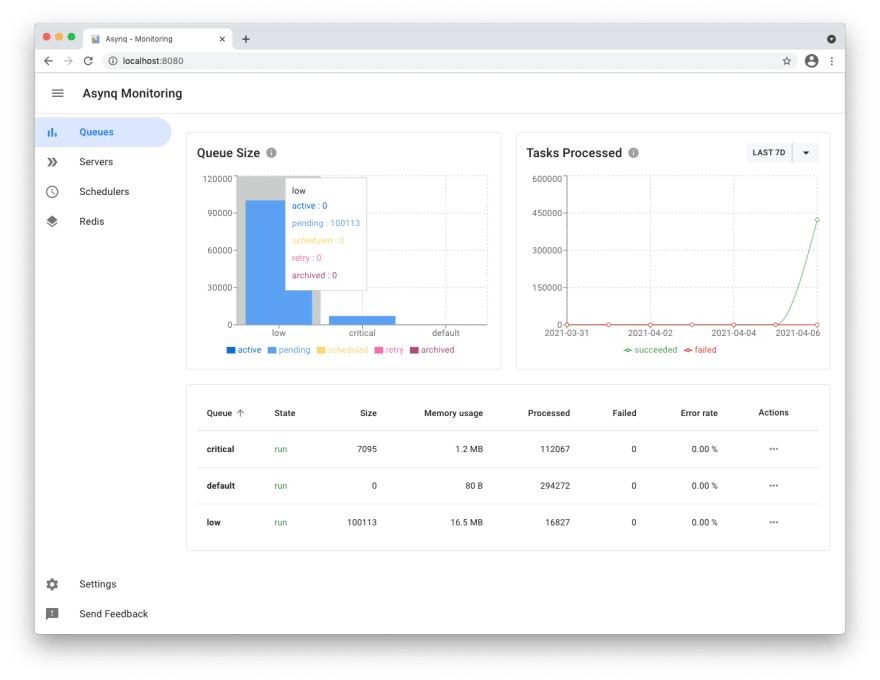
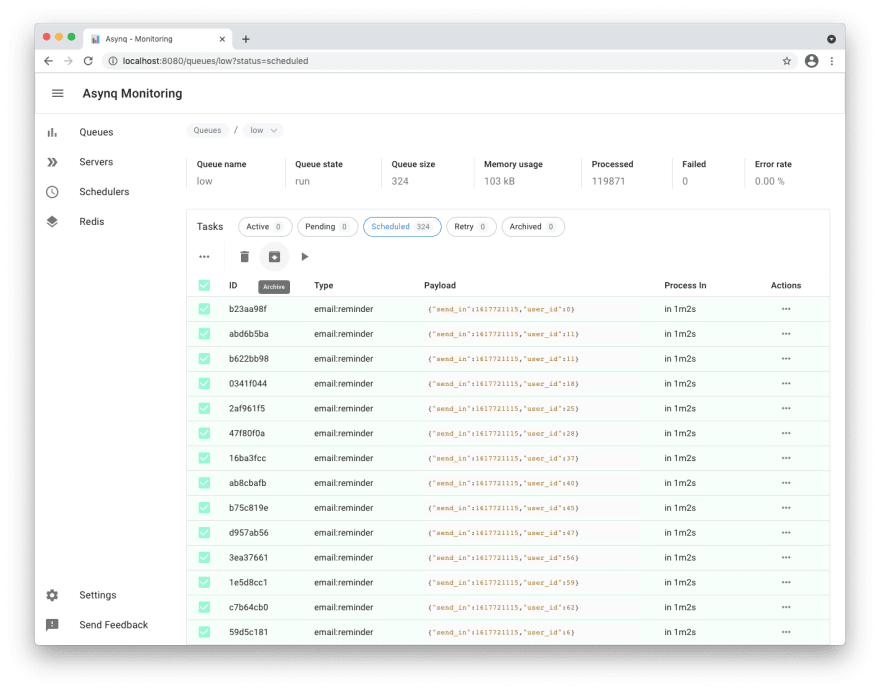
Asynqmon is a web based tool for monitoring and administrating Asynq queues and tasks.
Here's a few screenshots of the Web UI:
Queues view
Tasks view
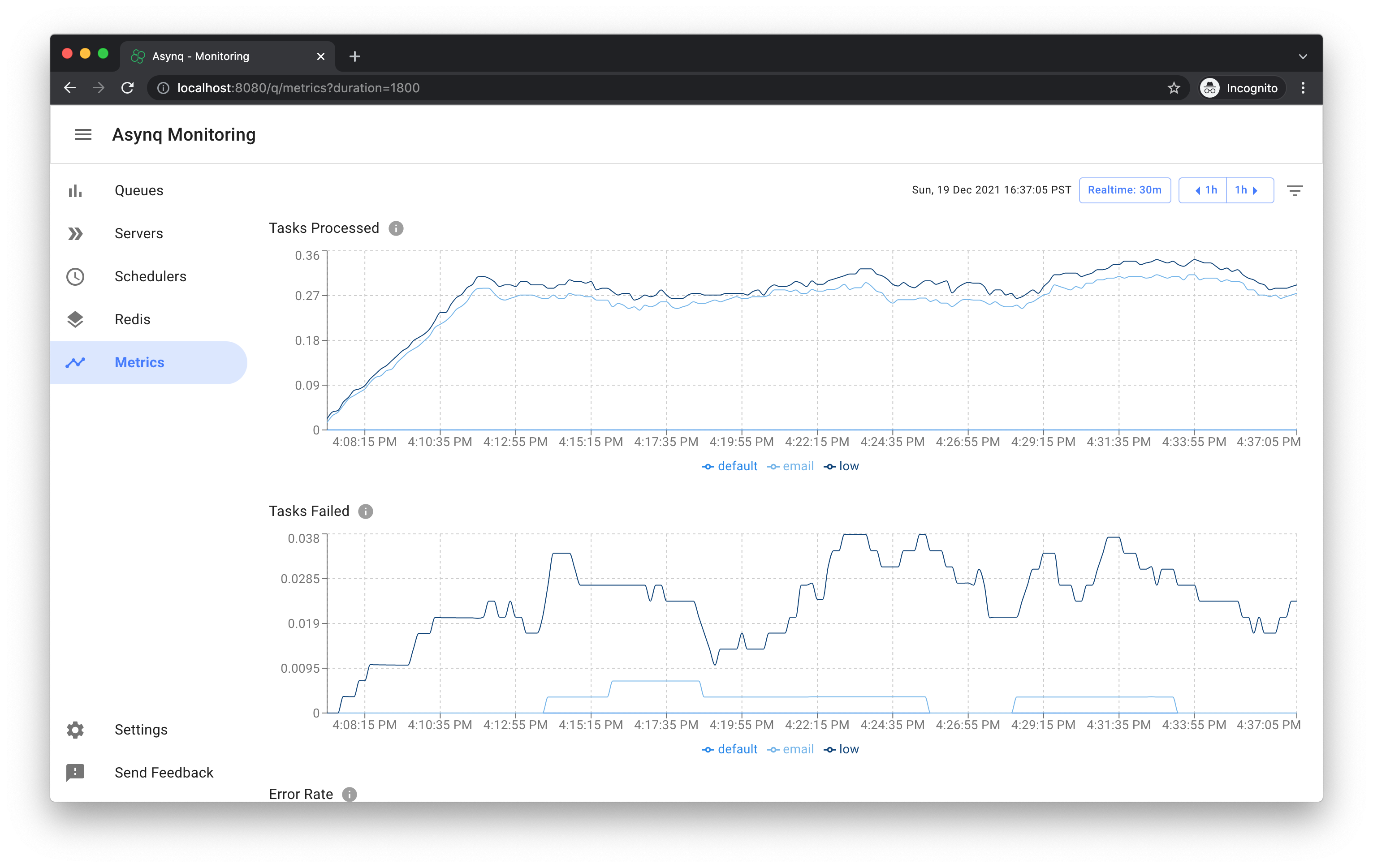
Metrics view
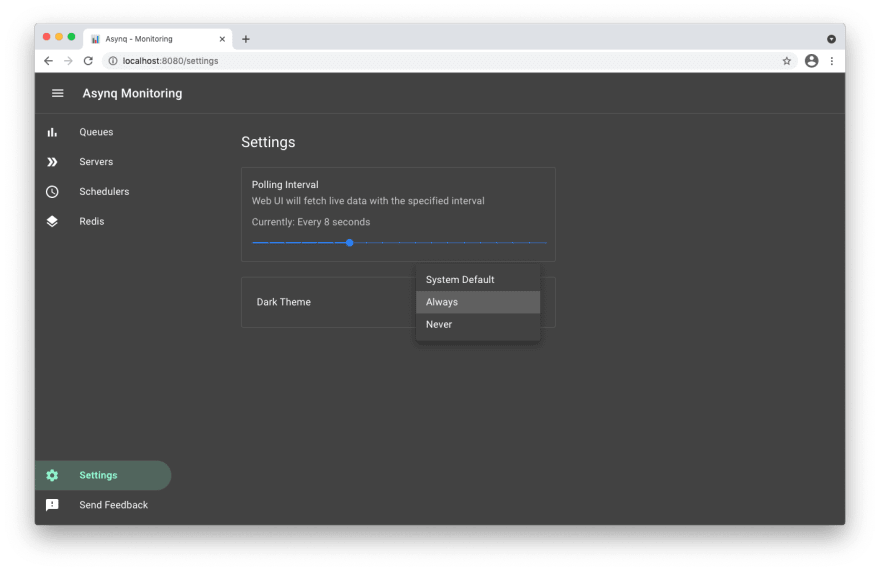
Settings and adaptive dark mode
For details on how to use the tool, refer to the tool's README.
Command Line Tool
Asynq ships with a command line tool to inspect the state of queues and tasks.
To install the CLI tool, run the following command:
go install github.com/hibiken/asynq/tools/asynq@latest
Here's an example of running the asynq dash command:
For details on how to use the tool, refer to the tool's README.
Contributing
We are open to, and grateful for, any contributions (GitHub issues/PRs, feedback on Gitter channel, etc) made by the community.
Please see the Contribution Guide before contributing.
License
Copyright (c) 2019-present Ken Hibino and Contributors. Asynq is free and open-source software licensed under the MIT License. Official logo was created by Vic Shóstak and distributed under Creative Commons license (CC0 1.0 Universal).
hibiken/asynq thuộc nhóm Backend trên TopGit, cùng 7 topic GitHub. Trang Trending và Topics liệt kê các repo cùng số sao và cùng ngôn ngữ để so sánh.
Đọc thêm về hibiken/asynq ở đâu?
Trang TopGit này là một snapshot — tab "Readme" hiển thị nguyên văn README của repo (đã bỏ link, giữ ảnh). Repo GitHub ở github.com/hibiken/asynq là nguồn chính thức.
hibiken/asynq có bao nhiêu sao?
hibiken/asynq có 13.6k sao GitHub — tải lại trang để xem số mới nhất, hoặc xem trực tiếp github.com/hibiken/asynq. TopGit phản chiếu số sao của GitHub nhưng không cam kết đến từng phút.
hibiken/asynq có những chủ đề gì?
GitHub topics của hibiken/asynq: "asynchronous-tasks", "background-jobs", "go", "golang", "redis", "task-queue", "worker-pool". TopGit xếp repo vào nhóm Backend.
hibiken/asynq có phải mã nguồn mở không?
Có — hibiken/asynq phát hành theo license MIT, nghĩa là mã nguồn mở để đọc, fork và (tùy license) tái sử dụng. Mã: github.com/hibiken/asynq.
hibiken/asynq có website riêng không?
TopGit chưa ghi nhận URL trang chủ cho hibiken/asynq. Phần README ở tab phía trên thường có link demo, hoặc xem mô tả GitHub của repo.
hibiken/asynq còn đang phát triển không?
Commit gần nhất trên hibiken/asynq là 1 tháng trước (theo timestamp GitHub). Repo có 974 fork — một chỉ báo về mức độ quan tâm của cộng đồng.
Đọc đầy đủ README ở tab phía trên.
asynq có đáng để bạn bỏ thời gian?
ChatGPT, Claude và Perplexity đều đọc được trang này. Hỏi thử xem họ nghĩ gì về asynq.
 /asynq