ropensci/targets là dự án R với 1.1k sao trong nhóm Automation. Function-oriented Make-like declarative workflows for R
Tóm tắt dựng từ metadata GitHub của chính dự án — chưa có bài review TopGit. Trang sẽ tự động cập nhật khi bài review đầy đủ được xuất bản.
VÌ SAO CHƯA CÓ REVIEW
TopGit viết bài đầy đủ cho repo có nhiều sao nhất và được yêu cầu nhiều nhất. Trang này là snapshot trong thời gian chờ — xem README gốc ở tab READ ME.
Pipeline tools coordinate the pieces of computationally demanding
analysis projects. The targets package is a Make-like pipeline tool
for statistics and data science in R. The package skips costly runtime
for tasks that are already up to date, orchestrates the necessary
computation with implicit parallel computing, and abstracts files as R
objects. If all the current output matches the current upstream code and
data, then the whole pipeline is up to date, and the results are more
trustworthy than otherwise.
Philosophy
A pipeline is a computational workflow that does statistics, analytics,
or data science. Examples include forecasting customer behavior,
simulating a clinical trial, and detecting differential expression from
genomics data. A pipeline contains tasks to prepare datasets, run
models, and summarize results for a business deliverable or research
paper. The methods behind these tasks are user-defined R functions that
live in R scripts, ideally in a folder called "R/" in the project. The
tasks themselves are called “targets”, and they run the functions and
return R objects. The targets package orchestrates the targets and
stores the output objects to make your pipeline efficient, painless, and
reproducible.
Prerequisites
Familiarity with the R programming
language, covered in R for Data
Science.
Data science workflow management
techniques.
How to write functions to
prepare data, analyze data, and summarize results in a data analysis
project.
Installation
If you are using targets with crew for distributed
computing, it is
recommended to use crew version 0.4.0 or higher.
install.packages("crew")
There are multiple ways to install the targets package itself, and
both the latest release and the development version are available.
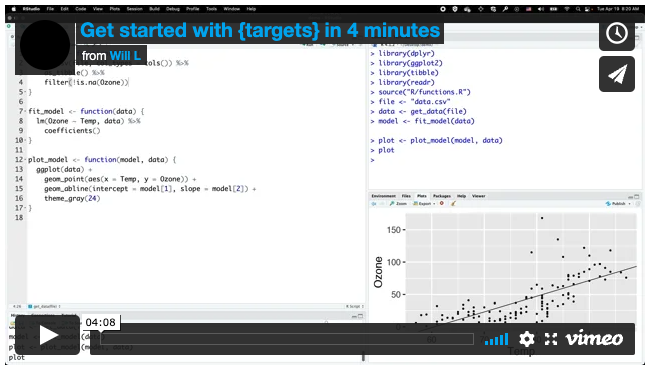
The 4-minute video at https://vimeo.com/700982360 demonstrates the
example pipeline used in the
walkthrough and
functions chapters
of the user manual. Visit
https://github.com/wlandau/targets-four-minutes for the code and
https://rstudio.cloud/project/3946303 to try out the code in a browser
(no download or installation required).
Usage
To create a pipeline of your own:
Write R
functions for a
pipeline and save them to R scripts (ideally in the "R/" folder of
your project).
Call
use_targets()
to write key files, including the vital _targets.R file which
configures and defines the pipeline.
Follow the comments in _targets.R to fill in the details of your
specific pipeline.
Check the pipeline with
tar_visnetwork(),
run it with
tar_make(),
and read output with
tar_read().
More
functions
are available.
Documentation
User manual: in-depth
discussion about how to use targets. The most important chapters are
the
walkthrough,
help guide, and
debugging guide.
Reference website: formal
documentation of all user-side functions, the statement of need, and
multiple design documents of the internal architecture.
Developer documentation:
software design documents for developers contributing to the deep
internal architecture of targets.
Help
Please read the help
guide to learn how best
to ask for help using targets.
Courses
Carpentries
workshop
by Joel Nitta
Half-day interactive tutorial with a Keras
example
Selected talks
English
Get started with targets in 4 minutes
(4:08)
Powerful simulation pipelines with
targets. useR! 2025
Conference
(1:00:25).
targets in Action
with Joel Nitta and Eric
Scott. rOpenSci Community
Call (1:09:56).
targets and crew for clinical trial simulation
pipelines.
R/Pharma 2023 (1:57:22).
targets and stantargets for Bayesian model validation
pipelines. R/Medicine 2021 (15:33)
Reproducible computation at scale in R with
targets New York Open Statistical
Programming Meetup, December 2020 (1:54:28).
ds-incubator series,
2021
by Mauro Lepore.
Español
Introducción a targets.
Irene Cruz, R-Ladies Barcelona, 2021-05-25 (1:25:12).
日本語
Bio”Pack”athon, 2022-03-31
(1:04:10), Joel
Nitta
Example projects
Four-minute example
Minimal example
Machine learning with
Keras
Validate a minimal Stan
model
Using Target Markdown and stantargets to validate a Bayesian
longitudinal model for clinical trial data
analysis
Shiny app that runs a
pipeline
Deploy a pipeline to RStudio
Connect
Apps
tar_watch():
a built-in Shiny app to visualize progress while a pipeline is
running. Available as a Shiny module via
tar_watch_ui()
and
tar_watch_server().
targetsketch: a Shiny
app to help sketch pipelines
(app,
source).
Deployment
tar_github_actions()
sets up a pipeline to run on GitHub Actions. The minimal
example demonstrates this
approach.
Extending and customizing targets
R Targetopia: a collection of
R packages that
extend targets. These
packages simplify
pipeline construction for specific fields of Statistics and data
science.
Target
factories:
a programming technique to write specialized interfaces for custom
pipelines. Posts here
and here
describe how.
Code of conduct
Please note that this package is released with a Contributor Code of
Conduct.
Citation
citation("targets")
To cite targets in publications use:

  Landau, W. M., (2021). The targets R package: a dynamic Make-like
  function-oriented pipeline toolkit for reproducibility and
  high-performance computing. Journal of Open Source Software, 6(57),
  2959, https://doi.org/10.21105/joss.02959

A BibTeX entry for LaTeX users is

  @Article{,
    title = {The targets R package: a dynamic Make-like function-oriented pipeline toolkit for reproducibility and high-performance computing},
    author = {William Michael Landau},
    journal = {Journal of Open Source Software},
    year = {2021},
    volume = {6},
    number = {57},
    pages = {2959},
    url = {https://doi.org/10.21105/joss.02959},
  }
ropensci/targets thuộc nhóm Automation trên TopGit, cùng 13 topic GitHub. Trang Trending và Topics liệt kê các repo cùng số sao và cùng ngôn ngữ để so sánh.
Đọc thêm về ropensci/targets ở đâu?
Trang TopGit này là một snapshot — tab "Readme" hiển thị nguyên văn README của repo (đã bỏ link, giữ ảnh). Repo GitHub ở github.com/ropensci/targets là nguồn chính thức.
ropensci/targets có bao nhiêu sao?
ropensci/targets có 1.1k sao GitHub — tải lại trang để xem số mới nhất, hoặc xem trực tiếp github.com/ropensci/targets. TopGit phản chiếu số sao của GitHub nhưng không cam kết đến từng phút.
ropensci/targets có phải mã nguồn mở không?
TopGit chưa ghi nhận license cho ropensci/targets. Phần lớn repo public trên GitHub là mã nguồn mở, nhưng điều khoản khác nhau từng repo — mở file LICENSE để xác nhận.
ropensci/targets có trang demo không?
Dự án có trang chủ ở https://docs.ropensci.org/targets/. Tab "Readme" ở trang này thường có ảnh chụp và hướng dẫn bắt đầu nhanh.
ropensci/targets là gì?
ropensci/targets (ropensci/targets) là dự án R trên GitHub. Theo mô tả gốc: Function-oriented Make-like declarative workflows for R
ropensci/targets so với các dự án Automation khác thế nào?
ropensci/targets được TopGit xếp vào nhóm Automation, với 1.1k sao GitHub và viết bằng R. Xem trang chủ đề Automation trên TopGit để so sánh với các dự án tương tự theo số sao và mức độ hoạt động.
Đọc đầy đủ README ở tab phía trên.
Chưa chắc targets có hợp với bạn?
Để ChatGPT, Claude hoặc Perplexity tìm hiểu giúp — bấm bên dưới và xem AI nói gì về targets.
 /targets