TopGit theo dõi tidyverse/dplyr trên GitHub, đã đạt 5.1k sao. dplyr: A grammar of data manipulation
Tóm tắt dựng từ metadata GitHub của chính dự án — chưa có bài review TopGit. Trang sẽ tự động cập nhật khi bài review đầy đủ được xuất bản.
VÌ SAO CHƯA CÓ REVIEW
TopGit viết bài đầy đủ cho repo có nhiều sao nhất và được yêu cầu nhiều nhất. Trang này là snapshot trong thời gian chờ — xem README gốc ở tab READ ME.
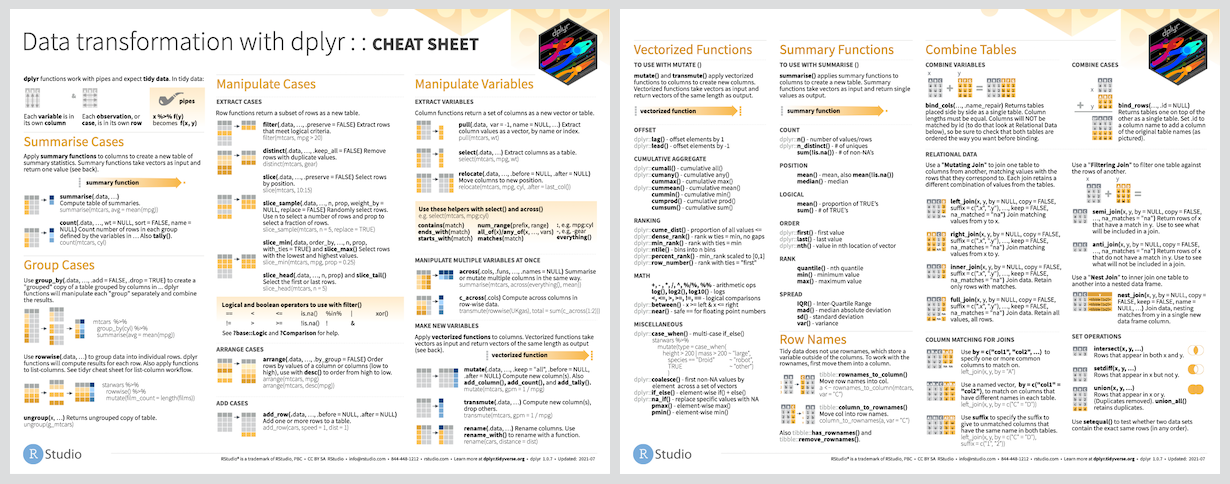
dplyr is a grammar of data manipulation, providing a consistent set of
verbs that help you solve the most common data manipulation challenges:
mutate() adds new variables that are functions of existing variables
select() picks variables based on their names.
filter() picks cases based on their values.
summarise() reduces multiple values down to a single summary.
arrange() changes the ordering of the rows.
These all combine naturally with group_by() which allows you to
perform any operation “by group”. You can learn more about them in
vignette("dplyr"). As well as these single-table verbs, dplyr also
provides a variety of two-table verbs, which you can learn about in
vignette("two-table").
If you are new to dplyr, the best place to start is the data
transformation chapter in R for
Data Science.
Backends
In addition to data frames/tibbles, dplyr makes working with other
computational backends accessible and efficient. Below is a list of
alternative backends:
arrow for larger-than-memory
datasets, including on remote cloud storage like AWS S3, using the
Apache Arrow C++ engine,
Acero.
dbplyr for data stored in a
relational database. Translates your dplyr code to SQL.
dtplyr for large, in-memory datasets.
Translates your dplyr code to high performance
data.table code.
duckplyr for large, in-memory
datasets. Translates your dplyr code to high performance
duckdb queries with zero extra copies and an
automatic R fallback when translation isn’t possible.
sparklyr for very large datasets stored in
Apache Spark.
Installation
# The easiest way to get dplyr is to install the whole tidyverse:
install.packages("tidyverse")

# Alternatively, install just dplyr:
install.packages("dplyr")
Development version
To get a bug fix or to use a feature from the development version, you
can install the development version of dplyr from GitHub.
library(dplyr)

starwars |>
  filter(species == "Droid")
#> # A tibble: 6 × 14
#>   name   height  mass hair_color skin_color  eye_color birth_year sex   gender
#>   <chr>   <int> <dbl> <chr>      <chr>       <chr>          <dbl> <chr> <chr>
#> 1 C-3PO     167    75 <NA>       gold        yellow           112 none  masculi…
#> 2 R2-D2      96    32 <NA>       white, blue red               33 none  masculi…
#> 3 R5-D4      97    32 <NA>       white, red  red               NA none  masculi…
#> 4 IG-88     200   140 none       metal       red               15 none  masculi…
#> 5 R4-P17     96    NA none       silver, red red, blue         NA none  feminine
#> # ℹ 1 more row
#> # ℹ 5 more variables: homeworld <chr>, species <chr>, films <list>,
#> #   vehicles <list>, starships <list>

starwars |>
  select(name, ends_with("color"))
#> # A tibble: 87 × 4
#>   name           hair_color skin_color  eye_color
#>   <chr>          <chr>      <chr>       <chr>
#> 1 Luke Skywalker blond      fair        blue
#> 2 C-3PO          <NA>       gold        yellow
#> 3 R2-D2          <NA>       white, blue red
#> 4 Darth Vader    none       white       yellow
#> 5 Leia Organa    brown      light       brown
#> # ℹ 82 more rows

starwars |>
  mutate(name, bmi = mass / ((height / 100)^2)) |>
  select(name:mass, bmi)
#> # A tibble: 87 × 4
#>   name           height  mass   bmi
#>   <chr>           <int> <dbl> <dbl>
#> 1 Luke Skywalker    172    77  26.0
#> 2 C-3PO             167    75  26.9
#> 3 R2-D2              96    32  34.7
#> 4 Darth Vader       202   136  33.3
#> 5 Leia Organa       150    49  21.8
#> # ℹ 82 more rows

starwars |>
  arrange(desc(mass))
#> # A tibble: 87 × 14
#>   name      height  mass hair_color skin_color eye_color birth_year sex   gender
#>   <chr>      <int> <dbl> <chr>      <chr>      <chr>          <dbl> <chr> <chr>
#> 1 Jabba De…    175  1358 <NA>       green-tan… orange         600   herm… mascu…
#> 2 Grievous     216   159 none       brown, wh… green, y…       NA   male  mascu…
#> 3 IG-88        200   140 none       metal      red             15   none  mascu…
#> 4 Darth Va…    202   136 none       white      yellow          41.9 male  mascu…
#> 5 Tarfful      234   136 brown      brown      blue            NA   male  mascu…
#> # ℹ 82 more rows
#> # ℹ 5 more variables: homeworld <chr>, species <chr>, films <list>,
#> #   vehicles <list>, starships <list>

starwars |>
  group_by(species) |>
  summarise(
    n = n(),
    mass = mean(mass, na.rm = TRUE)
  ) |>
  filter(
    n > 1,
    mass > 50
  )
#> # A tibble: 9 × 3
#>   species      n  mass
#>   <chr>    <int> <dbl>
#> 1 Droid        6  69.8
#> 2 Gungan       3  74
#> 3 Human       35  81.3
#> 4 Kaminoan     2  88
#> 5 Mirialan     2  53.1
#> # ℹ 4 more rows
Getting help
If you encounter a clear bug, please file an issue with a minimal
reproducible example on
GitHub. For questions and
other discussion, please use forum.posit.co.
Code of conduct
Please note that this project is released with a Contributor Code of
Conduct. By participating
in this project you agree to abide by its terms.
Trang TopGit này là một snapshot — tab "Readme" hiển thị nguyên văn README của repo (đã bỏ link, giữ ảnh). Repo GitHub ở github.com/tidyverse/dplyr là nguồn chính thức.
tidyverse/dplyr có bao nhiêu sao?
tidyverse/dplyr có 5.1k sao GitHub — tải lại trang để xem số mới nhất, hoặc xem trực tiếp github.com/tidyverse/dplyr. TopGit phản chiếu số sao của GitHub nhưng không cam kết đến từng phút.
tidyverse/dplyr có phải mã nguồn mở không?
TopGit chưa ghi nhận license cho tidyverse/dplyr. Phần lớn repo public trên GitHub là mã nguồn mở, nhưng điều khoản khác nhau từng repo — mở file LICENSE để xác nhận.
tidyverse/dplyr còn đang phát triển không?
Commit gần nhất trên tidyverse/dplyr là 2 tháng trước (theo timestamp GitHub). Repo có 2.1k fork — một chỉ báo về mức độ quan tâm của cộng đồng.
tidyverse/dplyr là gì?
tidyverse/dplyr (tidyverse/dplyr) là dự án R trên GitHub. Theo mô tả gốc: dplyr: A grammar of data manipulation
tidyverse/dplyr viết bằng ngôn ngữ gì?
tidyverse/dplyr chủ yếu viết bằng R. Trường "language" của GitHub dựa trên phần lớn byte ở nhánh mặc định.
Đọc đầy đủ README ở tab phía trên.
Vẫn đang phân vân về dplyr?
Một cú bấm sẽ gửi câu hỏi kèm trang này cho AI — xem AI nói gì về dplyr.
 /dplyr