trekhleb/homemade-machine-learning hiện có 24.8k sao trên GitHub, viết chủ yếu bằng Jupyter Notebook. 🤖 Python examples of popular machine learning algorithms with interactive Jupyter demos and math being explained
Tóm tắt dựng từ metadata GitHub của chính dự án — chưa có bài review TopGit. Trang sẽ tự động cập nhật khi bài review đầy đủ được xuất bản.
VÌ SAO CHƯA CÓ REVIEW
TopGit viết bài đầy đủ cho repo có nhiều sao nhất và được yêu cầu nhiều nhất. Trang này là snapshot trong thời gian chờ — xem README gốc ở tab READ ME.
🇺🇦 UKRAINE IS BEING ATTACKED BY RUSSIAN ARMY. CIVILIANS ARE GETTING KILLED. RESIDENTIAL AREAS ARE GETTING BOMBED.
Help Ukraine via:
Serhiy Prytula Charity Foundation
Come Back Alive Charity Foundation
National Bank of Ukraine
More info on war.ukraine.ua and MFA of Ukraine
Read this in other languages:Español
You might be interested in:
Homemade GPT • JS
Interactive Machine Learning Experiments
For Octave/MatLab version of this repository please check machine-learning-octave project.
This repository contains examples of popular machine learning algorithms implemented in Python with mathematics behind them being explained. Each algorithm has interactive Jupyter Notebook demo that allows you to play with training data, algorithms configurations and immediately see the results, charts and predictions right in your browser. In most cases the explanations are based on this great machine learning course by Andrew Ng.
The purpose of this repository is not to implement machine learning algorithms by using 3rd party library one-liners but rather to practice implementing these algorithms from scratch and get better understanding of the mathematics behind each algorithm. That's why all algorithms implementations are called "homemade" and not intended to be used for production.
Supervised Learning
In supervised learning we have a set of training data as an input and a set of labels or "correct answers" for each training set as an output. Then we're training our model (machine learning algorithm parameters) to map the input to the output correctly (to do correct prediction). The ultimate purpose is to find such model parameters that will successfully continue correct input→output mapping (predictions) even for new input examples.
Regression
In regression problems we do real value predictions. Basically we try to draw a line/plane/n-dimensional plane along the training examples.
Usage examples: stock price forecast, sales analysis, dependency of any number, etc.
🤖 Linear Regression
📗 Math | Linear Regression - theory and links for further readings
⚙️ Code | Linear Regression - implementation example
▶️ Demo | Univariate Linear Regression - predict country happiness score by economy GDP
▶️ Demo | Multivariate Linear Regression - predict country happiness score by economy GDP and freedom index
▶️ Demo | Non-linear Regression - use linear regression with polynomial and sinusoid features to predict non-linear dependencies
Classification
In classification problems we split input examples by certain characteristic.
Usage examples: spam-filters, language detection, finding similar documents, handwritten letters recognition, etc.
🤖 Logistic Regression
📗 Math | Logistic Regression - theory and links for further readings
⚙️ Code | Logistic Regression - implementation example
▶️ Demo | Logistic Regression (Linear Boundary) - predict Iris flower class based on petal_length and petal_width
▶️ Demo | Logistic Regression (Non-Linear Boundary) - predict microchip validity based on param_1 and param_2
Unsupervised learning is a branch of machine learning that learns from test data that has not been labeled, classified or categorized. Instead of responding to feedback, unsupervised learning identifies commonalities in the data and reacts based on the presence or absence of such commonalities in each new piece of data.
Clustering
In clustering problems we split the training examples by unknown characteristics. The algorithm itself decides what characteristic to use for splitting.
Usage examples: market segmentation, social networks analysis, organize computing clusters, astronomical data analysis, image compression, etc.
🤖 K-means Algorithm
📗 Math | K-means Algorithm - theory and links for further readings
⚙️ Code | K-means Algorithm - implementation example
▶️ Demo | K-means Algorithm - split Iris flowers into clusters based on petal_length and petal_width
Anomaly Detection
Anomaly detection (also outlier detection) is the identification of rare items, events or observations which raise suspicions by differing significantly from the majority of the data.
Usage examples: intrusion detection, fraud detection, system health monitoring, removing anomalous data from the dataset etc.
🤖 Anomaly Detection using Gaussian Distribution
📗 Math | Anomaly Detection using Gaussian Distribution - theory and links for further readings
⚙️ Code | Anomaly Detection using Gaussian Distribution - implementation example
▶️ Demo | Anomaly Detection - find anomalies in server operational parameters like latency and threshold
Neural Network (NN)
The neural network itself isn't an algorithm, but rather a framework for many different machine learning algorithms to work together and process complex data inputs.
Usage examples: as a substitute of all other algorithms in general, image recognition, voice recognition, image processing (applying specific style), language translation, etc.
🤖 Multilayer Perceptron (MLP)
📗 Math | Multilayer Perceptron - theory and links for further readings
⚙️ Code | Multilayer Perceptron - implementation example
▶️ Demo | Multilayer Perceptron | Fashion MNIST - recognize the type of clothes from 28x28 pixel images
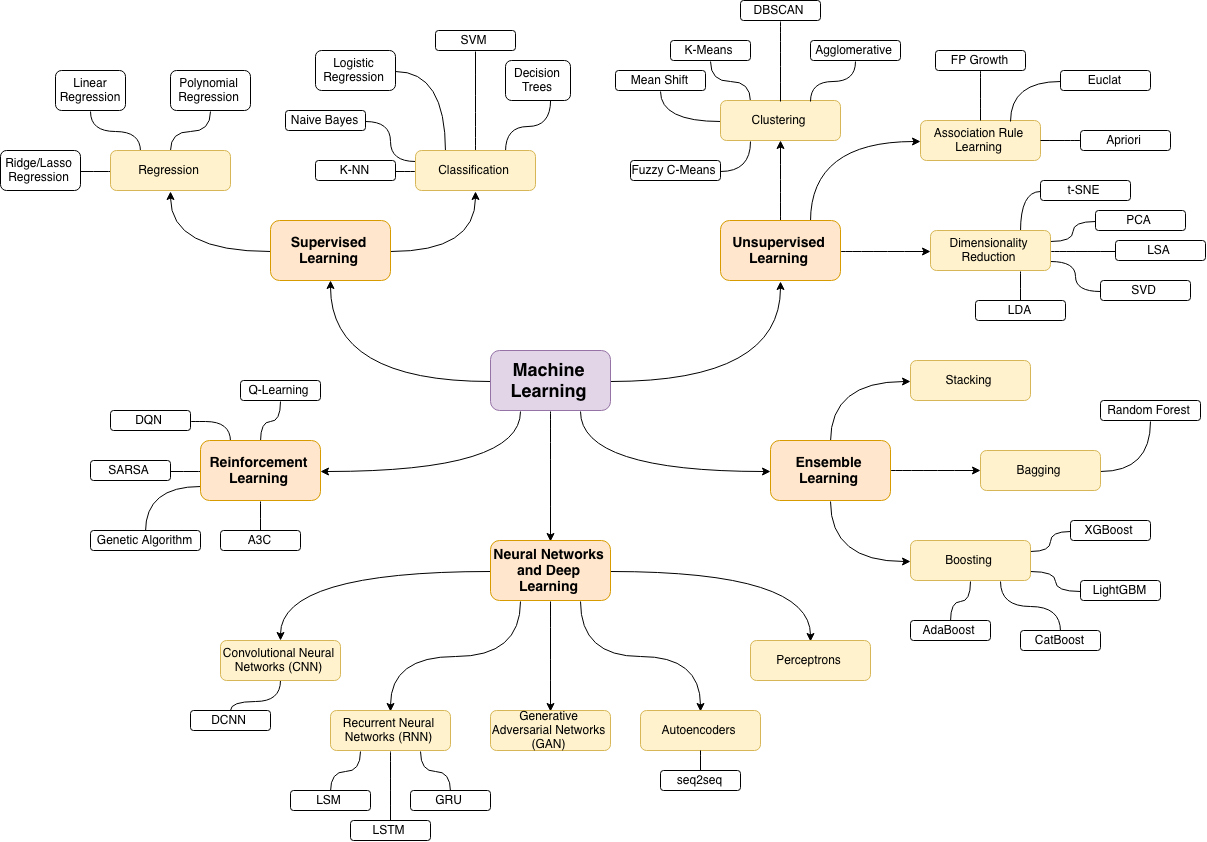
Machine Learning Map
The source of the following machine learning topics map is this wonderful blog post
Prerequisites
Installing Python
Make sure that you have Python installed on your machine.
You might want to use venv standard Python library
to create virtual environments and have Python, pip and all dependent packages to be installed and
served from the local project directory to avoid messing with system wide packages and their
versions.
Installing Dependencies
Install all dependencies that are required for the project by running:
pip install -r requirements.txt
Launching Jupyter Locally
All demos in the project may be run directly in your browser without installing Jupyter locally. But if you want to launch Jupyter Notebook locally you may do it by running the following command from the root folder of the project:
jupyter notebook
After this Jupyter Notebook will be accessible by http://localhost:8888.
Launching Jupyter Remotely
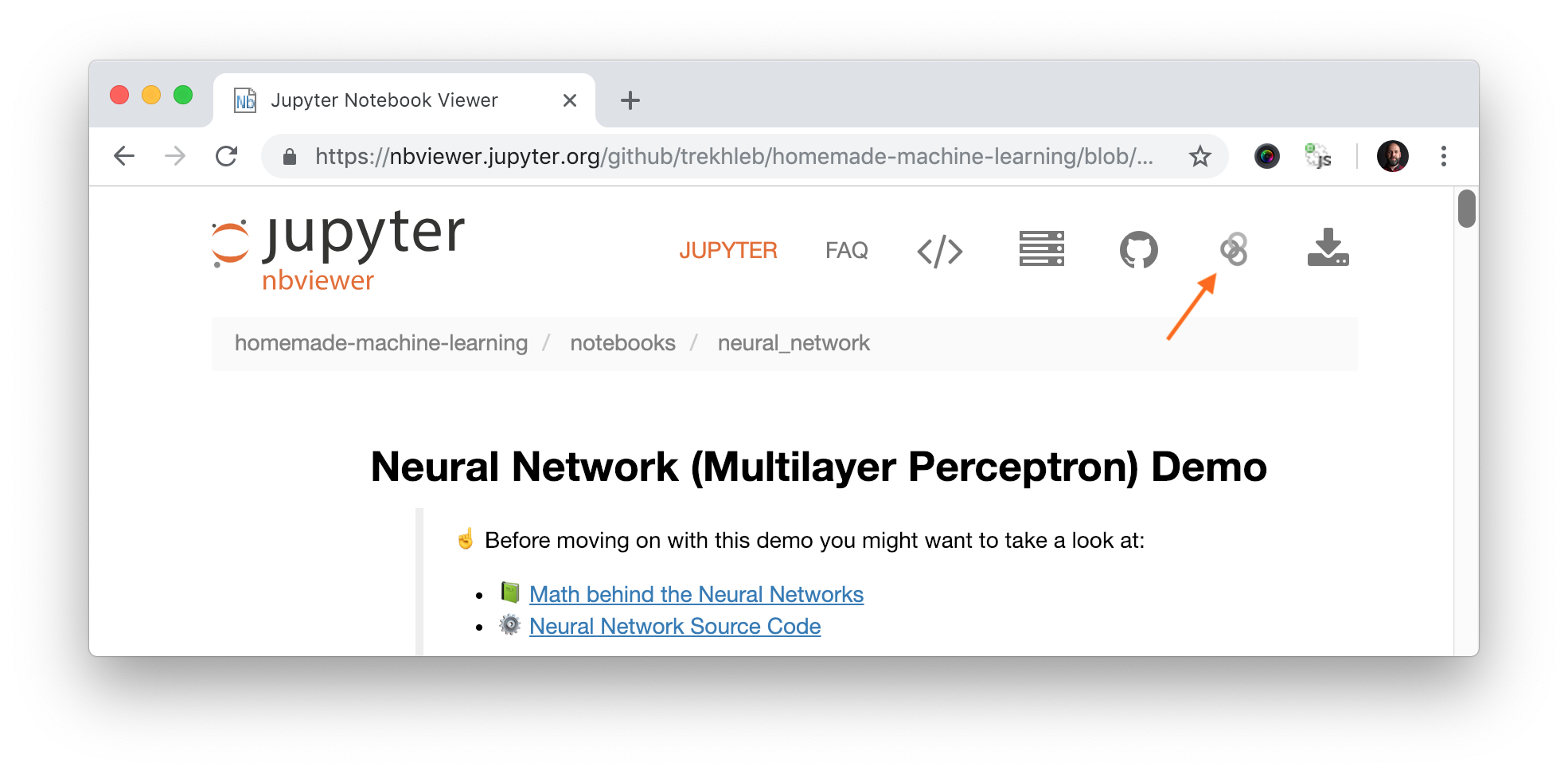
Each algorithm section contains demo links to Jupyter NBViewer. This is fast online previewer for Jupyter notebooks where you may see demo code, charts and data right in your browser without installing anything locally. In case if you want to change the code and experiment with demo notebook you need to launch the notebook in Binder. You may do it by simply clicking the "Execute on Binder" link in top right corner of the NBViewer.
Datasets
The list of datasets that is being used for Jupyter Notebook demos may be found in data folder.
Supporting the project
You may support this project via ❤️️ GitHub or ❤️️ Patreon.
trekhleb/homemade-machine-learning thuộc nhóm Developer Tools trên TopGit, cùng 7 topic GitHub. Trang Trending và Topics liệt kê các repo cùng số sao và cùng ngôn ngữ để so sánh.
Đọc thêm về trekhleb/homemade-machine-learning ở đâu?
Trang TopGit này là một snapshot — tab "Readme" hiển thị nguyên văn README của repo (đã bỏ link, giữ ảnh). Repo GitHub ở github.com/trekhleb/homemade-machine-learning là nguồn chính thức.
trekhleb/homemade-machine-learning có bao nhiêu sao?
trekhleb/homemade-machine-learning có 24.8k sao GitHub — tải lại trang để xem số mới nhất, hoặc xem trực tiếp github.com/trekhleb/homemade-machine-learning. TopGit phản chiếu số sao của GitHub nhưng không cam kết đến từng phút.
trekhleb/homemade-machine-learning có những chủ đề gì?
GitHub topics của trekhleb/homemade-machine-learning: "algorithm", "jupyter", "jupyter-notebook", "machine-learning", "machine-learning-algorithms", "machinelearning", "python". TopGit xếp repo vào nhóm Developer Tools.
trekhleb/homemade-machine-learning còn đang phát triển không?
Commit gần nhất trên trekhleb/homemade-machine-learning là 11 tháng trước (theo timestamp GitHub). Repo có 4.2k fork — một chỉ báo về mức độ quan tâm của cộng đồng.
trekhleb/homemade-machine-learning viết bằng ngôn ngữ gì?
trekhleb/homemade-machine-learning chủ yếu viết bằng Jupyter Notebook. Trường "language" của GitHub dựa trên phần lớn byte ở nhánh mặc định.
Vì sao trekhleb/homemade-machine-learning được xếp vào nhóm Developer Tools?
TopGit xếp trekhleb/homemade-machine-learning vào nhóm Developer Tools dựa trên GitHub topics và mô tả của repo (gắn thẻ: "algorithm", "jupyter", "jupyter-notebook"). Việc phân loại dựa trên metadata thật của repo, không phải đoán theo cảm tính biên tập.
Đọc đầy đủ README ở tab phía trên.
homemade-machine-learning có đáng để bạn bỏ thời gian?
ChatGPT, Claude và Perplexity đều đọc được trang này. Hỏi thử xem họ nghĩ gì về homemade-machine-learning.
 /homemade-machine-learning