AgriciDaniel/claude-obsidian is a open-source project on GitHub. It has 0 stars.
Snapshot summary built from the project's own GitHub metadata — there's no written TopGit review yet. The page will update automatically when a full review is published.
WHY NO REVIEW YET
TopGit writes full reviews for the most-starred, most-requested repositories. This page is a snapshot until then — see the READ ME tab for the original README in full.
Build an Obsidian knowledge base that becomes more useful every time you use it.
Capture sources, create connected notes, retrieve grounded answers, and keep the vault healthy—without giving up ownership of your files.
See the workflow ·
Quick start ·
Explore the skills ·
Installation guide ·
Windows & WSL
claude-obsidian is a local-first knowledge system for Claude Code and compatible
Agent Skills hosts. It turns source material into
linked, source-cited Obsidian pages; answers from the evidence already in the
vault; and provides explicit workflows for research, retrieval, maintenance,
and visual mapping.
Your vault remains a normal directory of Markdown, JSON, and source files. It is
not hidden in a plugin cache, locked in a cloud database, or silently uploaded
to a model.
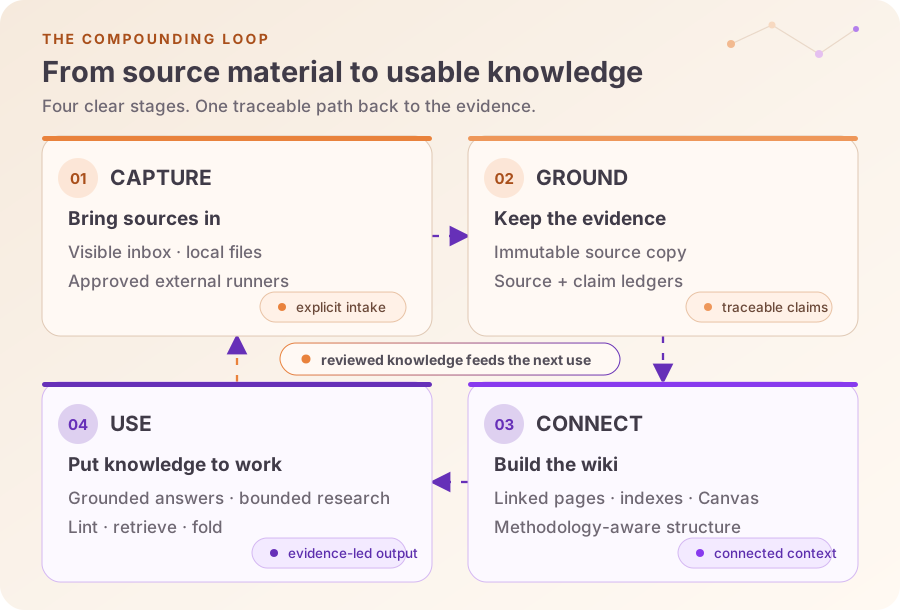
From source to living knowledge
Most AI note workflows stop after saving text. claude-obsidian is organized
around a repeatable loop: retain the source, ground the claims, connect the
knowledge, then put it back to work.
Capture with context. Bring local sources through a visible inbox and
preserve immutable, content-addressed copies before synthesis.
Ground every important claim. Source and claim ledgers retain authority,
freshness, support, contradiction, confidence, and review state.
Connect what you learn. Build linked pages, indexes, Maps of Content,
methodology-aware structures, and Obsidian Canvas views.
Use the vault again. Query, research, retrieve, lint, and fold what is
already known instead of starting every conversation from zero.
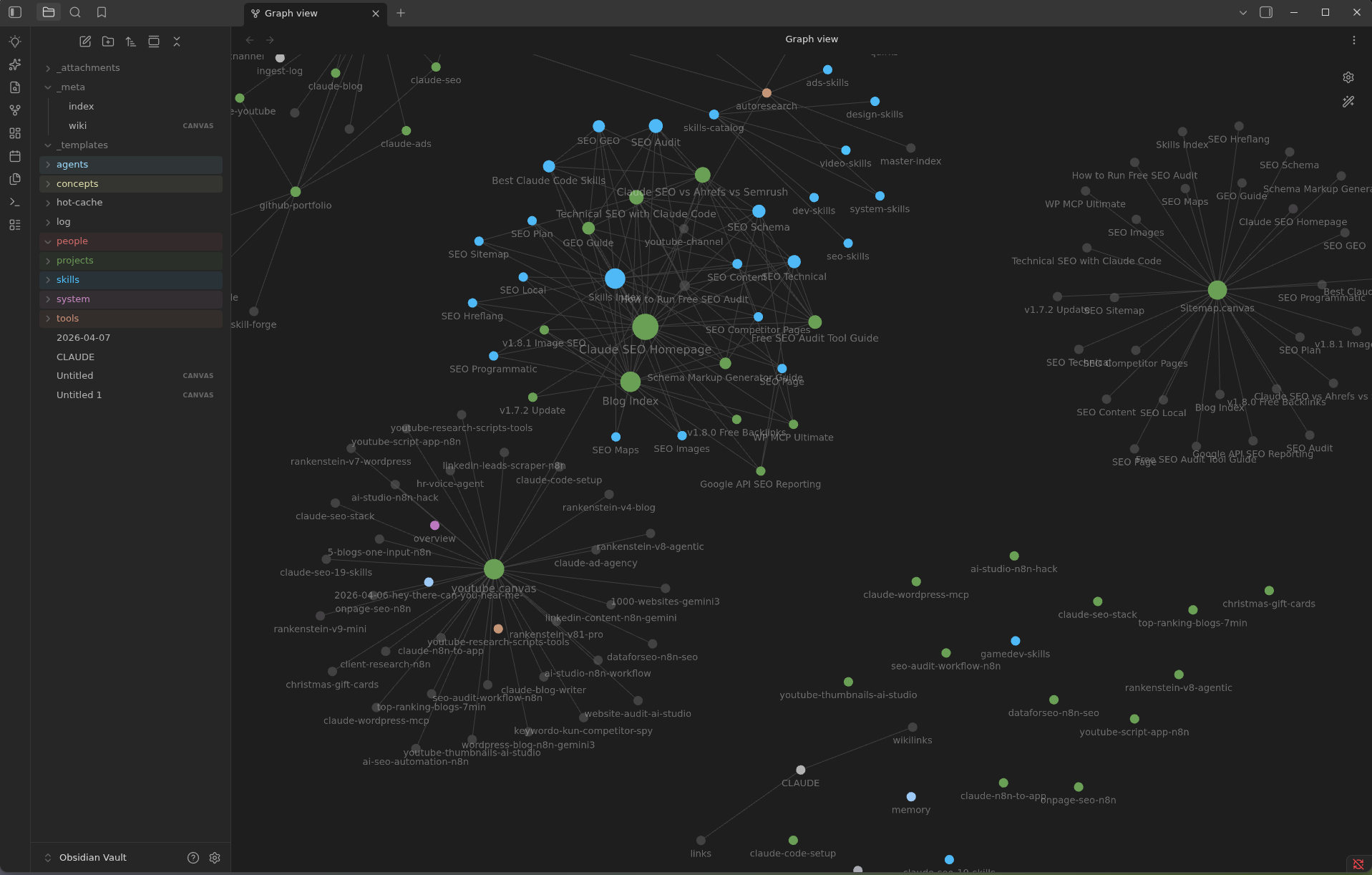
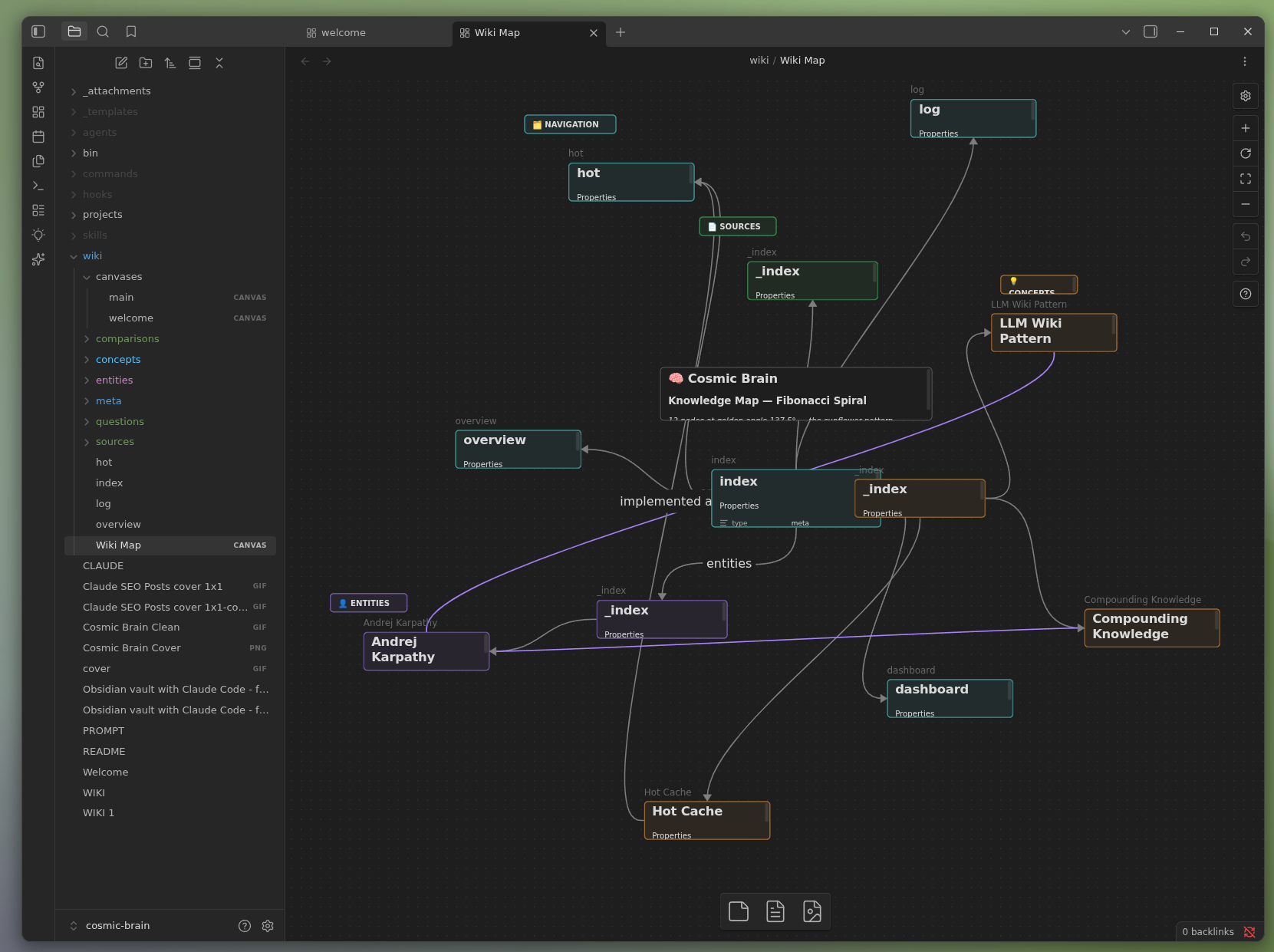
See the vault
The output is meant to remain useful with or without an agent: plain Markdown
for portability, Obsidian for navigation and visual exploration.
Linked knowledge in Graph view · A visual knowledge map in Obsidian Canvas
Why it feels different
Local by default. The vault is user-owned and works as ordinary files.
Network egress is a separate, explicit decision.
Sources survive the summary. Notes point back to durable source evidence;
unsupported and contradictory claims remain visible.
Knowledge compounds deliberately. Ingestion, querying, linting, retrieval,
research, and rollups share one provenance-aware model.
Parallel agents cannot race the vault. Workers return drafts. One
orchestrator inspects and applies one recoverable transaction.
Capabilities are stated honestly. Optional tools are detected, maturity
is declared, and missing adapters degrade clearly instead of being simulated.
This is not an automatic transcript recorder, a cloud sync service, a factual
oracle, or a substitute for backups and source control.
Quick start
The safest first run uses a source checkout and a separate user vault. Every
mutating setup command previews its exact operation before it can apply.
1. Get the product
git clone https://github.com/AgriciDaniel/claude-obsidian.git
cd claude-obsidian
The checkout contains the product. It is not your knowledge vault.
For an existing Obsidian vault, use the non-destructive adopt workflow
described in the installation guide.
3. Start from the vault
Open the new directory in Obsidian, then run Claude Code from that directory
with the local plugin:
cd "$HOME/Documents/MyKnowledgeVault"
claude --plugin-dir /absolute/path/to/claude-obsidian
Start with:
/claude-obsidian:wiki
Then place a source in inbox/ and invoke
/claude-obsidian:wiki-ingest. Save an answer explicitly with
/claude-obsidian:save; ask the vault with /claude-obsidian:wiki-query.
For Codex, OpenCode, or Gemini, preview and then apply the portable skill links
from the product checkout:
Cursor and Windsurf use workspace-local skill discovery. Marketplace setup,
every supported host, vault adoption, upgrades, and uninstall steps are covered
in the full installation guide.
15 skills, one system
The skills are small enough to invoke directly and coordinated enough to share
the same evidence, vault-selection, and mutation rules.
Build and use the wiki
Skill
What it does
wiki
Initializes or adopts a vault, diagnoses readiness, and routes work
save
Saves one scoped answer or insight—never an automatic transcript
wiki-ingest
Turns captured sources into linked pages and provenance records
wiki-query
Answers read-only from relevant vault evidence
wiki-lint
Reports dead links, orphans, metadata gaps, stale indexes, and empty sections
Extend the workflow
Skill
What it adds
autoresearch
Bounded web research with explicit egress and a separate canonical merge
canvas
Wiki-scoped Obsidian Canvas creation and maintenance
defuddle
Clean, readable web content before ingestion
wiki-fold
Extractive, traceable rollups of the operation log
wiki-mode
Generic, LYT, PARA, or Zettelkasten filing conventions
wiki-retrieve
Contextual prefixes, BM25, and optional cosine reranking
wiki-cli
Obsidian CLI reads and search with transaction-safe writes
Reference skills
Skill
What it provides
obsidian-markdown
Correct Obsidian Flavored Markdown, links, embeds, and callouts
obsidian-bases
Native .base tables, cards, filters, formulas, and summaries
think
A structured observe, listen, connect, create, and grow review loop
Claude Code exposes namespaced invocations such as
/claude-obsidian:wiki-lint; other hosts use their native Agent Skills
invocation. Trigger phrases and exact contracts live in each
skills/<name>/SKILL.md.
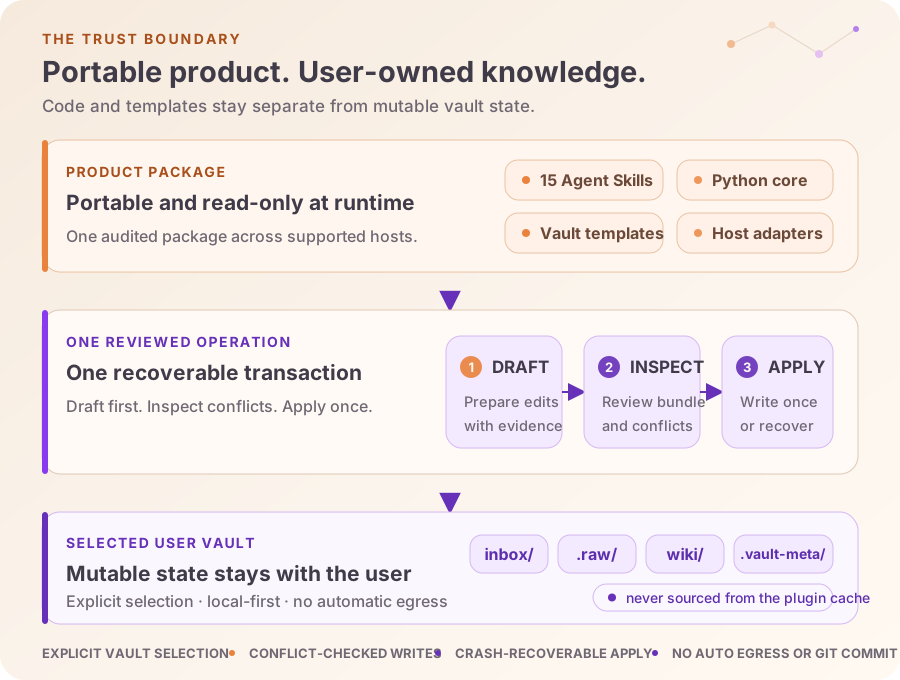
Trust is part of the architecture
The product never treats a source checkout, plugin cache, or contributor state
as the default vault. A vault is selected explicitly, through
CLAUDE_OBSIDIAN_VAULT, by the nearest .claude-obsidian.json, or by one
unambiguous initialized ancestor. If selection is uncertain, the command exits
without writing.
One logical knowledge operation is one recoverable transaction:
Read every target and record its expected SHA-256.
Let parallel workers return drafts and evidence only.
Merge the complete change into one operation bundle.
Inspect the bundle, then apply it once.
Report the operation ID and exact changed paths.
The core holds one process-lifetime vault lock, journals backups, uses atomic
replacement, and restores the prior state if an apply cannot finish. A changed
target is a conflict, never a silent overwrite. Git checkpoints, destructive
repairs, network egress, and canonical research merges remain explicit
operations.
Read the transaction contract,
provenance contract, and
Compound Vault architecture for the
machine-facing detail.
Metadata, hash, size, and bounded dimensions when available
PDF and EPUB
Metadata, hash, and size; no built-in semantic extraction
URL and YouTube
Validated consent plans; a configured external runner is required
OCR
Local-file consent plan; a configured external runner is required
BM25 retrieval
Local and deterministic
Contextual prefixes or remote models
Optional and gated by explicit egress consent
Obsidian CLI
Optional for reads/search; filesystem transport remains available
High-risk accepted claims require two independent sources. Unsupported or
contradictory evidence stays visible, and a grounded refusal is preferred over
an invented citation. Model-based retrieval falls back to deterministic BM25
when the embedding or reranking stage cannot be trusted.
Shape the vault to the way you think
wiki-mode can route new notes using four methodologies without bulk-moving
existing knowledge:
Mode
Filing principle
Generic
Sources, concepts, entities, and sessions
LYT
Maps of Content and linked atomic notes
PARA
Projects, Areas, Resources, and Archives
Zettelkasten
Stable identifiers, atomic notes, and dense links
Generic is the default when no mode is configured. Switching modes changes how
new notes are routed; it does not silently reorganize old ones. See the
methodology modes guide.
Operator reference
Portable CLI
The wrapper is python3 scripts/claude-obsidian.py.
Emit findings deterministic for the declared UTC date
contracts --verify --vault PATH
Execute capability readiness contracts
capture plan --vault PATH [SOURCE ...]
Run a local capture preflight without writes
capture apply --vault PATH [SOURCE ...]
Plan or create immutable content-addressed copies
checkpoint OPERATION_ID --vault PATH
Explicitly commit one completed operation
package validate
Check skills, hooks, manifests, and documentation coherence
release build --output FILE.zip
Build and self-audit a deterministic public artifact
release audit FILE.zip
Audit an artifact without extracting or publishing it
High-level mutating planners emit approved_plan_sha256. Pin
--generated-at and --operation-id, review the JSON operation, and pass that
exact hash with --apply. Filesystem or generated-bundle drift fails before a
vault write.
Public artifacts contain product code, deterministic templates, and reviewed
README assets. They reject contributor hot/log state, root raw sources, runtime
metadata, private paths, recognizable personal email addresses, secrets,
symlinks, unsafe archive entries, and unreviewed binaries.
The private development checkout deliberately has no marketplace catalog. The
release builder injects the reviewed catalog only into the distribution-clean
artifact. A public default branch must be populated from that audited tree,
never by pushing contributor-vault state.
Upgrade, rollback, and uninstall
Upgrade the product independently from the vault. For an older vault, first
preview the additive, idempotent migration:
Review its hash and rerun with --approved-plan-sha256 HASH --apply.
Migration preserves the legacy raw manifest byte-for-byte and does not infer
claims from prose.
Removing the plugin or host links never removes the vault. Delete only the
integration you installed; user notes, sources, ledgers, and Obsidian settings
remain yours.
Requirements
Python 3.11 or newer for the portable core
Obsidian for the visual vault experience; plain Markdown remains usable
without it
Bash for setup, optional extensions, and shell test suites
Git only for development, releases, or an explicit knowledge checkpoint
CI exercises Linux and macOS, plus a native-Windows smoke job for the portable
surface. On native Windows (including Git Bash), read-only inspection and
dry-run commands work; vault writes require WSL and fail closed with an
UNSUPPORTED_PLATFORM error otherwise. Approval hashes bind to the reviewing
environment, so review inside WSL when the apply will happen there. Platform
details, the support matrix, and WSL troubleshooting (including hangs from
virtualization conflicts) live in the
Windows and WSL guide. The bash setup scripts and shell
test suites remain POSIX-only. Optional tools such as Obsidian CLI, Ollama,
and defuddle are capability-detected and affect only their dependent workflow.
Development and release
make test
The test target runs every hermetic Python and shell suite, product and
capability contracts, skill and hook validation, manifest checks, and package
boundaries. CI repeats the suite on supported Linux and macOS/Python
combinations and verifies a byte-reproducible release build.
No command pushes, tags, publishes, opens issues, or creates releases
automatically. See CONTRIBUTING.md,
SECURITY.md, and CODE_OF_CONDUCT.md.
Lineage, license, and attribution
The design follows
Andrej Karpathy's LLM Wiki pattern
and uses kepano/obsidian-skills
as the reference substrate for Obsidian Markdown, Bases, and JSON Canvas
syntax.
MIT licensed. See ATTRIBUTION.md and
CITATION.cff.
Does AgriciDaniel/claude-obsidian have a project website?
No homepage URL was recorded for AgriciDaniel/claude-obsidian in TopGit's last sync. The README tab above frequently contains screenshots and demo links, or check the repository description on GitHub.
Does AgriciDaniel/claude-obsidian have any tags?
TopGit's last sync did not record any GitHub topics for AgriciDaniel/claude-obsidian. GitHub topics appear in the right sidebar of a repository page; that's the authoritative place to check.
How many stars does AgriciDaniel/claude-obsidian have?
AgriciDaniel/claude-obsidian has 0 GitHub stars — refresh the page for the live number, or check github.com/AgriciDaniel/claude-obsidian. TopGit mirrors GitHub's count but does not claim minute-by-minute accuracy.
Is AgriciDaniel/claude-obsidian still maintained?
TopGit's metadata for AgriciDaniel/claude-obsidian does not include a recent push date. Check the commit history on the GitHub repository page for the most authoritative activity timeline.
What language is AgriciDaniel/claude-obsidian written in?
TopGit's last sync did not record a primary language for AgriciDaniel/claude-obsidian. Open the repository on GitHub to see the full breakdown by file extension.
Where do I read more about AgriciDaniel/claude-obsidian?
This TopGit page is a snapshot — the READ ME tab shows the project's own README content (links stripped, images preserved). The GitHub repository at github.com/AgriciDaniel/claude-obsidian is the definitive source.
Read full README in the tab above.
Curious whether claude-obsidian is right for you?
Let ChatGPT, Claude, or Perplexity look into it — click below and see what AI actually says about claude-obsidian.
 /claude-obsidian