An open-source entry in TopGit's GitHub warehouse: alexjc/nanogpt-speedrun, 16 stars, Python. NanoGPT (124M) in 5 minutes
Snapshot summary built from the project's own GitHub metadata — there's no written TopGit review yet. The page will update automatically when a full review is published.
WHY NO REVIEW YET
TopGit writes full reviews for the most-starred, most-requested repositories. This page is a snapshot until then — see the READ ME tab for the original README in full.
This is a modified variant of the PyTorch GPT-2 trainer from
Andrej Karpathy's llm.c repo, which attains the same final validation loss in:
0.9B tokens instead of 10B
4.7 minutes on 8xH100 instead of 45
It uses the following techniques:
Modernized architecture: Rotary embeddings, QK-Norm, and ReLU^2.
New optimizer: Muon - Momentum Orthogonalized by Newton-schulz.
Untied head from embedding.
Projection and classification layers initialized to zero (muP-like).
Architectural shortcuts: value residual and embedding shortcut (partially following https://arxiv.org/abs/2410.17897).
Momentum warmup.
Tanh soft logit capping (following Gemma 2).
FlexAttention with window size warmup.
The training has attained this speed due to the contributions of meself, @Grad62304977,
@jxbz, @bozavlado, @brendanh0gan,
@KoszarskyB, & @fernbear.bsky.social.
Running the current record
To execute the training, run the following three commands.
They should all complete within <20min on an 8xH100 with decent internet connection.
pip install -r requirements.txt
pip install --pre torch --index-url https://download.pytorch.org/whl/nightly/cu124 --upgrade # install torch 2.6.0
python data/cached_fineweb10B.py 10 # downloads only the first 1.0B training tokens to save time
./run.sh
The result will be a transformer with 124M active parameters trained for 1750 steps on 0.9B tokens of Fineweb [1], achieving ~3.278 mean validation loss (w/ up to 0.005 inter-run stddev).
For comparison, the default llm.c PyTorch trainer yields >3.28 validation loss after training for 19560 steps on 10B tokens.
Note: torch.compile will take a while on the first run.
Running it on fewer GPUs or with less memory
To run on fewer GPUs, just modify run.sh to have a different --nproc_per_node.
If you're running out of memory, then go into train_gpt2.py and scale down the device_batch_size to either 16 or 32. (Update 11/19/24: Actually this is impossible now since we're using 64K seqlen with FlexAttention)
Both of these changes will have no effect on the training - you should get the exact same loss curve as the most recent record, because the training code
will automatically adjust the gradient accumulation in order to have the same total batch size.
Running with Docker
For cases where CUDA or NCCL versions aren't compatible with your current system setup, Docker can be a helpful alternative.
This approach standardizes versions for CUDA, NCCL, CUDNN, and Python, reducing dependency issues and simplifying setup.
Note: an NVIDIA driver must already be installed on the system (useful if only the NVIDIA driver and Docker are available).
sudo docker build -t modded-nanogpt .
sudo docker run -it --rm --gpus all -v $(pwd):/modded-nanogpt modded-nanogpt python data/cached_fineweb10B.py 18
sudo docker run -it --rm --gpus all -v $(pwd):/modded-nanogpt modded-nanogpt sh run.sh
World record history
The following is the progression of world records for the task of training a model with 124M active parameters to 3.28 validation loss on FineWeb in the minimal amount of time on an 8xH100 machine.
For the llm.c baseline: The 90 minute time is on 8xA100; it's 45 minutes on 8xH100. This baseline is essentially a hardware-optimized GPT-2-small replication using better training data.
All runs before 11/19/24 can be run with PyTorch 2.5.1 or below. Runs including and after 11/19/24 require PyTorch 2.6.0 (nightly) to use FlexAttention.
For more details on methods & authorship, see the linked post associated with each record.
Notable attempts
An 11/07/24 attempt, which I attempted to cerify on 11/09/24
Notable forks
https://github.com/BlinkDL/modded-nanogpt-rwkv
https://github.com/nikhilvyas/modded-nanogpt-SOAP
Speedrun rules
Must not modify the train or validation data pipelines. (Except to change batch size, seqlen, attention structure etc. I.e., just don't change the order of the tokens.)
Must use ≤ 124M active parameters per token. (So MoE is OK, and the untied embedding matrix only contributes hidden_dim active params.)
Must attain ≤ 3.28 val loss. (A tasteful number would be 3.278, so that the gap exceeds the inter-run variance.)
Other than that, go crazy! Anything is fair game
Q: What is the point of NanoGPT speedrunning?
A: The officially stated goal of NanoGPT speedrunning is as follows: gotta go fast. But for something a little more verbose involving an argument for good benchmarking, here's some kind of manifesto, adorned with a blessing from the master. https://x.com/karpathy/status/1846790537262571739
Q: What makes "NanoGPT speedrunning" not just another idiosyncratic benchmark?
A: Because it is a competitive benchmark. In particular, if you attain a new speed record (using whatever method you want), there is an open invitation for you
to post that record (on arXiv or X) and thereby vacuum up all the clout for yourself. I will even help you do it by reposting you as much as I can.
"Artificial intelligence advances by inventing games and gloating to goad others to play" - Professor Ben Recht
Q: NanoGPT speedrunning is cool and all, but meh it probably won't scale and is just overfitting to val loss
A: This is hard to refute, since "at scale" is an infinite category (what if the methods stop working only for >100T models?), making it impossible to fully prove.
Also, I would agree that some of the methods used in the speedrun are unlikely to scale.
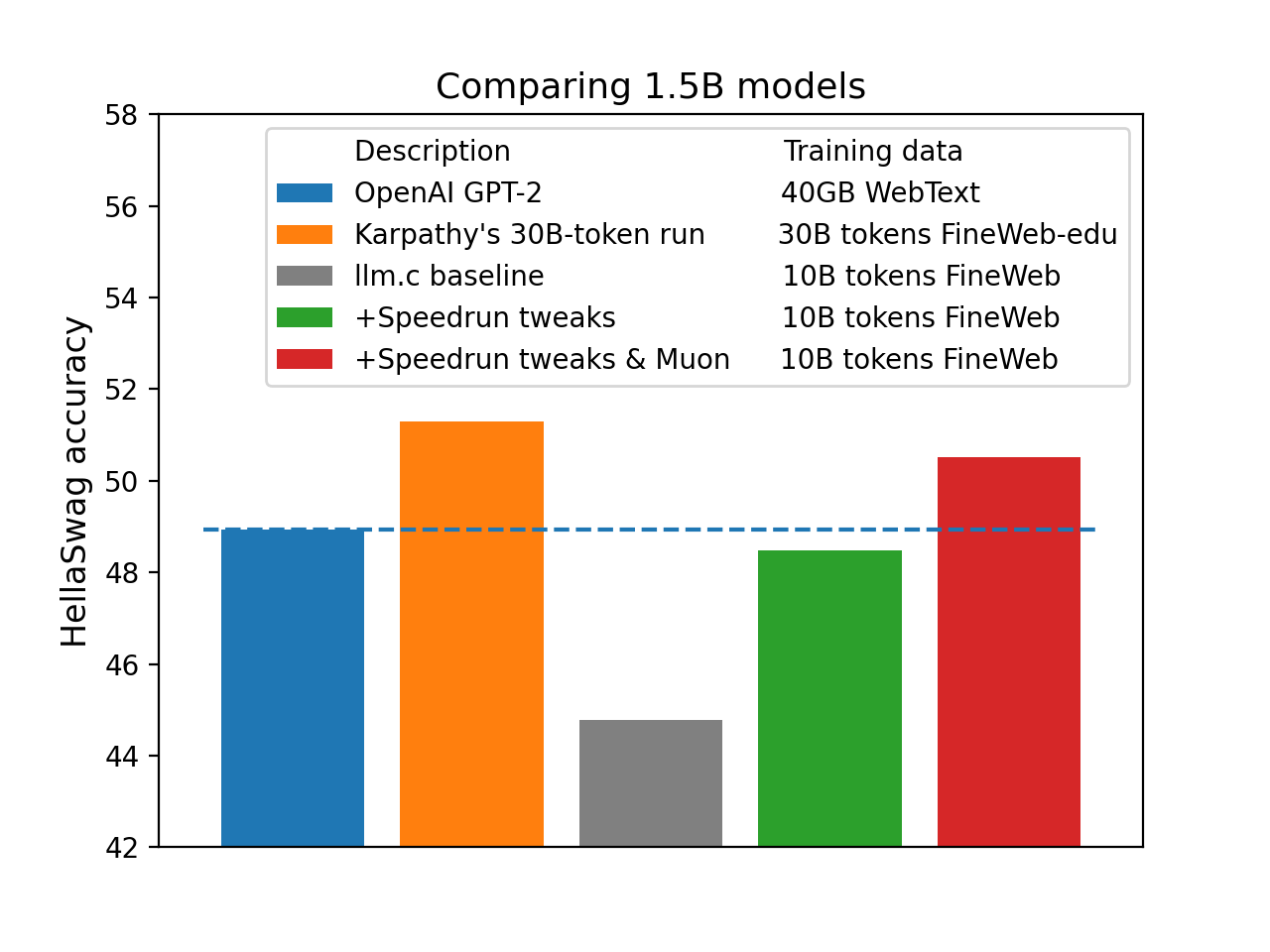
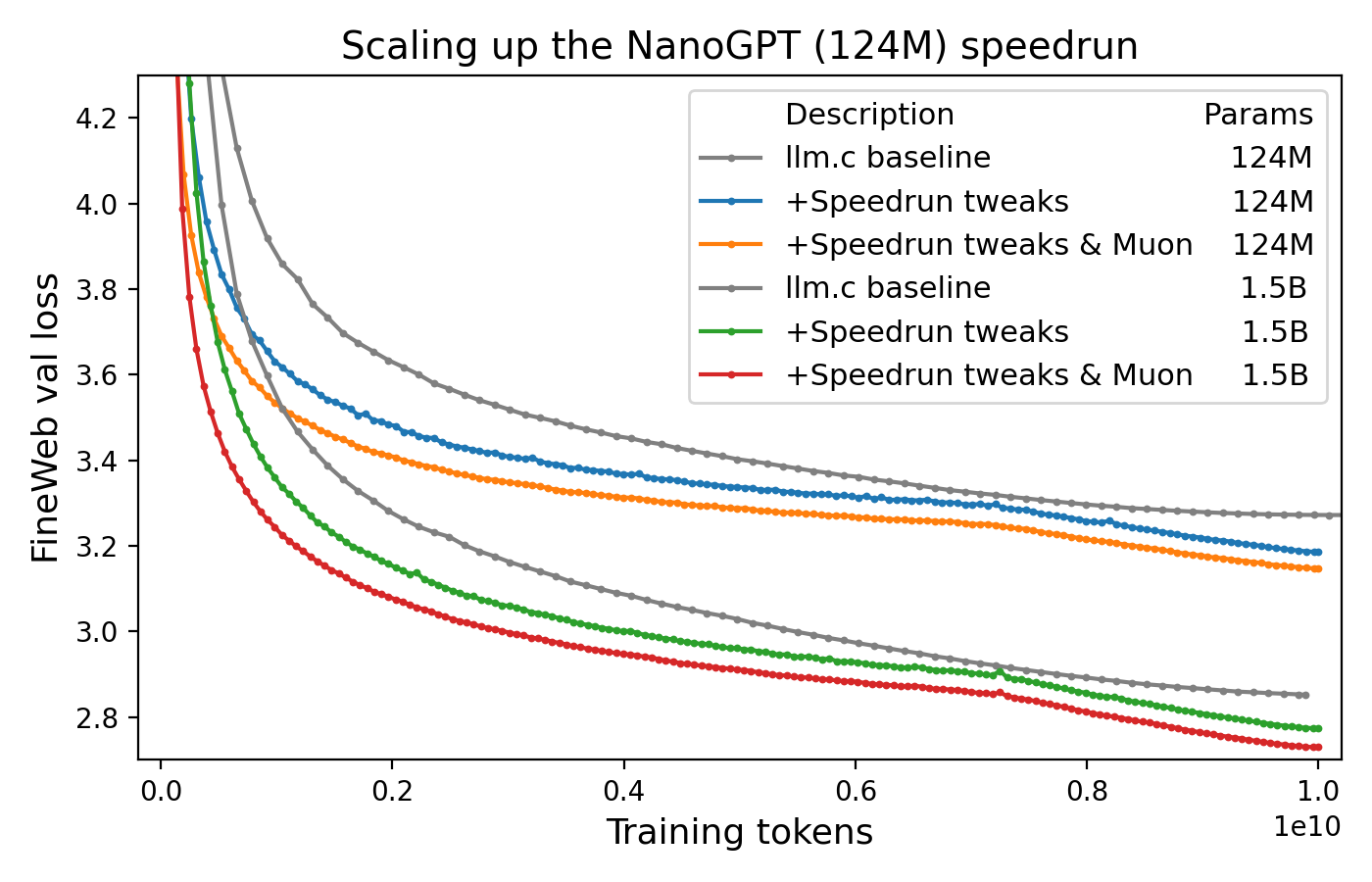
But if the reader cares about 1.5B models, they might be convinced by this result:
Straightforwardly scaling up the speedrun (10/18/24 version) to 1.5B parameters yields a model with GPT-2 (1.5B)-level HellaSwag performance 2.5x more cheaply than @karpathy's baseline ($233 instead of $576):
[reproducible log]
Muon optimizer
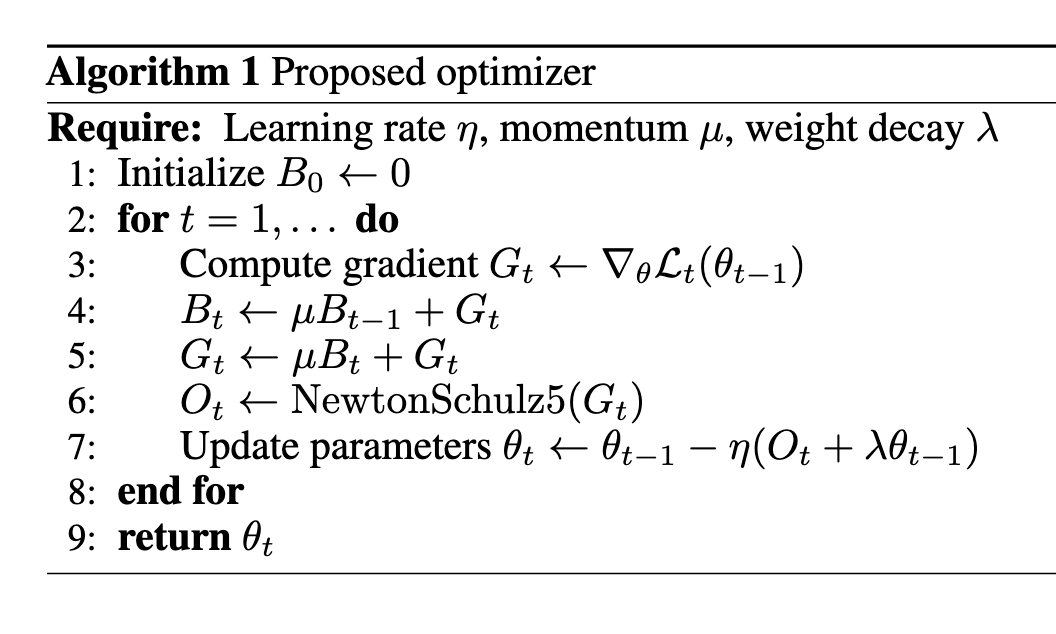
Muon is defined as follows:
Where NewtonSchulz5 is the following Newton-Schulz iteration [2, 3], which approximately replaces G with U @ V.T where U, S, V = G.svd().
@torch.compile
def zeroth_power_via_newtonschulz5(G, steps=5, eps=1e-7):
    assert len(G.shape) == 2
    a, b, c = (3.4445, -4.7750,  2.0315)
    X = G.bfloat16() / (G.norm() + eps)
    if G.size(0) > G.size(1):
        X = X.T
    for _ in range(steps):
        A = X @ X.T
        B = b * A + c * A @ A
        X = a * X + B @ X
    if G.size(0) > G.size(1):
        X = X.T
    return X.to(G.dtype)
For this training scenario, Muon has the following favorable properties:
Lower memory usage than Adam
~1.5x better sample-efficiency
<2% wallclock overhead
Provenance
Many of the choices made to generate this optimizer were obtained experimentally by our pursuit of CIFAR-10 speedrunning.
In particular, we experimentally obtained the following practices:
Using Nesterov momentum inside the update, with orthogonalization applied after momentum.
Using a specifically quintic Newton-Schulz iteration as the method of orthogonalization.
Using non-convergent coefficients for the quintic polynomial in order to maximize slope at zero, and thereby minimize the number of necessary Newton-Schulz iterations.
It turns out that the variance doesn't actually matter that much, so we end up with a quintic that (rapidly) converges to the range 0.68, 1.13 upon repeated application, rather than to 1.
Running the Newton-Schulz iteration in bfloat16 (whereas Shampoo implementations often depend on inverse-pth-roots run in fp32 or fp64).
Our use of a Newton-Schulz iteration for orthogonalization traces to Bernstein & Newhouse (2024),
who suggested it as a way to compute Shampoo [5, 6] preconditioners, and theoretically explored Shampoo without preconditioner accumulation.
In particular, Jeremy Bernstein @jxbz sent us the draft, which caused us to experiment with various Newton-Schulz iterations as the
orthogonalization method for this optimizer.
If we had used SVD instead of a Newton-Schulz iteration, this optimizer would have been too slow to be useful.
Bernstein & Newhouse also pointed out that Shampoo without preconditioner accumulation is equivalent to steepest descent in the spectral norm,
and therefore Shampoo can be thought of as a way to smooth out spectral steepest descent.
The proposed optimizer can be thought of as a second way of smoothing spectral steepest descent, with a different set of memory and runtime tradeoffs
compared to Shampoo.
Startup script
Here's a good startup script for a fresh 8xH100 instance.
Does alexjc/nanogpt-speedrun have a project website?
No homepage URL was recorded for alexjc/nanogpt-speedrun in TopGit's last sync. The README tab above frequently contains screenshots and demo links, or check the repository description on GitHub.
Is alexjc/nanogpt-speedrun open source?
Yes — alexjc/nanogpt-speedrun ships under the MIT license, which makes its source code freely readable (and, depending on license terms, forkable and reusable). Source: github.com/alexjc/nanogpt-speedrun.
What is alexjc/nanogpt-speedrun?
alexjc/nanogpt-speedrun (alexjc/nanogpt-speedrun) is a Python project on GitHub. From the project's own README: NanoGPT (124M) in 5 minutes
What license does alexjc/nanogpt-speedrun use?
alexjc/nanogpt-speedrun is released under the MIT license. Always verify the LICENSE file directly on GitHub for the authoritative terms — license strings can be edited out of sync with a project's actual stance.
Where do I read more about alexjc/nanogpt-speedrun?
This TopGit page is a snapshot — the READ ME tab shows the project's own README content (links stripped, images preserved). The GitHub repository at github.com/alexjc/nanogpt-speedrun is the definitive source.
Read full README in the tab above.
Curious whether nanogpt-speedrun is right for you?
Let ChatGPT, Claude, or Perplexity look into it — click below and see what AI actually says about nanogpt-speedrun.
 /nanogpt-speedrun
 [reproducible log]