aliyun/SimAI

aliyun/SimAI is a Python project with 1.2k stars.
Snapshot summary built from the project's own GitHub metadata — there's no written TopGit review yet. The page will update automatically when a full review is published.
TopGit writes full reviews for the most-starred, most-requested repositories. This page is a snapshot until then — see the READ ME tab for the original README in full.
Snapshot
Top contributors
Show top contributors
中文 | English | 日本語
SimAI


Latest News
Recent Updates
-
[2026/09] SimAI-CLEM -- Support for running large-scale CCL with a small number of GPUs for performance diagnosis and tuning. For detailed instructions on running SimAI-CLEM, please refer to https://github.com/aliyun/SimAI-CLEM. The SimAI-CLEM code is divided into the following two parts:
- The first part is located at https://github.com/aliyun/ns-3-alibabacloud/tree/dev/clem, which contains the incremental development for ns-3.
- The second part is in SimAI-CLEM, which contains the adaptation for CCL to support running large-scale CCL with a small number of GPUs.
-
[2026/08] SimAI 1.7 Released! Key updates:
- SimCCL: Updated to NCCL v2.30, decoupled from the SimAI main repository, and able to generate the flow model standalone for offline analysis.
-
[2026/04] SimAI 1.6 Released! Key updates:
- GPU memory modeling for inference simulation (parameter counting & KV cache).
- Linear interpolation for decode time estimation (replacing nearest-neighbor).
- Prefill-Decode Disaggregation memory planning (independent budgets for Prefill/Decode).
-
[2025/12] SimAI 1.5 Released! This release brings end-to-end simulation for multi-request inference workloads. Key features include:
- Advanced Inference Simulation: Model complex scenarios with Prefill/Decode separation.
- Modern Model Support: Now includes DeepSeek, Qwen3Moe and Qwen3Next. See AICB's README for more detailed information.
- Request Scheduling: Request scheduling is now handled by a component adapted from Microsoft's Vidur. See Vidur-Alibabacloud's README for more detailed information.
-
[2025/11] AICB now supports generating prefill/decode inference workloads for DeepSeek, Qwen3-MoE and Qwen3-Next.
-
[2025/09] AICB now supports generating training workloads for DeepSeek. Thanks to @parthpower for this contribution.
-
[2025/06] The code of SimCCL is first released in the branch SimCCL and will be released in SimCCL repository soon.
We warmly welcome contributions from the community! If you are interested in helping shape the future of SimAI, please feel free to open an issue to discuss your ideas or submit a pull request.
📅 Upcoming Events
| Date | Event | Location | Content | Type |
|---|---|---|---|---|
| -- |
🌟 Past Events
| Date | Event | Location | Content | Type |
|---|---|---|---|---|
| Aug 14, 2026 | SimAI 1.7 | 🌐 Online | The release of SimAI 1.7 | 💻 Virtual |
| Apr 23, 2026 | SimAI 1.6 | 🌐 Online | The release of SimAI 1.6 | 💻 Virtual |
| Dec 30, 2025 | SimAI 1.5 | 🌐 Online | The release of SimAI 1.5 | 💻 Virtual |
| Jun 4, 2025 | The first workshop of the SimAI community | 📍 Peking University | Three talks from community contributors | 🎓 On-site |
| May 24, 2025 | The 28th Chinasys workshop | 📍 Chongqing University | An invited talk about SimAI | 🎓 On-site |
| Dec 27, 2024 | SimAI Technical Presentation | 📍 Beihang University | SimAI Technical Sharing & Discussion | 🎓 On-site |
| Dec 6, 2024 | HKUST Technical Workshop | 📍 HKUST(GZ) | SimAI Technical Sharing & Discussion | 🎓 On-site |
| Dec 5, 2024 | Bench'24 Conference | 📍 Guangzhou | SimAI Tutorial & Deep-dive Session | 🎓 On-site |
| Nov 26, 2024 | SimAI Community Live Stream | 🌐 Online | Interactive Technical Discussion & Demo (400+ Attendees) | 💻 Virtual |
| Nov 15, 2024 | Technical Workshop | 📍 Thousand Island Lake | SimAI Offline Technical Exchange | 🎯 On-site |
| Oct 18, 2024 | Guest Lecture | 📍 Fudan University | SimAI Tutorial & Public Course | 🎓 On-site |
| Sept 24-26, 2024 | CCF HPC China 2024 | 📍 Wuhan | SimAI Introduction & Technical Presentation | 🎤 Conference |
Documentation
See Tutorial for full documentation.
Table of Contents
- SimAI Overview
- Introduction
- Components
- Scenario
- Citation
- Quick Start
- Setup
- Use SimAI-Analytical
- Use SimAI-Simulation
- Use SimCCL
- Use Multi-requests Inference Simulation
SimAI Overview
Introduction
SimAI is the industry's first full-stack, high-precision Simulator for AI large-scale inference and training. It provides detailed modeling and simulation of the entire LLM training process, encompassing framework, collective communication, network layers, and more. This comprehensive approach offers end-to-end performance data, enabling researchers to:
- Analyze inference/training process details
- Evaluate the time consumption of AI tasks under specific conditions
- Evaluate E2E performance gains from various algorithmic optimizations including:
- Framework parameters settings
- Collective communication algorithms
- NCCL environment variables
- Network transmission protocols
- Congestion control algorithms
- Adaptive routing algorithms
- Scale-up/out network topology modifications
- ...
Components
        |--- AICB
SimAI --|--- SimCCL
        |--- astra-sim-alibabacloud
        |--- ns-3-alibabacloud
        |--- vidur-alibabacloud
Building on pure simulation capabilities, SimAI has evolved into a versatile full-stack toolkit comprising four components (aicb, SimCCL, astra-sim-alibabacloud, ns-3-alibabacloud). These components can be combined in various ways to achieve different functionalities. Below, we present the main usage scenarios for SimAI. We encourage users to explore even more possibilities with this powerful tool.
Below is the architecture diagram of the SimAI Simulator:
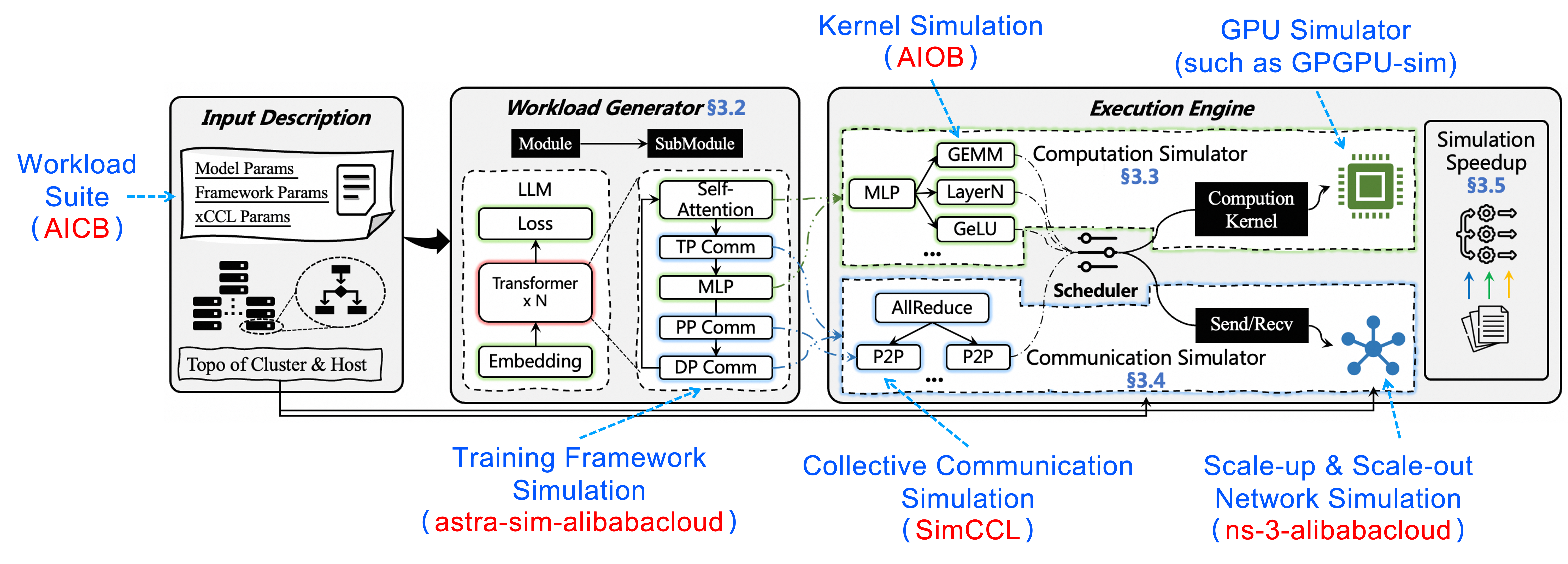
astra-sim-alibabacloud is extended from astra-sim. We are grateful to the astra-sim team for their excellent work and open-source contribution. We have integrated NCCL algorithms and added some new features.
Scenario
SimAI supports three major operation modes to meet different simulation requirements:
SimAI-Analytical offers fast simulation by abstracting network communication details using bus bandwidth (busbw) to estimate collective communication time. The current open-source binary computes busbw automatically from -nv/-nic/-n_p_s (the default, shown below). Note: the user-defined busbw.yaml path (-busbw) is not wired in the current open-source analytical binary; refer to earlier SimAI versions for that workflow.
SimAI-Simulation provides full-stack simulation with fine-grained network communication modeling. It leverages NS3 or other network simulators (NS3 currently open-sourced) to achieve detailed simulation of all communication behaviors, aiming for high-fidelity reproduction of actual training environments.
SimAI-Physical (Beta) enables physical traffic generation for CPU RDMA cluster environments. This mode generates NCCL-like traffic patterns, allowing in-depth study of NIC behaviors during LLM training. It is currently in internal testing phase.
| Scenario | Description | Component Combination |
|---|---|---|
| 1. AICB Test Suite | Run communication patterns on GPU clusters using AICB Test suite | AICB |
| 2. AICB/AIOB Workload | Model compute/communication patterns of inference/training process to generate workload | AICB |
| 3. Collective Comm Analyze | Break down collective communication operations into point-to-point communication sets | SimCCL |
| 4. Collective Comm w/o GPU | Perform RDMA collective communication traffic on non-GPU clusters | AICB + SimCCL + astra-sim-alibabacloud(physical) |
| 5. SimAI-Analytical | Conduct rapid AICB workload analysis and simulation on any server (ignoring underlying network details) | AICB + astra-sim-alibabacloud(analytical) |
| 6. SimAI-Simulation | Perform full simulation on any server | AICB + SimCCL + astra-sim-alibabacloud(simulation) + ns-3-alibabacloud |
| 7. Multi-requests Inference Simulation | Perform full multi-requests inference simulation using one GPU server | AICB + SimCCL + vidur-alibabacloud + astra-sim-alibabacloud(analytical/simulation) |
Citation
SimAI work has been accepted by NSDI'25 Spring, for more details, please refer to our paper below:
SimAI: Unifying Architecture Design and Performance Tuning for Large-Scale Large Language Model Training with Scalability and Precision.
[pdf] / [slides] / [video]
We encourage innovative research and extensions based on SimAI. Welcome to join our community group or reach out via email for discussion. We may provide technical support.
Quick Start
Here are some simple examples. SimAI full tutorials can be found here: SimAI@Tutorial, aicb@Tutorial, SimCCL@Tutorial, ns-3-alibabacloud@Tutorial
Setup
You can follow the instructions below to quickly set up the environments and run SimAI.
From Source Code
The following code has been successfully tested on GCC/G++ 9.4.0, python 3.8.10 in Ubuntu 20.04.
You can use the official Ubuntu 20.04 image, and do not install ninja.
(For generation workloads, it's recommended to leverage NGC container images directly.)
# Clone the repository
$ git clone https://github.com/aliyun/SimAI.git
$ cd ./SimAI/

# Clone submodules
$ git submodule update --init --recursive
# Make sure use the newest commit
$ git submodule update --remote

# Compile SimAI-Analytical
$ ./scripts/build.sh -c analytical

# Compile SimAI-Simulation (ns3)
$ ./scripts/build.sh -c ns3
Use SimAI-Analytical
By default, SimAI-Analytical calculates bus bandwidth automatically:
$ ./bin/SimAI_analytical -w ./example/workload_analytical.txt -g 9216 -nv 360 -nic 48.5 -n_p_s 8 -g_p_s 8 -r example-
Note: The
-busbw example/busbw.yaml(user-defined busbw) command below is not supported by the current open-source analytical binary — the-busbwflag is not parsed, so the command prints usage and exits. It is kept here for reference; see earlier SimAI versions for the manualbusbw.yamlworkflow.
$ ./bin/SimAI_analytical -w example/workload_analytical.txt -g 9216 -g_p_s 8 -r test- -busbw example/busbw.yaml
Use SimAI-Simulation
# Create network topo
$ python3 ./astra-sim-alibabacloud/inputs/topo/gen_Topo_Template.py -topo Spectrum-X -g 128 -gt A100 -bw 100Gbps -nvbw 2400Gbps

# Running
$ AS_SEND_LAT=3 AS_NVLS_ENABLE=1 ./bin/SimAI_simulator -t 16 -w ./example/microAllReduce.txt -n ./Spectrum-X_128g_8gps_100Gbps_A100 -c astra-sim-alibabacloud/inputs/config/SimAI.conf
Use SimCCL
SimCCL can be used independently to analyze collective communication flow decomposition without running full network simulation:
# Build SimCCL standalone binary
$ cd SimCCL/standalone
$ bash build.sh v2.30

# Single collective operation analysis
$ ./build/simccl-standalone --op AllReduce --size 4194304 \
    --nRanks 8 --nNodes 1 --gpus_per_node 8 --gpu_type H20

# Workload file mode
$ ./build/simccl-standalone -w ../../example/microAllReduce.txt \
    --nRanks 16 --nNodes 2 --gpus_per_node 8 --gpu_type H20
Output: ncclFlowModel_detailed_flows.csv — point-to-point flow decomposition of collective operations.
For detailed documentation, see SimCCL README.
Use Multi-requests Inference Simulation
For detailed information, please refer to the README file in the vidur-alibabacloud directory. This module leverages AICB to profile the computation time of inference workloads. Due to its reliance on specific hardware-accelerated libraries like DeepGEMM and FlashMLA, it is exclusively compatible with NVIDIA GPUs based on the Hopper (SM90) and Blackwell (SM100) architectures.
# Build from Dockerfile
docker build -t image:latest .
docker run --gpus all -it --rm image:latest
Note: Please add ENV FLASH_MLA_DISABLE_SM100=1 to Dockerfile if using Hopper GPUs.
To quickly validate all supported inference scenarios (Qwen3-Next-80B, DeepSeek-671B, Qwen3-MoE-235B), use the bundled 4-scenario test suite:
# Prerequisites: conda activate vidur
bash vidur-alibabacloud/examples/vidur-ali-scenarios/run_scenarios.sh --all
# Or run a single scenario:
bash vidur-alibabacloud/examples/vidur-ali-scenarios/run_scenarios.sh --scenario 1
Prerequisites: Requires
conda activate vidurenvironment. See Environment Setup for details.For detailed scenario configuration table and output file descriptions, see Vidur-AlibabaCloud README.
Acknowledgments
A huge thanks to the following people and organizations who have contributed to this project:
- TianHao Fu (Peking University) and TELOS-syslab
- Parth Parikh (KEYSIGHT)
- Sarah-Michelle Hammer & Ziyi Wang (TU-Berlin)
- Xinyue Li (BUPT)
- Tong Chen (Zhejiang University)
- Ming Wang (BUPT)
- Tao Jiang (Institute of Computing Technology, Chinese Academy of Sciences)
...and many other individual contributors from the community (See the Contributors to aliyun/SimAI).
We also thank Chenning Li (MIT CSAIL) who initiated the cooperation on integrating SimAI into M4, a new, innovative simulator.
This project still welcomes more contributions and suggestions.
Contributing
We welcome all contributions! Please read the following guides before getting started:
| Contributing Guide | How to submit issues and pull requests |
| Security Policy | How to report security vulnerabilities |
| Code of Conduct | Our community standards |
| Changelog | Version history from v1.5 onwards |
Contact us
Please email Gang Lu ([email protected]), Feiyang Xue ([email protected]) or Qingxu Li ([email protected]) if you have any questions.
Welcome to join the SimAI community chat groups, with the DingTalk group on the left and the WeChat group on the right.


Related repositories
Master programming by recreating your favorite technologies from scratch.
A curated meta-list of curated lists organized by technology domain. The repository acts as a directory pointing to hundreds of specialized awesome lists covering programming languages, platforms, frameworks, and tooling. All content is community-contributed under the CC0 public domain dedication.
Public APIs is a community-curated GitHub repository listing free, publicly accessible APIs across a wide range of categories, with auth type, HTTPS, and CORS noted for each entry. It's a browsable reference, not a library to install.
freeCodeCamp is a free, self-paced curriculum for learning to code, published as open source at freeCodeCamp/freeCodeCamp. It's a 501(c)(3) nonprofit funded by donor support, structured around six certifications in its Full-Stack Developer Curriculum, each gated by required projects instead of open-book quizzes. The repository also carries beta language certifications for developers, interview-prep resources, and the code that runs the live freecodecamp.org platform.
Quick answers
How active is development on aliyun/SimAI?
The most recent commit recorded on aliyun/SimAI was 1 month ago, based on the GitHub push timestamp. The repository has 190 forks — one of the better signals of community interest.
How many stars does aliyun/SimAI have?
aliyun/SimAI has 1.2k GitHub stars — refresh the page for the live number, or check github.com/aliyun/SimAI. TopGit mirrors GitHub's count but does not claim minute-by-minute accuracy.
Is aliyun/SimAI open source?
Yes — aliyun/SimAI ships under the Apache-2.0 license, which makes its source code freely readable (and, depending on license terms, forkable and reusable). Source: github.com/aliyun/SimAI.
What is aliyun/SimAI?
aliyun/SimAI (aliyun/SimAI) is a Python project tracked by TopGit. The repository has 1.2k GitHub stars at the time of our last sync.
Where do I read more about aliyun/SimAI?
This TopGit page is a snapshot — the READ ME tab shows the project's own README content (links stripped, images preserved). The GitHub repository at github.com/aliyun/SimAI is the definitive source.
Read full README in the tab above.
Is SimAI worth your time?
ChatGPT, Claude and Perplexity can all read this page. Ask one of them what it makes of SimAI.