Snapshot of automl/NASLib: 596★, Python. NASLib is a Neural Architecture Search (NAS) library for facilitating NAS research for the community by providing interfaces to several state-of-the-art NAS search spaces and optimizers.
Snapshot summary built from the project's own GitHub metadata — there's no written TopGit review yet. The page will update automatically when a full review is published.
WHY NO REVIEW YET
TopGit writes full reviews for the most-starred, most-requested repositories. This page is a snapshot until then — see the READ ME tab for the original README in full.
** For the Zero-Cost NAS Competition, please switch to the automl-conf-competition branch **
NASLib is a modular and flexible framework created with the aim of providing a common codebase to the community to facilitate research on Neural Architecture Search (NAS). It offers high-level abstractions for designing and reusing search spaces, interfaces to benchmarks and evaluation pipelines, enabling the implementation and extension of state-of-the-art NAS methods with a few lines of code. The modularized nature of NASLib
allows researchers to easily innovate on individual components (e.g., define a new
search space while reusing an optimizer and evaluation pipeline, or propose a new
optimizer with existing search spaces). It is designed to be modular, extensible and easy to use.
NASLib was developed by the AutoML Freiburg group and with the help of the NAS community, we are constantly adding new search spaces, optimizers and benchmarks to the library. Please reach out to [email protected] for any questions or potential collaborations.
Setup
| Usage
| Docs
| Contributing
| Cite
Setup
While installing the repository, creating a new conda environment is recomended. Install PyTorch GPU/CPU for your setup.
The test coverage can be seen with coverage report.
Queryable Benchmarks
NASLib allows you to query the following (tabular and surrogate) benchmarks for the performance of any architecture, for a given search space, dataset and task. To set them up, simply download the benchmark data files from the these URLs and place them in naslib/data.
search_space = SimpleCellSearchSpace()

optimizer = DARTSOptimizer(**config.search)
optimizer.adapt_search_space(search_space, config.dataset)

trainer = Trainer(optimizer, config)
trainer.search()        # Search for an architecture
trainer.evaluate()      # Evaluate the best architecture
For more examples see naslib tutorial, intro to search spaces and intro to predictors.
Scripts for running multiple experiments on a cluster
The scripts folder contains code for generating config files for running experiments across various configurations and seeds. It writes them into the naslib/configs folder.
cd scripts
bash bbo/make_configs_asr.sh
It also contains scheduler.sh files to automatically read these generated config files and submits a corresponding job to the cluster using SLURM.
Contributing
We welcome contributions to the library along with any potential issues or suggestions. Please create a pull request to the Develop branch.
Cite
If you use this code in your own work, please use the following bibtex entries:
@misc{naslib-2020,
  title={NASLib: A Modular and Flexible Neural Architecture Search Library},
  author={Ruchte, Michael and Zela, Arber and Siems, Julien and Grabocka, Josif and Hutter, Frank},
  year={2020}, publisher={GitHub},
  howpublished={\url{https://github.com/automl/NASLib}} }

@inproceedings{mehta2022bench,
  title={NAS-Bench-Suite: NAS Evaluation is (Now) Surprisingly Easy},
  author={Mehta, Yash and White, Colin and Zela, Arber and Krishnakumar, Arjun and Zabergja, Guri and Moradian, Shakiba and Safari, Mahmoud and Yu, Kaicheng and Hutter, Frank},
  booktitle={International Conference on Learning Representations},
  year={2022}
}
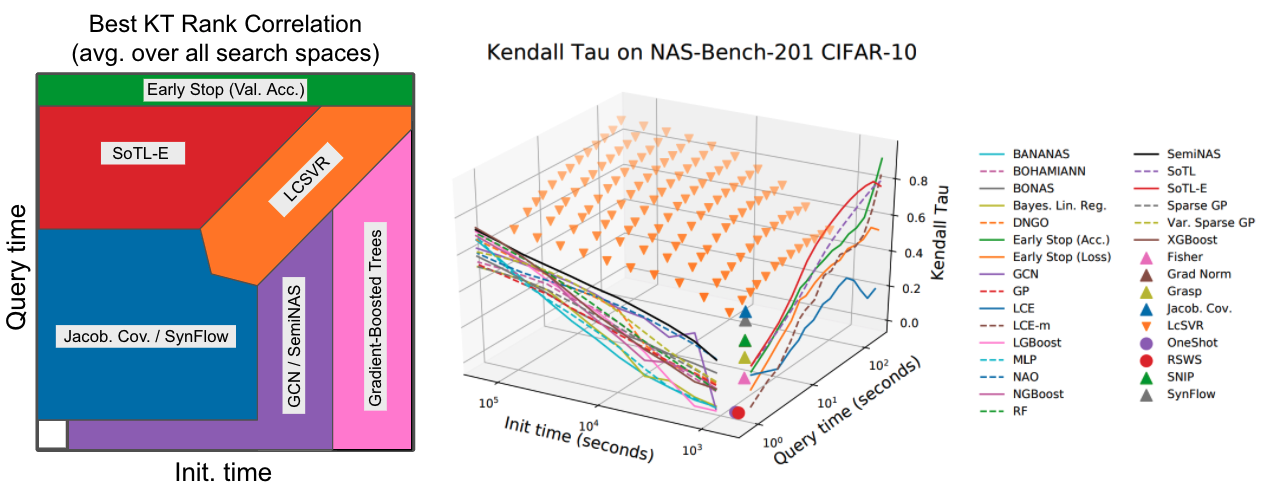
NASLib has been used to run an extensive comparison of 31 performance predictors (figure above). See the separate readme: predictors.md
and our paper: How Powerful are Performance Predictors in Neural Architecture Search?
@article{white2021powerful,
  title={How Powerful are Performance Predictors in Neural Architecture Search?},
  author={White, Colin and Zela, Arber and Ru, Robin and Liu, Yang and Hutter, Frank},
  journal={Advances in Neural Information Processing Systems},
  volume={34},
  year={2021}
}
The most recent commit recorded on automl/NASLib was 2.0 years ago, based on the GitHub push timestamp. The repository has 133 forks — one of the better signals of community interest.
How many stars does automl/NASLib have?
automl/NASLib has 596 GitHub stars — refresh the page for the live number, or check github.com/automl/NASLib. TopGit mirrors GitHub's count but does not claim minute-by-minute accuracy.
What is automl/NASLib?
automl/NASLib (automl/NASLib) is a Python project on GitHub. From the project's own README: NASLib is a Neural Architecture Search (NAS) library for facilitating NAS research for the community by providing interfaces to several state-of-the-art NAS search spaces and optimizers.
What language is automl/NASLib written in?
automl/NASLib is written primarily in Python. GitHub's language field is based on the largest share of bytes in the default branch.
What topics is automl/NASLib associated with?
GitHub's repository topics for automl/NASLib: "automl", "nas", "neural-architecture-search". TopGit's editorial category is open-source.
Read full README in the tab above.
Is NASLib worth your time?
ChatGPT, Claude and Perplexity can all read this page. Ask one of them what it makes of NASLib.

 /NASLib