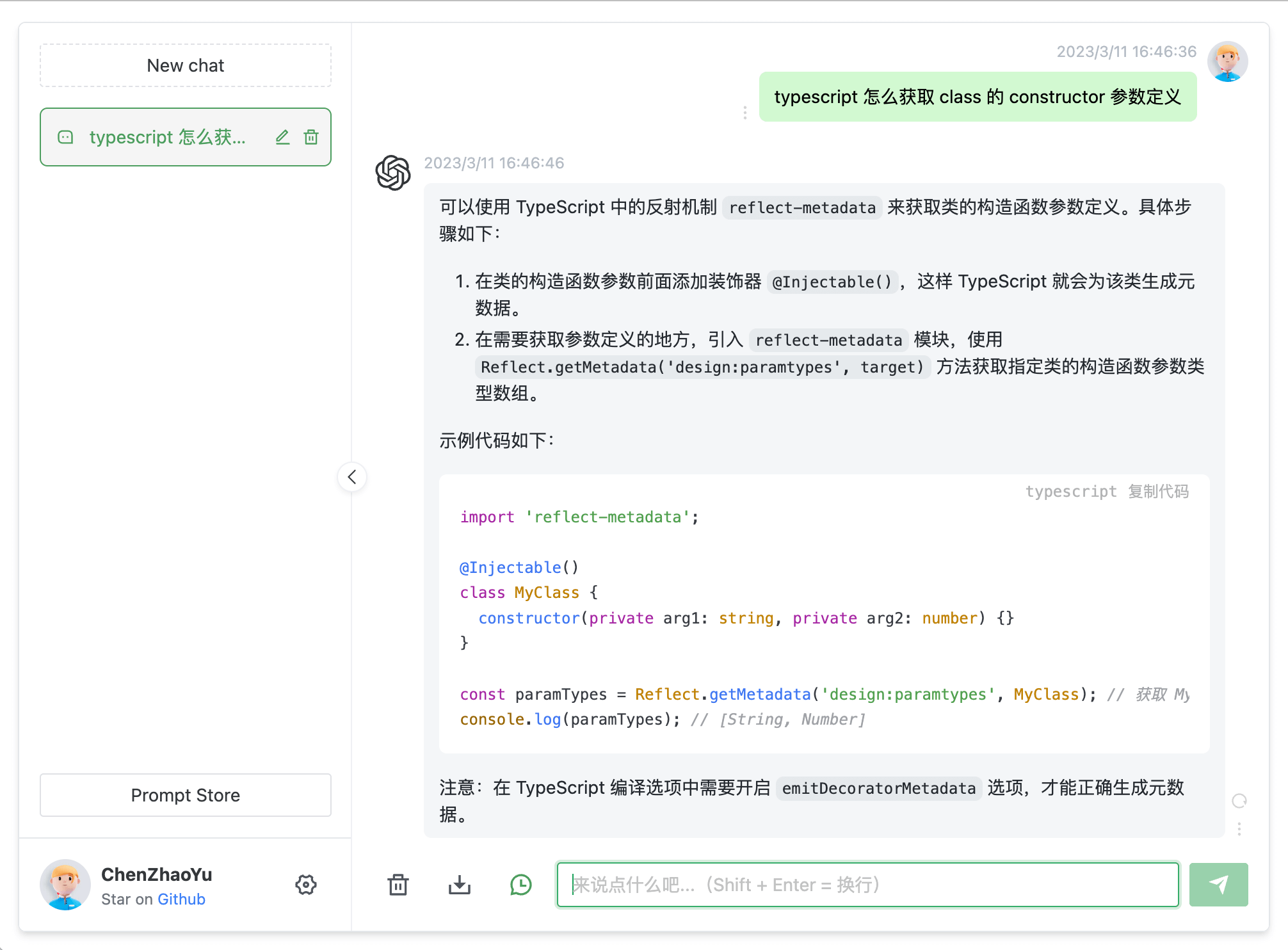
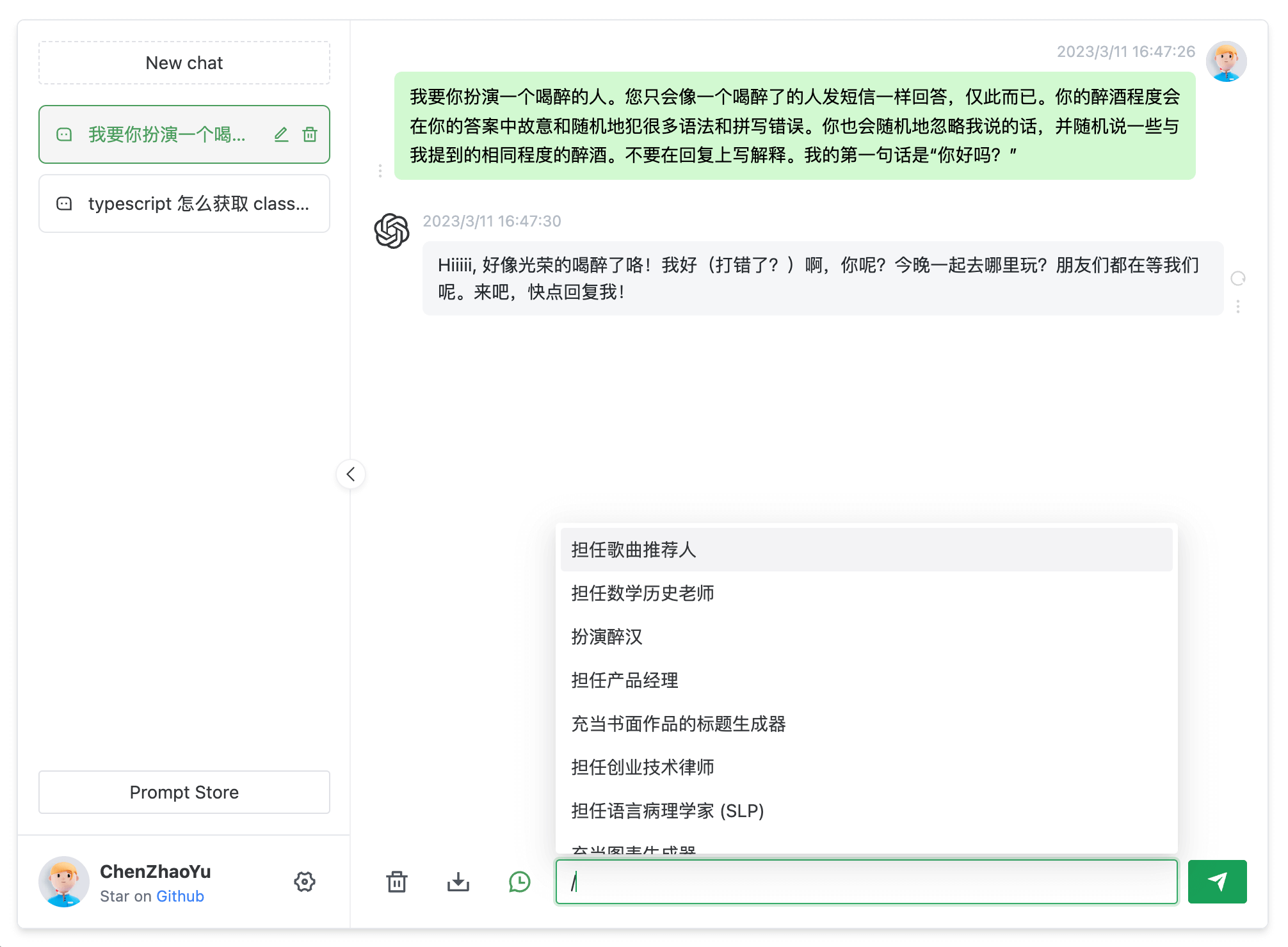
Snapshot summary built from the project's own GitHub metadata — there's no written TopGit review yet. The page will update automatically when a full review is published.
WHY NO REVIEW YET
TopGit writes full reviews for the most-starred, most-requested repositories. This page is a snapshot until then — see the READ ME tab for the original README in full.
Disclaimer: This project is only published on GitHub, based on the MIT license, free and for open source learning usage. And there will be no any form of account selling, paid service, discussion group, discussion group and other behaviors. Beware of being deceived.
中文
ChatGPT Web
Introduction
Roadmap
Prerequisites
Node
PNPM
Filling in the Key
Install Dependencies
Backend
Frontend
Run in Test Environment
Backend Service
Frontend Webpage
Environment Variables
Packaging
Use Docker
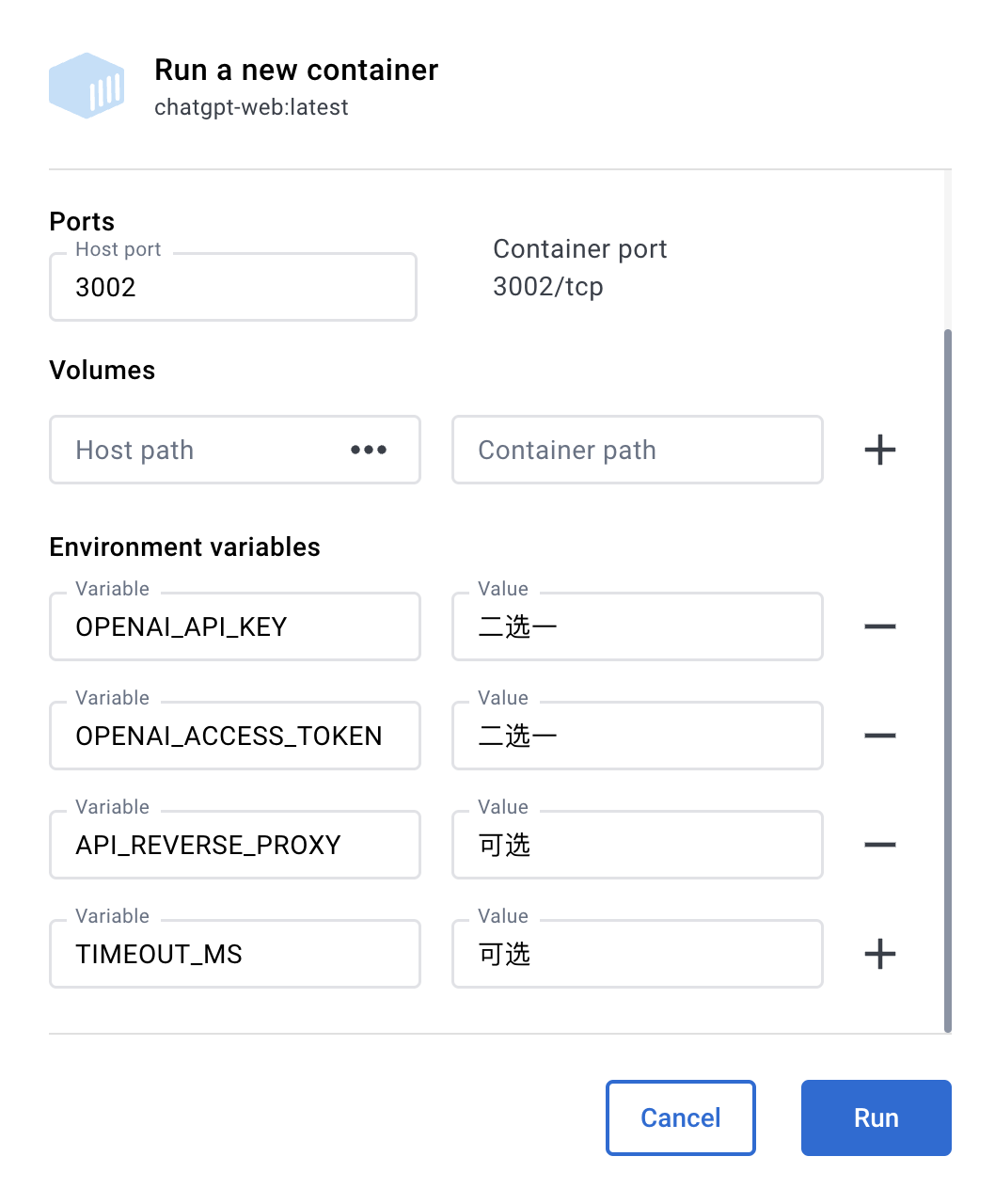
Docker Parameter Examples
Docker build & Run
Docker compose
Prevent Crawlers
Deploy with Railway
Railway Environment Variables
Deploy with Sealos
Package Manually
Backend Service
Frontend Webpage
FAQ
Contributing
Acknowledgements
Sponsors
License
Introduction
Supports dual models and provides two unofficial ChatGPT API methods
Method
Free?
Reliability
Quality
ChatGPTAPI(gpt-3.5-turbo-0301)
No
Reliable
Relatively stupid
ChatGPTUnofficialProxyAPI(web accessToken)
Yes
Relatively unreliable
Smart
Comparison:
ChatGPTAPI uses gpt-3.5-turbo through OpenAI official API to call ChatGPT
ChatGPTUnofficialProxyAPI uses unofficial proxy server to access ChatGPT's backend API, bypass Cloudflare (dependent on third-party servers, and has rate limits)
Warnings:
You should first use the API method
When using the API, if the network is not working, it is blocked in China, you need to build your own proxy, never use someone else's public proxy, which is dangerous.
When using the accessToken method, the reverse proxy will expose your access token to third parties. This should not have any adverse effects, but please consider the risks before using this method.
When using accessToken, whether you are a domestic or foreign machine, proxies will be used. The default proxy is pengzhile's https://ai.fakeopen.com/api/conversation. This is not a backdoor or monitoring unless you have the ability to flip over CF verification yourself. Use beforehand acknowledge. Community Proxy (Note: Only these two are recommended, other third-party sources, please identify for yourself)
When publishing the project to public network, you should set the AUTH_SECRET_KEY variable to add your password access, you should also modify the title in index. html to prevent it from being searched by keywords.
Switching methods:
Enter the service/.env.example file, copy the contents to the service/.env file
To use OpenAI API Key, fill in the OPENAI_API_KEY field (get apiKey)
To use Web API, fill in the OPENAI_ACCESS_TOKEN field (get accessToken)
OpenAI API Key takes precedence when both exist
Environment variables:
See all parameter variables here
Roadmap
[✓] Dual models
[✓] Multi-session storage and context logic
[✓] Formatting and beautification of code and other message types
[✓] Access control
[✓] Data import/export
[✓] Save messages as local images
[✓] Multilingual interface
[✓] Interface themes
[✗] More...
Prerequisites
Node
node requires version ^16 || ^18 || ^19 (node >= 14 needs fetch polyfill installation), use nvm to manage multiple local node versions
node -v
PNPM
If you haven't installed pnpm
npm install pnpm -g
Filling in the Key
Get Openai Api Key or accessToken and fill in the local environment variables Go to Introduction
# service/.env file

# OpenAI API Key - https://platform.openai.com/overview
OPENAI_API_KEY=

# change this to an `accessToken` extracted from the ChatGPT site's `https://chat.openai.com/api/auth/session` response
OPENAI_ACCESS_TOKEN=
Install Dependencies
For the convenience of "backend developers" to understand the burden, the front-end "workspace" mode is not adopted, but separate folders are used to store them. If you only need to do secondary development of the front-end page, delete the service folder.
Backend
Enter the folder /service and run the following commands
pnpm install
Frontend
Run the following commands at the root directory
pnpm bootstrap
Run in Test Environment
Backend Service
Enter the folder /service and run the following commands
pnpm start
Frontend Webpage
Run the following commands at the root directory
pnpm dev
Environment Variables
API available:
OPENAI_API_KEY and OPENAI_ACCESS_TOKEN choose one
OPENAI_API_MODEL Set model, optional, default: gpt-3.5-turbo
OPENAI_API_BASE_URL Set interface address, optional, default: https://api.openai.com
OPENAI_API_DISABLE_DEBUG Set interface to close debug logs, optional, default: empty does not close
ACCESS_TOKEN available:
OPENAI_ACCESS_TOKEN and OPENAI_API_KEY choose one, OPENAI_API_KEY takes precedence when both exist
API_REVERSE_PROXY Set reverse proxy, optional, default: https://ai.fakeopen.com/api/conversation, Community (Note: Only these two are recommended, other third party sources, please identify for yourself)
Common:
AUTH_SECRET_KEY Access permission key, optional
MAX_REQUEST_PER_HOUR Maximum number of requests per hour, optional, unlimited by default
TIMEOUT_MS Timeout, unit milliseconds, optional
SOCKS_PROXY_HOST and SOCKS_PROXY_PORT take effect together, optional
SOCKS_PROXY_PORT and SOCKS_PROXY_HOST take effect together, optional
version: '3'

services:
  app:
    image: chenzhaoyu94/chatgpt-web # always use latest, pull the tag image again to update
    ports:
      - 127.0.0.1:3002:3002
    environment:
      # choose one
      OPENAI_API_KEY: sk-xxx
      # choose one
      OPENAI_ACCESS_TOKEN: xxx
      # API interface address, optional, available when OPENAI_API_KEY is set
      OPENAI_API_BASE_URL: xxx
      # API model, optional, available when OPENAI_API_KEY is set, https://platform.openai.com/docs/models
      # gpt-4, gpt-4o, gpt-4o-mini, gpt-4-turbo, gpt-4-turbo-preview, gpt-4-0125-preview, gpt-4-1106-preview, gpt-4-0314, gpt-4-0613, gpt-4-32k, gpt-4-32k-0314, gpt-4-32k-0613, gpt-3.5-turbo-16k, gpt-3.5-turbo-16k-0613, gpt-3.5-turbo, gpt-3.5-turbo-0301, gpt-3.5-turbo-0613, text-davinci-003, text-davinci-002, code-davinci-002
      OPENAI_API_MODEL: xxx
      # reverse proxy, optional
      API_REVERSE_PROXY: xxx
      # access permission key, optional
      AUTH_SECRET_KEY: xxx
      # maximum number of requests per hour, optional, unlimited by default
      MAX_REQUEST_PER_HOUR: 0
      # timeout, unit milliseconds, optional
      TIMEOUT_MS: 60000
      # Socks proxy, optional, take effect with SOCKS_PROXY_PORT
      SOCKS_PROXY_HOST: xxx
      # Socks proxy port, optional, take effect with SOCKS_PROXY_HOST
      SOCKS_PROXY_PORT: xxx
      # HTTPS proxy, optional, support http,https,socks5
      HTTPS_PROXY: http://xxx:7890
OPENAI_API_BASE_URL Optional, available when OPENAI_API_KEY is set
OPENAI_API_MODEL Optional, available when OPENAI_API_KEY is set
Prevent Crawlers
nginx
Fill in the following configuration in the nginx configuration file to prevent crawlers. You can refer to the docker-compose/nginx/nginx.conf file to add anti-crawler methods
    # Prevent crawlers
    if ($http_user_agent ~* "360Spider|JikeSpider|Spider|spider|bot|Bot|2345Explorer|curl|wget|webZIP|qihoobot|Baiduspider|Googlebot|Googlebot-Mobile|Googlebot-Image|Mediapartners-Google|Adsbot-Google|Feedfetcher-Google|Yahoo! Slurp|Yahoo! Slurp China|YoudaoBot|Sosospider|Sogou spider|Sogou web spider|MSNBot|ia_archiver|Tomato Bot|NSPlayer|bingbot")
    {
      return 403;
    }
Deploy with Railway
Railway Environment Variables
Environment variable name
Required
Remarks
PORT
Required
Default 3002
AUTH_SECRET_KEY
Optional
Access permission key
MAX_REQUEST_PER_HOUR
Optional
Maximum number of requests per hour, optional, unlimited by default
TIMEOUT_MS
Optional
Timeout, unit milliseconds
OPENAI_API_KEY
OpenAI API choose one
apiKey required for OpenAI API (get apiKey)
OPENAI_ACCESS_TOKEN
Web API choose one
accessToken required for Web API (get accessToken)
OPENAI_API_BASE_URL
Optional, available when OpenAI API
API interface address
OPENAI_API_MODEL
Optional, available when OpenAI API
API model
API_REVERSE_PROXY
Optional, available when Web API
Web API reverse proxy address Details
SOCKS_PROXY_HOST
Optional, take effect with SOCKS_PROXY_PORT
Socks proxy
SOCKS_PROXY_PORT
Optional, take effect with SOCKS_PROXY_HOST
Socks proxy port
SOCKS_PROXY_USERNAME
Optional, take effect with SOCKS_PROXY_HOST
Socks proxy username
SOCKS_PROXY_PASSWORD
Optional, take effect with SOCKS_PROXY_HOST
Socks proxy password
HTTPS_PROXY
Optional
HTTPS proxy, support http,https, socks5
ALL_PROXY
Optional
All proxies, support http,https, socks5
Note: Modifying environment variables on Railway will re-Deploy
Deploy with Sealos
Environment variables are consistent with Docker environment variables
Package Manually
Backend Service
If you don't need the node interface of this project, you can omit the following operations
Copy the service folder to the server where you have the node service environment.
A: Because there is a commit message verification, please follow the Commit Guide
Q: Where to change the request interface if only the front-end page is used?
A: The VITE_GLOB_API_URL field in the .env file at the root directory.
Q: All files explode red when saving?
A: vscode please install the recommended plug-ins for the project, or manually install the Eslint plug-in.
Q: No typewriter effect on the front end?
A: One possible reason is that after Nginx reverse proxy, buffer is turned on, then Nginx will try to buffer some data from the backend before sending it to the browser. Please try adding proxy_buffering off; after the reverse proxy parameter, then reload Nginx. Other web server configurations are similar.
Contributing
Please read the Contributing Guide before contributing
Thanks to everyone who has contributed!
Acknowledgements
Thanks to JetBrains SoftWare for providing free Open Source license for this project.
Sponsors
If you find this project helpful and can afford it, you can give me a little support. Anyway, thanks for your support~
Does Chanzhaoyu/chatgpt-web have a project website?
No homepage URL was recorded for Chanzhaoyu/chatgpt-web in TopGit's last sync. The README tab above frequently contains screenshots and demo links, or check the repository description on GitHub.
Does Chanzhaoyu/chatgpt-web have any tags?
TopGit's last sync did not record any GitHub topics for Chanzhaoyu/chatgpt-web. GitHub topics appear in the right sidebar of a repository page; that's the authoritative place to check.
How active is development on Chanzhaoyu/chatgpt-web?
The most recent commit recorded on Chanzhaoyu/chatgpt-web was 2.0 years ago, based on the GitHub push timestamp. The repository has 10.7k forks — one of the better signals of community interest.
How many stars does Chanzhaoyu/chatgpt-web have?
Chanzhaoyu/chatgpt-web has 31.5k GitHub stars — refresh the page for the live number, or check github.com/Chanzhaoyu/chatgpt-web. TopGit mirrors GitHub's count but does not claim minute-by-minute accuracy.
Is Chanzhaoyu/chatgpt-web open source?
Yes — Chanzhaoyu/chatgpt-web ships under the MIT license, which makes its source code freely readable (and, depending on license terms, forkable and reusable). Source: github.com/Chanzhaoyu/chatgpt-web.
Where do I read more about Chanzhaoyu/chatgpt-web?
This TopGit page is a snapshot — the READ ME tab shows the project's own README content (links stripped, images preserved). The GitHub repository at github.com/Chanzhaoyu/chatgpt-web is the definitive source.
Read full README in the tab above.
Is chatgpt-web worth your time?
ChatGPT, Claude and Perplexity can all read this page. Ask one of them what it makes of chatgpt-web.
 /chatgpt-web