A look at cisco/mindmeld: 694 stars on GitHub, written primarily in Python. An Open Source Conversational AI Platform for Deep-Domain Voice Interfaces and Chatbots.
Snapshot summary built from the project's own GitHub metadata — there's no written TopGit review yet. The page will update automatically when a full review is published.
WHY NO REVIEW YET
TopGit writes full reviews for the most-starred, most-requested repositories. This page is a snapshot until then — see the READ ME tab for the original README in full.
The MindMeld SDK is no longer maintained. Though once a state-of-the-art conversational AI platform, MindMeld has long since been surpassed by technologies enabled by LLMs. If you are currently using the MindMeld library, we advise you to evaluate alternatives. MindMeld hasn't had a release since November of 2022, and will not have any future releases.
Thank you to all our users and contributors.
MindMeld Conversational AI Platform
This repository contains the MindMeld Conversational AI Platform.
Introducing MindMeld
The MindMeld Conversational AI platform is among the most advanced AI platforms for building production-quality conversational applications. It is a Python-based machine learning framework which encompasses all of the algorithms and utilities required for this purpose. Evolved over several years of building and deploying dozens of the most advanced conversational experiences achievable, MindMeld is optimized for building advanced conversational assistants which demonstrate deep understanding of a particular use case or domain while providing highly useful and versatile conversational experiences.
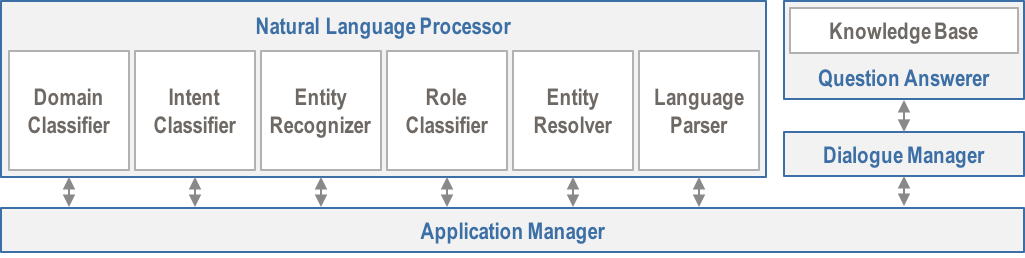
MindMeld is the only Conversational AI platform available today that provides tools and capabilities for every step in the workflow for a state-of-the-art conversational application. The architecture of MindMeld is illustrated below.
To summarize, the functionality available in MindMeld includes:
advanced Natural Language Processing, consisting of
Domain Classification
Intent Classification
Entity Recognition
Entity Role Labeling
Entity Resolution
Language Parsing
versatile dialogue management
custom knowledge base creation
advanced question answering
training data collection and management support
large-scale data analytics
The MindMeld Philosophy
MindMeld has been used for applications in dozens of different domains by some of the largest global organizations. Over the course of these production deployments, MindMeld has evolved to be ideally suited for building production-quality, large-vocabulary language understanding capabilities for any custom application domain. This has been achieved by following the architectural philosophy whose guiding principles are expressed in the table below.
Concept
Description
Power and Versatility
Unlike GUI-based tools typically too rigid to accommodate the functionality required by many applications, MindMeld provides powerful command-line utilities with the flexibility to accommodate nearly any product requirements.
Algorithms and Data
In contrast to machine learning toolkits which offer algorithms but little data, MindMeld provides not only state-of-the-art algorithms, but also functionality which streamlines the collection and management of large sets of custom training data.
NLP plus QA and DM
While conversational AI platforms available today typically provide natural language processing (NLP) support, few assist with question answering (QA) or dialogue management (DM). MindMeld provides end-to-end functionality including advanced NLP, QA, and DM, all three of which are required for production applications today.
Knowledge-Driven Learning
Nearly all production conversational applications rely on a comprehensive knowledge base to enhance intelligence and utility. MindMeld is the only Conversational AI platform available today which supports custom knowledge base creation. This makes MindMeld ideally suited for applications which must demonstrate deep understanding of a large product catalog, content library, or FAQ database, for example.
You Own Your Data
Differently from cloud-based NLP services, which require that you forfeit your data, MindMeld was designed from the start to ensure that proprietary training data and models always remain within the control and ownership of your application.
Quick Start
Assuming you have pip installed with Python 3.6 or Python 3.7 and Elasticsearch running in the background:
For detailed installation instructions, see Getting Started. To start with pre-built sample applications, see MindMeld Blueprints.
MindMeld UI
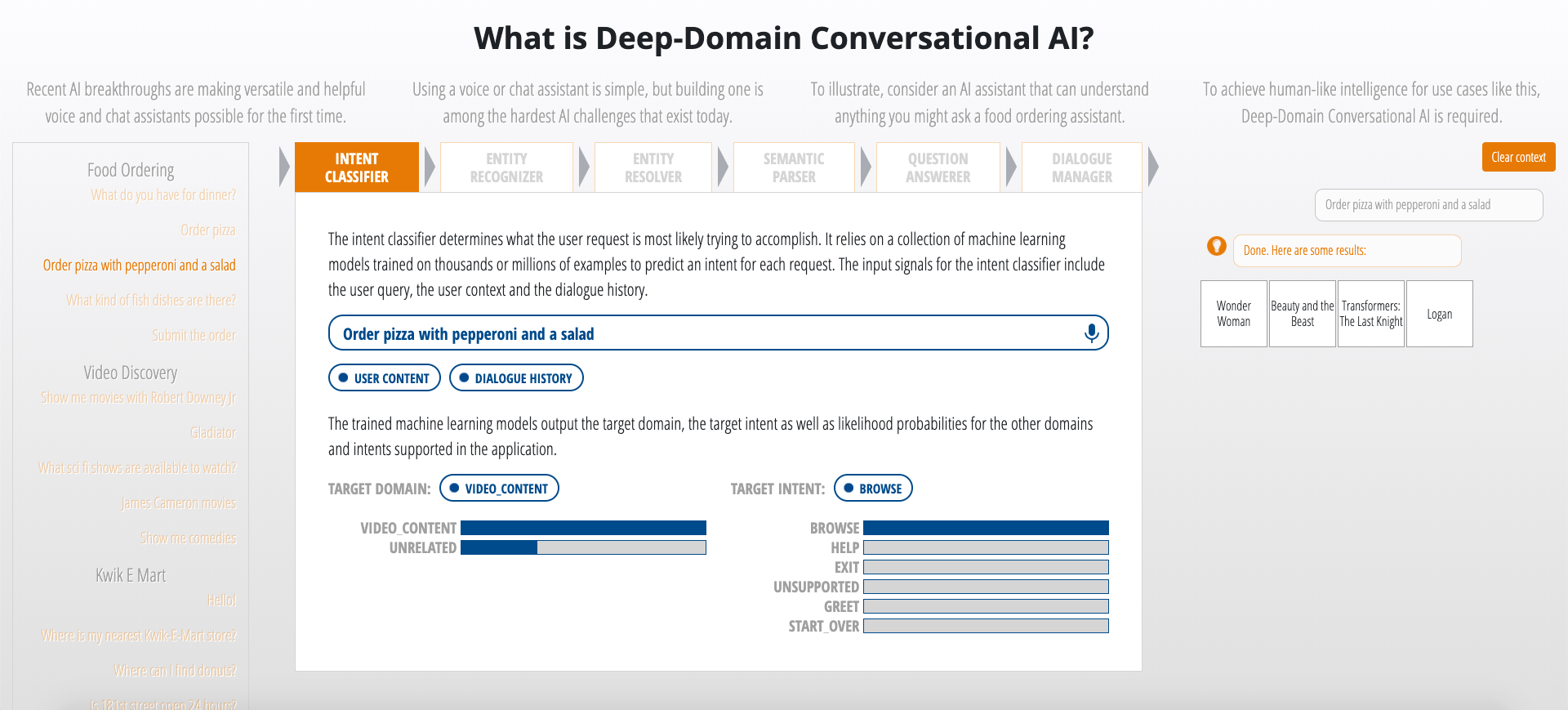
You can use our sample web-based chat client interface to interact with any MindMeld application. This web UI also serves as a debugging tool to step through the various stages of query processing by the MindMeld pipeline.
git clone [email protected]:cisco/mindmeld.git
cd mindmeld/mindmeld-ui
npm install
npm start
For detailed installation instructions, see Getting Started for UI.
Note: this web client only works on Chrome browser.
How to contribute to the MindMeld platform:
We are very happy to receive your contributions. We maintain a list of open issues on our GitHub project.
You can also create your own issue and link it to your code in a pull request, which we will promptly review.
To setup local development for MindMeld, first you will need to fork the MindMeld repository from GitHub and follow instructions on Getting Started page to setup the virtual environment.
To develop MindMeld, you need Python 3.6 or Python 3.7. To install and manage different versions of Python, you can checkout pyenv which also works with virtualenv.
Make sure that the numerical parser and Elasticsearch are running in the background. Finally we are ready to run MindMeld static style checks and unit tests.
./lintme
cd tests
pytest .
After making changes and all tests are passing locally, commit the code to your fork and issue a PR against the cisco/mindmeld repo.
Documentation
You can view the documentation for the latest stable release on mindmeld.com/docs and the documentation for the latest master branch version on our Github Page.
You can contribute to the documentation under the source directory.
To generate the documentation, please follow these steps:
pip install -r docs-requirements.txt
make apidoc
Citation
Please cite this paper if you use MindMeld in your work:
Raghuvanshi, A., Carroll, L. and Raghunathan, K., 2018, November. Developing Production-Level Conversational Interfaces with Shallow Semantic Parsing. In Proceedings of the 2018 Conference on Empirical Methods in Natural Language Processing: System Demonstrations (pp. 157-162)
@inproceedings{raghuvanshi2018developing,
  title={Developing Production-Level Conversational Interfaces with Shallow Semantic Parsing},
  author={Raghuvanshi, Arushi and Carroll, Lucien and Raghunathan, Karthik},
  booktitle={Proceedings of the 2018 Conference on Empirical Methods in Natural Language Processing:
             System Demonstrations},
  pages={157--162},
  year={2018}
}
Yes — cisco/mindmeld ships under the Apache-2.0 license, which makes its source code freely readable (and, depending on license terms, forkable and reusable). Source: github.com/cisco/mindmeld.
What is cisco/mindmeld?
cisco/mindmeld (cisco/mindmeld) is a Python project on GitHub. From the project's own README: An Open Source Conversational AI Platform for Deep-Domain Voice Interfaces and Chatbots.
What license does cisco/mindmeld use?
cisco/mindmeld is released under the Apache-2.0 license. Always verify the LICENSE file directly on GitHub for the authoritative terms — license strings can be edited out of sync with a project's actual stance.
Where can I see cisco/mindmeld in action?
The project maintains a homepage at http://mindmeld.com. The README tab on this page also usually contains screenshots and a quickstart.
Where do I read more about cisco/mindmeld?
This TopGit page is a snapshot — the READ ME tab shows the project's own README content (links stripped, images preserved). The GitHub repository at github.com/cisco/mindmeld is the definitive source.
Read full README in the tab above.
Still deciding about mindmeld?
One click hands the question to an AI along with this page — see what it says about mindmeld.

 /mindmeld