cvg/limap is a Python project with 873 stars. A toolbox for mapping and localization with line features.
Snapshot summary built from the project's own GitHub metadata — there's no written TopGit review yet. The page will update automatically when a full review is published.
WHY NO REVIEW YET
TopGit writes full reviews for the most-starred, most-requested repositories. This page is a snapshot until then — see the READ ME tab for the original README in full.
The documentations on brief tutorials and APIs are available here.
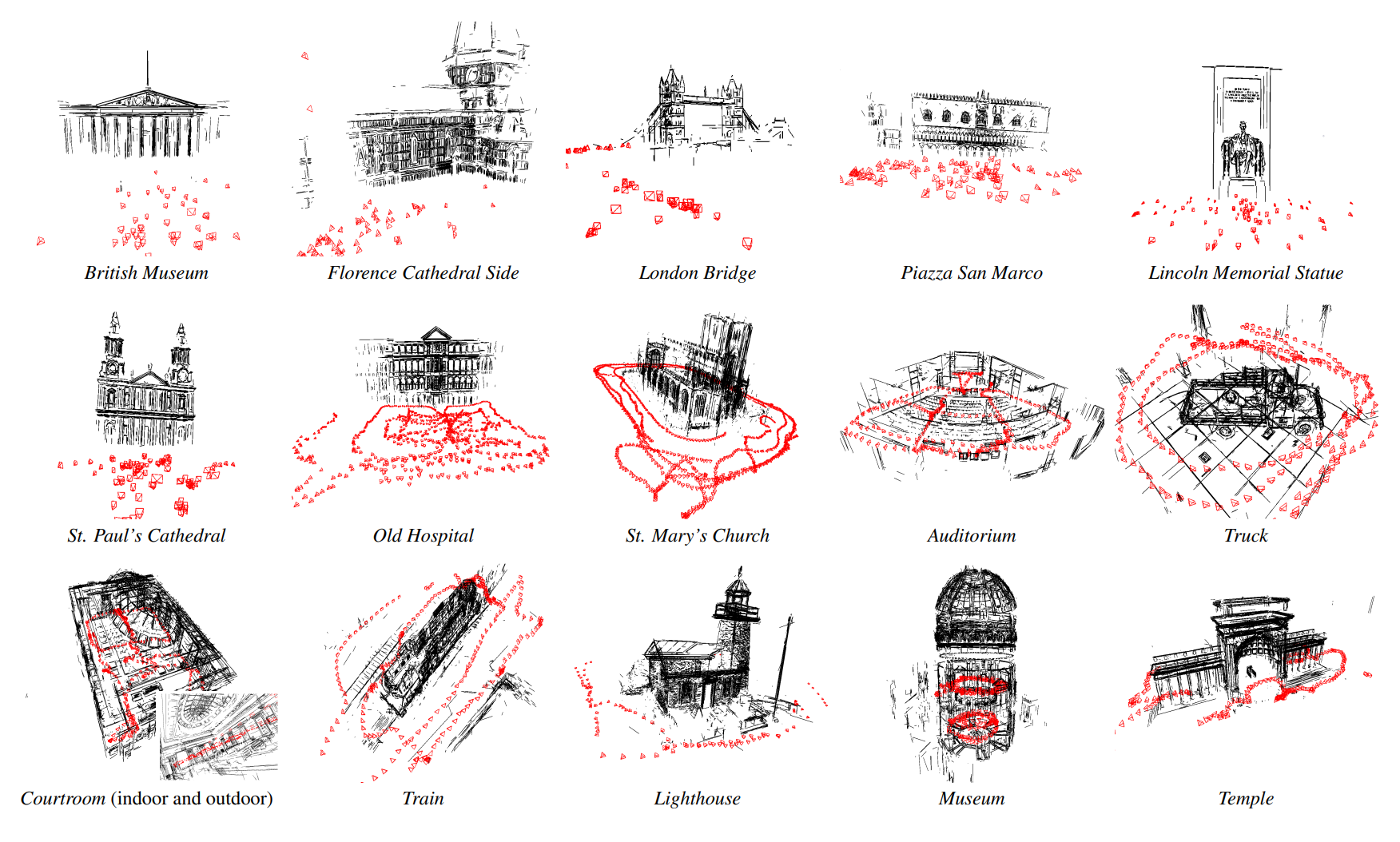
LIMAP is a toolbox for mapping and localization with line features. The system was initially described in the highlight paper 3D Line Mapping Revisited at CVPR 2023 in Vancouver, Canada. Contributors to this project are from the Computer Vision and Geometry Group at ETH Zurich.
In this project, we provide interfaces for various geometric operations on 2D/3D lines. We support off-the-shelf SfM software including VisualSfM, Bundler, and COLMAP to initialize the camera poses to build 3D line maps on the database. The line detectors, matchers, and vanishing point estimators are abstracted to ensure flexibility to support recent advances and future development.
Next step: Hybrid incremental SfM is under development and will be included in the next round of release.
To run Visualization of the 3D line maps after the reconstruction:
python visualize_3d_lines.py --input_dir outputs/quickstart_triangulation/finaltracks # add the camera frustums with "--imagecols outputs/quickstart_triangulation/imagecols.npy"
[Tips] Options are stored in the config folder: cfgs. You can easily change the options with the Python argument parser. The following shows an example:
In particular, --skip_exists is a very useful option to avoid running point-based SfM and line detection/description repeatedly in each pass.
Also, the combination LSD detector + Endpoints NN matcher can be enabled with --default_config_file cfgs/triangulation/default_fast.yaml for high efficiency (while with non-negligible performance degradation).
Example of Hybrid Point-Line Localization
We provide two query examples for localization from the Stairs scene in the 7Scenes Dataset, where traditional point-based methods normally struggle due to the repeated steps and lack of texture. The examples are provided in .npy files: runners/tests/data/localization/localization_test_data_stairs_[1|2].npy, which contains the necessary 2D-3D point and line correspondences along with the necessary configurations.
The script will print the pose error estimated using point-only (hloc), and the pose error estimated by our hybrid point-line localization framework. In addition, two images will be created in the output folder (default to outputs/test/localization) showing the inliers point and line correspondences in hybrid localization projected using the two estimated camera pose (by point-only and point+line) onto the query image with 2D point and line detections marked. An improved accuracy of the hybrid point-line method is expected to be observed.
Supported line detectors, matchers and VP estimators
If you wish to use the methods with separate installation needed you need to install it yourself with the corresponding guides. This is to avoid potential issues at the LIMAP installation to ensure a quicker start.
Note: PR on integration of new features are very welcome.
The following line detectors are currently supported:
LSD
SOLD2
HAWP (separate installation needed [Guide])
TP-LSD (separate installation needed [Guide])
DeepLSD
The following line descriptors/matchers are currently supported:
LBD (separate installation needed [Guide])
SOLD2
LineTR
L2D2
Endpoint matching with SuperPoint + Nearest Neighbors
Endpoint matching with SuperPoint + SuperGlue
GlueStick
Custom line matcher based on dense matcher RoMa (separate installation needed [Guide])
The following vanishing point estimators are currently supported:
If you use this code in your project, please consider citing the following paper:
@InProceedings{Liu_2023_LIMAP,
    author = {Liu, Shaohui and Yu, Yifan and Pautrat, Rémi and Pollefeys, Marc and Larsson, Viktor},
    title = {3D Line Mapping Revisited},
    booktitle = {Computer Vision and Pattern Recognition (CVPR)},
    year = {2023},
}
Contributors
This project is mainly developed and maintained by Shaohui Liu, Yifan Yu, Rémi Pautrat, and Viktor Larsson. Issues and contributions are very welcome at any time.
Yes — cvg/limap ships under the BSD-3-Clause license, which makes its source code freely readable (and, depending on license terms, forkable and reusable). Source: github.com/cvg/limap.
What is cvg/limap?
cvg/limap (cvg/limap) is a Python project on GitHub. From the project's own README: A toolbox for mapping and localization with line features.
Where do I read more about cvg/limap?
This TopGit page is a snapshot — the READ ME tab shows the project's own README content (links stripped, images preserved). The GitHub repository at github.com/cvg/limap is the definitive source.
Read full README in the tab above.
Still deciding about limap?
One click hands the question to an AI along with this page — see what it says about limap.
 /limap