cvg/NoPoSplat — an open-source project — sits at 977 GitHub stars. [ICLR'25 Oral] No Pose, No Problem: Surprisingly Simple 3D Gaussian Splats from Sparse Unposed Images
Snapshot summary built from the project's own GitHub metadata — there's no written TopGit review yet. The page will update automatically when a full review is published.
WHY NO REVIEW YET
TopGit writes full reviews for the most-starred, most-requested repositories. This page is a snapshot until then — see the READ ME tab for the original README in full.
No Pose, No Problem Surprisingly Simple 3D Gaussian Splats from Sparse Unposed Images
Botao Ye
·
Sifei Liu
·
Haofei Xu
·
Xueting Li
·
Marc Pollefeys
·
Ming-Hsuan Yang
·
Songyou Peng
Paper | Project Page
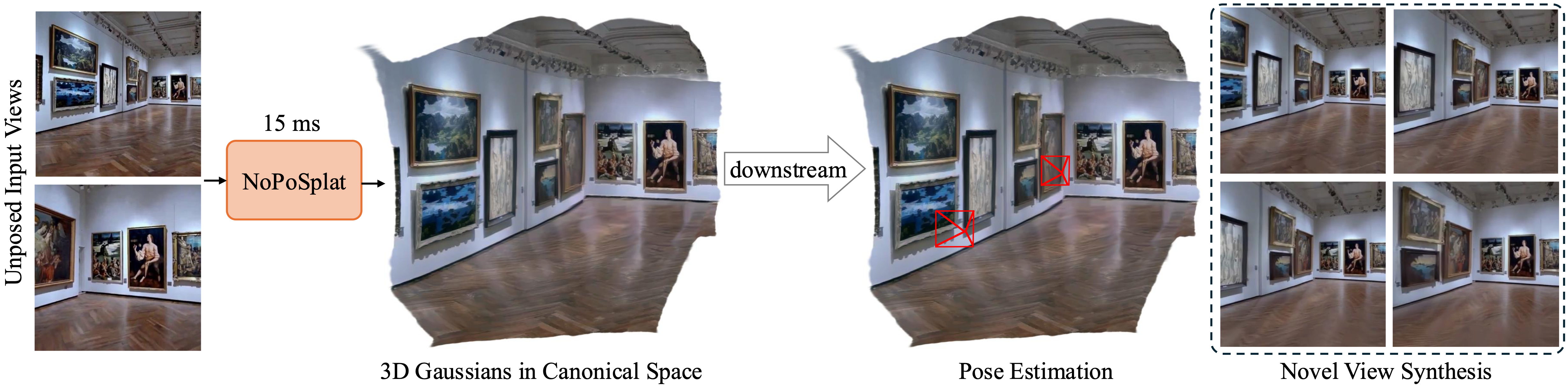
NoPoSplat predicts 3D Gaussians in a canonical space from unposed sparse images, enabling high-quality novel view synthesis and accurate pose estimation.
Table of Contents
Installation
Pre-trained Checkpoints
Camera Conventions
Datasets
Running the Code
Acknowledgements
Citation
Installation
Our code relies on Python 3.10+, and is developed based on PyTorch 2.1.2 and CUDA 11.8, but it should work with higher Pytorch/CUDA versions as well.
Clone NoPoSplat.
git clone https://github.com/cvg/NoPoSplat
cd NoPoSplat
Create the environment, here we show an example using conda.
Optional, compile the cuda kernels for RoPE (as in CroCo v2).
# NoPoSplat relies on RoPE positional embeddings for which you can compile some cuda kernels for faster runtime.
cd src/model/encoder/backbone/croco/curope/
python setup.py build_ext --inplace
cd ../../../../../..
Pre-trained Checkpoints
Our models are hosted on Hugging Face 🤗
Model name
Training resolutions
Training data
Input view num.
re10k.ckpt
256x256
re10k
2
acid.ckpt
256x256
acid
2
mixRe10kDl3dv.ckpt
256x256
re10k, dl3dv
2
mixRe10kDl3dv_512x512.ckpt
512x512
re10k, dl3dv
2
re10k_3views.ckpt
256x256
re10k
3
We assume the downloaded weights are located in the pretrained_weights directory.
Camera Conventions
Our camera system is the same as pixelSplat. The camera intrinsic matrices are normalized (the first row is divided by image width, and the second row is divided by image height).
The camera extrinsic matrices are OpenCV-style camera-to-world matrices ( +X right, +Y down, +Z camera looks into the screen).
Datasets
Please refer to DATASETS.md for dataset preparation.
Running the Code
Training
First download the MASt3R pretrained model and put it in the ./pretrained_weights directory.
Then call src/main.py via:
# 8 GPUs, with each batch size = 16. Remove the last two arguments if you don't want to use wandb for logging
python -m src.main +experiment=re10k wandb.mode=online wandb.name=re10k
This default training configuration requires 8x GPUs with a batch size of 16 on each GPU (>=80GB memory).
The training will take approximately 6 hours to complete.
You can adjust the batch size to fit your hardware, but note that changing the total batch size may require modifying the initial learning rate to maintain performance.
You can refer to the re10k_1x8 for training on 1 A6000 GPU (48GB memory), which will produce similar performance.
Note that here we show the evaluation using the mixed model trained on RealEstate10K and DL3DV. You can replace the checkpoint path with other trained models.
Acknowledgements
This project is developed with several fantastic repos: pixelSplat, DUSt3R, and CroCo. We thank the original authors for their excellent work.
We thank the kindly help of David Charatan for providing the evaluation code and the pretrained models for some of the previous methods.
Citation
@article{ye2024noposplat,
      title   = {No Pose, No Problem: Surprisingly Simple 3D Gaussian Splats from Sparse Unposed Images},
      author  = {Ye, Botao and Liu, Sifei and Xu, Haofei and Xueting, Li and Pollefeys, Marc and Yang, Ming-Hsuan and Songyou, Peng},
      journal = {arXiv preprint arXiv:2410.24207},
      year    = {2024}
    }
The most recent commit recorded on cvg/NoPoSplat was 5 months ago, based on the GitHub push timestamp. The repository has 54 forks — one of the better signals of community interest.
How many stars does cvg/NoPoSplat have?
cvg/NoPoSplat has 977 GitHub stars — refresh the page for the live number, or check github.com/cvg/NoPoSplat. TopGit mirrors GitHub's count but does not claim minute-by-minute accuracy.
Is cvg/NoPoSplat open source?
Yes — cvg/NoPoSplat ships under the MIT license, which makes its source code freely readable (and, depending on license terms, forkable and reusable). Source: github.com/cvg/NoPoSplat.
What is cvg/NoPoSplat?
cvg/NoPoSplat (cvg/NoPoSplat) is a Python project on GitHub. From the project's own README: [ICLR'25 Oral] No Pose, No Problem: Surprisingly Simple 3D Gaussian Splats from Sparse Unposed Images
What language is cvg/NoPoSplat written in?
cvg/NoPoSplat is written primarily in Python. GitHub's language field is based on the largest share of bytes in the default branch.
What license does cvg/NoPoSplat use?
cvg/NoPoSplat is released under the MIT license. Always verify the LICENSE file directly on GitHub for the authoritative terms — license strings can be edited out of sync with a project's actual stance.
Where do I read more about cvg/NoPoSplat?
This TopGit page is a snapshot — the READ ME tab shows the project's own README content (links stripped, images preserved). The GitHub repository at github.com/cvg/NoPoSplat is the definitive source.
Read full README in the tab above.
Curious whether NoPoSplat is right for you?
Let ChatGPT, Claude, or Perplexity look into it — click below and see what AI actually says about NoPoSplat.
 /NoPoSplat