As an open-source project, deezer/carousel_bandits has picked up 60 stars on GitHub (Python). Source code and data from the RecSys 2020 article "Carousel Personalization in Music Streaming Apps with Contextual Bandits" by W. Bendada, G. Salha and T. Bontempelli
Snapshot summary built from the project's own GitHub metadata — there's no written TopGit review yet. The page will update automatically when a full review is published.
WHY NO REVIEW YET
TopGit writes full reviews for the most-starred, most-requested repositories. This page is a snapshot until then — see the READ ME tab for the original README in full.
Carousel Personalization in Music Streaming Apps with Contextual Bandits - RecSys 2020
This repository provides Python code and data to reproduce experiments from the article Carousel Personalization in Music Streaming Apps with Contextual Bandits published in the proceedings of the 14th ACM Conference on Recommender Systems (RecSys 2020 - Best Short Paper Candidate).
Carousel Personalization
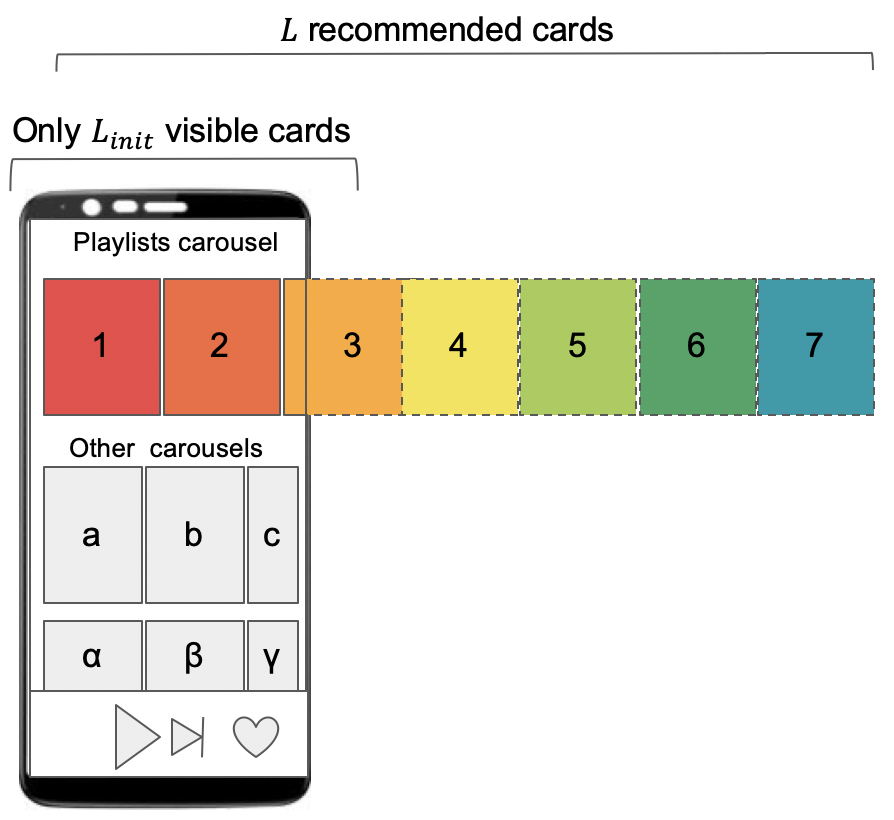
Media services providers, such as the music streaming platform Deezer, often leverage swipeable carousels to recommend personalized content to their users. These carousels are ranked lists of L items or cards from a substantially larger catalog (of size K), e.g. L albums, artists or playlists recommended on the homepage of the Deezer app. Only a few cards, say L_init < L, are initially displayed to users, who can swipe the screen to see additional cards.
Selecting the most relevant content to display in carousels is a challenging task, as the catalog is large and as users have different preferences. Also, ranking matters: some cards might not be seen by some users due to the swipeable structure.
In Section 2 of our RecSys paper, we model carousel personalization as a multi-armed bandit problem with multiple plays, cascade-based updates, delayed batch feedback and contextual information on users. We aim at capturing the most important characteristics of real-world swipeable carousels.
Then, we evaluate our framework by addressing a carousel-based playlist recommendation task on Deezer. We selected K = 862 playlists, that were created by professional curators from Deezer with the purpose of complying with a specific music genre, cultural area or mood, and that are among the most popular ones on the service. Playlists' cover images constitute the cards that can be recommended to users on the app homepage in a carousel, updated on a daily basis, with L = 12 available slots and L_init = 3 cards initially displayed. We aim at maximizing display-to-stream rates i.e. at identifying the L cards on which each user is the most likely to click and then to stream the underlying content, at least once during the round (= binary reward of 1 for each streamed playlist).
To determine which method (among the several bandit-based strategies mentioned in the paper - see table below) would best succeed in making users stream the recommended playlists, extensive experiments were conducted in two steps:
First, offline experiments simulating the responses of 974 960 users (anonymized) to carousel-based recommendations were run, on a simulation environment and on data that we both publicly release in this repository.
In the paper, these experiments were completed by an online A/B test on the Deezer app.
Installation
Code
git clone https://github.com/deezer/carousel_bandits
cd carousel_bandits
We release two datasets, detailed in Section 3.2 of the paper:
user_features.csv: a dataset of 974 960 fully anonymized Deezer users. Each user is described by:
a 96-dimensional embedding vector (fields dim_0 to dim_95), to which we subsequently add a bias term in our code, summarizing the user's musical preferences (see paper for details on computations of embedding vectors)
a segment: a k-means clustering with k = 100 clusters was performed internally, to also assign a segment to each user, as required by policies implementing our proposed semi-personalization strategy
playlist_features.csv: a dataset of 862 playlists. Each playlist i is described by:
a 97-dimensional weight vector, corresponding to the theta_i vectors from Section 3.2 of the paper (see paper for details on computations of weight vectors). For each user-playlist pair (u,i), the released "ground-truth" display-to-stream probability is as follows, where the 97-dimensional x_u vector corresponds to the concatenation of the 96-dim embedding vector of user u and of the bias term, and where sigma denotes the sigmoid activation function:
Download complete datasets
Due to size restrictions, this repository only provides the playlist_features.csv dataset and a very small version of the user dataset with 9 users, named user_features_small.csv, in the data folder.
The complete user_features.csv dataset with 974 960 users is available for download on Zenodo.
Please download it there and subsequently place it in the data folder.
Run Offline Experiments
Simulations proceed as detailed in Section 3.2 of the paper.
Type in the following commands to run offline experiments with similar hyperparameters w.r.t. the paper.
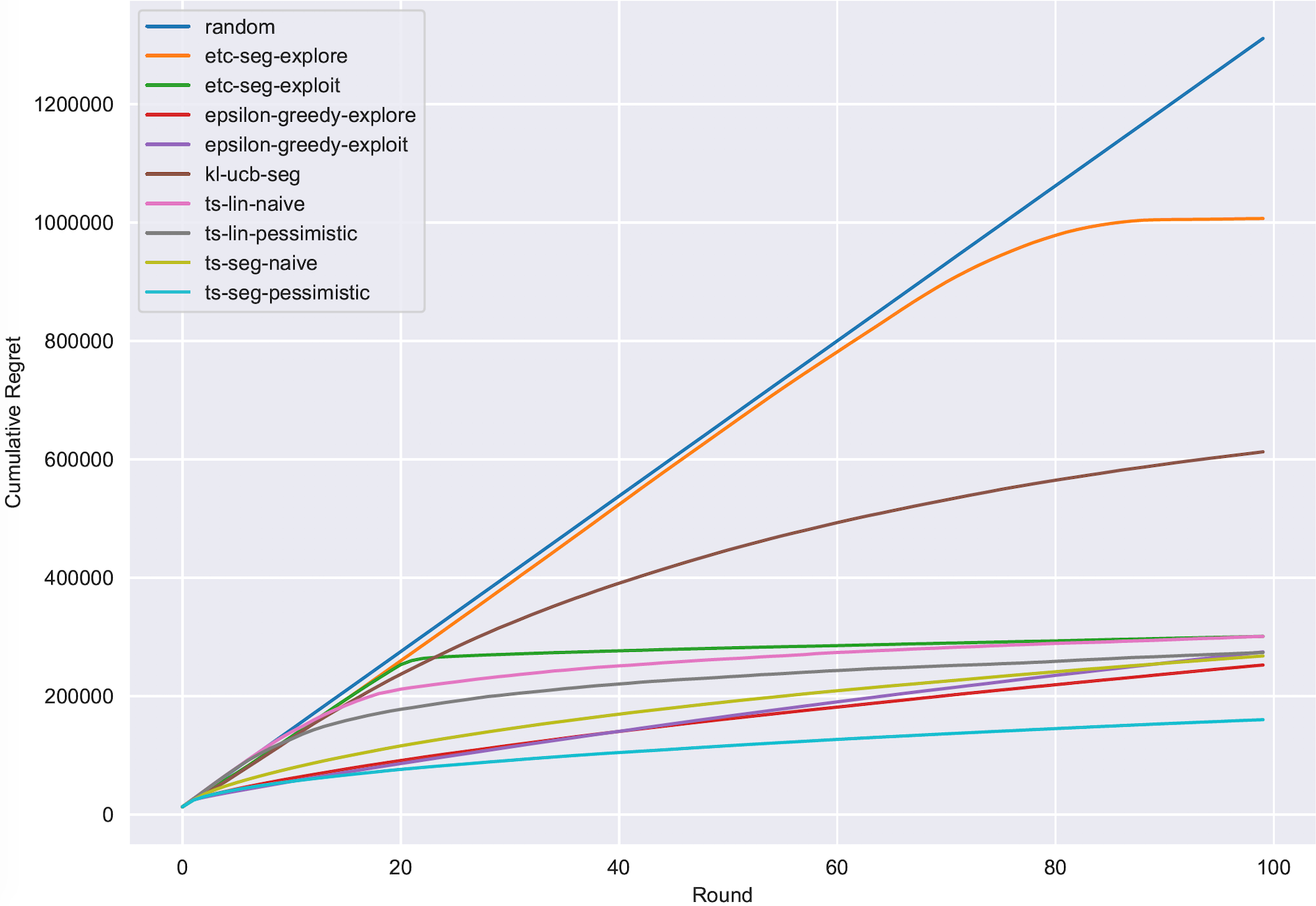
General Experiments (Figure 2 of RecSys paper)
Offline evaluation of Top-12 playlist recommendation: expected cumulative regrets of policies over 100 simulated rounds.
Evaluation of all policies on user_features_small.csv (useful for quick testing)
Note on running times: the ts-lin-naive and ts-lin-pessimistic policies might take a few minutes per round on a regular laptop. To speed up computations, you might consider removing them from the list of evaluated policies.
Results should look like:
Important note on ts-lin policies: our implementation of naive and pessimistic linear Thompson Sampling strategies have been improved since the publication of the RecSys paper. As a consequence, regret curves from these two policies are a bit different than in Figure 2 of the paper (results are better). Nonetheless, all conclusions from the article remain valid, especially regarding the comparison with ts-seg-pessimistic, and the comparison among ts-lin-naive and ts-lin-pessimistic.
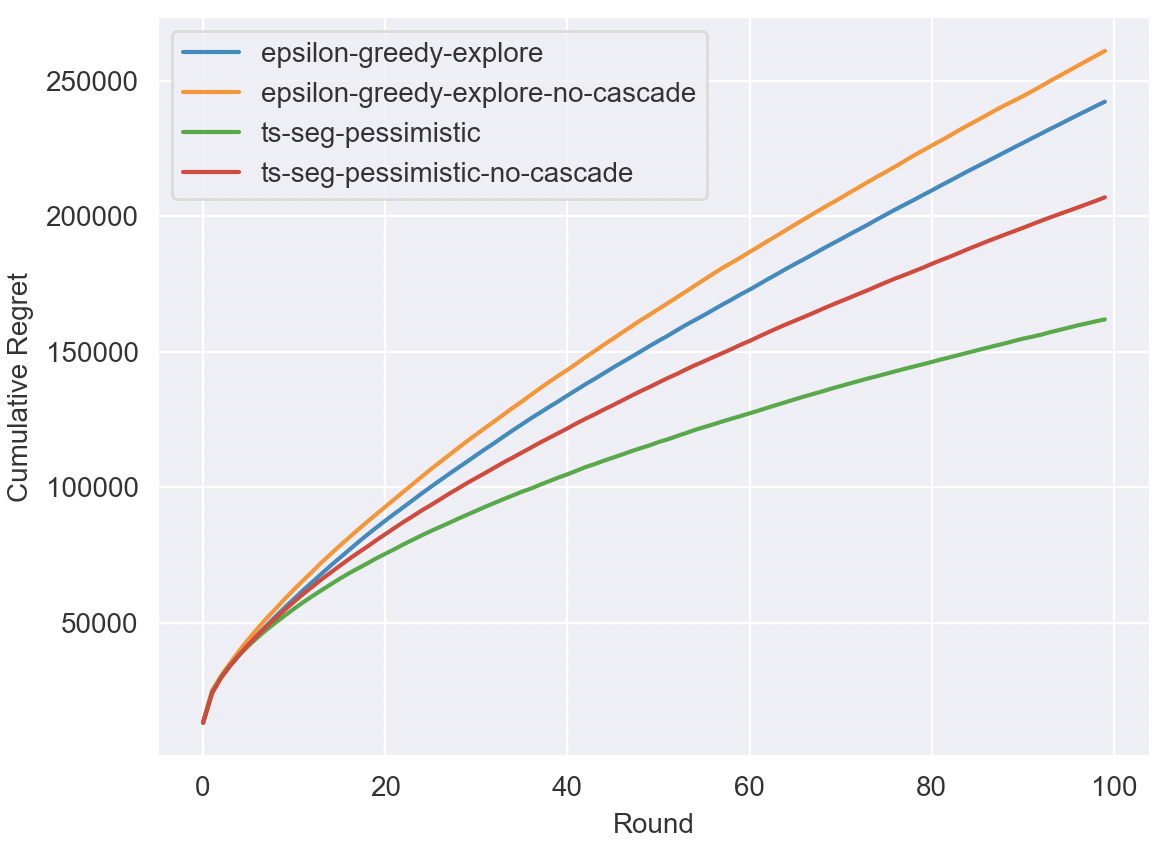
Cascade vs No-Cascade Experiments (Figure 3 of RecSys paper)
Comparison of cascade vs no-cascade policies for epsilon-greedy and ts-seg-pessimistic policies, over 100 simulated rounds.
We provide comments on our implementation of a cascade-based behaviour for these experiments in policies.py.
Path to a json file to save regret values of each policy accross time
results.json
policies
string
List of bandit policies to evaluate, separated by commas, among: - random - etc-seg-explore - etc-seg-exploit - epsilon-greedy-explore - epsilon-greedy-exploit - kl-ucb-seg - ts-seg-naive - ts-seg-pessimistic - ts-lin-naive - ts-lin-pessimistic - epsilon-greedy-explore-no-cascade - ts-seg_pessimistic-no-cascade Please see Section 3 of the RecSys paper for details on policies. New policies must be implemented in policies.py and then defined in the set_policies function from main.py.
random,ts-seg-naive
n_recos
int
Number of slots L in the carousel i.e. number of recommendations that each policy must provide to users at each round
12
l_init
int
Number of slots L_init initially visible in the carousel
3
n_users_per_round
int
Number of users drawn on the random subsets of users selected at each round. Note: users are drawn with replacement, implying that some users might click on several playlists during a same round (multi-armed bandit with multiple plays setting)
20 000
n_rounds
int
Number of simulated rounds
100
print_every
int
Print cumulative regrets of all policies every print_every round
10
Cite
Please cite our paper if you use this code or data in your own work:
@inproceedings{bendada2020carousel,
  title={Carousel Personalization in Music Streaming Apps with Contextual Bandits},
  author={Bendada, Walid and Salha, Guillaume and Bontempelli, Theo},
  booktitle={14th ACM Conference on Recommender Systems (RecSys 2020)},
  year={2020}
}
TopGit's metadata for deezer/carousel_bandits does not record a license. Most public repositories on GitHub ARE open source, but the exact terms vary — verify by opening the LICENSE file directly.
What is deezer/carousel_bandits?
deezer/carousel_bandits (deezer/carousel_bandits) is a Python project on GitHub. From the project's own README: Source code and data from the RecSys 2020 article "Carousel Personalization in Music Streaming Apps with Contextual Bandits" by W. Bendada, G. Salha and T. Bontempelli
Where do I read more about deezer/carousel_bandits?
This TopGit page is a snapshot — the READ ME tab shows the project's own README content (links stripped, images preserved). The GitHub repository at github.com/deezer/carousel_bandits is the definitive source.
Read full README in the tab above.
Want a second opinion on carousel_bandits?
Ask an AI that can read this page — one click and you get its take on carousel_bandits.
 /carousel_bandits