On GitHub, derv82/wifit3 has picked up 3.4k stars, Python. Wifite but USB-only & cross-platform.
Snapshot summary built from the project's own GitHub metadata — there's no written TopGit review yet. The page will update automatically when a full review is published.
WHY NO REVIEW YET
TopGit writes full reviews for the most-starred, most-requested repositories. This page is a snapshot until then — see the READ ME tab for the original README in full.
wifit3 uses Astral's uv. sync sets up dependencies:
uv sync
uv run wifit3
Option 3: Build your own binary
uv run pyinstaller wifit3.spec --noconfirm --clean
Binary executable is written to dist/ subdirectory.
One-Time Driver Setup
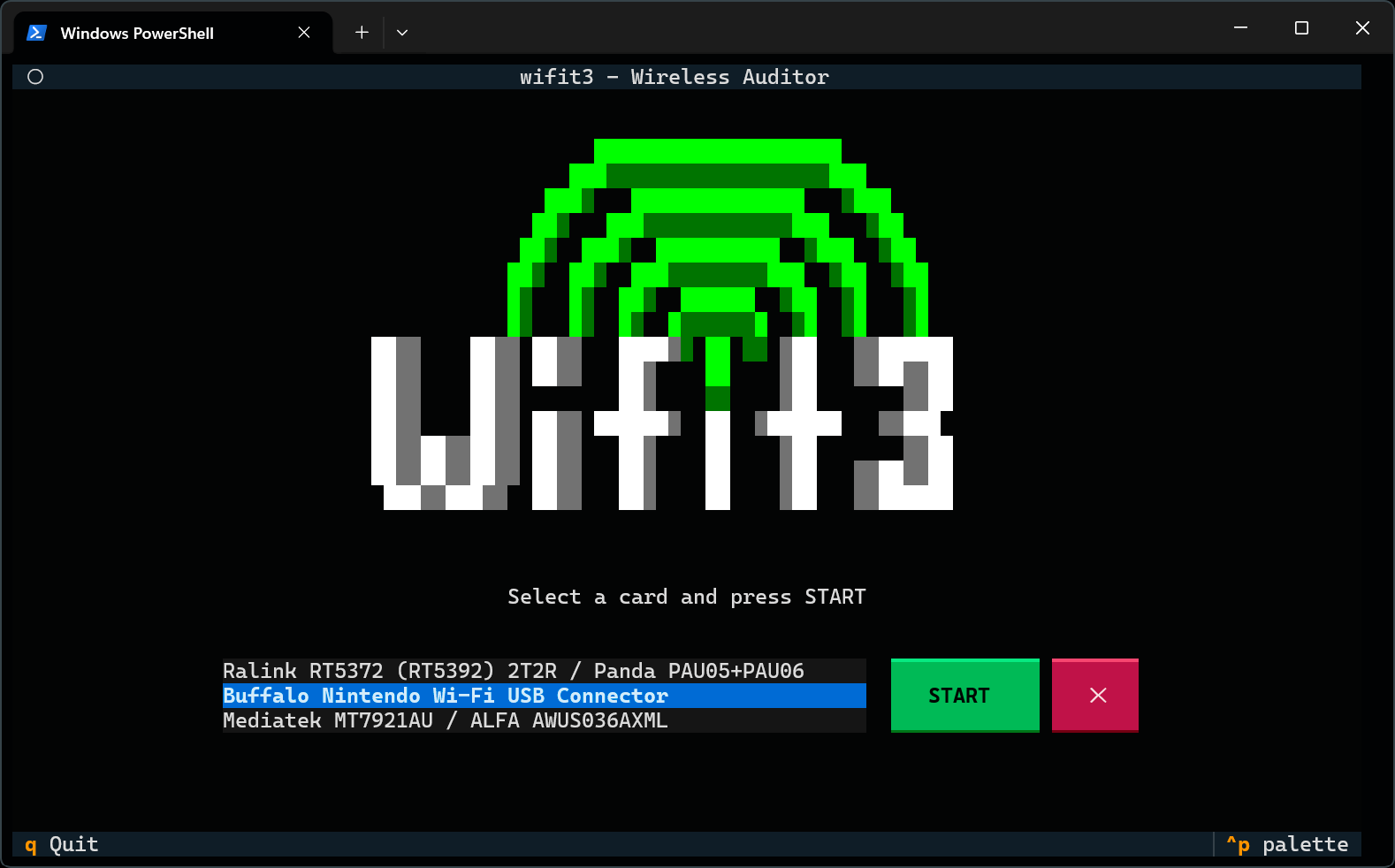
wifit3 automatically handles hardware configuration within the app, after clicking the START button:
Linux: Prompts once via pkexec/sudo to write udev permissions and blocklists in /etc/modprobe.d/.
macOS: No installation required; plug in the device and select Allow in the authorization dialog.
Windows: Prompts once via UAC to install WinUSB for the device.
VirtualBox: Add your device(s) to VirtualBox's USB Filtersbefore plugging in.
Uninstalling
Return the previously-installed device to your operating system's Wi-Fi stack:
Select the card on the wifit3 splash screen.
Click the Uninstall button and confirm.
Accept the elevation prompt (UAC on Windows or pkexec on Linux).
Unplug and re-plug the adapter.
On Linux, this deletes wifit3's udev and modprobe rules.
On Windows, this uninstalls the WinUSB binding, and triggers a PnP device rescan (old driver reattaches).
Thank you, Linux!
wifit3 only exists because of the great people who reverse-engineered and maintained these Linux wireless
drivers. It's usually a thankless job.
Special thanks to:
Christian "kimo" B. (@kimocoder) who maintains wifite2 and aircrack-ng's RTL8188EUS DKMS driver.
Neur0sp1cy: Close friend and the master to my Linux & wireless-hacking apprenticeship.
Nick Morrow (@morrownr), legend, maintains the out-of-tree Realtek USB
DKMS drivers.
The full list is in CREDITS.md.
How it Works: Mini-Drivers
wifit3 bypasses the operating system's native Wi-Fi stack entirely. It ships with lightweight Python ports of Linux kernel drivers (src/wifit3/chips/*) that directly control wireless devices over USB bulk and control transfers.
Because register-level frame injection and monitor mode are performed entirely in user space, Windows NDIS restrictions and Linux kernel driver locking do not apply.
For architecture details, driver porting methodology, and USB trace replay tooling, see the Porting Documentation.
License & Disclaimer
Code: Licensed under GNU General Public License v2.0 (matching upstream Linux drivers).
Firmware: Vendor firmware blobs loaded onto adapters are redistributed verbatim under their respective manufacturers' licenses (details in FIRMWARE.md).
⚠️ Notice & Disclaimer: For use only on networks and equipment you own or are explicitly authorized to audit. wifit3 operates directly on USB hardware registers without kernel guardrails; use at your own risk.
The most recent commit recorded on derv82/wifit3 was 15 days ago, based on the GitHub push timestamp. The repository has 357 forks — one of the better signals of community interest.
How many stars does derv82/wifit3 have?
derv82/wifit3 has 3.4k GitHub stars — refresh the page for the live number, or check github.com/derv82/wifit3. TopGit mirrors GitHub's count but does not claim minute-by-minute accuracy.
What is derv82/wifit3?
derv82/wifit3 (derv82/wifit3) is a Python project on GitHub. From the project's own README: Wifite but USB-only & cross-platform.
What language is derv82/wifit3 written in?
derv82/wifit3 is written primarily in Python. GitHub's language field is based on the largest share of bytes in the default branch.
What topics is derv82/wifit3 associated with?
GitHub's repository topics for derv82/wifit3: "cross-platform", "userland", "wifi-scanner", "wifi-security", "wireless-security". TopGit's editorial category is open-source.
Read full README in the tab above.
Still deciding about wifit3?
One click hands the question to an AI along with this page — see what it says about wifit3.

 /wifit3