digitalocean/firebolt sits at 719 stars on GitHub, written primarily in Go. Golang framework for streaming ETL, observability data pipeline, and event processing apps
Snapshot summary built from the project's own GitHub metadata — there's no written TopGit review yet. The page will update automatically when a full review is published.
WHY NO REVIEW YET
TopGit writes full reviews for the most-starred, most-requested repositories. This page is a snapshot until then — see the READ ME tab for the original README in full.
A golang framework for streaming event processing & data pipeline apps
Introduction
Firebolt has a simple model intended to make it easier to write reliable pipeline applications that process a stream of data.
It can be used to build systems such as:
logging/observability pipelines
streaming ETL
event processing pipelines
Every application's pipeline starts with a single source, the component that receives events from some external system. Sources
must implement the node.Source interface.
We provide one built-in source:
kafkaconsumer - Events come from a Kafka topic, and are passed to the root nodes as []byte
The processing of your application is executed by its nodes which form a processing tree. Data - events - flow down
this tree. A parent node passes results down to it's child nodes. Nodes may process events synchronously or
asynchronously. A synchronous node type node.FanoutNode returns a slice of results for fanout or 'demultiplexing' use
cases. Each node must implement the node.SyncNode, node.FanoutNode, or node.AsyncNode interfaces accordingly.
We provide two built-in node types:
kafkaproducer - Events are produced onto a kafka topic by an asynchronous producer.
elasticsearch - Events are bulk indexed into Elasticsearch.
Firebolt has both run and compile-time dependencies on librdkafka, see Developing
Example: Logging Pipeline
At DigitalOcean, our first use of Firebolt was in our logging pipeline. This pipeline consumes logs from just about
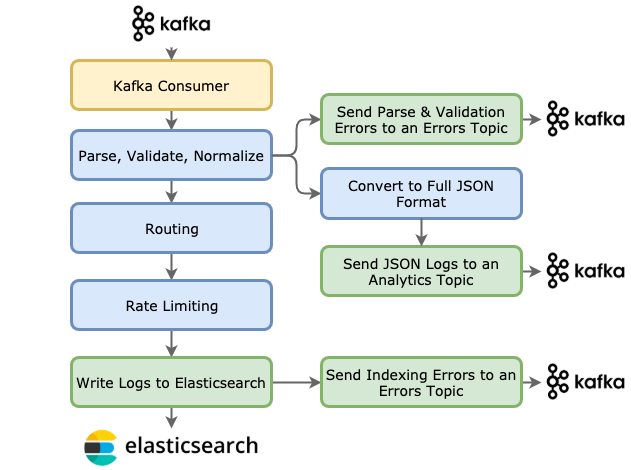
every system we run. The diagram below depicts the source and nodes in this application.
This system uses the built-in kafkaconsumer source (in yellow) and kafkaproducer and elasticsearch nodes (in green).
The blue nodes are custom to this application.
What does Firebolt do for me?
Firebolt is intended to address a number of concerns that are common to near-realtime data pipeline applications, making it easy
to run a clustered application that scales predictably to handle large data volume.
It is not an analytics tool - it does not provide an easy way to support 'wide operations' like record grouping, windowing,
or sorting that require shuffling data within the cluster. Firebolt is for 'straight through' processing pipelines that are
not sensitive to the order in which events are processed.
Some of the concerns Firebolt addresses include:
kafka sources Minimal configuration and no code required to consume from a Kafka topic, consumer lag metrics included
kafka sinks Same for producing to a Kafka topic
loose coupling Nodes in the pipeline are loosely coupled, making them easily testable and highly reusable
simple stream filtering Filter the stream by returning nil in your nodes
convenient error handling Send events that fail processing to a kafka topic for recovery or analysis with a few lines of config
outage recovery: offset management Configurable Kafka offset management during recovery lets you determine the maximum "catch up" to attempt after an outage, so you can quickly get back to realtime processing.
outage recovery: parallel recovery After an outage, process realtime data and "fill-in" the outage time window in parallel, with a rate limit on the recovery window.
monitorability Firebolt exposes Prometheus metrics to track the performance of your Source and all Nodes without writing code. Your nodes can expose their own custom internal metrics as needed.
leader election Firebolt uses Zookeeper to conduct leader elections, facilitating any processing that may need to be conducted on one-and-only-one instance.
Documentation
Configuration The configuration file format
Execution How Firebolt processes your data
Registry Adding node types to the registry
Sample Application Code Example code for running the Firebolt executor
Sources Implementing and using sources
Sync Nodes Implementing and using synchronous nodes
Fanout Nodes Implementing and using fanout nodes
Async Nodes Implementing and using asynchronous nodes
Leader Election Starting leader election and accessing election results
Messaging How to send and receive messages between the components of your system
Metrics What metrics are exposed by default, and how to add custom metrics to your nodes
Built-In Types
Kafka Producer Node for producing events onto a Kafka topic
Elasticsearch Node for indexing documents to an Elasticsearch cluster
Developing
Firebolt depends on librdkafka v1.3.0 or later. To get started building a
firebolt app (or working on firebolt itself), install it following the
instructions here.
TopGit's metadata for digitalocean/firebolt does not record a license. Most public repositories on GitHub ARE open source, but the exact terms vary — verify by opening the LICENSE file directly.
What is digitalocean/firebolt?
digitalocean/firebolt (digitalocean/firebolt) is a Go project on GitHub. From the project's own README: Golang framework for streaming ETL, observability data pipeline, and event processing apps
Where do I read more about digitalocean/firebolt?
This TopGit page is a snapshot — the READ ME tab shows the project's own README content (links stripped, images preserved). The GitHub repository at github.com/digitalocean/firebolt is the definitive source.
Read full README in the tab above.
Curious whether firebolt is right for you?
Let ChatGPT, Claude, or Perplexity look into it — click below and see what AI actually says about firebolt.
 /firebolt