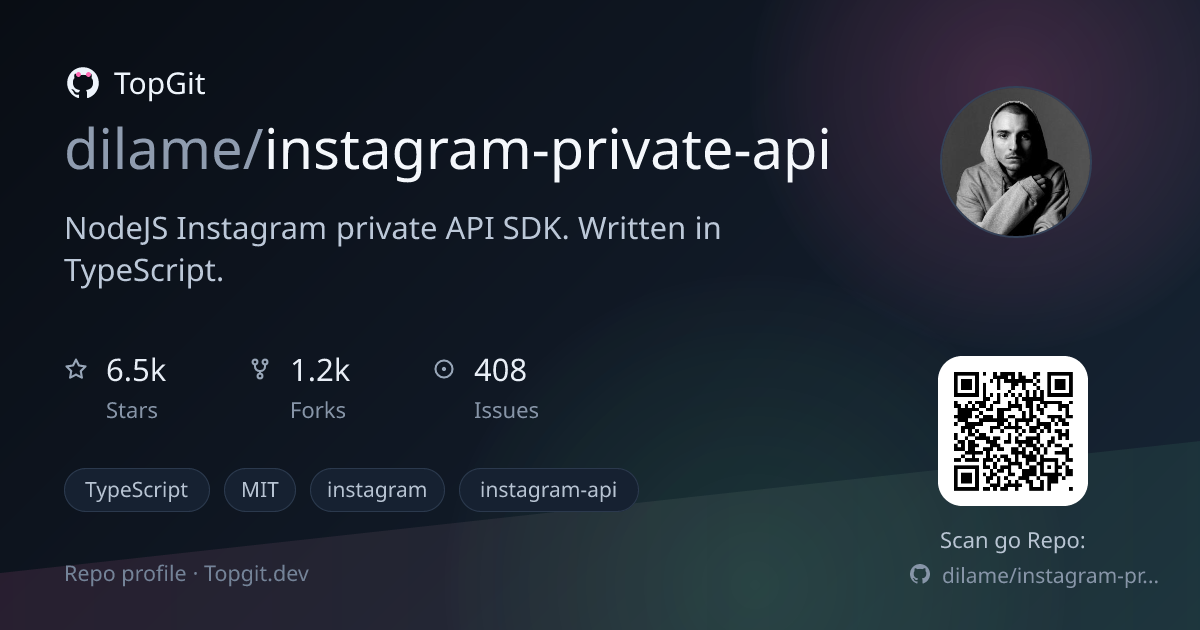
Snapshot of dilame/instagram-private-api: 6.5k★, TypeScript. NodeJS Instagram private API SDK. Written in TypeScript.
Snapshot summary built from the project's own GitHub metadata — there's no written TopGit review yet. The page will update automatically when a full review is published.
WHY NO REVIEW YET
TopGit writes full reviews for the most-starred, most-requested repositories. This page is a snapshot until then — see the READ ME tab for the original README in full.
Nerix and I are excited to announce the next 3.x.x version of this library.
It features an extended list of capabilities and is a significant release.
We have substantially expanded the functionality and possibilities.
The library has transformed into a monorepository and is now a set of libraries connected in an ecosystem.
It consists of:
Android API
Web API
FBNS, Realtime
We've made some design decisions and simplified the state management process.
Now, you can easily create a snapshot of the account state, save it in persistent storage, and restore a 1-to-1 copy with just one function call.
With new realtime features, you can listen for new direct messages, notifications, and other events.
You can take a look at the type documentation for the next version by following this link – https://docs.igpapi.com
The new version is hosted in a private repository and access is paid.
Members receive exhaustive support for the entire integration process.
Contact me in telegram or email for details.
Table of Contents
Install
Support us
Examples
Basic Concepts
Feeds
Repositories
Services
Contribution
Useful Links
Special Thanks
Thanks to Contributors
End User License Agreement (EULA)
Install
From npm
npm install instagram-private-api
From github
npm install github:dilame/instagram-private-api
This package uses url-regex-safe (GitHub) to check for links when sending direct messages.
By default, the safe regex engine re2 is not installed.
⚠ It's highly recommended for you to install re2 by running npm install re2, else you will be vulnerable to CVE-2020-7661.
Support us
If you find this library useful for you, you can support it by donating any amount
BTC: 1Dqnz9QuswAvD3t7Jsw7LhwprR6HAWprW6
Examples
You can find usage examples here.
Note for JavaScript users:
As of Node v.13.5.0, there isn't support for ESModules and the 'import'-syntax.
So you have to read the imports in the examples like this:
import { A } from 'b' ➡ const { A } = require('b')
import { IgApiClient } from 'instagram-private-api';
import { sample } from 'lodash';

const ig = new IgApiClient();
// You must generate device id's before login.
// Id's generated based on seed
// So if you pass the same value as first argument - the same id's are generated every time
ig.state.generateDevice(process.env.IG_USERNAME);
// Optionally you can setup proxy url
ig.state.proxyUrl = process.env.IG_PROXY;
(async () => {
  // Execute all requests prior to authorization in the real Android application
  // Not required but recommended
  await ig.simulate.preLoginFlow();
  const loggedInUser = await ig.account.login(process.env.IG_USERNAME, process.env.IG_PASSWORD);
  // The same as preLoginFlow()
  // Optionally wrap it to process.nextTick so we dont need to wait ending of this bunch of requests
  process.nextTick(async () => await ig.simulate.postLoginFlow());
  // Create UserFeed instance to get loggedInUser's posts
  const userFeed = ig.feed.user(loggedInUser.pk);
  const myPostsFirstPage = await userFeed.items();
  // All the feeds are auto-paginated, so you just need to call .items() sequentially to get next page
  const myPostsSecondPage = await userFeed.items();
  await ig.media.like({
    // Like our first post from first page or first post from second page randomly
    mediaId: sample([myPostsFirstPage[0].id, myPostsSecondPage[0].id]),
    moduleInfo: {
      module_name: 'profile',
      user_id: loggedInUser.pk,
      username: loggedInUser.username,
    },
    d: sample([0, 1]),
  });
})();
Basic concepts
You can find documentation in the docs folder.
Consider starting in IgApiClient (index module), the root class.
You'll often see ig in the docs.
This just refers to the client, an instance of IgApiClient holding the state for one user.
import { IgApiClient } from 'instagram-private-api';

// This is the general convention on how to name the client
//    vv
const ig = new IgApiClient();

// login, load a session etc.
Repositories
Repositories implement low-level operations - every method sends exactly one api-request.
See the list of available repositories here.
See the list of their keys in IgApiClient here.
You access repositories on the client (IgApiClient) by their lower-case (camelCase) name without the Repository suffix.
For example, you access the instance of AddressBookRepository by ig.addressBook.
Feeds
Feeds represent paginated endpoints like a user's feed (UserFeed).
Think of feeds like (async-)iterators/streams/observables (in fact feeds are async iterable and observable (feed.item$)).
Every feed is accessible via ig.feed.feedName() (camelCase name). ig.feed is the FeedFactory that creates feeds for you connected to the instance of ig.
See the list of available feeds here.
See the list of their keys in FeedFactory (ig.feed) here.
See this example and learn how to work with library feeds.
Most of the feeds require initialization parameter(s), like a user-pk (id).
Services
Services will help you to maintain some actions without calling a couple repository methods or perform complex things like pre and postlogin flow simulations or photo/video publishing.
See the list of available repositories here.
See the list of their keys in IgApiClient here.
Debugging
In order to get debug infos provided by the library, you can enable debugging.
The prefix for this library is ig.
To get all debug logs (recommended) set the namespace to ig:*.
Node
In Node you only have to set the environment variable DEBUG to the desired namespace.
Further information
Contribution
If you need features that is not implemented - feel free to implement and create PRs!
Plus we need some documentation, so if you are good in it - you are welcome.
Setting up your environment is described here.
Useful links
instagram-id-to-url-segment - convert the image url fragment to the media ID
Special thanks
Richard Hutta, original author of this library. Thanks to him for starting it.
Thanks to contributors
Nerixyz, for writing a huge amount of code for this library.
Does dilame/instagram-private-api have a project website?
No homepage URL was recorded for dilame/instagram-private-api in TopGit's last sync. The README tab above frequently contains screenshots and demo links, or check the repository description on GitHub.
How many stars does dilame/instagram-private-api have?
dilame/instagram-private-api has 6.5k GitHub stars — refresh the page for the live number, or check github.com/dilame/instagram-private-api. TopGit mirrors GitHub's count but does not claim minute-by-minute accuracy.
Is dilame/instagram-private-api open source?
Yes — dilame/instagram-private-api ships under the MIT license, which makes its source code freely readable (and, depending on license terms, forkable and reusable). Source: github.com/dilame/instagram-private-api.
What is dilame/instagram-private-api?
dilame/instagram-private-api (dilame/instagram-private-api) is a TypeScript project on GitHub. From the project's own README: NodeJS Instagram private API SDK. Written in TypeScript.
Where do I read more about dilame/instagram-private-api?
This TopGit page is a snapshot — the READ ME tab shows the project's own README content (links stripped, images preserved). The GitHub repository at github.com/dilame/instagram-private-api is the definitive source.
Read full README in the tab above.
Is instagram-private-api worth your time?
ChatGPT, Claude and Perplexity can all read this page. Ask one of them what it makes of instagram-private-api.

 /instagram-private-api