As an open-source project, discord/manifold has picked up 1.9k stars on GitHub (Elixir). Fast batch message passing between nodes for Erlang/Elixir.
Snapshot summary built from the project's own GitHub metadata — there's no written TopGit review yet. The page will update automatically when a full review is published.
WHY NO REVIEW YET
TopGit writes full reviews for the most-starred, most-requested repositories. This page is a snapshot until then — see the READ ME tab for the original README in full.
Erlang and Elixir make it very easy to send messages between processes even across the network, but there are a few pitfalls.
Sending a message to many PIDs across the network also copies the message across the network that many times.
Send calls cost about 70 µs/op so doing them in a loop eventually gets too expensive.
Discord runs a single GenServer per Discord server and some of these ~100,000 PIDs connected to them from many different Erlang nodes. Increasingly we noticed some of them getting behind on processing their message queues and the culprit was the cost of 70 µs per send/2 call multiplied by connected sessions. How could we solve this?
Inspired by a blog post about boosting performance of message passing between nodes, Manifold was born. Manifold distributes the work of sending messages to the remote nodes of the PIDs, which guarantees that the sending processes at most only calls send/2 equal to the number of involved remote nodes. Manifold does this by first grouping PIDs by their remote node and then sending to Manifold.Partitioner on each of those nodes. The partitioner then consistently hashes the PIDs using :erlang.phash2/2, groups them by number of cores, sends to child workers, and finally those workers send to the actual PIDs. This ensures the partitioner does not get overloaded and still provides the linearizability guaranteed by send/2.
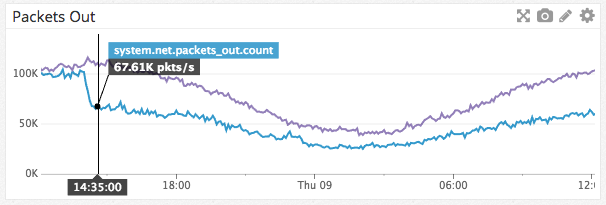
The results were great! We observed packets/sec drop by half immediately after deploying. The Discord servers in question also were finally able to keep up with their message queues.
Usage
Add it to mix.exs
defp deps do
  [{:manifold, "~> 1.0"}]
end
Then just use it like the normal send/2 except it can also take a list of PIDs.
When using Manifold there are two performance options you can choose to enable.
pack_mode
By default Manifold will send the message using vanilla External Term Format. If pack_mode is not specified or is set to nil or :etf then this mode will be used.
When messages are very large pack_mode can be set to :binary and this will cause Manifold to ensure that the term is only converted into External Term Format once. The encoding will happen in the sending process (either the calling process or a Manifold.Sender, see send_mode for additional details) and will
The :binary optimization works best with large and deeply nested messages that are being sent to PIDs across multiple nodes. Without the optimization, a message sent to N nodes will have to be translated into External Term Format N times. With large data structures, this operation can be expensive. With the optimization enabled, the encoding into binary happens once and then over distribution each sending process only needs to transmit the binary.
To send using the binary pack mode, just add the pack_mode argument
Manifold.send(self(), :hello, pack_mode: :binary)
send_mode
By default Manifold will send the message over the network from the caller process. If send_mode is not specified then the default behavior of sending from the caller process will be used.
When messages are very large, send_mode can be set to :offload which offloads the send from the calling process to a pool of Manifold.Sender processes. To maintain the linearizability guaranteed by send/2, the same calling process
always offloads the work to the same Manifold.Sender process. The size of the Manifold.Sender pool is configurable.
This send mode is optional because its benefits are workload dependent. The optimization works best when the cost of sending a message to a local process < the cost of sending a message over distribution. This is most common for messages that are very large in size. For some workloads, it might degrade overall performance. Use with caution.
Caution: To maintain the linearizability guaranteed by send/2, do not mix calls to Manifold with and without offloading. Mixed use of the two different send modes to the same set of receiving nodes would break the linearizability guarantee.
To use the :offload send mode, make sure the Manifold.Sender pool size is appropriate for the workload:
Manifold reads the following application environment options, which can be set in your config.exs. All of them are
optional; Manifold applies sensible runtime defaults when they are not set, so only configure the ones you want to
override:
Sets the module that Manifold dispatches to in order to actually call send. The default is GenServer. The configured
module must define a cast/2 function that matches the types of GenServer.cast/2.
partitioners
The number of Manifold.Partitioner processes to run per node. Defaults to 1 and is capped at 32. Increasing this
spreads partitioning work across more processes so the partitioner does not become a bottleneck.
workers_per_partitioner
The number of child workers each partitioner uses to send to the actual PIDs. Defaults to System.schedulers_online()
(the number of online schedulers, typically the number of cores).
senders
The size of the Manifold.Sender pool used when sending with send_mode: :offload (see send_mode).
Defaults to System.schedulers_online() and is capped at 128.
License
Manifold is released under the MIT License.
Check LICENSE file for more information.
No homepage URL was recorded for discord/manifold in TopGit's last sync. The README tab above frequently contains screenshots and demo links, or check the repository description on GitHub.
How active is development on discord/manifold?
The most recent commit recorded on discord/manifold was 4 months ago, based on the GitHub push timestamp. The repository has 76 forks — one of the better signals of community interest.
How many stars does discord/manifold have?
discord/manifold has 1.9k GitHub stars — refresh the page for the live number, or check github.com/discord/manifold. TopGit mirrors GitHub's count but does not claim minute-by-minute accuracy.
Is discord/manifold open source?
Yes — discord/manifold ships under the MIT license, which makes its source code freely readable (and, depending on license terms, forkable and reusable). Source: github.com/discord/manifold.
What topics is discord/manifold associated with?
GitHub's repository topics for discord/manifold: "elixir", "erlang", "message-passing", "performance". TopGit's editorial category is open-source.
Where do I read more about discord/manifold?
This TopGit page is a snapshot — the READ ME tab shows the project's own README content (links stripped, images preserved). The GitHub repository at github.com/discord/manifold is the definitive source.
Read full README in the tab above.
Want a second opinion on manifold?
Ask an AI that can read this page — one click and you get its take on manifold.

 /manifold