A look at drakeet/MultiType: 5.7k stars on GitHub, written primarily in Kotlin. Flexible multiple types for Android RecyclerView.
Snapshot summary built from the project's own GitHub metadata — there's no written TopGit review yet. The page will update automatically when a full review is published.
WHY NO REVIEW YET
TopGit writes full reviews for the most-starred, most-requested repositories. This page is a snapshot until then — see the READ ME tab for the original README in full.
Easier and more flexible to create multiple types for Android RecyclerView.
Previously, when we need to develop a complex RecyclerView / ListView, it is difficult and
troublesome work. We should override the getItemViewType() of RecyclerView.Adapter , add some types, and create some ViewHolders relating to those types. Once we need to add a new item type, we have to go to the original adapter file and modify some old codes carefully,
and these adapter classes will get more complicated.
Nowadays, I created a new intuitive and flexible way to easily create complex RecyclerViews,
with the MultiType library, we could insert a new item type without changing any old adapter codes and make them more readable.
Getting started
In your build.gradle:
MultiType has been rebuilt based on AndroidX. If you are still using the android support library, please use me.drakeet.multitype:multitype:3.4.4 and me.drakeet.multitype:multitype-kotlin:3.4.4.
In addition, since 4.0.0 we have migrated to fully build with Kotlin. If you don't want to use Kotlin, you can use the last stable version me.drakeet.multitype:multitype:3.5.0 and see 3.x.
Step 1. Create a Kotlin class or data class, for example:
data class Foo(
  val value: String
)
Step 2. Create a class extends ItemViewDelegate<T, VH : ViewHolder>, for example:
class FooViewDelegate: ItemViewDelegate<Foo, FooViewDelegate.ViewHolder>() {

  override fun onCreateViewHolder(context: Context, parent: ViewGroup): ViewHolder {
    // If you want a LayoutInflater parameter instead of a Context,
    // you can use ItemViewBinder as the parent of this class.
    return ViewHolder(FooView(context))
  }

  override fun onBindViewHolder(holder: ViewHolder, item: Foo) {
    holder.fooView.text = item.value

    Log.d("ItemViewDelegate API", "position: ${holder.bindingAdapterPosition}")
    Log.d("ItemViewDelegate API", "items: $adapterItems")
    Log.d("ItemViewDelegate API", "adapter: $adapter")
    Log.d("More", "Context: ${holder.itemView.context}")
  }

  class ViewHolder(itemView : View): RecyclerView.ViewHolder(itemView) {
    val fooView: TextView = itemView.findViewById(R.id.foo)
  }
}
Or if you are using a custom View instead of XML layout, you can use ViewDelegate:
The ViewDelegate is a simple ItemViewDelegate that does not require to declare and provide a RecyclerView.ViewHolder.
(See RichViewDelegate & RichView examples for more details)
Step 3. register your types and setup your RecyclerView, for example:
class SampleActivity : AppCompatActivity() {

  private val adapter = MultiTypeAdapter()
  private val items = ArrayList<Any>()

  override fun onCreate(savedInstanceState: Bundle?) {
    super.onCreate(savedInstanceState)
    setContentView(R.layout.activity_list)
    val recyclerView = findViewById<RecyclerView>(R.id.list)

    adapter.register(TextItemViewDelegate())
    adapter.register(ImageItemViewDelegate())
    adapter.register(RichItemViewDelegate())
    recyclerView.adapter = adapter

    val textItem = TextItem("world")
    val imageItem = ImageItem(R.mipmap.ic_launcher)
    val richItem = RichItem("小艾大人赛高", R.drawable.img_11)

    for (i in 0..19) {
      items.add(textItem)
      items.add(imageItem)
      items.add(richItem)
    }
    adapter.items = items
    adapter.notifyDataSetChanged()
  }
}
That's all, you're good to go!
Advanced usage
One to many:
adapter.register(Data::class).to(
  DataType1ViewDelegate(),
  DataType2ViewDelegate()
).withKotlinClassLinker { _, data ->
  when (data.type) {
    Data.TYPE_2 -> DataType2ViewDelegate::class
    else -> DataType1ViewDelegate::class
  }
}
See OneDataToManyActivity, OneToManyFlow and OneToManyEndpoint for more details.
More methods that you can override from ItemViewDelegate:
open fun onBindViewHolder(holder: VH, item: T, payloads: List<Any>)
open fun getItemId(item: T): Long
open fun onViewRecycled(holder: VH)
open fun onFailedToRecycleView(holder: VH): Boolean
open fun onViewAttachedToWindow(holder: VH)
open fun onViewDetachedFromWindow(holder: VH)
Android Studio Plugin
drakeet/MultiTypeTemplates
An intellij idea plugin for Android to generate MultiTypeItem and ItemViewDelegate easily.
Screenshots
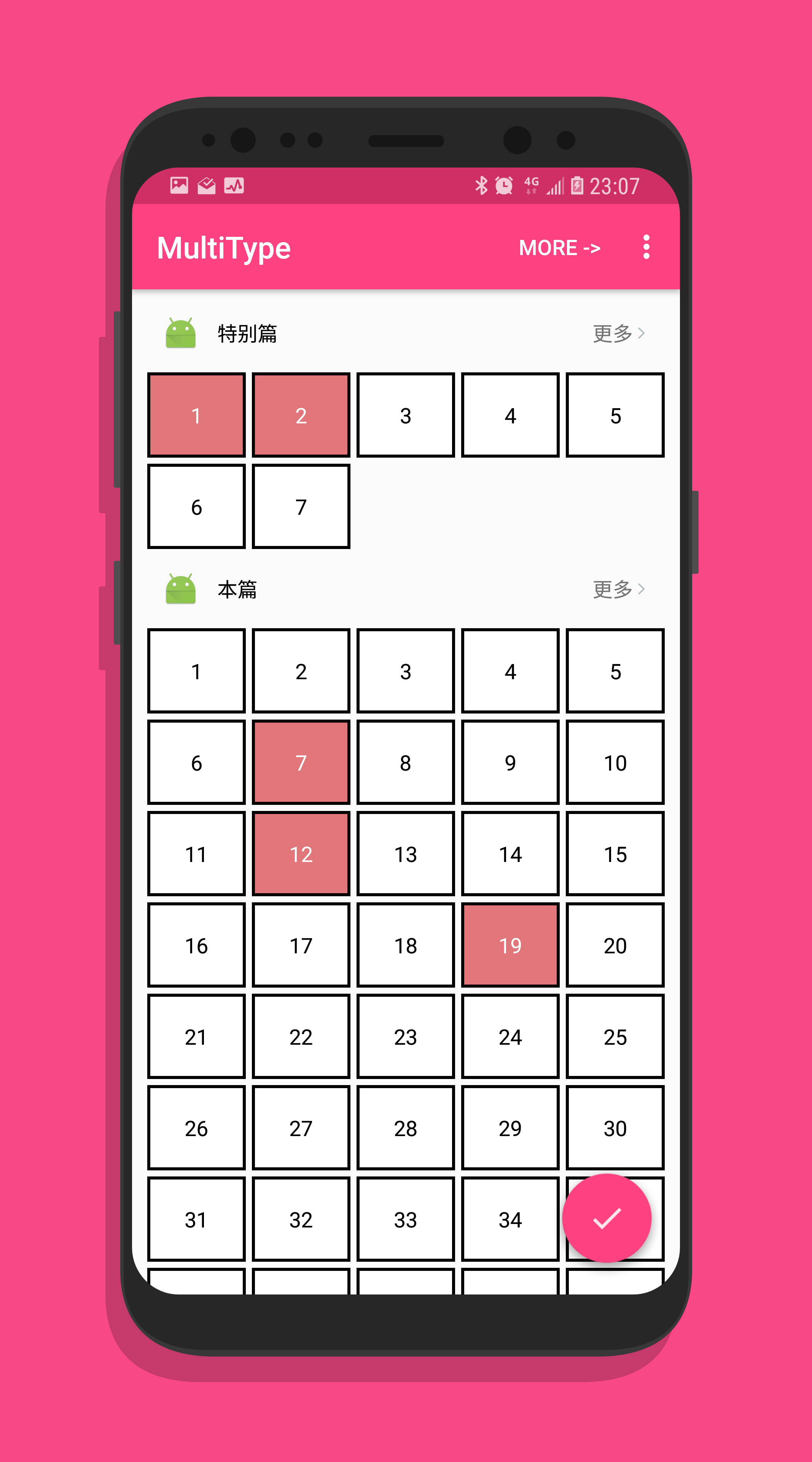
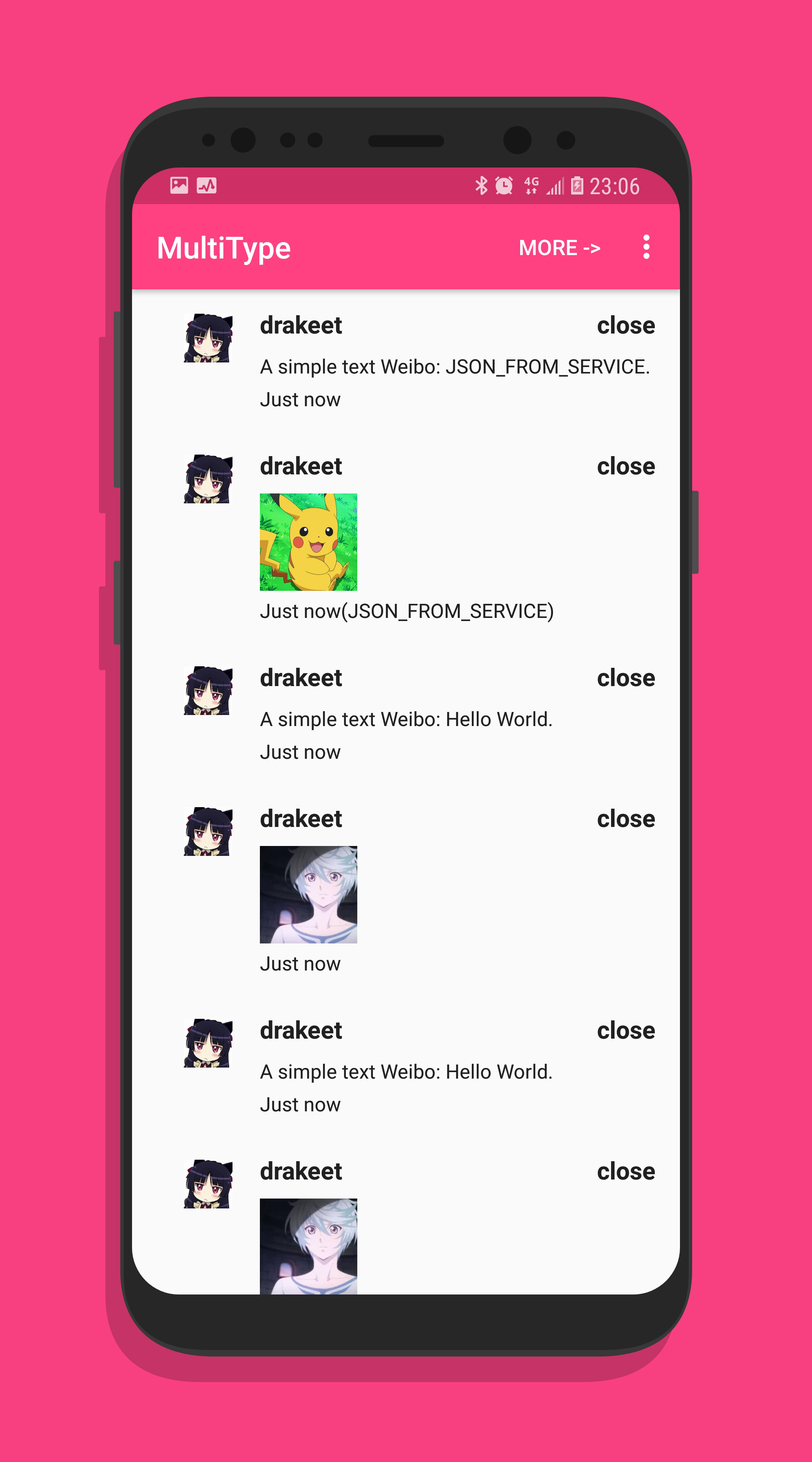
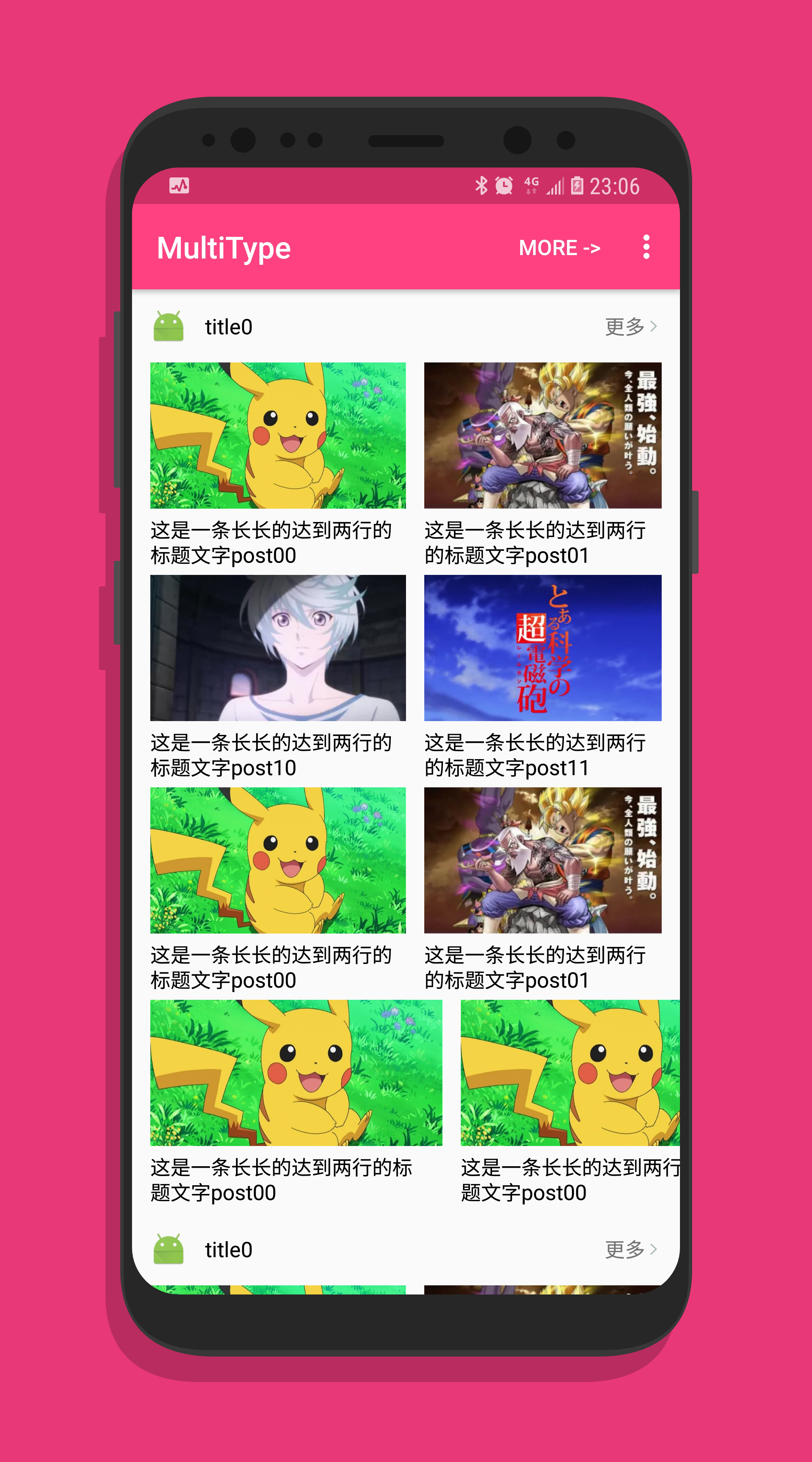
Pages created with MultiType:
License
Copyright (c) 2016-present. Drakeet Xu

Licensed under the Apache License, Version 2.0 (the "License");
you may not use this file except in compliance with the License.
You may obtain a copy of the License at

   http://www.apache.org/licenses/LICENSE-2.0

Unless required by applicable law or agreed to in writing, software
distributed under the License is distributed on an "AS IS" BASIS,
WITHOUT WARRANTIES OR CONDITIONS OF ANY KIND, either express or implied.
See the License for the specific language governing permissions and
limitations under the License.
The most recent commit recorded on drakeet/MultiType was 4.2 years ago, based on the GitHub push timestamp. The repository has 747 forks — one of the better signals of community interest.
How many stars does drakeet/MultiType have?
drakeet/MultiType has 5.7k GitHub stars — refresh the page for the live number, or check github.com/drakeet/MultiType. TopGit mirrors GitHub's count but does not claim minute-by-minute accuracy.
What is drakeet/MultiType?
drakeet/MultiType (drakeet/MultiType) is a Kotlin project on GitHub. From the project's own README: Flexible multiple types for Android RecyclerView.
What language is drakeet/MultiType written in?
drakeet/MultiType is written primarily in Kotlin. GitHub's language field is based on the largest share of bytes in the default branch.
What topics is drakeet/MultiType associated with?
GitHub's repository topics for drakeet/MultiType: "android-library", "multitype", "one-to-many", "one2many", "recyclerview", "recyclerview-multi-type". TopGit's editorial category is open-source.
Read full README in the tab above.
Want a second opinion on MultiType?
Ask an AI that can read this page — one click and you get its take on MultiType.

 /MultiType