An open-source entry in TopGit's GitHub warehouse: facebookresearch/AugLy, 5.1k stars, Python. A data augmentations library for audio, image, text, and video.
Snapshot summary built from the project's own GitHub metadata — there's no written TopGit review yet. The page will update automatically when a full review is published.
WHY NO REVIEW YET
TopGit writes full reviews for the most-starred, most-requested repositories. This page is a snapshot until then — see the READ ME tab for the original README in full.
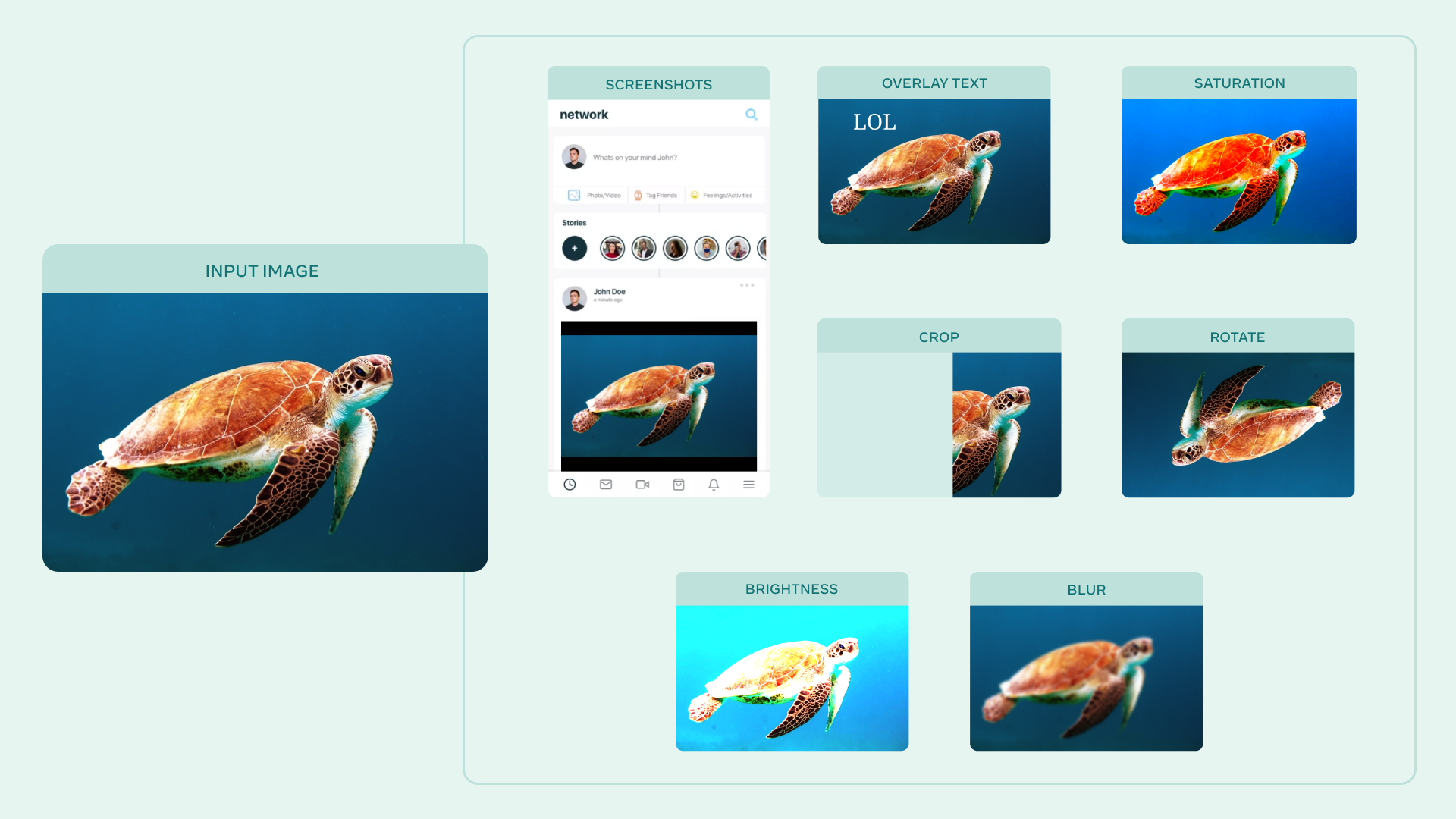
AugLy is a data augmentations library that currently supports four modalities (audio, image, text & video) and over 100 augmentations. Each modality’s augmentations are contained within its own sub-library. These sub-libraries include both function-based and class-based transforms, composition operators, and have the option to provide metadata about the transform applied, including its intensity.
AugLy is a great library to utilize for augmenting your data in model training, or to evaluate the robustness gaps of your model! We designed AugLy to include many specific data augmentations that users perform in real life on internet platforms like Facebook's -- for example making an image into a meme, overlaying text/emojis on images/videos, reposting a screenshot from social media. While AugLy contains more generic data augmentations as well, it will be particularly useful to you if you're working on a problem like copy detection, hate speech detection, or copyright infringement where these "internet user" types of data augmentations are prevalent.
To see more examples of augmentations, open the Colab notebooks in the README for each modality! (e.g. image README & Colab)
The library is Python-based and requires at least Python 3.6, as we use dataclasses.
Authors
Joanna Bitton — Software Engineer at Meta AI
Zoe Papakipos — Software Engineer at Meta AI
Installation
AugLy is a Python 3.6+ library. It can be installed with:
pip install augly[all]
If you want to only install the dependencies needed for one sub-library e.g. audio, you can install like so:
pip install augly[audio]
Or clone AugLy if you want to be able to run our unit tests, contribute a pull request, etc:
Backwards compatibility note: In versions augly<=0.2.1 we did not separate the dependencies by modality. For those versions to install most dependencies you could use pip install augly, and if you want to use the audio or video modalities you would install with pip install augly[av].
In some environments, pip doesn't install python-magic as expected. In that case, you will need to additionally run:
conda install -c conda-forge python-magic
Or if you aren't using conda:
sudo apt-get install python3-magic
Documentation
Check out our documentation on ReadtheDocs!
For more details about how to use each sub-library, how to run the tests, and links to colab notebooks with runnable examples, please see the READMEs in each respective directory (audio, image, text, & video).
Assets
We provide various media assets to use with some of our augmentations. These assets include:
Emojis (Twemoji) - Copyright 2020 Twitter, Inc and other contributors. Code licensed under the MIT License. Graphics licensed under CC-BY 4.0.
Fonts (Noto fonts) - Noto is a trademark of Google Inc. Noto fonts are open source. All Noto fonts are published under the SIL Open Font License, Version 1.1.
Screenshot Templates - Images created by a designer at Facebook specifically to use with AugLy. You can use these with the overlay_onto_screenshot augmentation in both the image and video libraries to make it look like your source image/video was screenshotted in a social media feed similar to Facebook or Instagram.
Links
Facebook AI blog post: https://ai.facebook.com/blog/augly-a-new-data-augmentation-library-to-help-build-more-robust-ai-models/
Image Similarity Challenge - a NeurIPS 2021 competition run by Facebook AI with $200k in prizes, currently open for sign ups; also produced the DISC21 dataset, which will be made publicly available after the challenge concludes!
DeepFake Detection Challenge - a Kaggle competition run by Facebook AI in 2020 with $1 million in prizes; also produced the DFDC dataset
SimSearchNet - a near-duplicate detection model developed at Facebook AI to identify infringing content on our platforms
Citation
If you use AugLy in your work, please cite our Arxiv paper using the citation below:
@misc{papakipos2022augly,
  author        = {Zoe Papakipos and Joanna Bitton},
  title         = {AugLy: Data Augmentations for Robustness},
  year          = {2022},
  eprint        = {2201.06494},
  archivePrefix = {arXiv},
  primaryClass  = {cs.AI}}
}
License
AugLy is MIT licensed, as found in the LICENSE file. Please note that some of the dependencies AugLy uses may be licensed under different terms.
How active is development on facebookresearch/AugLy?
The most recent commit recorded on facebookresearch/AugLy was 1 month ago, based on the GitHub push timestamp. The repository has 312 forks — one of the better signals of community interest.
How many stars does facebookresearch/AugLy have?
facebookresearch/AugLy has 5.1k GitHub stars — refresh the page for the live number, or check github.com/facebookresearch/AugLy. TopGit mirrors GitHub's count but does not claim minute-by-minute accuracy.
Is facebookresearch/AugLy open source?
TopGit's metadata for facebookresearch/AugLy does not record a license. Most public repositories on GitHub ARE open source, but the exact terms vary — verify by opening the LICENSE file directly.
What is facebookresearch/AugLy?
facebookresearch/AugLy (facebookresearch/AugLy) is a Python project on GitHub. From the project's own README: A data augmentations library for audio, image, text, and video.
Where do I read more about facebookresearch/AugLy?
This TopGit page is a snapshot — the READ ME tab shows the project's own README content (links stripped, images preserved). The GitHub repository at github.com/facebookresearch/AugLy is the definitive source.
Read full README in the tab above.
Curious whether AugLy is right for you?
Let ChatGPT, Claude, or Perplexity look into it — click below and see what AI actually says about AugLy.
 /AugLy