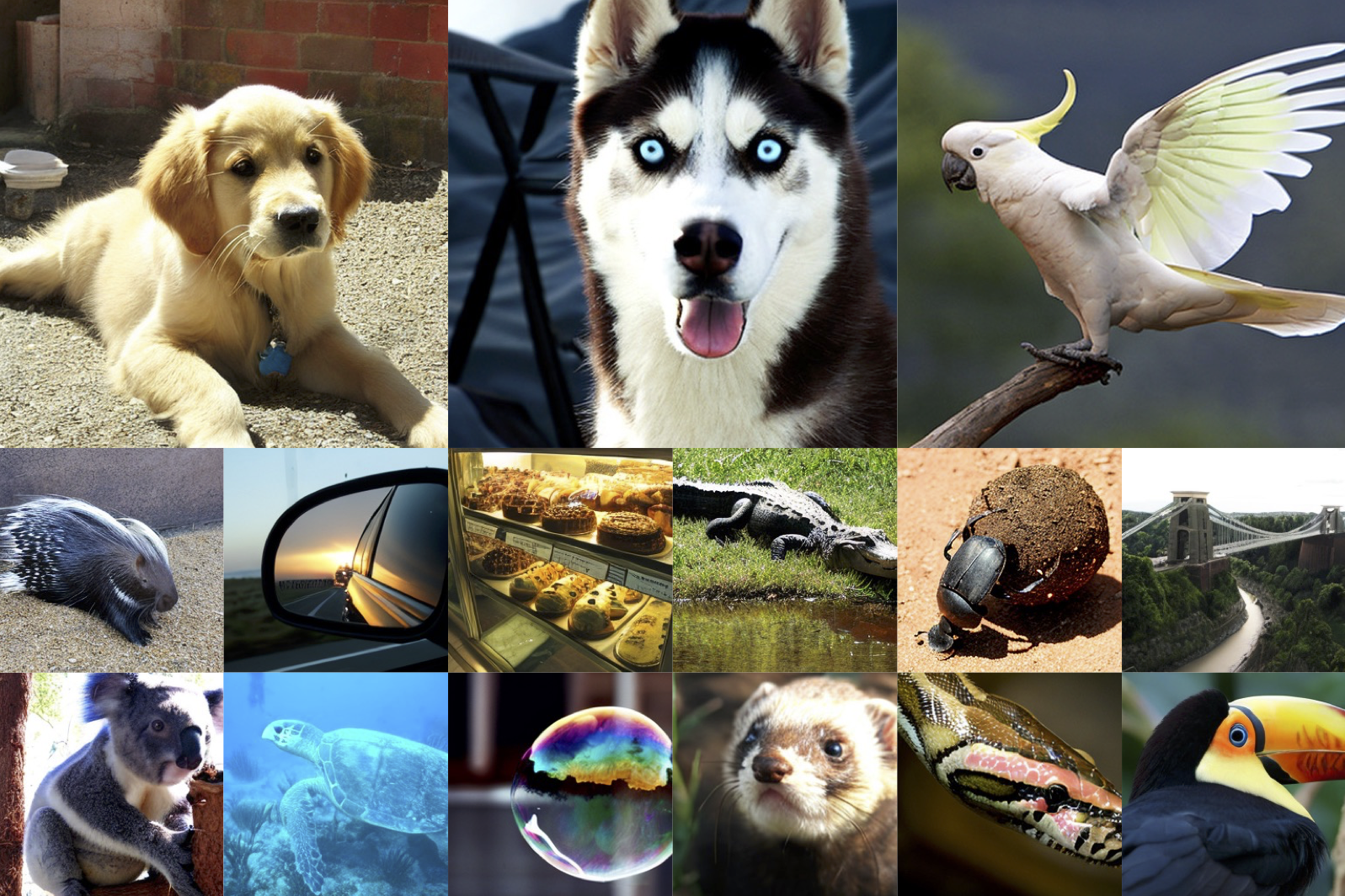
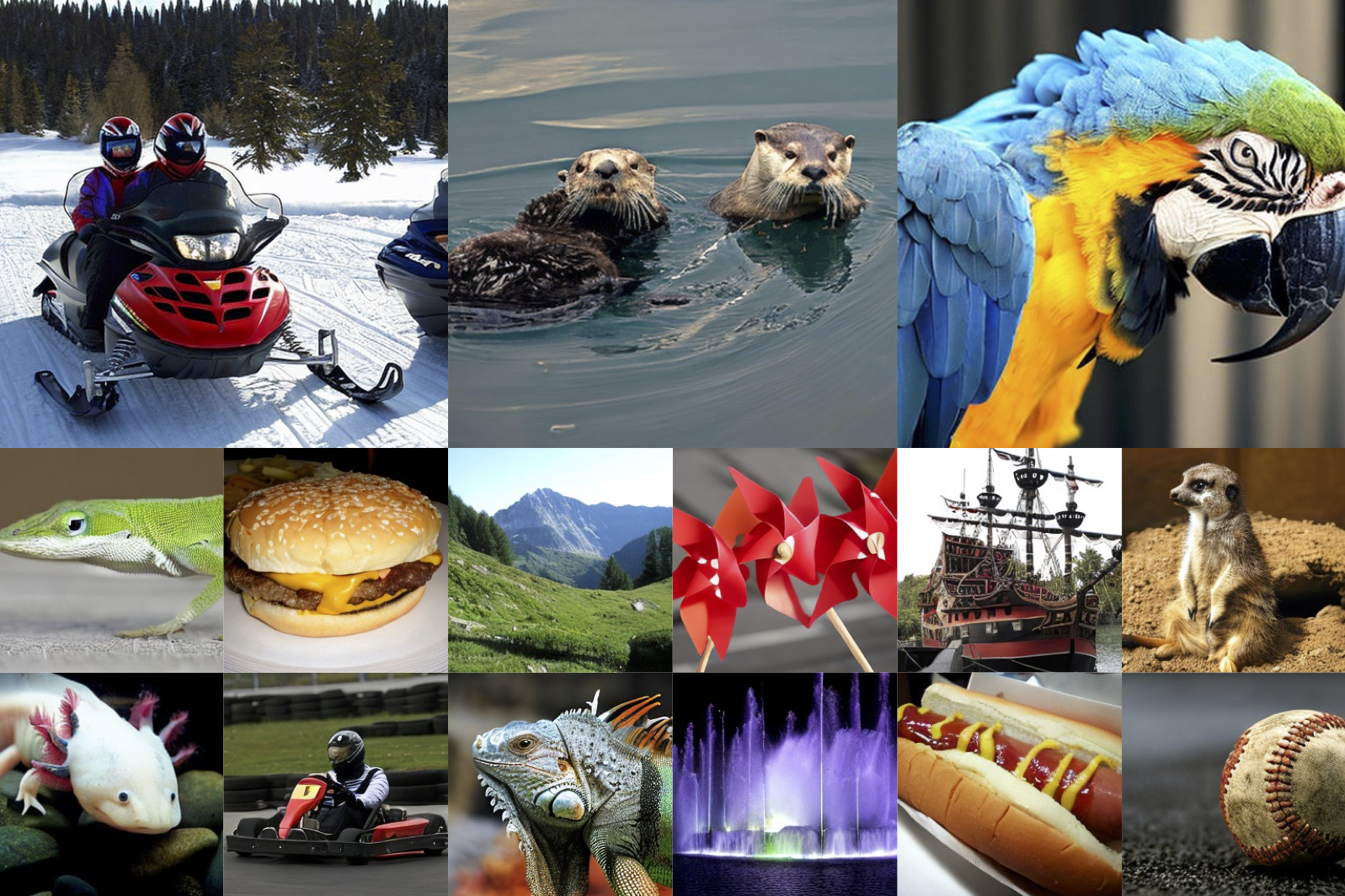
facebookresearch/DiT is an open-source project on GitHub with 8.7k stars, written primarily in Python. Official PyTorch Implementation of "Scalable Diffusion Models with Transformers"
Snapshot summary built from the project's own GitHub metadata — there's no written TopGit review yet. The page will update automatically when a full review is published.
WHY NO REVIEW YET
TopGit writes full reviews for the most-starred, most-requested repositories. This page is a snapshot until then — see the READ ME tab for the original README in full.
Scalable Diffusion Models with Transformers (DiT) Official PyTorch Implementation
Paper | Project Page | Run DiT-XL/2
This repo contains PyTorch model definitions, pre-trained weights and training/sampling code for our paper exploring
diffusion models with transformers (DiTs). You can find more visualizations on our project page.
Scalable Diffusion Models with Transformers
William Peebles, Saining Xie
UC Berkeley, New York University
We train latent diffusion models, replacing the commonly-used U-Net backbone with a transformer that operates on
latent patches. We analyze the scalability of our Diffusion Transformers (DiTs) through the lens of forward pass
complexity as measured by Gflops. We find that DiTs with higher Gflops---through increased transformer depth/width or
increased number of input tokens---consistently have lower FID. In addition to good scalability properties, our
DiT-XL/2 models outperform all prior diffusion models on the class-conditional ImageNet 512×512 and 256×256 benchmarks,
achieving a state-of-the-art FID of 2.27 on the latter.
This repository contains:
🪐 A simple PyTorch implementation of DiT
⚡️ Pre-trained class-conditional DiT models trained on ImageNet (512x512 and 256x256)
💥 A self-contained Hugging Face Space and Colab notebook for running pre-trained DiT-XL/2 models
🛸 A DiT training script using PyTorch DDP
An implementation of DiT directly in Hugging Face diffusers can also be found here.
Setup
First, download and set up the repo:
git clone https://github.com/facebookresearch/DiT.git
cd DiT
We provide an environment.yml file that can be used to create a Conda environment. If you only want
to run pre-trained models locally on CPU, you can remove the cudatoolkit and pytorch-cuda requirements from the file.
conda env create -f environment.yml
conda activate DiT
Sampling
Pre-trained DiT checkpoints. You can sample from our pre-trained DiT models with sample.py. Weights for our pre-trained DiT model will be
automatically downloaded depending on the model you use. The script has various arguments to switch between the 256x256
and 512x512 models, adjust sampling steps, change the classifier-free guidance scale, etc. For example, to sample from
our 512x512 DiT-XL/2 model, you can use:
python sample.py --image-size 512 --seed 1
For convenience, our pre-trained DiT models can be downloaded directly here as well:
DiT Model
Image Resolution
FID-50K
Inception Score
Gflops
XL/2
256x256
2.27
278.24
119
XL/2
512x512
3.04
240.82
525
Custom DiT checkpoints. If you've trained a new DiT model with train.py (see below), you can add the --ckpt
argument to use your own checkpoint instead. For example, to sample from the EMA weights of a custom
256x256 DiT-L/4 model, run:
We provide a training script for DiT in train.py. This script can be used to train class-conditional
DiT models, but it can be easily modified to support other types of conditioning. To launch DiT-XL/2 (256x256) training with N GPUs on
one node:
We've trained DiT-XL/2 and DiT-B/4 models from scratch with the PyTorch training script
to verify that it reproduces the original JAX results up to several hundred thousand training iterations. Across our experiments, the PyTorch-trained models give
similar (and sometimes slightly better) results compared to the JAX-trained models up to reasonable random variation. Some data points:
DiT Model
Train Steps
FID-50K (JAX Training)
FID-50K (PyTorch Training)
PyTorch Global Training Seed
XL/2
400K
19.5
18.1
42
B/4
400K
68.4
68.9
42
B/4
400K
68.4
68.3
100
These models were trained at 256x256 resolution; we used 8x A100s to train XL/2 and 4x A100s to train B/4. Note that FID
here is computed with 250 DDPM sampling steps, with the mse VAE decoder and without guidance (cfg-scale=1).
TF32 Note (important for A100 users). When we ran the above tests, TF32 matmuls were disabled per PyTorch's defaults.
We've enabled them at the top of train.py and sample.py because it makes training and sampling way way way faster on
A100s (and should for other Ampere GPUs too), but note that the use of TF32 may lead to some differences compared to
the above results.
Enhancements
Training (and sampling) could likely be sped-up significantly by:
using Flash Attention in the DiT model
using torch.compile in PyTorch 2.0
Basic features that would be nice to add:
Monitor FID and other metrics
Generate and save samples from the EMA model periodically
Resume training from a checkpoint
AMP/bfloat16 support
🔥 Feature Update Check out this repository at https://github.com/chuanyangjin/fast-DiT to preview a selection of training speed acceleration and memory saving features including gradient checkpointing, mixed precision training and pre-extrated VAE features. With these advancements, we have achieved a training speed of 0.84 steps/sec for DiT-XL/2 using just a single A100 GPU.
Evaluation (FID, Inception Score, etc.)
We include a sample_ddp.py script which samples a large number of images from a DiT model in parallel. This script
generates a folder of samples as well as a .npz file which can be directly used with ADM's TensorFlow
evaluation suite to compute FID, Inception Score and
other metrics. For example, to sample 50K images from our pre-trained DiT-XL/2 model over N GPUs, run:
There are several additional options; see sample_ddp.py for details.
Differences from JAX
Our models were originally trained in JAX on TPUs. The weights in this repo are ported directly from the JAX models.
There may be minor differences in results stemming from sampling with different floating point precisions. We re-evaluated
our ported PyTorch weights at FP32, and they actually perform marginally better than sampling in JAX (2.21 FID
versus 2.27 in the paper).
BibTeX
@article{Peebles2022DiT,
  title={Scalable Diffusion Models with Transformers},
  author={William Peebles and Saining Xie},
  year={2022},
  journal={arXiv preprint arXiv:2212.09748},
}
Acknowledgments
We thank Kaiming He, Ronghang Hu, Alexander Berg, Shoubhik Debnath, Tim Brooks, Ilija Radosavovic and Tete Xiao for helpful discussions.
William Peebles is supported by the NSF Graduate Research Fellowship.
This codebase borrows from OpenAI's diffusion repos, most notably ADM.
License
The code and model weights are licensed under CC-BY-NC. See LICENSE.txt for details.
No homepage URL was recorded for facebookresearch/DiT in TopGit's last sync. The README tab above frequently contains screenshots and demo links, or check the repository description on GitHub.
Does facebookresearch/DiT have any tags?
TopGit's last sync did not record any GitHub topics for facebookresearch/DiT. GitHub topics appear in the right sidebar of a repository page; that's the authoritative place to check.
How active is development on facebookresearch/DiT?
The most recent commit recorded on facebookresearch/DiT was 2.5 years ago, based on the GitHub push timestamp. The repository has 807 forks — one of the better signals of community interest.
Is facebookresearch/DiT open source?
TopGit's metadata for facebookresearch/DiT does not record a license. Most public repositories on GitHub ARE open source, but the exact terms vary — verify by opening the LICENSE file directly.
Where do I read more about facebookresearch/DiT?
This TopGit page is a snapshot — the READ ME tab shows the project's own README content (links stripped, images preserved). The GitHub repository at github.com/facebookresearch/DiT is the definitive source.
Read full README in the tab above.
Is DiT worth your time?
ChatGPT, Claude and Perplexity can all read this page. Ask one of them what it makes of DiT.

 /DiT