An open-source entry in TopGit's GitHub warehouse: facebookresearch/ParlAI, 10.6k stars, Python. A framework for training and evaluating AI models on a variety of openly available dialogue datasets.
Snapshot summary built from the project's own GitHub metadata — there's no written TopGit review yet. The page will update automatically when a full review is published.
WHY NO REVIEW YET
TopGit writes full reviews for the most-starred, most-requested repositories. This page is a snapshot until then — see the READ ME tab for the original README in full.
ParlAI (pronounced “par-lay”) is a python framework for
sharing, training and testing dialogue models, from open-domain chitchat, to
task-oriented dialogue, to visual question answering.
Its goal is to provide researchers:
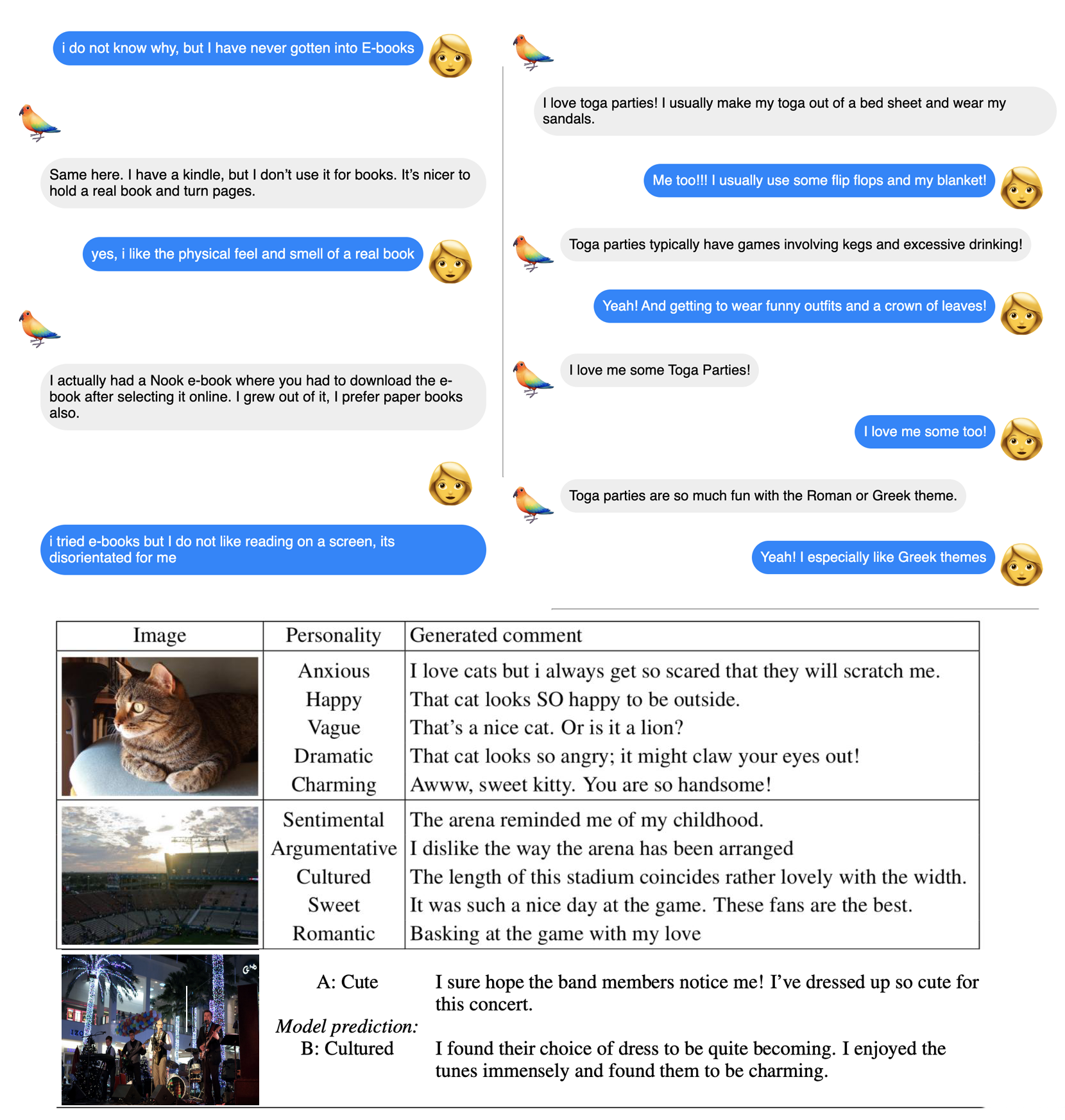
100+ popular datasets available all in one place, with the same API, among them PersonaChat, DailyDialog, Wizard of Wikipedia, Empathetic Dialogues, SQuAD, MS MARCO, QuAC, HotpotQA, QACNN & QADailyMail, CBT, BookTest, bAbI Dialogue tasks, Ubuntu Dialogue, OpenSubtitles, Image Chat, VQA, VisDial and CLEVR. See the complete list here.
a wide set of reference models -- from retrieval baselines to Transformers.
a large zoo of pretrained models ready to use off-the-shelf
seamless integration of Amazon Mechanical Turk for data collection and human evaluation
integration with Facebook Messenger to connect agents with humans in a chat interface
a large range of helpers to create your own agents and train on several tasks with multitasking
multimodality, some tasks use text and images
ParlAI is described in the following paper:
“ParlAI: A Dialog Research Software Platform", arXiv:1705.06476
or see these more up-to-date slides.
Follow us on Twitter and check out our Release
notes to see the latest
information about new features & updates, and the website
http://parl.ai for further docs. For an archived list of updates,
check out NEWS.md.
Interactive Tutorial
For those who want to start with ParlAI now, you can try our Colab Tutorial.
Installing ParlAI
Operating System
ParlAI should work as inteded under Linux or macOS. We do not support Windows at this time, but many users report success on Windows using Python 3.8 and issues with Python 3.9. We are happy to accept patches that improve Windows support.
Python Interpreter
ParlAI currently requires Python3.8+.
Requirements
ParlAI supports Pytorch 1.6 or higher.
All requirements of the core modules are listed in requirements.txt. However, some models included (in parlai/agents) have additional requirements.
Virtual Environment
We strongly recommend you install ParlAI in a virtual environment using venv or conda.
End User Installation
If you want to use ParlAI without modifications, you can install it with:
Many users will want to modify some parts of ParlAI. To set up a development
environment, run the following commands to clone the repository and install
ParlAI:
Note
Sometimes the install from source maynot work due to dependencies (specially in PyTorch related packaged).
In that case try building a fresh conda environment and running the similar to the following:
conda install pytorch==2.0.0 torchvision torchaudio torchtext pytorch-cuda=11.8 -c pytorch -c nvidia.
Check torch setup documentation for your CUDA and OS versions.
All needed data will be downloaded to ~/ParlAI/data. If you need to clear out
the space used by these files, you can safely delete these directories and any
files needed will be downloaded again.
Documentation
Quick Start
Basics: world, agents, teachers, action and observations
Creating a new dataset/task
List of available tasks/datasets
Creating a seq2seq agent
List of available agents
Model zoo (list pretrained models)
Running crowdsourcing tasks
Plug into Facebook Messenger
Examples
A large set of scripts can be found in parlai/scripts. Here are a few of them.
Note: If any of these examples fail, check the installation section to see if you have missed something.
Display 10 random examples from the SQuAD task
parlai display_data -t squad
Evaluate an IR baseline model on the validation set of the Personachat task:
Train a single layer transformer on PersonaChat (requires pytorch and torchtext).
Detail: embedding size 300, 4 attention heads, 2 epochs using batchsize 64, word vectors are initialized with fasttext and the other elements of the batch are used as negative during training.
agents: contains agents which can interact with the different tasks (e.g. machine learning models)
scripts: contains a number of useful scripts, like training, evaluating, interactive chatting, ...
tasks: contains code for the different tasks available from within ParlAI
mturk: contains code for setting up Mechanical Turk, as well as sample MTurk tasks
messenger: contains code for interfacing with Facebook Messenger
utils: contains a wide number of frequently used utility methods
crowdsourcing: contains code for running crowdsourcing tasks, such as on Amazon Mechanical Turk
chat_service: contains code for interfacing with services such as Facebook Messenger
zoo: contains code to directly download and use pretrained models from our model zoo
Support
If you have any questions, bug reports or feature requests, please don't hesitate to post on our Github Issues page.
You may also be interested in checking out our FAQ and
our Tips n Tricks.
Please remember to follow our Code of Conduct.
Contributing
We welcome PRs from the community!
You can find information about contributing to ParlAI in our
Contributing
document.
The Team
ParlAI is currently maintained by Moya Chen, Emily Dinan, Dexter Ju, Mojtaba
Komeili, Spencer Poff, Pratik Ringshia, Stephen Roller, Kurt Shuster,
Eric Michael Smith, Megan Ung, Jack Urbanek, Jason Weston, Mary Williamson,
and Jing Xu. Kurt Shuster is the current Tech Lead.
Former major contributors and maintainers include Alexander H. Miller, Margaret
Li, Will Feng, Adam Fisch, Jiasen Lu, Antoine Bordes, Devi Parikh, Dhruv Batra,
Filipe de Avila Belbute Peres, Chao Pan, and Vedant Puri.
Citation
Please cite the arXiv paper if you use ParlAI in your work:
@article{miller2017parlai,
  title={ParlAI: A Dialog Research Software Platform},
  author={{Miller}, A.~H. and {Feng}, W. and {Fisch}, A. and {Lu}, J. and {Batra}, D. and {Bordes}, A. and {Parikh}, D. and {Weston}, J.},
  journal={arXiv preprint arXiv:{1705.06476}},
  year={2017}
}
License
ParlAI is MIT licensed. See the LICENSE file for details.
TopGit's last sync did not record any GitHub topics for facebookresearch/ParlAI. GitHub topics appear in the right sidebar of a repository page; that's the authoritative place to check.
How active is development on facebookresearch/ParlAI?
The most recent commit recorded on facebookresearch/ParlAI was 3.0 years ago, based on the GitHub push timestamp. The repository has 2.1k forks — one of the better signals of community interest.
Is facebookresearch/ParlAI open source?
Yes — facebookresearch/ParlAI ships under the MIT license, which makes its source code freely readable (and, depending on license terms, forkable and reusable). Source: github.com/facebookresearch/ParlAI.
What license does facebookresearch/ParlAI use?
facebookresearch/ParlAI is released under the MIT license. Always verify the LICENSE file directly on GitHub for the authoritative terms — license strings can be edited out of sync with a project's actual stance.
Where can I see facebookresearch/ParlAI in action?
The project maintains a homepage at https://parl.ai. The README tab on this page also usually contains screenshots and a quickstart.
Where do I read more about facebookresearch/ParlAI?
This TopGit page is a snapshot — the READ ME tab shows the project's own README content (links stripped, images preserved). The GitHub repository at github.com/facebookresearch/ParlAI is the definitive source.
Read full README in the tab above.
Is ParlAI worth your time?
ChatGPT, Claude and Perplexity can all read this page. Ask one of them what it makes of ParlAI.

 /ParlAI