On GitHub, facebookresearch/sam3 has picked up 12.3k stars, Python. The repository provides code for running inference and finetuning with the Meta Segment Anything Model 3 (SAM 3), links for downloading the trained model checkpoints, and example notebooks that show how to use the model.
Snapshot summary built from the project's own GitHub metadata — there's no written TopGit review yet. The page will update automatically when a full review is published.
WHY NO REVIEW YET
TopGit writes full reviews for the most-starred, most-requested repositories. This page is a snapshot until then — see the READ ME tab for the original README in full.
Nicolas Carion*,
Laura Gustafson*,
Yuan-Ting Hu*,
Shoubhik Debnath*,
Ronghang Hu*,
Didac Suris*,
Chaitanya Ryali*,
Kalyan Vasudev Alwala*,
Haitham Khedr*, Andrew Huang,
Jie Lei,
Tengyu Ma,
Baishan Guo,
Arpit Kalla, Markus Marks,
Joseph Greer,
Meng Wang, Peize Sun,
Roman Rädle,
Triantafyllos Afouras,
Effrosyni Mavroudi,
Katherine Xu°,
Tsung-Han Wu°,
Yu Zhou°,
Liliane Momeni°,
Rishi Hazra°,
Shuangrui Ding°,
Sagar Vaze°,
Francois Porcher°,
Feng Li°,
Siyuan Li°,
Aishwarya Kamath°,
Ho Kei Cheng°,
Piotr Dollar†,
Nikhila Ravi†,
Kate Saenko†,
Pengchuan Zhang†,
Christoph Feichtenhofer†
* core contributor, ° intern, † project lead, order is random within groups
[Paper]
[Project]
[Demo]
[Blog]
[BibTeX]
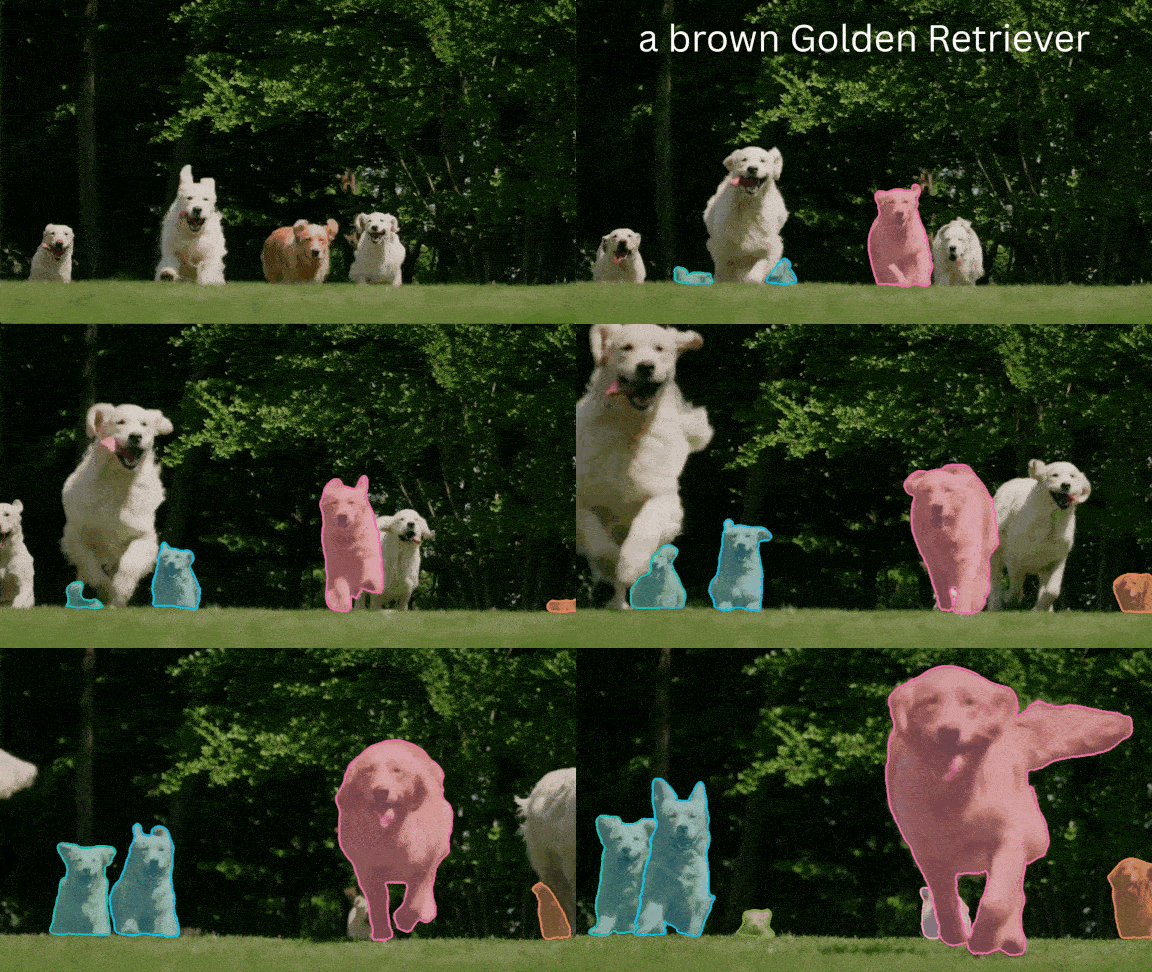
SAM 3 is a unified foundation model for promptable segmentation in images and videos. It can detect, segment, and track objects using text or visual prompts such as points, boxes, and masks. Compared to its predecessor SAM 2, SAM 3 introduces the ability to exhaustively segment all instances of an open-vocabulary concept specified by a short text phrase or exemplars. Unlike prior work, SAM 3 can handle a vastly larger set of open-vocabulary prompts. It achieves 75-80% of human performance on our new SA-CO benchmark which contains 270K unique concepts, over 50 times more than existing benchmarks.
This breakthrough is driven by an innovative data engine that has automatically annotated over 4 million unique concepts, creating the largest high-quality open-vocabulary segmentation dataset to date. In addition, SAM 3 introduces a new model architecture featuring a presence token that improves discrimination between closely related text prompts (e.g., “a player in white” vs. “a player in red”), as well as a decoupled detector–tracker design that minimizes task interference and scales efficiently with data.
Latest updates
03/27/2026 -- SAM 3.1 Object Multiplex is released. It introduces a shared-memory approach for joint multi-object tracking that is significantly faster without sacrificing accuracy.
A new suite of improved model checkpoints (denoted as SAM 3.1) are released on Hugging Face. See RELEASE_SAM3p1.md for full details.
To use the new SAM 3.1 checkpoints, you need the latest model code from this repo. If you have installed an earlier version of this repo, pull the latest code from this repo (with git pull), and then reinstall the repo following Installation below.
⚠️ Before using SAM 3, please request access to the checkpoints on the SAM 3
Hugging Face repo. Once accepted, you
need to be authenticated to download the checkpoints. You can do this by running
the following steps
(e.g. hf auth login after generating an access token.)
Basic Usage
import torch
#################################### For Image ####################################
from PIL import Image
from sam3.model_builder import build_sam3_image_model
from sam3.model.sam3_image_processor import Sam3Processor
# Load the model
model = build_sam3_image_model()
processor = Sam3Processor(model)
# Load an image
image = Image.open("<YOUR_IMAGE_PATH.jpg>")
inference_state = processor.set_image(image)
# Prompt the model with text
output = processor.set_text_prompt(state=inference_state, prompt="<YOUR_TEXT_PROMPT>")

# Get the masks, bounding boxes, and scores
masks, boxes, scores = output["masks"], output["boxes"], output["scores"]

#################################### For Video ####################################

from sam3.model_builder import build_sam3_video_predictor

video_predictor = build_sam3_video_predictor()
video_path = "<YOUR_VIDEO_PATH>" # a JPEG folder or an MP4 video file
# Start a session
response = video_predictor.handle_request(
    request=dict(
        type="start_session",
        resource_path=video_path,
    )
)
response = video_predictor.handle_request(
    request=dict(
        type="add_prompt",
        session_id=response["session_id"],
        frame_index=0, # Arbitrary frame index
        text="<YOUR_TEXT_PROMPT>",
    )
)
output = response["outputs"]
Examples
The examples directory contains notebooks demonstrating how to use SAM3 with
various types of prompts:
sam3_image_predictor_example.ipynb
: Demonstrates how to prompt SAM 3 with text and visual box prompts on images.
sam3_video_predictor_example.ipynb
: Demonstrates how to prompt SAM 3 with text prompts on videos, and doing
further interactive refinements with points.
sam3_image_batched_inference.ipynb
: Demonstrates how to run batched inference with SAM 3 on images.
sam3_agent.ipynb: Demonsterates the use of SAM
3 Agent to segment complex text prompt on images.
saco_gold_silver_vis_example.ipynb
: Shows a few examples from SA-Co image evaluation set.
saco_veval_vis_example.ipynb :
Shows a few examples from SA-Co video evaluation set.
There are additional notebooks in the examples directory that demonstrate how to
use SAM 3 for interactive instance segmentation in images and videos (SAM 1/2
tasks), or as a tool for an MLLM, and how to run evaluations on the SA-Co
dataset.
To run the Jupyter notebook examples:
# Make sure you have the notebooks dependencies installed
pip install -e ".[notebooks]"

# Start Jupyter notebook
jupyter notebook examples/sam3_image_predictor_example.ipynb
Model
SAM 3 consists of a detector and a tracker that share a vision encoder. It has 848M parameters. The
detector is a DETR-based model conditioned on text, geometry, and image
exemplars. The tracker inherits the SAM 2 transformer encoder-decoder
architecture, supporting video segmentation and interactive refinement.
Image Results
Model
Instance Segmentation
Box Detection
LVIS
SA-Co/Gold
LVIS
COCO
SA-Co/Gold
cgF1
AP
cgF1
cgF1
AP
AP
APo
cgF1
Human
-
-
72.8
-
-
-
-
74.0
OWLv2*
29.3
43.4
24.6
30.2
45.5
46.1
23.9
24.5
DINO-X
-
38.5
21.3
-
52.4
56.0
-
22.5
Gemini 2.5
13.4
-
13.0
16.1
-
-
-
14.4
SAM 3
37.2
48.5
54.1
40.6
53.6
56.4
55.7
55.7
* Partially trained on LVIS, APo refers to COCO-O accuracy
Video Results
Model
SA-V test
YT-Temporal-1B test
SmartGlasses test
LVVIS test
BURST test
cgF1
pHOTA
cgF1
pHOTA
cgF1
pHOTA
mAP
HOTA
Human
53.1
70.5
71.2
78.4
58.5
72.3
-
-
SAM 3
30.3
58.0
50.8
69.9
36.4
63.6
36.3
44.5
SA-Co Dataset
We release 2 image benchmarks, SA-Co/Gold and
SA-Co/Silver, and a video benchmark
SA-Co/VEval. The datasets contain images (or videos) with annotated noun phrases. Each image/video and noun phrase pair is annotated with instance masks and unique IDs of each object matching the phrase. Phrases that have no matching objects (negative prompts) have no masks, shown in red font in the figure. See the linked READMEs for more details on how to download and run evaluations on the datasets.
HuggingFace host: SA-Co/Gold, SA-Co/Silver and SA-Co/VEval
Roboflow host: SA-Co/Gold, SA-Co/Silver and SA-Co/VEval
Development
To set up the development environment:
pip install -e ".[dev,train]"
To format the code:
ufmt format .
Contributing
See contributing and the
code of conduct.
License
This project is licensed under the SAM License - see the LICENSE file
for details.
Acknowledgements
We would like to thank the following people for their contributions to the SAM 3 project: Alex He, Alexander Kirillov,
Alyssa Newcomb, Ana Paula Kirschner Mofarrej, Andrea Madotto, Andrew Westbury, Ashley Gabriel, Azita Shokpour,
Ben Samples, Bernie Huang, Carleigh Wood, Ching-Feng Yeh, Christian Puhrsch, Claudette Ward, Daniel Bolya,
Daniel Li, Facundo Figueroa, Fazila Vhora, George Orlin, Hanzi Mao, Helen Klein, Hu Xu, Ida Cheng, Jake Kinney,
Jiale Zhi, Jo Sampaio, Joel Schlosser, Justin Johnson, Kai Brown, Karen Bergan, Karla Martucci, Kenny Lehmann,
Maddie Mintz, Mallika Malhotra, Matt Ward, Michelle Chan, Michelle Restrepo, Miranda Hartley, Muhammad Maaz,
Nisha Deo, Peter Park, Phillip Thomas, Raghu Nayani, Rene Martinez Doehner, Robbie Adkins, Ross Girshik, Sasha
Mitts, Shashank Jain, Spencer Whitehead, Ty Toledano, Valentin Gabeur, Vincent Cho, Vivian Lee, William Ngan,
Xuehai He, Yael Yungster, Ziqi Pang, Ziyi Dou, Zoe Quake.
Citing SAM 3
If you use SAM 3 or the SA-Co dataset in your research, please use the following BibTeX entry.
@misc{carion2025sam3segmentconcepts,
      title={SAM 3: Segment Anything with Concepts},
      author={Nicolas Carion and Laura Gustafson and Yuan-Ting Hu and Shoubhik Debnath and Ronghang Hu and Didac Suris and Chaitanya Ryali and Kalyan Vasudev Alwala and Haitham Khedr and Andrew Huang and Jie Lei and Tengyu Ma and Baishan Guo and Arpit Kalla and Markus Marks and Joseph Greer and Meng Wang and Peize Sun and Roman Rädle and Triantafyllos Afouras and Effrosyni Mavroudi and Katherine Xu and Tsung-Han Wu and Yu Zhou and Liliane Momeni and Rishi Hazra and Shuangrui Ding and Sagar Vaze and Francois Porcher and Feng Li and Siyuan Li and Aishwarya Kamath and Ho Kei Cheng and Piotr Dollár and Nikhila Ravi and Kate Saenko and Pengchuan Zhang and Christoph Feichtenhofer},
      year={2025},
      eprint={2511.16719},
      archivePrefix={arXiv},
      primaryClass={cs.CV},
      url={https://arxiv.org/abs/2511.16719},
}
How active is development on facebookresearch/sam3?
The most recent commit recorded on facebookresearch/sam3 was 7 days ago, based on the GitHub push timestamp. The repository has 1.9k forks — one of the better signals of community interest.
How many stars does facebookresearch/sam3 have?
facebookresearch/sam3 has 12.3k GitHub stars — refresh the page for the live number, or check github.com/facebookresearch/sam3. TopGit mirrors GitHub's count but does not claim minute-by-minute accuracy.
Is facebookresearch/sam3 open source?
TopGit's metadata for facebookresearch/sam3 does not record a license. Most public repositories on GitHub ARE open source, but the exact terms vary — verify by opening the LICENSE file directly.
What is facebookresearch/sam3?
facebookresearch/sam3 (facebookresearch/sam3) is a Python project on GitHub. From the project's own README: The repository provides code for running inference and finetuning with the Meta Segment Anything Model 3 (SAM 3), links for downloading the trained model checkpoints, and example notebooks that show how to use the model.
Where do I read more about facebookresearch/sam3?
This TopGit page is a snapshot — the READ ME tab shows the project's own README content (links stripped, images preserved). The GitHub repository at github.com/facebookresearch/sam3 is the definitive source.
Read full README in the tab above.
Is sam3 worth your time?
ChatGPT, Claude and Perplexity can all read this page. Ask one of them what it makes of sam3.

 /sam3
 SAM 3 is a unified foundation model for promptable segmentation in images and videos. It can detect, segment, and track objects using text or visual prompts such as points, boxes, and masks. Compared to its predecessor SAM 2, SAM 3 introduces the ability to exhaustively segment all instances of an open-vocabulary concept specified by a short text phrase or exemplars. Unlike prior work, SAM 3 can handle a vastly larger set of open-vocabulary prompts. It achieves 75-80% of human performance on our new SA-CO benchmark which contains 270K unique concepts, over 50 times more than existing benchmarks.