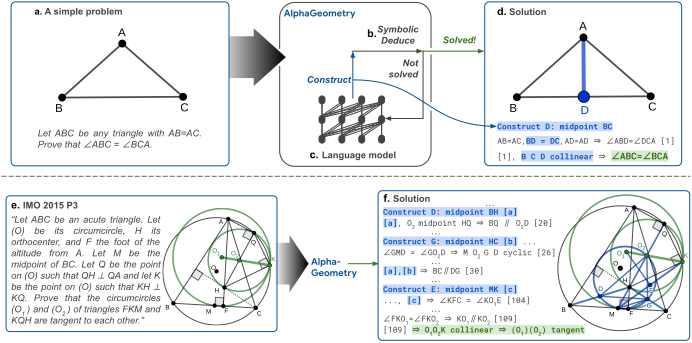
As an open-source project, google-deepmind/alphageometry has picked up 4.9k stars on GitHub (Python).
Snapshot summary built from the project's own GitHub metadata — there's no written TopGit review yet. The page will update automatically when a full review is published.
WHY NO REVIEW YET
TopGit writes full reviews for the most-starred, most-requested repositories. This page is a snapshot until then — see the READ ME tab for the original README in full.
Before running the python scripts,
let us first prepare some commonly used flags.
The symbolic engine needs definitions and deduction rules to operate.
These definitions and rules are provided in two text files
defs.txt and rules.txt.
Next, we define the flags relevant to the proof search.
To reproduce the simple examples below,
we use lightweight values for the proof search parameters:
NOTE: The results in our paper can be obtained by setting
BATCH_SIZE=32, BEAM_SIZE=512, DEPTH=16
as described in section Methods.
To stay under IMO time limits, 4 V100-GPUs and 250 CPU workers
are needed as shown in Extended Data - Figure 1.
Note that we also strip away other memory/speed optimizations
due to internal dependencies and to promote code clarity.
Assume the downloaded checkpoint and vocabulary is placed in DATA,
and the installed meliad source code is at MELIAD_PATH.
We make use of the gin library to manage model configurations,
following meliad conventions. We now define the flags relevant to the
language model:
TIP: Note that you can still run the DDAR solver
without defining SEARCH_ARGS and LM_ARGS.
In such case, simply disable the import of the lm_inference module
inside alphageometry.py.
Run DDAR
The script loads a problem by reading a list of problems
from a text file and solves the specific problem in the list according
to its name. We pass these two pieces of information through the flags
--problems_file and --problem_name.
We use --mode=ddar to indicate that we want to use the DDAR solver.
graph.py:468] translated_imo_2000_p1
graph.py:469] a b = segment a b; g1 = on_tline g1 a a b; g2 = on_tline g2 b b a; m = on_circle m g1 a, on_circle m g2 b; n = on_circle n g1 a, on_circle n g2 b; c = on_pline c m a b, on_circle c g1 a; d = on_pline d m a b, on_circle d g2 b; e = on_line e a c, on_line e b d; p = on_line p a n, on_line p c d; q = on_line q b n, on_line q c d ? cong e p e q
ddar.py:41] Depth 1/1000 time = 1.7772269248962402
ddar.py:41] Depth 2/1000 time = 5.63526177406311
ddar.py:41] Depth 3/1000 time = 6.883412837982178
ddar.py:41] Depth 4/1000 time = 10.275688409805298
ddar.py:41] Depth 5/1000 time = 12.048273086547852
alphageometry.py:190]
==========================
 * From theorem premises:
A B G1 G2 M N C D E P Q : Points
AG_1 ⟂ AB [00]
BA ⟂ G_2B [01]
G_2M = G_2B [02]
G_1M = G_1A [03]

...
[log omitted]
...

036. ∠QEB = ∠(QP-EA) [46] & ∠(BE-QP) = ∠AEP [55] ⇒  ∠EQP = ∠QPE [56]
037. ∠PQE = ∠EPQ [56] ⇒  EP = EQ

==========================
The output first includes a list of relevant premises that it uses,
and then proof steps that gradually build up the proof.
All predicates are numbered to track how they are derived
from the premises, and to show that the proof is fully justified.
TIP: Additionally passing the flag --out_file=path/to/output/text/file.txt
will write the proof to a text file.
Running on all problems in imo_ag_30.txt will yield solutions to
14 of them, as reported in Table 1 in our paper.
Run AlphaGeometry:
As a simple example, we load --problem_name=orthocenter
from --problem_file=examples.txt.
This time, we pass --mode=alphageometry to use the AlphaGeometry solver
and pass the SEARCH_ARGS and LM_ARGS flags.
...
[log omitted]
...
training_loop.py:725] Total parameters: 152072288
training_loop.py:739] Total state size: 0
training_loop.py:492] Training loop: creating task for mode beam_search

graph.py:468] orthocenter
graph.py:469] a b c = triangle a b c; d = on_tline d b a c, on_tline d c a b ? perp a d b c
ddar.py:41] Depth 1/1000 time = 0.009987592697143555 branch = 4
ddar.py:41] Depth 2/1000 time = 0.00672602653503418 branch = 0
alphageometry.py:221] DD+AR failed to solve the problem.
alphageometry.py:457] Depth 0. There are 1 nodes to expand:
alphageometry.py:460] {S} a : ; b : ; c : ; d : T a b c d 00 T a c b d 01 ? T a d b c {F1} x00
alphageometry.py:465] Decoding from {S} a : ; b : ; c : ; d : T a b c d 00 T a c b d 01 ? T a d b c {F1} x00
...
[log omitted]
...
alphageometry.py:470] LM output (score=-1.102287): "e : C a c e 02 C b d e 03 ;"
alphageometry.py:471] Translation: "e = on_line e a c, on_line e b d"

alphageometry.py:480] Solving: "a b c = triangle a b c; d = on_tline d b a c, on_tline d c a b; e = on_line e a c, on_line e b d ? perp a d b c"
graph.py:468]
graph.py:469] a b c = triangle a b c; d = on_tline d b a c, on_tline d c a b; e = on_line e a c, on_line e b d ? perp a d b c
ddar.py:41] Depth 1/1000 time = 0.021120786666870117
ddar.py:41] Depth 2/1000 time = 0.033370018005371094
ddar.py:41] Depth 3/1000 time = 0.04297471046447754
alphageometry.py:140]
==========================
 * From theorem premises:
A B C D : Points
BD ⟂ AC [00]
CD ⟂ AB [01]

 * Auxiliary Constructions:
E : Points
E,B,D are collinear [02]
E,C,A are collinear [03]

 * Proof steps:
001. E,B,D are collinear [02] & E,C,A are collinear [03] & BD ⟂ AC [00] ⇒  ∠BEA = ∠CED [04]
002. E,B,D are collinear [02] & E,C,A are collinear [03] & BD ⟂ AC [00] ⇒  ∠BEC = ∠AED [05]
003. A,E,C are collinear [03] & E,B,D are collinear [02] & AC ⟂ BD [00] ⇒  EC ⟂ EB [06]
004. EC ⟂ EB [06] & CD ⟂ AB [01] ⇒  ∠(EC-BA) = ∠(EB-CD) [07]
005. E,C,A are collinear [03] & E,B,D are collinear [02] & ∠(EC-BA) = ∠(EB-CD) [07] ⇒  ∠BAE = ∠CDE [08]
006. ∠BEA = ∠CED [04] & ∠BAE = ∠CDE [08] (Similar Triangles)⇒  EB:EC = EA:ED [09]
007. EB:EC = EA:ED [09] & ∠BEC = ∠AED [05] (Similar Triangles)⇒  ∠BCE = ∠ADE [10]
008. EB:EC = EA:ED [09] & ∠BEC = ∠AED [05] (Similar Triangles)⇒  ∠EBC = ∠EAD [11]
009. ∠BCE = ∠ADE [10] & E,C,A are collinear [03] & E,B,D are collinear [02] & ∠EBC = ∠EAD [11] ⇒  AD ⟂ BC
==========================

alphageometry.py:505] Solved.
NOTE: Point H is automatically renamed to D,
as the LM is trained on synthetic problems
where the points are named alphabetically, and so it expects
the same during test time.
NOTE: In this implementation of AlphaGeometry,
we removed all optimizations that are dependent on
internal infrastructure, e.g.,
parallelized model inference on multi GPUs,
parallelized DDAR on multiple CPUs,
parallel execution of LM and DDAR,
shared pool of CPU workers across different problems, etc.
We also removed some memory/speed optimizations and code
abstractions in favor of code clarity.
As can be seen in the output, initially DDAR failed to solve the problem.
The LM proposes two auxiliary constructions (because BATCH_SIZE=2):
e = eqdistance e c a b, eqdistance e b a c, i.e.,
construct E as the intersection of circle (center=C, radius=AB) and
circle (center=B, radius=AC). This construction has a score of -1.186.
e = on_line e a c, on_line e b d, i.e.,
E is the intersection of AC and BD.
This construction has a higher score (-1.102287) than the previous.
Since the second construction has a higher score, DDAR attempted the second
construction first and found the solution right away.
The proof search therefore terminates and there is no second iteration.
Results
Before attempting to reproduce the AlphaGeometry numbers in our paper,
please make sure to pass all tests in the prepared test suite:
bash run_tests.sh
NOTE: Issues#14 reports that although the top beam decodes are still the same, the LM is not giving the same score for different users.
Then, pass the corresponding values for --problem_file (column)
and --mode (row), and
iterate on all problems to obtain the following results:
Number of solved problems:
imo_ag_30.txt
jgex_ag_231.txt
ddar
14
198
alphageometry
25
228
Source code description
Files in this repository include python modules/scripts to run the solvers and
resource files necessary for the script to execute. We listed below
each of them and their description.
File name
Description
geometry.py
Implements nodes (Point, Line, Circle, etc) in the proof state graph.
numericals.py
Implements the numerical engine in the dynamic geometry environment.
graph_utils.py
Implements utilities for the proof state graph.
graph.py
Implements the proof state graph.
problem.py
Implements the classes that represent the problem premises, conclusion, DAG nodes.
dd.py
Implements DD and its traceback.
ar.py
Implements AR and its traceback.
trace_back.py
Implements the recursive traceback and dependency difference algorithm.
ddar.py
Implements the combination DD+AR.
beam_search.py
Implements beam decoding of a language model in JAX.
models.py
Implements the transformer model.
transformer_layer.py
Implements the transformer layer.
decoder_stack.py
Implements the transformer decoder stack.
lm_inference.py
Implements an interface to a trained LM to perform decoding.
alphageometry.py
Main script that loads problems, calls DD+AR or AlphaGeometry solver, and prints solutions.
pretty.py
Pretty formating the solutions output by solvers.
*_test.py
Tests for the corresponding module.
download.sh
Script to download model checkpoints and LM
run.sh
Script to execute instructions in README.
run_tests.sh
Script to execute the test suite.
Resource files:
Resource file name
Description
defs.txt
Definitions of different geometric construction actions.
rules.txt
Deduction rules for DD.
geometry_150M_generate.gin
Gin config of the LM implemented in meliad.
imo_ag_30.txt
Problems in IMO-AG-30.
jgex_ag_231.txt
Problems in JGEX-AG-231.
Citing this work
@Article{AlphaGeometryTrinh2024,
  author  = {Trinh, Trieu and Wu, Yuhuai and Le, Quoc and He, He and Luong, Thang},
  journal = {Nature},
  title   = {Solving Olympiad Geometry without Human Demonstrations},
  year    = {2024},
  doi     = {10.1038/s41586-023-06747-5}
}
Acknowledgements
This research is a collaboration between the Google Brain team
(now Google Deepmind) and
the Computer Science Department of New York University.
We thank Rif A. Saurous, Denny Zhou, Christian Szegedy, Delesley Hutchins,
Thomas Kipf, Hieu Pham, Petar Veličković, Debidatta Dwibedi,
Kyunghyun Cho, Lerrel Pinto, Alfredo Canziani,
Thomas Wies, He He’s research group,
Evan Chen (the USA’s IMO team coach),
Mirek Olsak, Patrik Bak,
and all three Nature's referees for their help and support.
The code of AlphaGeometry communicates with and/or references the following
separate libraries and packages:
Abseil
JAX
matplotlib
NumPy
SciPy
TensorFlow
Meliad
Flax
Gin
T5
SentencePiece
We thank all their contributors and maintainers!
Disclaimer
This is not an officially supported Google product.
This research code is provided "as-is" to the broader research community.
Google does not promise to maintain or otherwise support this code in any way.
Code License
Copyright 2023 DeepMind Technologies Limited
All software is licensed under the Apache License, Version 2.0 (Apache 2.0);
you may not use this file except in compliance with the Apache 2.0 license.
You may obtain a copy of the Apache 2.0 license at:
https://www.apache.org/licenses/LICENSE-2.0
All other materials are licensed under the Creative Commons Attribution 4.0
International License (CC-BY). You may obtain a copy of the CC-BY license at:
https://creativecommons.org/licenses/by/4.0/legalcode
Unless required by applicable law or agreed to in writing, all software and
materials distributed here under the Apache 2.0 or CC-BY licenses are
distributed on an "AS IS" BASIS, WITHOUT WARRANTIES OR CONDITIONS OF ANY KIND,
either express or implied. See the licenses for the specific language governing
permissions and limitations under those licenses.
Model Parameters License
The AlphaGeometry checkpoints and vocabulary are made available
under the terms of the Creative Commons Attribution 4.0
International (CC BY 4.0) license.
You can find details at:
https://creativecommons.org/licenses/by/4.0/legalcode
How active is development on google-deepmind/alphageometry?
The most recent commit recorded on google-deepmind/alphageometry was 7 months ago, based on the GitHub push timestamp. The repository has 573 forks — one of the better signals of community interest.
How many stars does google-deepmind/alphageometry have?
google-deepmind/alphageometry has 4.9k GitHub stars — refresh the page for the live number, or check github.com/google-deepmind/alphageometry. TopGit mirrors GitHub's count but does not claim minute-by-minute accuracy.
Is google-deepmind/alphageometry open source?
Yes — google-deepmind/alphageometry ships under the Apache-2.0 license, which makes its source code freely readable (and, depending on license terms, forkable and reusable). Source: github.com/google-deepmind/alphageometry.
What is google-deepmind/alphageometry?
google-deepmind/alphageometry (google-deepmind/alphageometry) is a Python project tracked by TopGit. The repository has 4.9k GitHub stars at the time of our last sync.
What language is google-deepmind/alphageometry written in?
google-deepmind/alphageometry is written primarily in Python. GitHub's language field is based on the largest share of bytes in the default branch.
What license does google-deepmind/alphageometry use?
google-deepmind/alphageometry is released under the Apache-2.0 license. Always verify the LICENSE file directly on GitHub for the authoritative terms — license strings can be edited out of sync with a project's actual stance.
Where do I read more about google-deepmind/alphageometry?
This TopGit page is a snapshot — the READ ME tab shows the project's own README content (links stripped, images preserved). The GitHub repository at github.com/google-deepmind/alphageometry is the definitive source.
Read full README in the tab above.
Is alphageometry worth your time?
ChatGPT, Claude and Perplexity can all read this page. Ask one of them what it makes of alphageometry.
 /alphageometry