henrygd/semaphore — an open-source project — sits at 51 GitHub stars. Faster inline semaphores and mutexes in javascript
Snapshot summary built from the project's own GitHub metadata — there's no written TopGit review yet. The page will update automatically when a full review is published.
WHY NO REVIEW YET
TopGit writes full reviews for the most-starred, most-requested repositories. This page is a snapshot until then — see the READ ME tab for the original README in full.
Fast inline semaphores and mutexes. See comparisons and benchmarks.
Semaphores limit simultaneous access to code and resources (e.g. a file) among multiple concurrent tasks.
Works with:
Usage
Create or retrieve a semaphore by calling getSemaphore with optional key and concurrency limit.
const sem = getSemaphore('key', 1)
Use the acquire and release methods to limit access.
await sem.acquire()
// access here is limited to one task at a time
sem.release()
Full example
We use semaphores here to prevent multiple requests to an API for the same resource.
The first calls to fetchPokemon will acquire access to the protected code. Subsequent calls will wait, then return the data from the cache.
We use a key to allow access based on the name. This lets ditto and snorlax run simultaneously.
import { getSemaphore } from '@henrygd/semaphore'

const cache = new Map()

for (let i = 0; i < 5; i++) {
    fetchPokemon('ditto')
    fetchPokemon('snorlax')
}

async function fetchPokemon(name) {
    // get semaphore with key based on name
    const sem = getSemaphore(name)
    // acquire access from the semaphore
    await sem.acquire()
    try {
        // return data from cache if available
        if (cache.has(name)) {
            console.log('Cache hit:', name)
            return cache.get(name)
        }
        // otherwise fetch from API
        console.warn('Fetching from API:', name)
        const res = await fetch(`https://pokeapi.co/api/v2/pokemon/${name}`)
        const json = await res.json()
        cache.set(name, json)
        return json
    } finally {
        // release access when done
        sem.release()
    }
}
Interface
/**
 * Creates or retrieves existing semaphore with optional key and concurrency level.
 *
 * key - Key used to identify the semaphore. Defaults to `Symbol()`.
 * concurrency - Maximum concurrent tasks allowed access. Defaults to `1`.
 */
function getSemaphore(key?: any, concurrency?: number): Semaphore

interface Semaphore {
    /** Returns a promise that resolves when access is acquired */
    acquire(): Promise<void>
    /** Release access to the semaphore */
    release(): void
    /** Returns the total number of tasks active or waiting for access */
    size(): number
}
Keys and persistence
Keyed semaphores are held in a Map and deleted from the Map once they've been acquired and fully released (no waiting tasks).
If you need to reuse the same semaphore even after deletion from the Map, use a persistent variable instead of calling getSemaphore again.
Concurrency
Concurrency is set for each semaphore on first creation via getSemaphore. If called again using the key for an active semaphore, the concurrency argument is ignored and the existing semaphore is returned.
Comparisons and benchmarks
Note that we're looking at libraries which provide a promise-based locking mechanism, not callbacks.
Library
Version
Bundle size (B)
Keys
Weekly Downloads
@henrygd/semaphore
0.0.1
267
yes
¯\_(ツ)_/¯
async-mutex
0.5.0
4,758
no
1,639,071
async-sema
3.1.1
3,532
no
1,258,877
await-semaphore
0.1.3
1,184
no
60,449
@shopify/semaphore
3.1.0
604
no
29,089
If there's a library you'd like added to the table or benchmarks, please open an issue.
Benchmarks
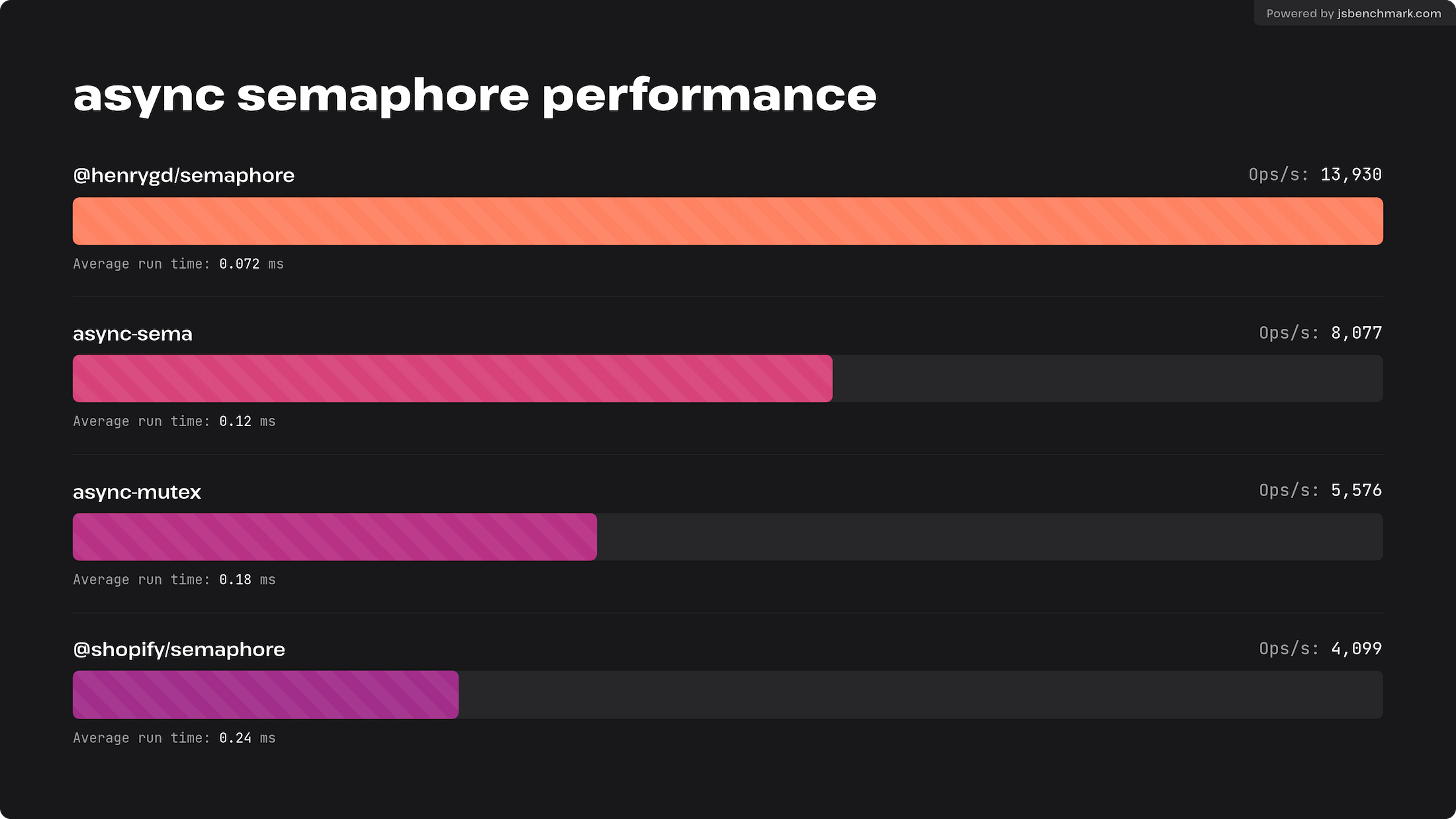
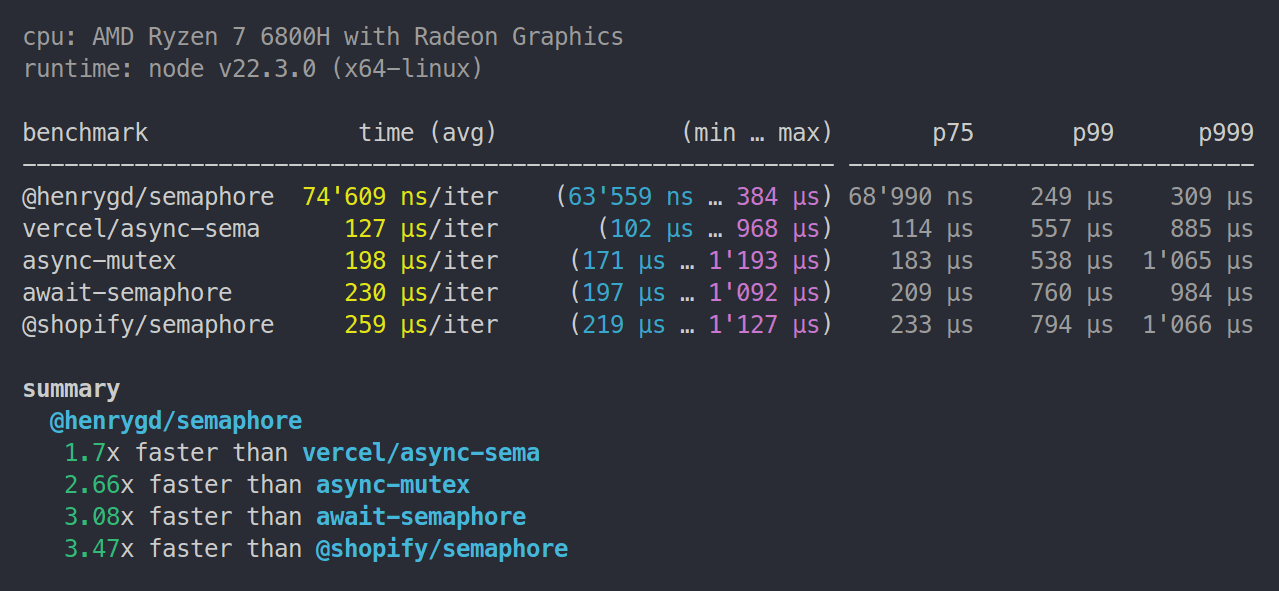
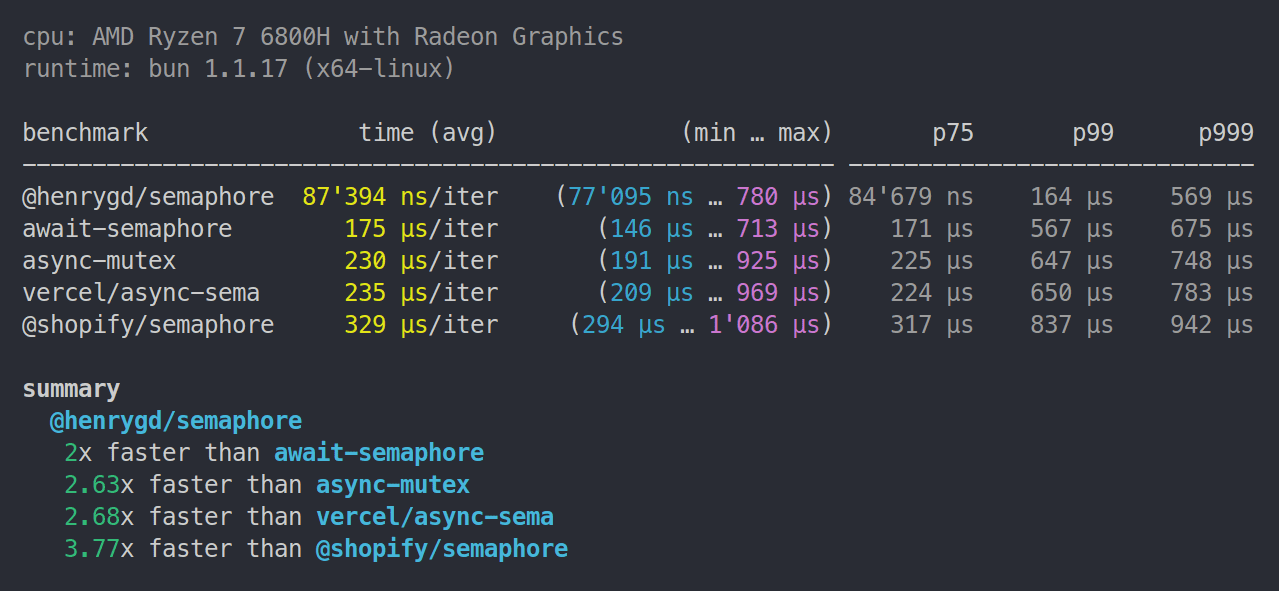
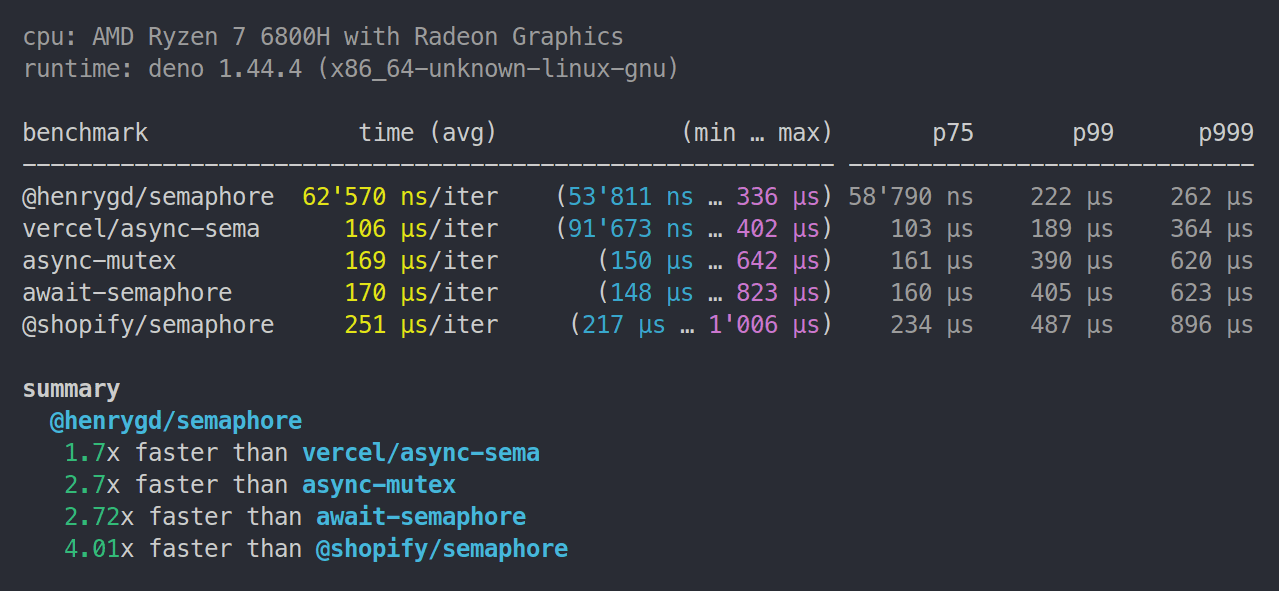
All libraries run the same test. Each operation measures how long it takes a binary semaphore with 1,000 queued acquire requests to allow and release all requests.
Browser benchmark
This test was run in Chromium. Chrome and Edge are the same. Safari is more lopsided with Vercel's async-sema dropping to third. Firefox, though I love and respect it, seems to be hard capped by slow promise handling, with async-mutex not far behind.
You can run or tweak for yourself here: https://jsbm.dev/8bBxR1pBLw0TM
Note: await-semaphore is extremely slow for some reason and I didn't want to include it in the image because it seems excessive. Not sure what's happening there.
Node.js benchmark
Bun benchmark
Deno benchmark
Cloudflare Workers benchmark
Uses oha to make 1,000 requests to each worker. Each request creates a semaphore and resolves 5,000 acquisitions / releases.
This was run locally using Wrangler. Wrangler uses the same workerd runtime as workers deployed to Cloudflare, so the relative difference should be accurate. Here's the repo for this benchmark.
Library
Requests/sec
Total (sec)
Average
Slowest
@henrygd/semaphore
941.8135
1.0618
0.0521
0.0788
async-mutex
569.5130
1.7559
0.0862
0.1251
async-sema
375.7332
2.6615
0.1308
0.1818
@shopify/semaphore
167.8239
5.9586
0.2925
0.4063
await-semaphore*
n/a
n/a
n/a
n/a
* await-semaphore does not work with concurrent requests.
Related
@henrygd/queue - Tiny async queue with concurrency control. Like p-limit or fastq, but smaller and faster.
No homepage URL was recorded for henrygd/semaphore in TopGit's last sync. The README tab above frequently contains screenshots and demo links, or check the repository description on GitHub.
Is henrygd/semaphore open source?
Yes — henrygd/semaphore ships under the MIT license, which makes its source code freely readable (and, depending on license terms, forkable and reusable). Source: github.com/henrygd/semaphore.
What is henrygd/semaphore?
henrygd/semaphore (henrygd/semaphore) is a TypeScript project on GitHub. From the project's own README: Faster inline semaphores and mutexes in javascript
What license does henrygd/semaphore use?
henrygd/semaphore is released under the MIT license. Always verify the LICENSE file directly on GitHub for the authoritative terms — license strings can be edited out of sync with a project's actual stance.
Where do I read more about henrygd/semaphore?
This TopGit page is a snapshot — the READ ME tab shows the project's own README content (links stripped, images preserved). The GitHub repository at github.com/henrygd/semaphore is the definitive source.
Read full README in the tab above.
Is semaphore worth your time?
ChatGPT, Claude and Perplexity can all read this page. Ask one of them what it makes of semaphore.

 /semaphore