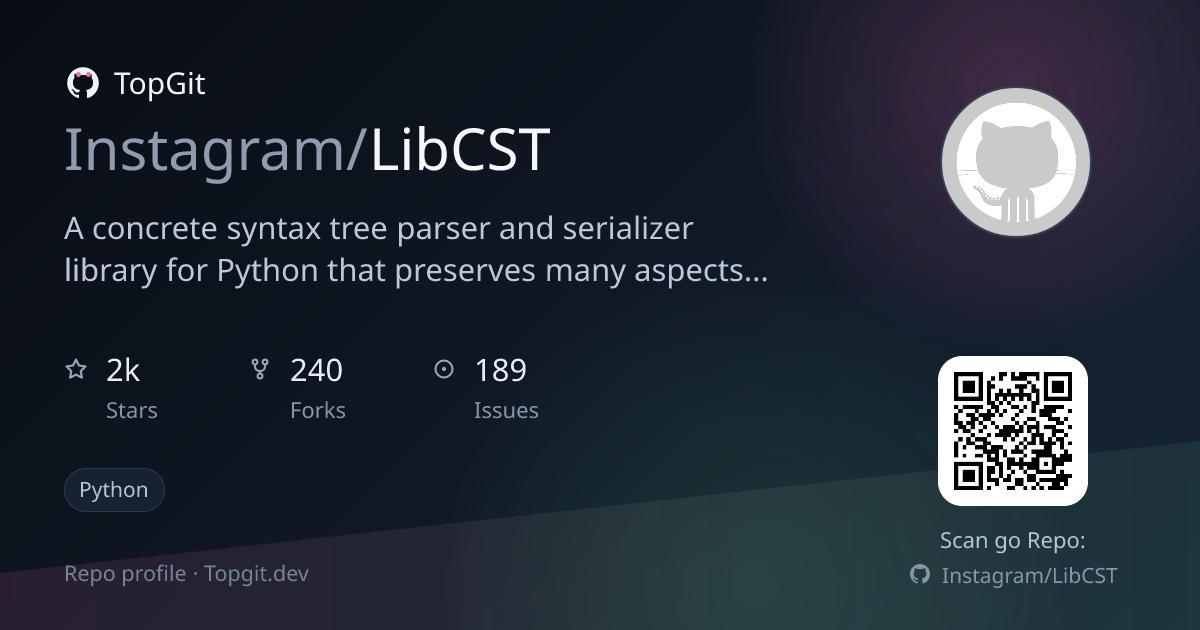
Snapshot of Instagram/LibCST: 2.0k★, Python. A concrete syntax tree parser and serializer library for Python that preserves many aspects of Python's abstract syntax tree
Snapshot summary built from the project's own GitHub metadata — there's no written TopGit review yet. The page will update automatically when a full review is published.
WHY NO REVIEW YET
TopGit writes full reviews for the most-starred, most-requested repositories. This page is a snapshot until then — see the READ ME tab for the original README in full.
.. |support-ukraine| image:: https://img.shields.io/badge/Support-Ukraine-FFD500?style=flat&labelColor=005BBB
:alt: Support Ukraine - Help Provide Humanitarian Aid to Ukraine.
:target: https://opensource.fb.com/support-ukraine
LibCST parses Python 3.0 -> 3.15 source code as a CST tree that keeps
all formatting details (comments, whitespaces, parentheses, etc). It's useful for
building automated refactoring (codemod) applications and linters.
.. intro-end
.. why-libcst-intro-start
LibCST creates a compromise between an Abstract Syntax Tree (AST) and a traditional
Concrete Syntax Tree (CST). By carefully reorganizing and naming node types and
fields, we've created a lossless CST that looks and feels like an AST.
.. why-libcst-intro-end
You can learn more about the value that LibCST provides <https://libcst.readthedocs.io/en/latest/why_libcst.html>__ and our motivations for the project <https://libcst.readthedocs.io/en/latest/motivation.html>__
in our documentation <https://libcst.readthedocs.io/en/latest/index.html>.
Try it out with notebook examples <https://mybinder.org/v2/gh/Instagram/LibCST/main?filepath=docs%2Fsource%2Ftutorial.ipynb>.
For a more detailed usage example, see our documentation <https://libcst.readthedocs.io/en/latest/tutorial.html>__.
Installation
LibCST requires Python 3.9+ and can be easily installed using most common Python
packaging tools. We recommend installing the latest stable release from
PyPI <https://pypi.org/project/libcst/>_ with pip:
.. code-block:: shell
pip install libcst
For parsing, LibCST ships with a native extension, so releases are distributed as binary
wheels as well as the source code. If a binary wheel is not available for your system
(Linux/Windows x86/x64 and Mac x64/arm are covered), you'll need a recent
Rust toolchain <https://rustup.rs>_ for installing.
Further Reading
Static Analysis at Scale: An Instagram Story. <https://instagram-engineering.com/static-analysis-at-scale-an-instagram-story-8f498ab71a0c>_
Refactoring Python with LibCST. <https://chairnerd.seatgeek.com/refactoring-python-with-libcst/>_
Development
See CONTRIBUTING.md <CONTRIBUTING.md>_ for more details.
Building
In order to build LibCST, which includes a native parser module, you
will need to have the Rust build tool ``cargo`` on your path. You can
usually install ``cargo`` using your system package manager, but the
most popular way to install cargo is using
`rustup <https://rustup.rs/>`_.

To build just the native parser, do the following from the ``native``
directory:

.. code-block:: shell

    cargo build

The ``libcst.native`` module should be rebuilt automatically, but to force it:

.. code-block:: shell

    uv sync --reinstall-package libcst

Type Checking
We use Pyre <https://github.com/facebook/pyre-check>_ for type-checking.
To verify types for the library, do the following in the root:
.. code-block:: shell
uv run poe typecheck
Generating Documents
To generate documents, do the following in the root:

.. code-block:: shell

    uv run --group docs poe docs

Future
======

- Advanced full repository facts providers like fully qualified name and call graph.

License
=======

LibCST is `MIT licensed <LICENSE>`_, as found in the LICENSE file.

.. fb-docs-start

Privacy Policy and Terms of Use
===============================

- `Privacy Policy <https://opensource.facebook.com/legal/privacy>`_
- `Terms of Use <https://opensource.facebook.com/legal/terms>`_

.. fb-docs-end

Acknowledgements
================

- Guido van Rossum for creating the parser generator pgen2 (originally used in lib2to3 and forked into parso).
- David Halter for parso which provides the parser and tokenizer that LibCST sits on top of.
- Zac Hatfield-Dodds for hypothesis integration which continues to help us find bugs.
- Zach Hammer improved type annotation for Mypy compatibility.
TopGit's last sync did not record any GitHub topics for Instagram/LibCST. GitHub topics appear in the right sidebar of a repository page; that's the authoritative place to check.
How active is development on Instagram/LibCST?
The most recent commit recorded on Instagram/LibCST was 3 months ago, based on the GitHub push timestamp. The repository has 240 forks — one of the better signals of community interest.
How many stars does Instagram/LibCST have?
Instagram/LibCST has 2.0k GitHub stars — refresh the page for the live number, or check github.com/Instagram/LibCST. TopGit mirrors GitHub's count but does not claim minute-by-minute accuracy.
What is Instagram/LibCST?
Instagram/LibCST (Instagram/LibCST) is a Python project on GitHub. From the project's own README: A concrete syntax tree parser and serializer library for Python that preserves many aspects of Python's abstract syntax tree
What language is Instagram/LibCST written in?
Instagram/LibCST is written primarily in Python. GitHub's language field is based on the largest share of bytes in the default branch.
Read full README in the tab above.
Curious whether LibCST is right for you?
Let ChatGPT, Claude, or Perplexity look into it — click below and see what AI actually says about LibCST.

 /LibCST