lfnovo/podcast-creator

On GitHub, lfnovo/podcast-creator has picked up 130 stars, Python. A simple to use python library for creating podcasts with support for many LLM and TTS providers
Snapshot summary built from the project's own GitHub metadata — there's no written TopGit review yet. The page will update automatically when a full review is published.
TopGit writes full reviews for the most-starred, most-requested repositories. This page is a snapshot until then — see the READ ME tab for the original README in full.
Snapshot
Top contributors
Show top contributors
Podcast Creator
An AI-powered podcast generation library that creates conversational audio content from text-based sources. This pip-installable package processes documents, generates structured outlines, creates natural dialogue transcripts, and converts them into high-quality audio podcasts using LangGraph workflow orchestration.
🎧 Live Demo
Listen to a real podcast generated with this tool - a 4-person debate on the Situational Awareness Paper. Includes my own cloned voice 😂
Generated using the diverse_panel episode profile with 4 AI experts discussing the nuances of artificial general intelligence and situational awareness.
And here is a one-speaker version of it, like your real dedicated teacher.
🚀 Quick Start
Installation
# Library only (programmatic use)
uv add podcast-creator
# or pip install podcast-creator

# Full installation with web UI
uv add podcast-creator --extra ui
# or pip install podcast-creator[ui]

# Or install from source
git clone <repository-url>
cd podcast-creator
uv sync

# Don't have uv? Install it with:
# curl -LsSf https://astral.sh/uv/install.sh | sh
# or
# pip install uv
Installation Options:
- Library only:
pip install podcast-creator- For programmatic use without web interface - With UI:
pip install podcast-creator[ui]- Includes Streamlit web interface for visual management
Configure API Keys
# Copy the example environment file
cp .env.example .env

# Edit .env and add your API keys:
# - OpenAI API key for LLM models
# - ElevenLabs API key for high-quality TTS
# - Other provider keys as needed
Initialize Your Project
# Create templates and configuration files
podcast-creator init

# This creates:
# - prompts/podcast/outline.jinja
# - prompts/podcast/transcript.jinja
# - speakers_config.json
# - episodes_config.json
# - example_usage.py
Generate Your First Podcast
🎨 New: Web Interface
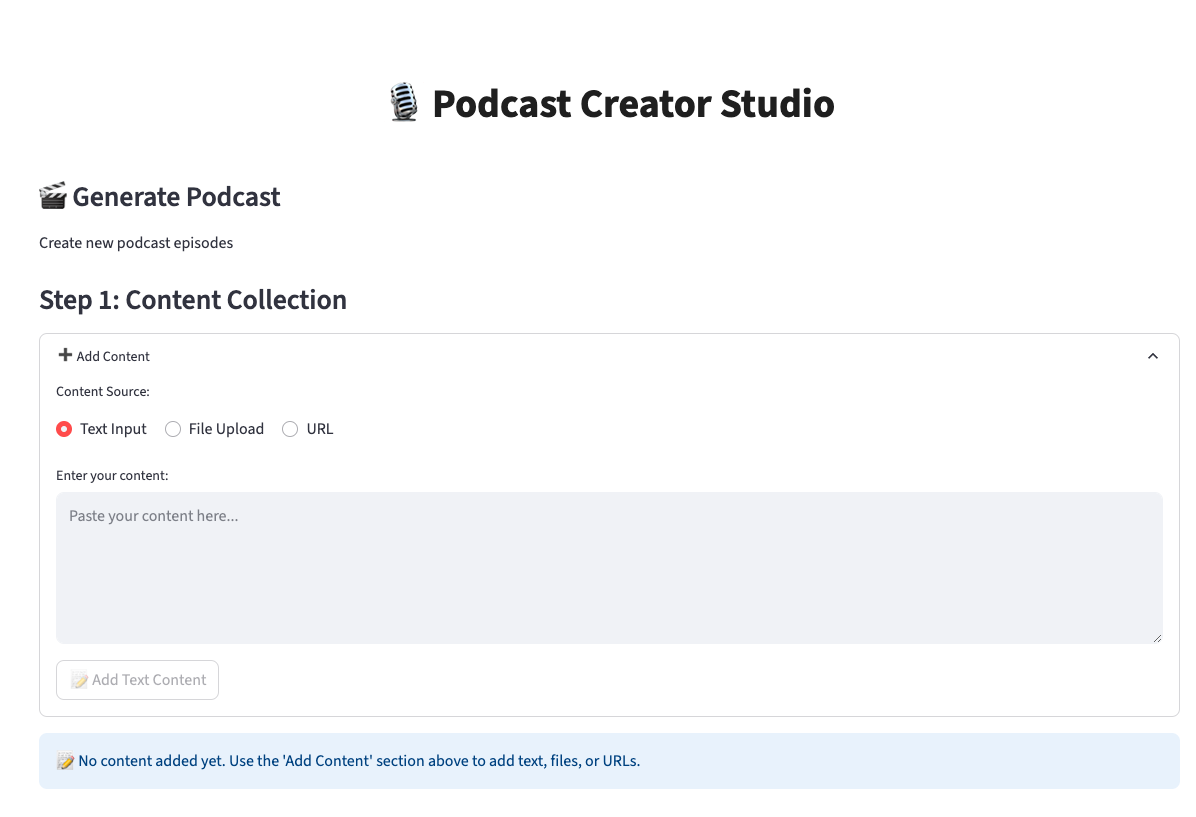
# Launch the Streamlit web interface
podcast-creator ui

# Custom port/host
podcast-creator ui --port 8080 --host 0.0.0.0

# The UI provides:
# - Visual profile management
# - Multi-content podcast generation
# - Episode library with playback
# - Import/export functionality
🚀 Episode Profiles (Streamlined)
import asyncio
from podcast_creator import create_podcast

async def main():
    # One-liner podcast creation with episode profiles!
    result = await create_podcast(
        content="Your content here...",
        episode_profile="tech_discussion",  # 🎯 Pre-configured settings
        episode_name="my_podcast",
        output_dir="output/my_podcast"
    )
    print(f"✅ Podcast created: {result['final_output_file_path']}")

asyncio.run(main())
📝 Classic: Full Configuration
import asyncio
from podcast_creator import create_podcast

async def main():
    result = await create_podcast(
        content="Your content here...",
        briefing="Create an engaging discussion about...",
        episode_name="my_podcast",
        output_dir="output/my_podcast",
        speaker_config="ai_researchers"
    )
    print(f"✅ Podcast created: {result['final_output_file_path']}")

asyncio.run(main())
🎯 Episode Profiles - Streamlined Podcast Creation
Episode Profiles are pre-configured sets of podcast generation parameters that enable one-liner podcast creation for common use cases while maintaining full customization flexibility.
🚀 Why Episode Profiles?
- 67% fewer parameters to specify for common use cases
- Consistent configurations across podcast series
- Faster iteration and prototyping
- Team collaboration with shared settings
- Full backward compatibility with existing code
📋 Bundled Profiles
| Profile | Description | Speakers | Segments | Use Case |
|---|---|---|---|---|
tech_discussion | Technology topics with expert analysis | 2 AI researchers | 4 | Technical content, AI/ML topics |
solo_expert | Educational explanations | 1 expert teacher | 3 | Learning content, tutorials |
business_analysis | Market and business insights | 3 business analysts | 4 | Business strategy, market analysis |
diverse_panel | Multi-perspective discussions | 4 diverse voices | 5 | Complex topics, debate-style content |
🎪 Usage Patterns
# 1. Simple profile usage
result = await create_podcast(
    content="Your content...",
    episode_profile="tech_discussion",
    episode_name="my_podcast",
    output_dir="output/my_podcast"
)

# 2. Profile with briefing suffix
result = await create_podcast(
    content="Your content...",
    episode_profile="business_analysis",
    briefing_suffix="Focus on ROI and cost optimization",
    episode_name="my_podcast",
    output_dir="output/my_podcast"
)

# 3. Profile with parameter overrides
result = await create_podcast(
    content="Your content...",
    episode_profile="solo_expert",
    outline_model="gpt-4o",  # Override default
    num_segments=5,          # Override default
    episode_name="my_podcast",
    output_dir="output/my_podcast"
)
🔧 Custom Episode Profiles
from podcast_creator import configure

# Define your own episode profiles
configure("episode_config", {
    "profiles": {
        "my_startup_pitch": {
            "speaker_config": "business_analysts",
            "outline_model": "gpt-4o",
            "default_briefing": "Create an engaging startup pitch...",
            "num_segments": 6,
            "audio_gap_ms": 500  # optional pause between turns (default 400, 0 disables)
        }
    }
})

# Use your custom profile
result = await create_podcast(
    content="Your content...",
    episode_profile="my_startup_pitch",
    episode_name="pitch_deck",
    output_dir="output/pitch_deck"
)
✨ Features
🔧 Flexible Configuration
from podcast_creator import configure

# Configure with custom templates
configure("templates", {
    "outline": "Your custom outline template...",
    "transcript": "Your custom transcript template..."
})

# Configure with custom paths
configure({
    "prompts_dir": "./my_templates",
    "speakers_config": "./my_speakers.json",
    "output_dir": "./podcasts"
})

# Configure speakers inline
configure("speakers_config", {
    "profiles": {
        "my_hosts": {
            "tts_provider": "elevenlabs",
            "tts_model": "eleven_flash_v2_5",
            "speakers": [...]
        }
    }
})
🎙️ Core Features
- 🎨 Web Interface: Complete Streamlit UI for visual podcast creation
- 🎯 Episode Profiles: Pre-configured settings for one-liner podcast creation
- 🔄 LangGraph Workflow: Advanced state management and parallel processing
- 🔁 Automatic Retry: Exponential backoff for transient API failures (LLM & TTS)
- 👥 Multi-Speaker Support: Dynamic 1-4 speaker configurations with rich personalities
- ⚡ Parallel Audio Generation: API-safe batching with concurrent processing
- 🔧 Fully Configurable: Multiple AI providers (OpenAI, Anthropic, Google, etc.)
- 📊 Multi-Content Support: Combine text, files, and URLs in structured arrays
- 🤖 AI-Powered Generation: Creates structured outlines and natural dialogues
- 🎵 Multi-Provider TTS: ElevenLabs, OpenAI, Google TTS support
- 📝 Flexible Templates: Jinja2-based prompt customization
- 🌍 Multilingual Support: Generate content in multiple languages
- 📚 Episode Library: Built-in audio playback and transcript viewing
🏗️ Architecture
Configuration Priority
The library uses a smart priority system for loading resources:
-
User Configuration (highest priority)
configure("templates", {"outline": "...", "transcript": "..."}) -
Custom Paths
configure("prompts_dir", "/path/to/templates") -
Working Directory
./prompts/podcast/*.jinja./speakers_config.json./episodes_config.json
-
Bundled Defaults (lowest priority)
- Package includes production-ready templates
- Multiple speaker profiles included
📚 Usage Examples
🎯 Episode Profiles (Recommended)
import asyncio
from podcast_creator import create_podcast

# Simple episode profile usage
async def main():
    result = await create_podcast(
        content="AI has transformed many industries...",
        episode_profile="tech_discussion",  # 🚀 One-liner magic!
        episode_name="ai_impact",
        output_dir="output/ai_impact"
    )

asyncio.run(main())
📝 Classic Configuration
import asyncio
from podcast_creator import create_podcast

async def main():
    result = await create_podcast(
        content="AI has transformed many industries...",
        briefing="Create an informative discussion about AI impact",
        episode_name="ai_impact",
        output_dir="output/ai_impact",
        speaker_config="ai_researchers"
    )

asyncio.run(main())
Advanced Configuration
from podcast_creator import configure, create_podcast

# Custom speaker configuration (with optional per-speaker TTS overrides)
configure("speakers_config", {
    "profiles": {
        "tech_experts": {
            "tts_provider": "elevenlabs",
            "tts_model": "eleven_flash_v2_5",
            "speakers": [
                {
                    "name": "Dr. Alex Chen",
                    "voice_id": "your_voice_id",
                    "backstory": "Senior AI researcher with focus on ethics",
                    "personality": "Thoughtful, asks probing questions"
                },
                {
                    "name": "Jamie Rodriguez",
                    "voice_id": "alloy",
                    "backstory": "Tech journalist and startup advisor",
                    "personality": "Enthusiastic, great at explanations",
                    "tts_provider": "openai",
                    "tts_model": "tts-1"
                }
            ]
        }
    }
})

# Custom templates
configure("templates", {
    "outline": """
    Create a {{ num_segments }}-part podcast outline about: {{ briefing }}

    Content: {{ context }}

    Speakers: {% for speaker in speakers %}{{ speaker.name }}: {{ speaker.personality }}{% endfor %}
    """,
    "transcript": """
    Generate natural dialogue for: {{ segment.name }}

    Keep it conversational and engaging.
    """
})

# Generate podcast with custom configuration
result = await create_podcast(
    content="Your content...",
    briefing="Your briefing...",
    episode_name="custom_podcast",
    speaker_config="tech_experts"
)
🎪 Episode Profile Variations
# Solo expert explanation
result = await create_podcast(
    content="Technical content...",
    episode_profile="solo_expert",
    episode_name="deep_dive",
    output_dir="output/deep_dive"
)

# Business analysis
result = await create_podcast(
    content="Market trends...",
    episode_profile="business_analysis",
    episode_name="market_analysis",
    output_dir="output/market_analysis"
)

# Panel discussion with diverse perspectives
result = await create_podcast(
    content="Complex topic...",
    episode_profile="diverse_panel",
    episode_name="panel_discussion",
    output_dir="output/panel_discussion"
)
🔧 Episode Profile Customization
# Use profile with briefing suffix
result = await create_podcast(
    content="Cloud computing trends...",
    episode_profile="business_analysis",
    briefing_suffix="Focus on cost optimization and ROI metrics",
    episode_name="cloud_economics",
    output_dir="output/cloud_economics"
)

# Override specific parameters
result = await create_podcast(
    content="Quantum computing...",
    episode_profile="tech_discussion",
    outline_model="gpt-4o",  # Override default
    num_segments=6,          # Override default
    episode_name="quantum_deep",
    output_dir="output/quantum_deep"
)
🔧 Configuration API
Main Functions
from podcast_creator import configure, get_config, create_podcast

# Set configuration
configure(key, value)
configure({"key1": "value1", "key2": "value2"})

# Get configuration
value = get_config("key", default_value)

# Generate podcast
result = await create_podcast(...)
Configuration Options
| Key | Type | Description |
|---|---|---|
prompts_dir | str | Directory containing template files |
templates | dict | Inline template content |
speakers_config | str/dict | Path to speaker JSON or inline config |
episode_config | str/dict | Path to episode JSON or inline config |
output_dir | str | Default output directory |
🎭 Speaker Configuration
Speaker Profile Structure
{
  "profiles": {
    "profile_name": {
      "tts_provider": "elevenlabs",
      "tts_model": "eleven_flash_v2_5",
      "speakers": [
        {
          "name": "Speaker Name",
          "voice_id": "voice_id_from_provider",
          "backstory": "Rich background that informs expertise",
          "personality": "Speaking style and traits"
        }
      ]
    }
  }
}
Per-Speaker TTS Overrides
Individual speakers can override the profile-level TTS provider, model, and config. This lets you mix different TTS services within the same podcast — for example, one speaker on ElevenLabs and another on OpenAI TTS.
{
  "profiles": {
    "mixed_providers": {
      "tts_provider": "openai",
      "tts_model": "tts-1",
      "speakers": [
        {
          "name": "Dr. Sarah Chen",
          "voice_id": "custom_eleven_voice_id",
          "backstory": "AI researcher...",
          "personality": "Analytical and methodical",
          "tts_provider": "elevenlabs",
          "tts_model": "eleven_flash_v2_5",
          "tts_config": { "voice_settings": { "stability": 0.8 } }
        },
        {
          "name": "Marcus Rivera",
          "voice_id": "alloy",
          "backstory": "Tech journalist...",
          "personality": "Engaging and curious"
        }
      ]
    }
  }
}
In this example, Dr. Sarah Chen uses ElevenLabs while Marcus Rivera uses the profile-level OpenAI TTS. All three fields (tts_provider, tts_model, tts_config) are optional per speaker — any field not set falls back to the profile-level value. If a speaker defines tts_config, it replaces the profile-level config entirely (no merging).
Creating Custom Speakers
- Get Voice IDs from your TTS provider
- Design Personalities that complement each other
- Write Rich Backstories to guide content expertise
- Test Combinations with different content types
🌐 Supported Providers
Language Models (via Esperanto)
- OpenAI: GPT-4o and newer GPT / o-series models
- Anthropic: Claude Sonnet 5.5, Claude Opus 5.5
- Google / Vertex AI: Gemini 2.5 Pro, Gemini 2.5 Flash
- Groq: GPT-OSS, Llama models
- Ollama: Local model support
- Perplexity: Research-enhanced models
- Azure OpenAI: Enterprise OpenAI
- Mistral: Mistral models
- DeepSeek: DeepSeek models
- xAI: Grok models
- OpenRouter: Multi-provider access
- Cohere, DashScope (Qwen), MiniMax, Z.ai, SiliconFlow, Novita, PayPerQ and any OpenAI-compatible endpoint (vLLM, LM Studio, ...)
Text-to-Speech Services
- ElevenLabs: Professional voice synthesis
- OpenAI TTS: High-quality voices
- Google (Gemini TTS) and Vertex AI
- Azure OpenAI
- Deepgram (Aura), Mistral (Voxtral), MiniMax, xAI
- OpenRouter, PayPerQ and OpenAI-compatible TTS servers (e.g. Speaches/Kokoro)
See the Esperanto provider docs for the full, current list.
📁 Output Structure
output/episode_name/
├── outline.json          # Structured outline
├── transcript.json       # Complete dialogue
├── clips/               # Individual audio clips
│   ├── 0000.mp3         # First segment
│   ├── 0001.mp3         # Second segment
│   └── ...              # Additional segments
└── audio/               # Final output
    └── episode_name.mp3  # Complete podcast
🛠️ CLI Commands
# Launch web interface (requires UI installation)
podcast-creator ui

# Launch on custom port/host
podcast-creator ui --port 8080 --host 0.0.0.0

# Skip dependency check
podcast-creator ui --skip-init-check

# Initialize project with templates
podcast-creator init

# Initialize in specific directory
podcast-creator init --output-dir /path/to/project

# Overwrite existing files
podcast-creator init --force

# Show version
podcast-creator version
Note: The ui command requires the UI installation: pip install podcast-creator[ui]
🎨 Web Interface Features
The podcast-creator ui command launches a comprehensive Streamlit interface that provides:
- 🏠 Dashboard: Statistics and quick actions
- 🎙️ Speaker Management: Visual profile creation with voice selection dropdowns
- 📺 Episode Management: Configure generation parameters and AI models
- 🎬 Podcast Generation: Multi-content support (text, files, URLs) with real-time progress
- 📚 Episode Library: Audio playback, transcript viewing, and downloads
- 📤 Import/Export: Share profiles via JSON files
The interface automatically detects missing dependencies and offers to run initialization if needed.
🚀 Performance
- ⚡ Parallel Processing: 5 concurrent audio clips per batch (configurable)
- 🔄 API-Safe Batching: Respects provider rate limits
- 📊 Scalable: Handles 30+ dialogue segments efficiently
- ⏱️ Fast Generation: ~2-3 minutes for typical podcasts
- 🎯 Optimized Workflow: Smart resource management
⚠️ Rate Limiting Configuration
If you encounter errors like ElevenLabs API error: Too many concurrent requests, you can adjust the parallel processing batch size:
# In your .env file
TTS_BATCH_SIZE=2  # Reduce from default 5 to 2 for ElevenLabs free plan
This is particularly useful for:
- ElevenLabs Free Plan: Limited to 2 concurrent requests
- Other TTS providers with stricter rate limits
- Debugging: Set to 1 for sequential processing
⏸️ Pauses Between Turns
When combining clips, a short pause is inserted between dialogue turns for natural conversational pacing (TTS clips usually end without trailing silence). The default is 400 ms; set audio_gap_ms on the episode profile or pass it to create_podcast() (the argument wins), and use 0 to disable it:
result = await create_podcast(
    content="Your content...",
    episode_profile="tech_discussion",
    episode_name="my_podcast",
    output_dir="output/my_podcast",
    audio_gap_ms=600,
)
🔁 Retry Configuration
LLM and TTS API calls automatically retry on transient failures (network errors, timeouts, rate limits) with exponential backoff. Non-retryable errors are raised immediately without retry — this includes programming errors (e.g. ValueError) and HTTP 4xx client errors (e.g. 404 model not found, 401 auth failure), except 429 rate-limit which is retried.
# In your .env file
PODCAST_RETRY_MAX_ATTEMPTS=3       # Max retry attempts (default: 3)
PODCAST_RETRY_WAIT_MULTIPLIER=5    # Backoff multiplier in seconds (default: 5)
PODCAST_RETRY_WAIT_MAX=30          # Max wait between retries in seconds (default: 30)
You can also configure retries programmatically for LLM calls (outline and transcript generation):
result = await create_podcast(
    content="Your content...",
    episode_profile="tech_discussion",
    episode_name="my_podcast",
    output_dir="output/my_podcast",
    retry_max_attempts=5,        # Override default
    retry_wait_multiplier=3,     # Override default
)
To disable retries entirely, set PODCAST_RETRY_MAX_ATTEMPTS=1.
📏 LLM Output Limits
Outline and transcript generation request up to 8192 output tokens by default. This is podcast-creator's request limit, not a model cap: current models, including the default Claude Sonnet 5.5, support much larger outputs. If your model has a lower output limit (some legacy models cap at 4096), or you need more room, override max_tokens via outline_config / transcript_config, either in create_podcast() or in the episode profile:
result = await create_podcast(
    content="Your content...",
    episode_profile="tech_discussion",
    episode_name="my_podcast",
    output_dir="output/my_podcast",
    outline_config={"max_tokens": 4096},
    transcript_config={"max_tokens": 4096},
)
🧩 Structured Output
Outline and transcript generation ask the model for JSON that matches the package's own schemas (json_schema structured output via Esperanto), so providers that support it return exactly the expected shape. When an endpoint rejects json_schema (some OpenAI-compatible servers only accept generic JSON), podcast-creator logs a warning and retries that call once in generic JSON mode, then keeps using JSON mode for that model for the rest of the run; the output is still validated against the same schema. To skip the first rejected request, or for models that fail in other ways (for example, Anthropic requires Claude 4.5 or newer for schemas), set generic JSON mode explicitly:
result = await create_podcast(
    content="Your content...",
    episode_profile="tech_discussion",
    episode_name="my_podcast",
    output_dir="output/my_podcast",
    outline_config={"structured": {"type": "json"}},
    transcript_config={"structured": {"type": "json"}},
)
The same keys work inside an episode profile's outline_config / transcript_config. An explicit structured setting is always used as is, with no automatic fallback.
🌐 Proxy Configuration
If you're behind a corporate firewall or need to route requests through a proxy, use standard environment variables:
# In your .env file or shell environment
HTTP_PROXY=http://proxy.example.com:8080
HTTPS_PROXY=http://proxy.example.com:8080
NO_PROXY=localhost,127.0.0.1
Authenticated Proxies:
# Proxies with authentication are supported
HTTP_PROXY=http://user:[email protected]:8080
HTTPS_PROXY=http://user:[email protected]:8080
The underlying libraries (esperanto, content-core) automatically detect and use these standard proxy environment variables for all network requests.
🧪 Development
Installing for Development
git clone <repository-url>
cd podcast-creator

# Install with uv (recommended)
uv sync

# This installs the package in editable mode
# along with all dependencies
Project Structure
podcast-creator/
├── src/
│   └── podcast_creator/
│       ├── __init__.py           # Public API
│       ├── config.py             # Configuration system
│       ├── cli.py                # CLI commands (with UI command)
│       ├── core.py               # Core utilities
│       ├── graph.py              # LangGraph workflow
│       ├── nodes.py              # Workflow nodes
│       ├── retry.py              # Retry utilities with exponential backoff
│       ├── speakers.py           # Speaker management
│       ├── episodes.py           # Episode profile management
│       ├── state.py              # State management
│       ├── validators.py         # Validation utilities
│       └── resources/            # Bundled templates
│           ├── prompts/
│           ├── speakers_config.json
│           ├── episodes_config.json
│           ├── streamlit_app/    # Web interface
│           └── examples/
├── pyproject.toml               # Package configuration
└── README.md
Testing
# Test the package
python -c "from podcast_creator import create_podcast; print('Import successful')"

# Test CLI
podcast-creator --help

# Test web interface
podcast-creator ui

# Test initialization
mkdir test_project
cd test_project
podcast-creator init
python example_usage.py
📝 Examples
Check the examples/ directory for:
- Episode Profiles: Comprehensive guide to streamlined podcast creation
- Basic usage examples
- Advanced configuration
- Custom speaker setups
- Multi-language podcasts
- Different content types
🤝 Contributing
We welcome contributions! Please see our Contributing Guide for details on:
- 🚀 Getting started with development
- 📋 Our pull request process
- 🧪 Testing guidelines
- 🎨 Code style and standards
- 🐛 How to report bugs
- 💡 How to suggest new features
Quick links:
- Good First Issues
- Contributing Guide
- Report a Bug
- Request a Feature
📄 License
This project is licensed under the MIT License - see the LICENSE file for details.
🔗 Links
- Examples: Examples
Made with ❤️ for the AI community
Related repositories
Master programming by recreating your favorite technologies from scratch.
A curated meta-list of curated lists organized by technology domain. The repository acts as a directory pointing to hundreds of specialized awesome lists covering programming languages, platforms, frameworks, and tooling. All content is community-contributed under the CC0 public domain dedication.
Public APIs is a community-curated GitHub repository listing free, publicly accessible APIs across a wide range of categories, with auth type, HTTPS, and CORS noted for each entry. It's a browsable reference, not a library to install.
freeCodeCamp is a free, self-paced curriculum for learning to code, published as open source at freeCodeCamp/freeCodeCamp. It's a 501(c)(3) nonprofit funded by donor support, structured around six certifications in its Full-Stack Developer Curriculum, each gated by required projects instead of open-book quizzes. The repository also carries beta language certifications for developers, interview-prep resources, and the code that runs the live freecodecamp.org platform.
Quick answers
Does lfnovo/podcast-creator have any tags?
TopGit's last sync did not record any GitHub topics for lfnovo/podcast-creator. GitHub topics appear in the right sidebar of a repository page; that's the authoritative place to check.
How active is development on lfnovo/podcast-creator?
The most recent commit recorded on lfnovo/podcast-creator was 23 days ago, based on the GitHub push timestamp. The repository has 33 forks — one of the better signals of community interest.
How many stars does lfnovo/podcast-creator have?
lfnovo/podcast-creator has 130 GitHub stars — refresh the page for the live number, or check github.com/lfnovo/podcast-creator. TopGit mirrors GitHub's count but does not claim minute-by-minute accuracy.
What is lfnovo/podcast-creator?
lfnovo/podcast-creator (lfnovo/podcast-creator) is a Python project on GitHub. From the project's own README: A simple to use python library for creating podcasts with support for many LLM and TTS providers
What language is lfnovo/podcast-creator written in?
lfnovo/podcast-creator is written primarily in Python. GitHub's language field is based on the largest share of bytes in the default branch.
Read full README in the tab above.
Still deciding about podcast-creator?
One click hands the question to an AI along with this page — see what it says about podcast-creator.