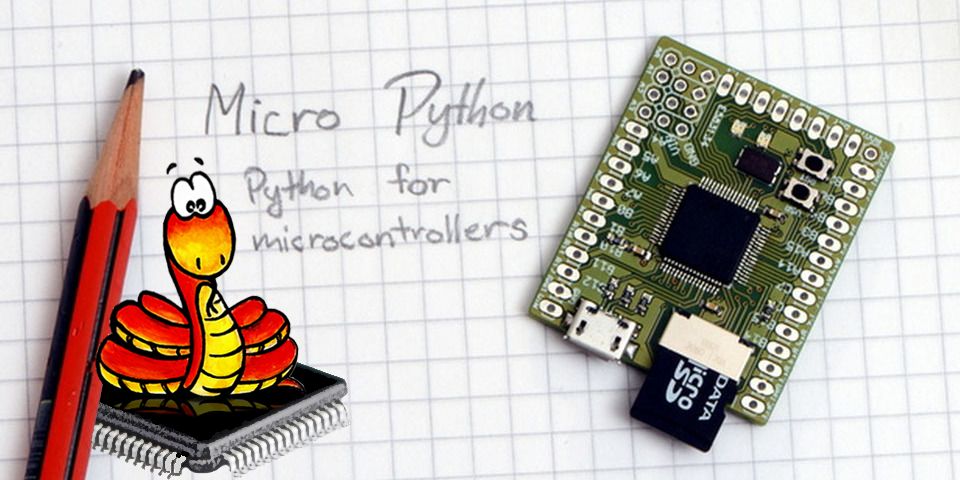
micropython/micropython-infineon is a open-source project on GitHub, written primarily in C. It has 36 stars. MicroPython ported to Infineon MCUs
Snapshot summary built from the project's own GitHub metadata — there's no written TopGit review yet. The page will update automatically when a full review is published.
WHY NO REVIEW YET
TopGit writes full reviews for the most-starred, most-requested repositories. This page is a snapshot until then — see the READ ME tab for the original README in full.
This is the MicroPython project, which aims to put an implementation
of Python 3.x on microcontrollers and small embedded systems.
You can find the official website at micropython.org.
WARNING: this project is in beta stage and is subject to changes of the
code-base, including project-wide name changes and API changes.
MicroPython implements the entire Python 3.4 syntax (including exceptions,
"with", "yield from", etc., and additionally "async" keyword from Python 3.5).
The following core datatypes are provided: str (including basic Unicode
support), bytes, bytearray, tuple, list, dict, set, frozenset, array.array,
collections.namedtuple, classes and instances. Builtin modules include sys,
time, and struct. Note that only subset of Python 3.4 functionality
implemented for the data types and modules.
See the repository www.github.com/micropython/pyboard for the Micro
Python board, the officially supported reference electronic circuit board.
Major components in this repository:
py/ -- the core Python implementation, including compiler, runtime, and
core library.
unix/ -- a version of MicroPython that runs on Unix.
stmhal/ -- a version of MicroPython that runs on the MicroPython board
with an STM32F405RG (using ST's Cube HAL drivers).
minimal/ -- a minimal MicroPython port. Start with this if you want
to port MicroPython to another microcontroller.
tests/ -- test framework and test scripts.
docs/ -- user documentation in Sphinx reStructuredText format.
Additional components:
bare-arm/ -- a bare minimum version of MicroPython for ARM MCUs. Used
mostly to control code size.
teensy/ -- a version of MicroPython that runs on the Teensy 3.1
(preliminary but functional).
pic16bit/ -- a version of MicroPython for 16-bit PIC microcontrollers.
cc3200/ -- a version of MicroPython that runs on the CC3200 from TI.
esp8266/ -- an experimental port for ESP8266 WiFi modules.
tools/ -- various tools, including the pyboard.py module.
examples/ -- a few example Python scripts.
The subdirectories above may include READMEs with additional info.
"make" is used to build the components, or "gmake" on BSD-based systems.
You will also need bash and Python (at least 2.7 or 3.3).
The Unix version
The "unix" port requires a standard Unix environment with gcc and GNU make.
x86 and x64 architectures are supported (i.e. x86 32- and 64-bit), as well
as ARM and MIPS. Making full-featured port to another architecture requires
writing some assembly code for the exception handling and garbage collection.
Alternatively, fallback implementation based on setjmp/longjmp can be used.
To build (see section below for required dependencies):
$ cd unix
$ make axtls
$ make
Then to give it a try:
$ ./micropython
>>> list(5 * x + y for x in range(10) for y in [4, 2, 1])
Use CTRL-D (i.e. EOF) to exit the shell.
Learn about command-line options (in particular, how to increase heap size
which may be needed for larger applications):
$ ./micropython --help
Run complete testsuite:
$ make test
Unix version comes with a builtin package manager called upip, e.g.:
Browse available modules on
PyPI.
Standard library modules come from
micropython-lib project.
External dependencies
Building Unix version requires some dependencies installed. For
Debian/Ubuntu/Mint derivative Linux distros, install build-essential
(includes toolchain and make), libffi-dev, and pkg-config packages.
Other dependencies can be built together with MicroPython. Oftentimes,
you need to do this to enable extra features or capabilities. To build
these additional dependencies, first fetch git submodules for them:
$ git submodule update --init
Use this same command to get the latest versions of dependencies, as
they are updated from time to time. After that, in unix/ dir, execute:
$ make deplibs
This will build all available dependencies (regardless whether they
are used or not). If you intend to build MicroPython with additional
options (like cross-compiling), the same set of options should be passed
to make deplibs. To actually enabled use of dependencies, edit
unix/mpconfigport.mk file, which has inline descriptions of the options.
For example, to build SSL module (required for upip tool described above),
set MICROPY_PY_USSL to 1.
In unix/mpconfigport.mk, you can also disable some dependencies enabled
by default, like FFI support, which requires libffi development files to
be installed.
The STM version
The "stmhal" port requires an ARM compiler, arm-none-eabi-gcc, and associated
bin-utils. For those using Arch Linux, you need arm-none-eabi-binutils and
arm-none-eabi-gcc packages. Otherwise, try here:
https://launchpad.net/gcc-arm-embedded
To build:
$ cd stmhal
$ make
You then need to get your board into DFU mode. On the pyboard, connect the
3V3 pin to the P1/DFU pin with a wire (on PYBv1.0 they are next to each other
on the bottom left of the board, second row from the bottom).
Then to flash the code via USB DFU to your device:
$ make deploy
This will use the included tools/pydfu.py script. If flashing the firmware
does not work it may be because you don't have the correct permissions, and
need to use sudo make deploy.
See the README.md file in the stmhal/ directory for further details.
Does micropython/micropython-infineon have a project website?
No homepage URL was recorded for micropython/micropython-infineon in TopGit's last sync. The README tab above frequently contains screenshots and demo links, or check the repository description on GitHub.
How many stars does micropython/micropython-infineon have?
micropython/micropython-infineon has 36 GitHub stars — refresh the page for the live number, or check github.com/micropython/micropython-infineon. TopGit mirrors GitHub's count but does not claim minute-by-minute accuracy.
Is micropython/micropython-infineon open source?
Yes — micropython/micropython-infineon ships under the MIT license, which makes its source code freely readable (and, depending on license terms, forkable and reusable). Source: github.com/micropython/micropython-infineon.
What is micropython/micropython-infineon?
micropython/micropython-infineon (micropython/micropython-infineon) is a C project on GitHub. From the project's own README: MicroPython ported to Infineon MCUs
Where do I read more about micropython/micropython-infineon?
This TopGit page is a snapshot — the READ ME tab shows the project's own README content (links stripped, images preserved). The GitHub repository at github.com/micropython/micropython-infineon is the definitive source.
Read full README in the tab above.
Want a second opinion on micropython-infineon?
Ask an AI that can read this page — one click and you get its take on micropython-infineon.

 /micropython-infineon