microsoft/promptbase is an open-source project on GitHub with 5.8k stars, written primarily in Python. All things prompt engineering
Snapshot summary built from the project's own GitHub metadata — there's no written TopGit review yet. The page will update automatically when a full review is published.
WHY NO REVIEW YET
TopGit writes full reviews for the most-starred, most-requested repositories. This page is a snapshot until then — see the READ ME tab for the original README in full.
promptbase is an evolving collection of resources, best practices, and example scripts for eliciting the best performance from foundation models like GPT-4. We currently host scripts demonstrating the Medprompt methodology, including examples of how we further extended this collection of prompting techniques ("Medprompt+") into non-medical domains:
Benchmark
GPT-4 Prompt
GPT-4 Results
Gemini Ultra Results
MMLU
Medprompt+
90.10%
90.04%
GSM8K
Zero-shot
95.3%
94.4%
MATH
Zero-shot
68.4%
53.2%
HumanEval
Zero-shot
87.8%
74.4%
BIG-Bench-Hard
Few-shot + CoT
89.0%
83.6%
DROP
Zero-shot + CoT
83.7%
82.4%
HellaSwag
10-shot
95.3%
87.8%
In the near future, promptbase will also offer further case studies and structured interviews around the scientific process we take behind prompt engineering. We'll also offer specialized deep dives into specialized tooling that accentuates the prompt engineering process. Stay tuned!
Medprompt and The Power of Prompting
"Can Generalist Foundation Models Outcompete Special-Purpose Tuning? Case Study in Medicine" (H. Nori, Y. T. Lee, S. Zhang, D. Carignan, R. Edgar, N. Fusi, N. King, J. Larson, Y. Li, W. Liu, R. Luo, S. M. McKinney, R. O. Ness, H. Poon, T. Qin, N. Usuyama, C. White, E. Horvitz 2023)
@article{nori2023can,
title={Can Generalist Foundation Models Outcompete Special-Purpose Tuning? Case Study in Medicine},
author={Nori, Harsha and Lee, Yin Tat and Zhang, Sheng and Carignan, Dean and Edgar, Richard and Fusi, Nicolo and King, Nicholas and Larson, Jonathan and Li, Yuanzhi and Liu, Weishung and others},
journal={arXiv preprint arXiv:2311.16452},
year={2023}
}
Paper link
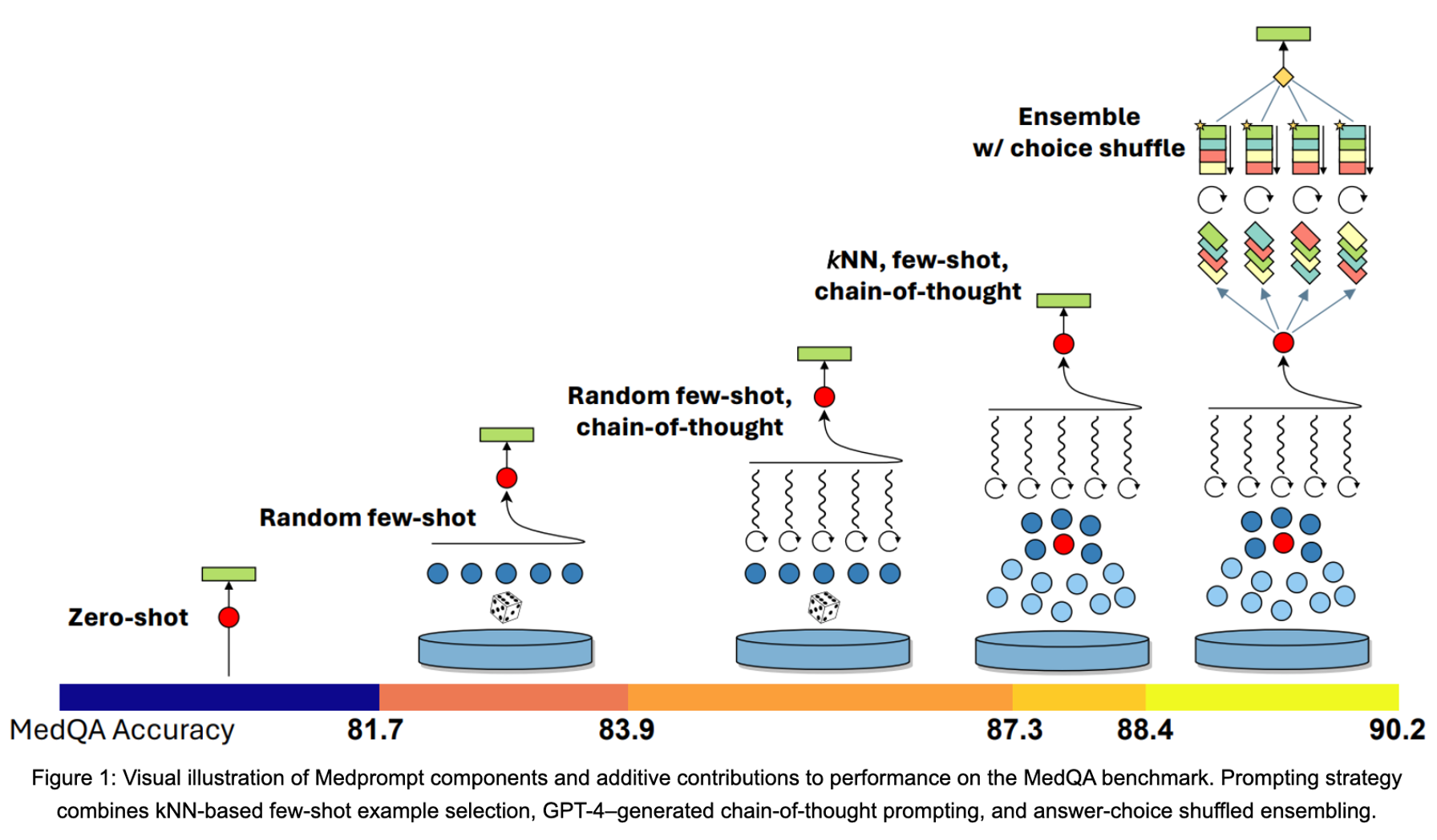
In a recent study, we showed how the composition of several prompting strategies into a method that we refer to as Medprompt can efficiently steer generalist models like GPT-4 to achieve top performance, even when compared to models specifically finetuned for medicine. Medprompt composes three distinct strategies together -- including dynamic few-shot selection, self-generated chain of thought, and choice-shuffle ensembling -- to elicit specialist level performance from GPT-4. We briefly describe these strategies here:
Dynamic Few Shots: Few-shot learning -- providing several examples of the task and response to a foundation model -- enables models quickly adapt to a specific domain and
learn to follow the task format. For simplicity and efficiency, the few-shot examples applied in prompting for a particular task are typically fixed; they are unchanged across test examples. This necessitates that the few-shot examples selected are broadly representative and relevant to a wide distribution of text examples. One approach to meeting these requirements is to have domain experts carefully hand-craft exemplars. Even so, this approach cannot guarantee that the curated, fixed few-shot examples will be appropriately representative of every test example. However, with enough available data, we can select different few-shot examples for different task inputs. We refer to this approach as employing dynamic few-shot examples. The method makes use of a mechanism to identify examples based on their similarity to the case at hand. For Medprompt, we did the following to identify representative few shot examples: Given a test example, we choose k training examples that are semantically similar using a k-NN clustering in the embedding space. Specifically, we first use OpenAI's text-embedding-ada-002 model to embed candidate exemplars for few-shot learning. Then, for each test question x, we retrieve its nearest k neighbors x1, x2, ..., xk from the training set (according to distance in the embedding space of text-embedding-ada-002). These examples -- the ones most similar in embedding space to the test question -- are ultimately registered in the prompt.
Self-Generated Chain of Thought (CoT): Chain-of-thought (CoT) uses natural language statements, such as “Let’s think step by step,” to explicitly encourage the model to generate a series of intermediate reasoning steps. The approach has been found to significantly improve the ability of foundation models to perform complex reasoning. Most approaches to chain-of-thought center on the use of experts to manually compose few-shot examples with chains of thought for prompting. Rather than rely on human experts, we pursued
a mechanism to automate the creation of chain-of-thought examples. We found that we could simply ask GPT-4 to generate chain-of-thought for the training examples, with appropriate guardrails for reducing risk of hallucination via incorrect reasoning chains.
Majority Vote Ensembling: Ensembling refers to combining the output of several algorithms together to yield better predictive performance than any individual algorithm. Frontier models like GPT-4 benefit from ensembling of their own outputs. A simple technique is to have a variety of prompts, or a single prompt with varied temperature, and report the most frequent answer amongst the ensemble constituents. For multiple choice questions, we employ a further trick that increases the diversity of the ensemble called choice-shuffling, where we shuffle the relative order of the answer choices before generating each reasoning
path. We then select the most consistent answer, i.e., the one that is least sensitive to choice shuffling, which increases the robustness of the answer.
The combination of these three techniques led to breakthrough performance in Medprompt for medical challenge questions. Implementation details of these techniques can be found here: https://github.com/microsoft/promptbase/tree/main/src/promptbase/mmlu
Medprompt+ | Extending the power of prompting
Here we provide some intuitive details on how we extended the medprompt prompting framework to elicit even stronger out-of-domain performance on the MMLU (Measuring Massive Multitask Language Understanding) benchmark. MMLU was established as a test of general knowledge and reasoning powers of large language models. The complete MMLU benchmark contains tens of thousands of challenge problems of different forms across 57 areas from basic mathematics to United States history, law, computer science, engineering, medicine, and more.
We found that applying Medprompt without modification to the whole MMLU achieved a score of 89.1%. Not bad for a single policy working across a great diversity of problems! But could we push Medprompt to do better? Simply scaling-up MedPrompt can yield further benefits. As a first step, we increased the number of ensembled calls from five to 20. This boosted performance to 89.56%.
On working to push further with refinement of Medprompt, we noticed that performance was relatively poor for specific topics of the MMLU. MMLU contains a great diversity of types of questions, depending on the discipline and specific benchmark at hand. How might we push GPT-4 to perform even better on MMLU given the diversity of problems?
We focused on extension to a portfolio approach based on the observation that some topical areas tend to ask questions that would require multiple steps of reasoning and perhaps a scratch pad to keep track of multiple parts of a solution. Other areas seek factual answers that follow more directly from questions. Medprompt employs “chain-of-thought” (CoT) reasoning, resonating with multi-step solving. We wondered if the sophisticated Medprompt-classic approach might do less well on very simple questions and if the system might do better if a simpler method were used for the factual queries.
Following this argument, we found that we could boost the performance on MMLU by extending MedPrompt with a simple two-method prompt portfolio. We add to the classic Medprompt a set of 10 simple, direct few-shot prompts soliciting an answer directly without Chain of Thought. We then ask GPT-4 for help with deciding on the best strategy for each topic area and question. As a screening call, for each question we first ask GPT-4:
# Question
{{ question }}

# Task
Does answering the question above require a scratch-pad?
A. Yes
B. No
If GPT-4 thinks the question does require a scratch-pad, then the contribution of the Chain-of-Thought component of the ensemble is doubled. If it doesn't, we halve that contribution (and let the ensemble instead depend more on the direct few-shot prompts). Dynamically leveraging the appropriate prompting technique in the ensemble led to a further +0.5% performance improvement across the MMLU.
We note that Medprompt+ relies on accessing confidence scores (logprobs) from GPT-4. These are not publicly available via the current API but will be enabled for all in the near future.
Running Scripts
Note: Some scripts hosted here are published for reference on methodology, but may not be immediately executable against public APIs. We're working hard on making the pipelines easier to run "out of the box" over the next few days, and appreciate your patience in the interim!
First, clone the repo and install the promptbase package:
cd src
pip install -e .
Next, decide which tests you'd like to run. You can choose from:
bigbench
drop
gsm8k
humaneval
math
mmlu
Before running the tests, you will need to download the datasets from the original sources (see below) and place them in the src/promptbase/datasets directory.
After downloading datasets and installing the promptbase package, you can run a test with:
python -m promptbase dataset_name
For example:
python -m promptbase gsm8k
Dataset Links
To run evaluations, download these datasets and add them to /src/promptbase/datasets/
MMLU: https://github.com/hendrycks/test
Download the data.tar file from the above page
Extract the contents
Run mkdir src/promptbase/datasets/mmlu
Run python ./src/promptbase/format/format_mmlu.py --mmlu_csv_dir /path/to/extracted/csv/files --output_path ./src/promptbase/datasets/mmlu
You will also need to set the following environment variables:
AZURE_OPENAI_API_KEY
AZURE_OPENAI_CHAT_API_KEY
AZURE_OPENAI_CHAT_ENDPOINT_URL
AZURE_OPENAI_EMBEDDINGS_URL
Run with python -m promptbase mmlu --subject <SUBJECT> where <SUBJECT> is one of the MMLU datasets (such as 'abstract_algebra')
In addition to the individual subjects, the format_mmlu.py script prepares files which enables all to be passed as a subject, which will run on the entire dataset
Big-Bench-Hard: https://github.com/suzgunmirac/BIG-Bench-Hard
The contents of this repo need to be put into a directory called BigBench in the datasets directory
No homepage URL was recorded for microsoft/promptbase in TopGit's last sync. The README tab above frequently contains screenshots and demo links, or check the repository description on GitHub.
How many stars does microsoft/promptbase have?
microsoft/promptbase has 5.8k GitHub stars — refresh the page for the live number, or check github.com/microsoft/promptbase. TopGit mirrors GitHub's count but does not claim minute-by-minute accuracy.
Is microsoft/promptbase open source?
Yes — microsoft/promptbase ships under the MIT license, which makes its source code freely readable (and, depending on license terms, forkable and reusable). Source: github.com/microsoft/promptbase.
What is microsoft/promptbase?
microsoft/promptbase (microsoft/promptbase) is a Python project on GitHub. From the project's own README: All things prompt engineering
Where do I read more about microsoft/promptbase?
This TopGit page is a snapshot — the READ ME tab shows the project's own README content (links stripped, images preserved). The GitHub repository at github.com/microsoft/promptbase is the definitive source.
Read full README in the tab above.
Curious whether promptbase is right for you?
Let ChatGPT, Claude, or Perplexity look into it — click below and see what AI actually says about promptbase.

 /promptbase