microsoft/SPTAG — 5.0k★ on GitHub (C++). A distributed approximate nearest neighborhood search (ANN) library which provides a high quality vector index build, search and distributed online serving toolkits for large scale vector search scenario.
Snapshot summary built from the project's own GitHub metadata — there's no written TopGit review yet. The page will update automatically when a full review is published.
WHY NO REVIEW YET
TopGit writes full reviews for the most-starred, most-requested repositories. This page is a snapshot until then — see the READ ME tab for the original README in full.
SPTAG: A library for fast approximate nearest neighbor search
SPTAG
SPTAG (Space Partition Tree And Graph) is a library for large scale vector approximate nearest neighbor search scenario released by Microsoft Research (MSR) and Microsoft Bing.
What's NEW
Result Iterator with Relaxed Monotonicity Signal Support
New Research Paper SPFresh: Incremental In-Place Update for Billion-Scale Vector Search - published in SOSP 2023
New Research Paper VBASE: Unifying Online Vector Similarity Search and Relational Queries via Relaxed Monotonicity - published in OSDI 2023
Introduction
This library assumes that the samples are represented as vectors and that the vectors can be compared by L2 distances or cosine distances.
Vectors returned for a query vector are the vectors that have smallest L2 distance or cosine distances with the query vector.
SPTAG provides two methods: kd-tree and relative neighborhood graph (SPTAG-KDT)
and balanced k-means tree and relative neighborhood graph (SPTAG-BKT).
SPTAG-KDT is advantageous in index building cost, and SPTAG-BKT is advantageous in search accuracy in very high-dimensional data.
How it works
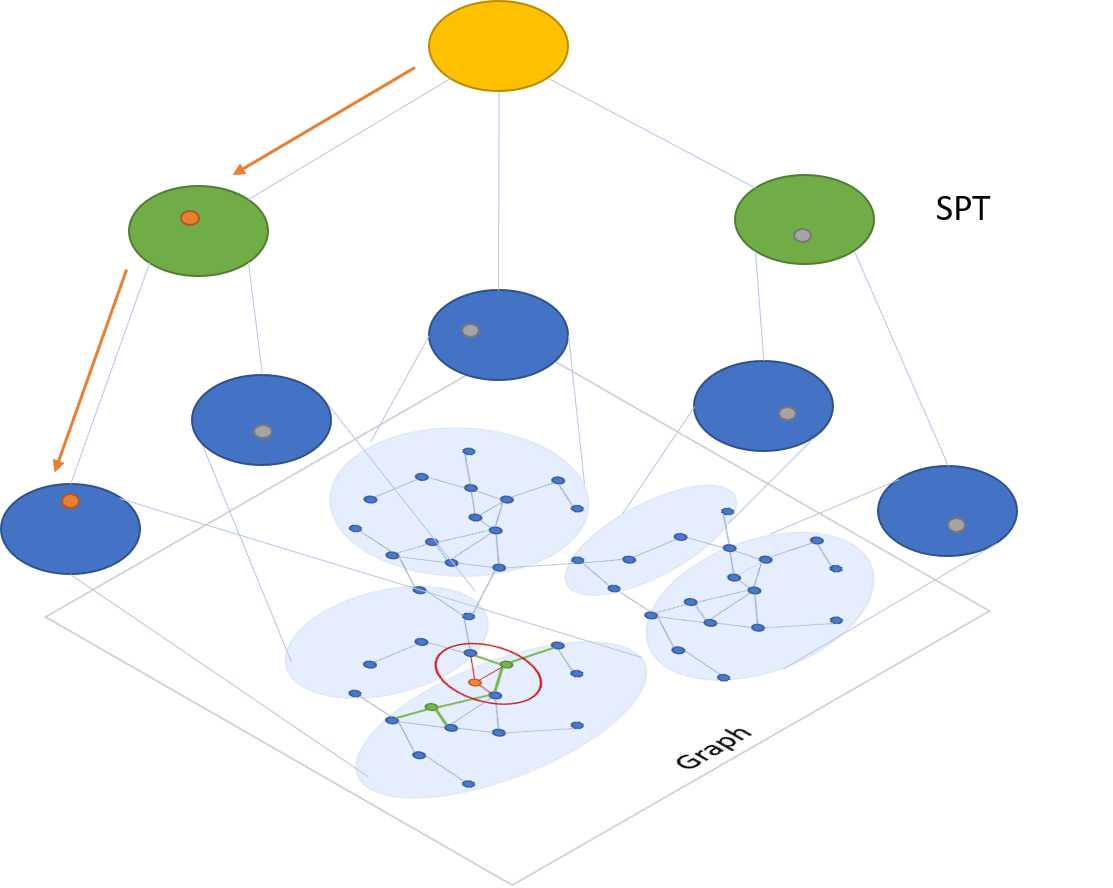
SPTAG is inspired by the NGS approach [WangL12]. It contains two basic modules: index builder and searcher.
The RNG is built on the k-nearest neighborhood graph [WangWZTG12, WangWJLZZH14]
for boosting the connectivity. Balanced k-means trees are used to replace kd-trees to avoid the inaccurate distance bound estimation in kd-trees for very high-dimensional vectors.
The search begins with the search in the space partition trees for
finding several seeds to start the search in the RNG.
The searches in the trees and the graph are iteratively conducted.
Highlights
Fresh update: Support online vector deletion and insertion
Distributed serving: Search over multiple machines
cd ThirdParty/spdk
./scripts/pkgdep.sh
CC=gcc-9 ./configure
CC=gcc-9 make -j
Compile isal-l_crypto
cd ThirdParty/isal-l_crypto
./autogen.sh
./configure
make -j
Build RocksDB
mkdir build && cd build
cmake -DUSE_RTTI=1 -DWITH_JEMALLOC=1 -DWITH_SNAPPY=1 -DCMAKE_C_COMPILER=gcc-7 -DCMAKE_CXX_COMPILER=g++-7 -DCMAKE_BUILD_TYPE=Release -DCMAKE_CXX_FLAGS="-fPIC" ..
make -j
sudo make install
Build SPTAG
mkdir build
cd build && cmake -DSPDK=OFF -DROCKSDB=OFF .. && make
It will generate a Release folder in the code directory which contains all the build targets.
For Windows:
mkdir build
cd build && cmake -A x64 -DSPDK=OFF -DROCKSDB=OFF ..
It will generate a SPTAGLib.sln in the build directory.
Compiling the ALL_BUILD project in the Visual Studio (at least 2019) will generate a Release directory which contains all the build targets.
For detailed instructions on installing Windows binaries, please see here
Using Docker:
docker build -t sptag .
Will build a docker container with binaries in /app/Release/.
Verify
Run the SPTAGTest (or Test.exe) in the Release folder to verify all the tests have passed.
Usage
The detailed usage can be found in Get started. There is also an end-to-end tutorial for building vector search online service using Python Wrapper in Python Tutorial.
The detailed parameters tunning can be found in Parameters.
References
Please cite SPTAG in your publications if it helps your research:
@inproceedings{xu2023spfresh,
  title={SPFresh: Incremental In-Place Update for Billion-Scale Vector Search},
  author={Xu, Yuming and Liang, Hengyu and Li, Jin and Xu, Shuotao and Chen, Qi and Zhang, Qianxi and Li, Cheng and Yang, Ziyue and Yang, Fan and Yang, Yuqing and others},
  booktitle={Proceedings of the 29th Symposium on Operating Systems Principles},
  pages={545--561},
  year={2023}
}

@inproceedings{zhang2023vbase,
  title={$\{$VBASE$\}$: Unifying Online Vector Similarity Search and Relational Queries via Relaxed Monotonicity},
  author={Zhang, Qianxi and Xu, Shuotao and Chen, Qi and Sui, Guoxin and Xie, Jiadong and Cai, Zhizhen and Chen, Yaoqi and He, Yinxuan and Yang, Yuqing and Yang, Fan and others},
  booktitle={17th USENIX Symposium on Operating Systems Design and Implementation (OSDI 23)},
  year={2023}
}

@inproceedings{ChenW21,
  author = {Qi Chen and
            Bing Zhao and
            Haidong Wang and
            Mingqin Li and
            Chuanjie Liu and
            Zengzhong Li and
            Mao Yang and
            Jingdong Wang},
  title = {SPANN: Highly-efficient Billion-scale Approximate Nearest Neighbor Search},
  booktitle = {35th Conference on Neural Information Processing Systems (NeurIPS 2021)},
  year = {2021}
}

@manual{ChenW18,
  author    = {Qi Chen and
               Haidong Wang and
               Mingqin Li and
               Gang Ren and
               Scarlett Li and
               Jeffery Zhu and
               Jason Li and
               Chuanjie Liu and
               Lintao Zhang and
               Jingdong Wang},
  title     = {SPTAG: A library for fast approximate nearest neighbor search},
  url       = {https://github.com/Microsoft/SPTAG},
  year      = {2018}
}

@inproceedings{WangL12,
  author    = {Jingdong Wang and
               Shipeng Li},
  title     = {Query-driven iterated neighborhood graph search for large scale indexing},
  booktitle = {ACM Multimedia 2012},
  pages     = {179--188},
  year      = {2012}
}

@inproceedings{WangWZTGL12,
  author    = {Jing Wang and
               Jingdong Wang and
               Gang Zeng and
               Zhuowen Tu and
               Rui Gan and
               Shipeng Li},
  title     = {Scalable k-NN graph construction for visual descriptors},
  booktitle = {CVPR 2012},
  pages     = {1106--1113},
  year      = {2012}
}

@article{WangWJLZZH14,
  author    = {Jingdong Wang and
               Naiyan Wang and
               You Jia and
               Jian Li and
               Gang Zeng and
               Hongbin Zha and
               Xian{-}Sheng Hua},
  title     = {Trinary-Projection Trees for Approximate Nearest Neighbor Search},
  journal   = {{IEEE} Trans. Pattern Anal. Mach. Intell.},
  volume    = {36},
  number    = {2},
  pages     = {388--403},
  year      = {2014
}
Contribute
This project welcomes contributions and suggestions from all the users.
We use GitHub issues for tracking suggestions and bugs.
The most recent commit recorded on microsoft/SPTAG was 4 months ago, based on the GitHub push timestamp. The repository has 625 forks — one of the better signals of community interest.
How many stars does microsoft/SPTAG have?
microsoft/SPTAG has 5.0k GitHub stars — refresh the page for the live number, or check github.com/microsoft/SPTAG. TopGit mirrors GitHub's count but does not claim minute-by-minute accuracy.
Is microsoft/SPTAG open source?
Yes — microsoft/SPTAG ships under the MIT license, which makes its source code freely readable (and, depending on license terms, forkable and reusable). Source: github.com/microsoft/SPTAG.
What is microsoft/SPTAG?
microsoft/SPTAG (microsoft/SPTAG) is a C++ project on GitHub. From the project's own README: A distributed approximate nearest neighborhood search (ANN) library which provides a high quality vector index build, search and distributed online serving toolkits for large scale vector search scenario.
Where do I read more about microsoft/SPTAG?
This TopGit page is a snapshot — the READ ME tab shows the project's own README content (links stripped, images preserved). The GitHub repository at github.com/microsoft/SPTAG is the definitive source.
Read full README in the tab above.
Still deciding about SPTAG?
One click hands the question to an AI along with this page — see what it says about SPTAG.

 /SPTAG