dtoa Benchmark
Copyright(c) 2014 Milo Yip ([email protected])
Introduction
This benchmark evaluates the performance of conversion from double precision IEEE-754 floating point (double) to ASCII string. The function prototype is:
void dtoa(double value, char* buffer);
The character string result must be convertible to the original value exactly via some correct implementation of strtod(), i.e. roundtrip convertible.
Note that dtoa() is not a standard function in C and C++.
Procedure
Firstly the program verifies the correctness of implementations.
Then, one case for benchmark is carried out:
- RandomDigit: Generates 1000 random
double values, filtered out +/-inf and nan. Then convert them to limited precision (1 to 17 decimal digits in significand). Finally convert these numbers into ASCII.
Each digit group is run for 100 times. The minimum time duration is measured for 10 trials.
Build and Run
- Obtain premake4.
- Copy premake4 executable to
dtoa-benchmark/build folder (or system path).
- Run
premake.bat or premake.sh in dtoa-benchmark/build
- On Windows, build the solution at
dtoa-benchmark/build/vs2008/ or /vs2010/.
- On other platforms, run GNU
make config=release32 (or release64) at dtoa-benchmark/build/gmake/
- On success, run the
dtoa executable is generated at dtoa-benchmark/
- The results in CSV format will be written to
dtoa-benchmark/result.
- Run GNU
make in dtoa-benchmark/result to generate results in HTML.
Results
The following are sequential results measured on a PC (Core i7 920 @2.67Ghz), where u32toa() is compiled by Visual C++ 2013 and run on Windows 64-bit. The speedup is based on sprintf().
| Function | Time (ns) | Speedup |
|---|
| ostringstream | 2,778.748 | 0.45x |
| ostrstream | 2,628.365 | 0.48x |
| gay | 1,646.310 | 0.76x |
| sprintf | 1,256.376 | 1.00x |
| fpconv | 273.822 | 4.59x |
| grisu2 | 220.251 | 5.70x |
| doubleconv | 201.645 | 6.23x |
| milo | 138.021 | 9.10x |
| null | 2.146 | 585.58x |
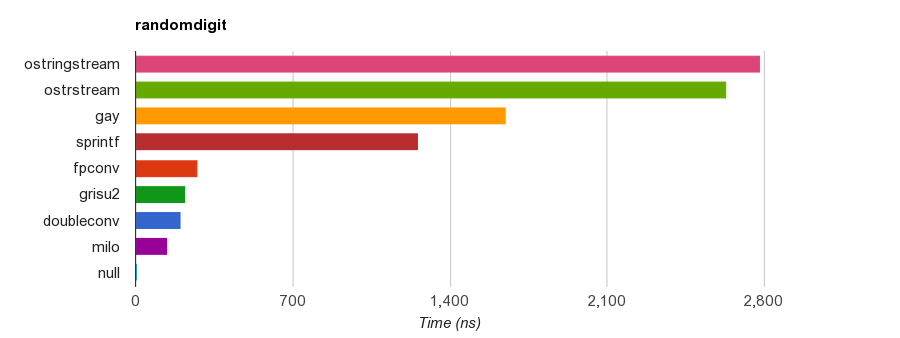
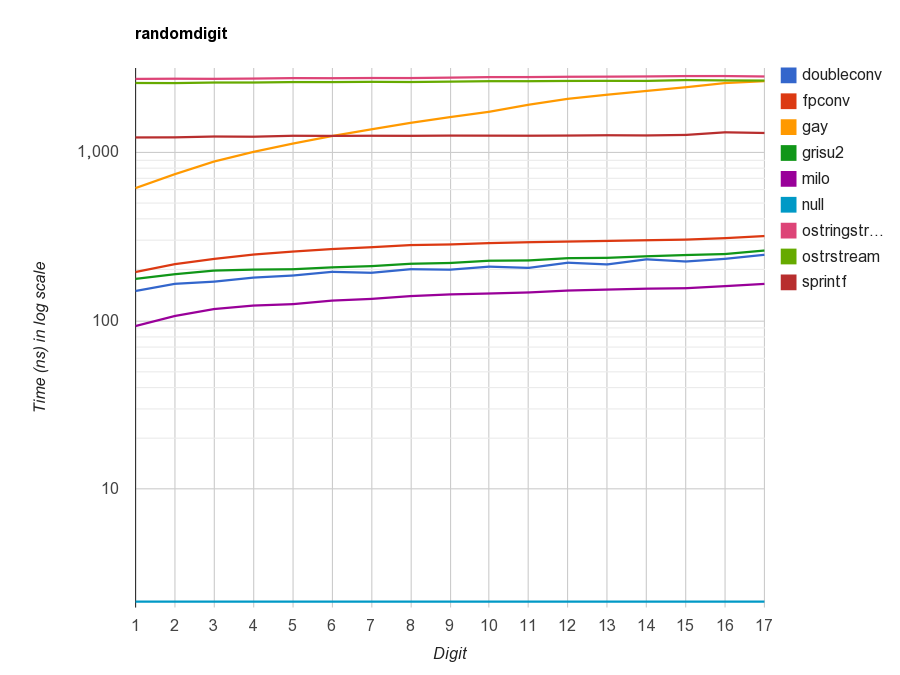
Note that the null implementation does nothing. It measures the overheads of looping and function call.
Some results of various configurations are located at dtoa-benchmark/result. They can be accessed online, with interactivity provided by Google Charts:
Implementations
| Function | Description |
|---|
| ostringstream | std::ostringstream in C++ standard library with setprecision(17). |
| ostrstream | std::ostrstream in C++ standard library with setprecision(17). |
| sprintf | sprintf() in C standard library with "%.17g" format. |
| stb_sprintf | fast sprintf replacement with "%.17g" format. |
| gay | David M. Gay's dtoa() C implementation. |
| grisu2 | Florian Loitsch's Grisu2 C implementation [1]. |
| doubleconv | C++ implementation extracted from Google's V8 JavaScript Engine with EcmaScriptConverter().ToShortest() (based on Grisu3, fall back to slower bignum algorithm when Grisu3 failed to produce shortest implementation). |
| fpconv | night-shift's Grisu2 C implementation. |
| milo | miloyip's Grisu2 C++ header-only implementation. |
| null | Do nothing. |
Notes:
-
tostring() is not tested as it does not fulfill the roundtrip requirement.
-
Grisu2 is chosen because it can generate better human-readable number and >99.9% of results are in shortest. Grisu3 needs another dtoa() implementation for not meeting the shortest requirement.
FAQ
-
How to add an implementation?
You may clone an existing implementation file. And then modify it. Re-run premake to add it to project or makefile. Note that it will automatically register to the benchmark by macro REGISTER_TEST(name).
Making pull request of new implementations is welcome.
-
Why not converting double to std::string?
It may introduce heap allocation, which is a big overhead. User can easily wrap these low-level functions to return std::string, if needed.
-
Why fast dtoa() functions is needed?
They are a very common operations in writing data in text format. The standard way of sprintf(), std::stringstream, often provides poor performance. The author of this benchmark would optimize the sprintf implementation in RapidJSON, thus he creates this project.
References
[1] Loitsch, Florian. "Printing floating-point numbers quickly and accurately with integers." ACM Sigplan Notices 45.6 (2010): 233-243.
Related Benchmarks and Discussions
- Printing Floating-Point Numbers
