nickscamara/open-deep-research sits at 6.3k stars on GitHub, written primarily in TypeScript. An open source deep research clone. AI Agent that reasons large amounts of web data extracted with Firecrawl
Snapshot summary built from the project's own GitHub metadata — there's no written TopGit review yet. The page will update automatically when a full review is published.
WHY NO REVIEW YET
TopGit writes full reviews for the most-starred, most-requested repositories. This page is a snapshot until then — see the READ ME tab for the original README in full.
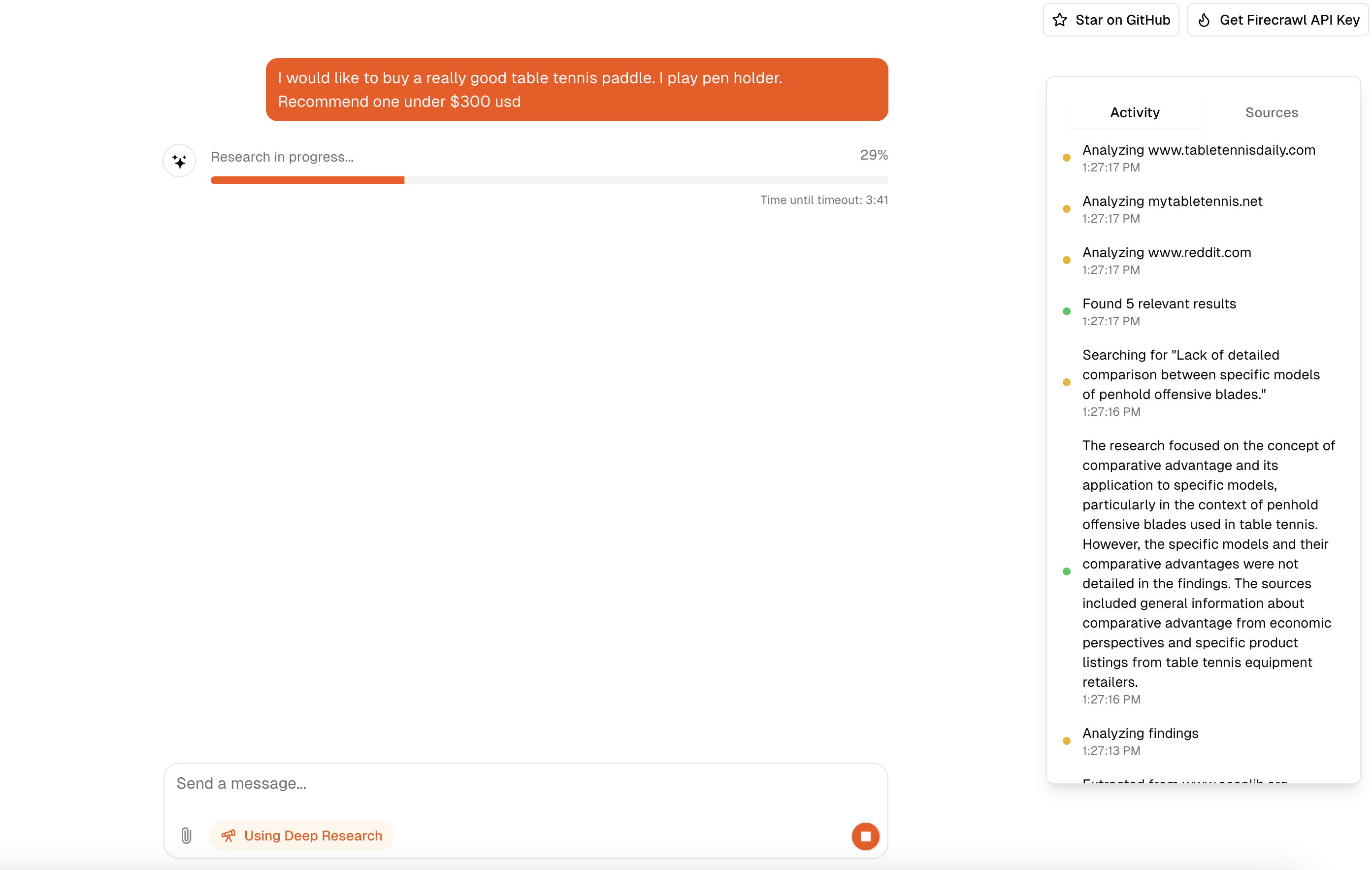
An Open-Source clone of Open AI's Deep Research experiment. Instead of using a fine-tuned version of o3, this method uses Firecrawl's extract + search with a reasoning model to deep research the web.
Check out the demo here
Features
Firecrawl Search + Extract
Feed realtime data to the AI via search
Extract structured data from multiple websites via extract
Next.js App Router
Advanced routing for seamless navigation and performance
React Server Components (RSCs) and Server Actions for server-side rendering and increased performance
AI SDK
Unified API for generating text, structured objects, and tool calls with LLMs
Hooks for building dynamic chat and generative user interfaces
Supports OpenAI (default), Anthropic, Cohere, and other model providers
shadcn/ui
Styling with Tailwind CSS
Component primitives from Radix UI for accessibility and flexibility
Data Persistence
Vercel Postgres powered by Neon for saving chat history and user data
Vercel Blob for efficient file storage
NextAuth.js
Simple and secure authentication
Model Providers
This template ships with OpenAI gpt-4o as the default. However, with the AI SDK, you can switch LLM providers to OpenAI, Anthropic, Cohere, and many more with just a few lines of code.
This repo is compatible with OpenRouter and OpenAI. To use OpenRouter, you need to set the OPENROUTER_API_KEY environment variable.
Function Max Duration
By default, the function timeout is set to 300 seconds (5 minutes). If you're using Vercel's Hobby tier, you'll need to reduce this to 60 seconds. You can adjust this by changing the MAX_DURATION environment variable in your .env file:
MAX_DURATION=60
Learn more about it here
Deploy Your Own
You can deploy your own version of the Next.js AI Chatbot to Vercel with one click:
Running locally
You will need to use the environment variables defined in .env.example to run Next.js AI Chatbot. It's recommended you use Vercel Environment Variables for this, but a .env file is all that is necessary.
Note: You should not commit your .env file or it will expose secrets that will allow others to control access to your various OpenAI and authentication provider accounts.
Install Vercel CLI: npm i -g vercel
Link local instance with Vercel and GitHub accounts (creates .vercel directory): vercel link
Download your environment variables: vercel env pull
1. First install all dependencies
pnpm install
2. Then run database migrations
pnpm db:migrate
3. Run the app
pnpm dev
Your app template should now be running on localhost:3000.
Models dependencies
If you want to use a model other than the default, you will need to install the dependencies for that model.
TogetherAI's Deepseek:
pnpm add @ai-sdk/togetherai
Note: Maximum rate limit https://docs.together.ai/docs/rate-limits
Reasoning Model Configuration
The application uses a separate model for reasoning tasks (like research analysis and structured outputs). This can be configured using the REASONING_MODEL environment variable.
Available Options
Provider
Models
Notes
OpenAI
gpt-4o, o1, o3-mini
Native JSON schema support
TogetherAI
deepseek-ai/DeepSeek-R1
Requires BYPASS_JSON_VALIDATION=true
Important Notes
Only certain OpenAI models (gpt-4o, o1, o3-mini) natively support structured JSON outputs
Other models (deepseek-reasoner) can be used but may require disabling JSON schema validation
When using models that don't support JSON schema:
Set BYPASS_JSON_VALIDATION=true in your .env file
This allows non-OpenAI models to be used for reasoning tasks
Note: Without JSON validation, the model responses may be less structured
The reasoning model is used for tasks that require structured thinking and analysis, such as:
Research analysis
Document suggestions
Data extraction
Structured responses
If no REASONING_MODEL is specified, it defaults to o1-mini
If an invalid model is specified, it will fall back to o1-mini
Usage
Add to your .env file:
# Choose one of: deepseek-reasoner, deepseek-ai/DeepSeek-R1
REASONING_MODEL=deepseek-ai/DeepSeek-R1

# Required when using models that don't support JSON schema (like deepseek-reasoner)
BYPASS_JSON_VALIDATION=true
The reasoning model is automatically used when the application needs structured outputs or complex analysis, regardless of which model the user has selected for general chat.
Does nickscamara/open-deep-research have any tags?
TopGit's last sync did not record any GitHub topics for nickscamara/open-deep-research. GitHub topics appear in the right sidebar of a repository page; that's the authoritative place to check.
How active is development on nickscamara/open-deep-research?
The most recent commit recorded on nickscamara/open-deep-research was 1.5 years ago, based on the GitHub push timestamp. The repository has 732 forks — one of the better signals of community interest.
How many stars does nickscamara/open-deep-research have?
nickscamara/open-deep-research has 6.3k GitHub stars — refresh the page for the live number, or check github.com/nickscamara/open-deep-research. TopGit mirrors GitHub's count but does not claim minute-by-minute accuracy.
What language is nickscamara/open-deep-research written in?
nickscamara/open-deep-research is written primarily in TypeScript. GitHub's language field is based on the largest share of bytes in the default branch.
Where do I read more about nickscamara/open-deep-research?
This TopGit page is a snapshot — the READ ME tab shows the project's own README content (links stripped, images preserved). The GitHub repository at github.com/nickscamara/open-deep-research is the definitive source.
Read full README in the tab above.
Want a second opinion on open-deep-research?
Ask an AI that can read this page — one click and you get its take on open-deep-research.

 /open-deep-research