OpenDriveLab/UniVLA

A look at OpenDriveLab/UniVLA: 1.1k stars on GitHub, written primarily in Python. [RSS 2025] Learning to Act Anywhere with Task-centric Latent Actions
Snapshot summary built from the project's own GitHub metadata — there's no written TopGit review yet. The page will update automatically when a full review is published.
TopGit writes full reviews for the most-starred, most-requested repositories. This page is a snapshot until then — see the READ ME tab for the original README in full.
Snapshot
Top contributors
Show top contributors
[!IMPORTANT] 🌟 Stay up to date at opendrivelab.com!
:earth_asia: UniVLA
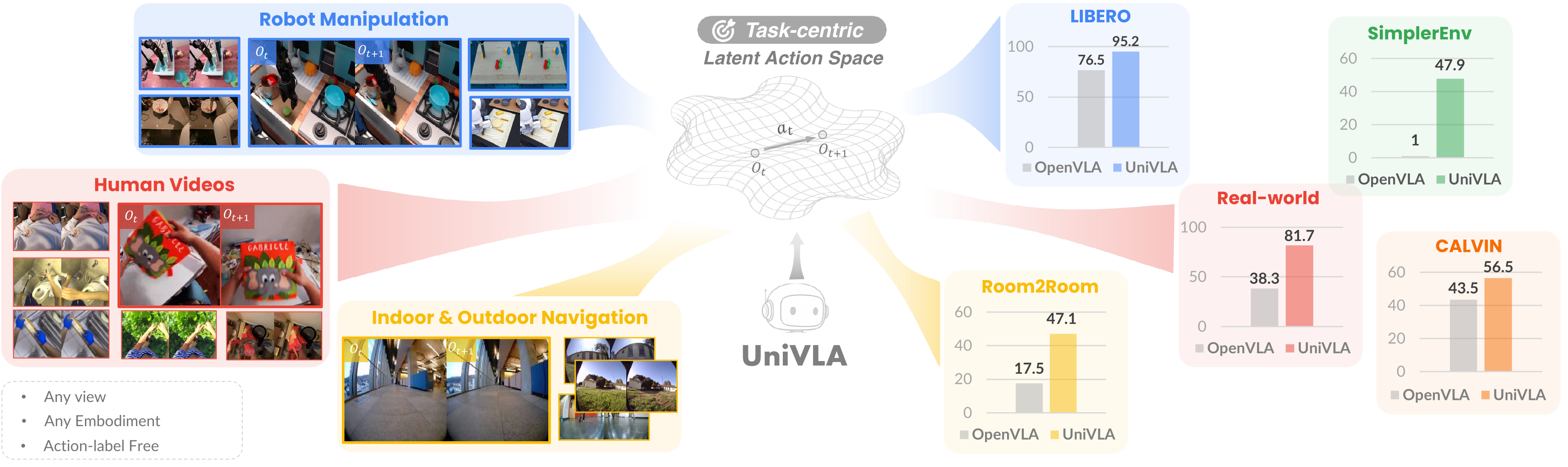
:page_facing_up: Paper | :rocket: Demo Page (Coming Soon)
:black_nib: Qingwen Bu, Y. Yang, J. Cai, S. Gao, G. Ren, M. Yao, P. Luo, H. Li
:e-mail: Primary Contact: Qingwen Bu ([email protected])
:fire: Highlights
- A recipe towards generalist policy by planning in a unified, embodiment-agnostic action space.
- A novel approach for extracting task-centric latent actions from cross-embodiment videos.
- A VLA that achieves state-of-the-art results on multiple benchmarks with compute-efficient training.
Table of Contents
- :movie_camera: Demo
- :loudspeaker: News
- 🤗 Model Zoo
- :video_game: Getting Started
- :fire: Training Recipe
- Data Preparation
- Task-centric Latent Action Learning
- Pretraining of Generalist Policy
- Post-training for Deployment & Evaluations
- Real-world Experiment
- LIBERO
- CALVIN
- Room2Room
- SimplerEnv
- :rocket: UniVLA's Performance
- :pencil: Citation
:movie_camera: Demo
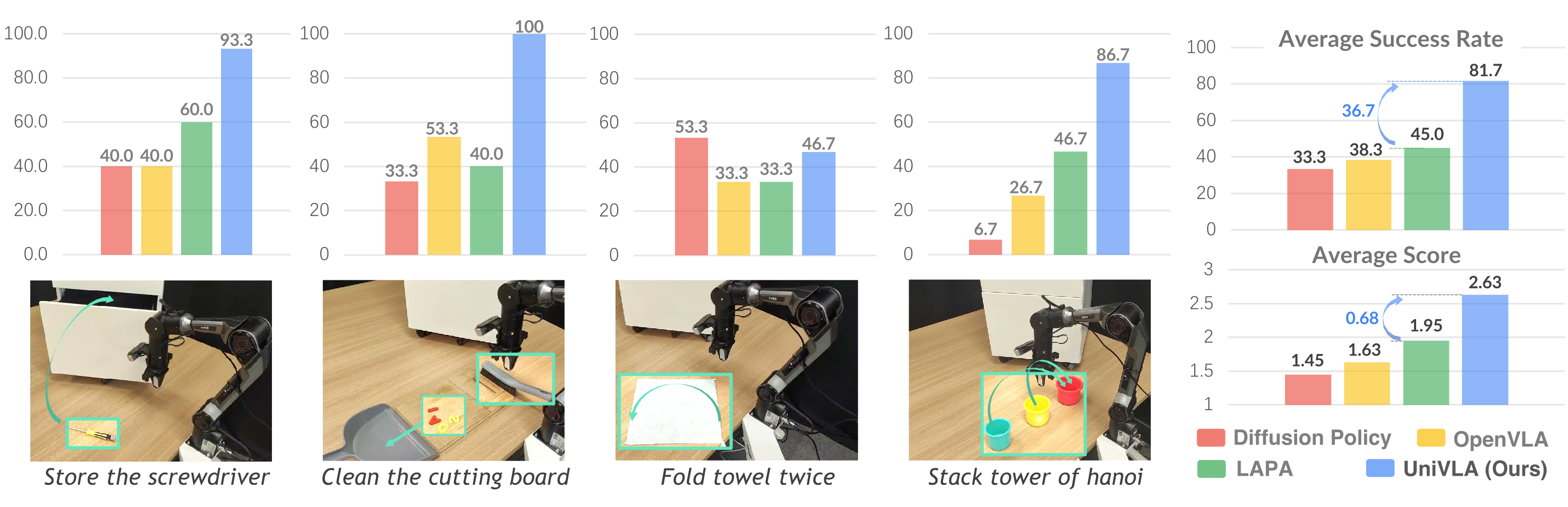
Real-world robot experiments.
| Store the screwdriver (1x speed) | Clean the cutting board (1x speed) | Fold towel twice (1x speed) |
| Stack the tower of hanoi (1x speed) | ||
:loudspeaker: News
- [2025/05] The code of UniVLA v1.0 is released. Please check it out!
🤗 Model Zoo
| Model Name | Backbone | HF Path | Note |
|---|---|---|---|
| lam-stage-1 | - | univla-latent-action-model | The stage-1 latent action model trained on OpenX and Ego4D. |
| lam-stage-2 | - | univla-latent-action-model | The stage-2 latent action model trained on OpenX and Ego4D. (Generate task-centric latent actions.) |
| univla-7b | TRI-ML/prismatic-vlms/prism-dinosiglip-224px+7b | univla-7b | UniVLA pretrained on our full data collection (Manip. + Navi. + Human). |
| univla-7b-bridge-pt | TRI-ML/prismatic-vlms/prism-dinosiglip-224px+7b | univla-7b-bridge-pt | UniVLA pretrained only on BridgeV2 data. |
| univla-7b-human-pt | TRI-ML/prismatic-vlms/prism-dinosiglip-224px+7b | univla-7b-human-pt | UniVLA pretrained only on Ego4D human videos. |
| univla-libero | univla-7b | univla-7b-224-sft-libero | Finetuned on the LIBERO dataset |
| univla-calvin | univla-7b | univla-7b-224-sft-calvin | Finetuned on the CALVIN dataset |
| univla-r2r | univla-7b | univla-7b-224-sft-r2r | Finetuned on the R2R dataset |
| univla-bridge | univla-7b | univla-7b-224-sft-simpler-bridge | Finetuned on the BridgeV2 (OXE ver.) dataset |
:video_game: Getting Started
- (Optional) We use conda to manage the environment.
conda create -n univla python=3.10 -y
conda activate univla
- Install dependencies.
# Install pytorch
# Look up https://pytorch.org/get-started/previous-versions/ with your cuda version for a correct command
# Our experiments are conducted with 'torch 2.2.0 + cuda 12.1'
pip install torch torchvision

# Clone our repo and pip install to download dependencies
git clone [email protected]:OpenDriveLab/UniVLA.git
cd univla
pip install -e .

# Install Flash Attention 2 for training (https://github.com/Dao-AILab/flash-attention)
pip install packaging ninja
ninja --version; echo $?  # Verify Ninja --> should return exit code "0"
pip install "flash-attn==2.5.5" --no-build-isolation
:fire: Training Recipe
:zero: Data Preparation
Please refer to this script for an example of how to download datasets from OXE
[optional] Please follow this instruction if you'd like to convert Ego4D data into RLDS format for training UniVLA.
:one: Task-centric Latent Action Learning
We hightly recommond directly using our pre-trained latent action model ckeckpoints to save your time and compute.
[!NOTE] Our latent action model is trained on a comprehensive data collection, encompassing multiple robotic manipulation and navigation datasets from Open X-Embodiment, along with a curated subset of the Ego4D dataset (detailed data construction procedures are provided in the appendix of our paper).
To adapt the model to additional datasets or custom data sources, users may refer to
./prismatic/vla/datasets/rlds/oxe/mixtures.pyto either utilize predefined data mixtures or define new ones. Subsequently, thedata_mixparameter in the configuration file should be updated accordingly.
The latent action model is implemented based on VQ-VAE. We train the latent action model on the collection of dataset comprising robot manipulation, navigation and human videos. In stage-1 training, we use an overall batch size of 512 and 100k optimization steps to construct the task-irrelevant latent actions:
torchrun --standalone --nnodes 1 --nproc-per-node 8 main.py fit \
    --config config/lam-stage-1.yaml \
    2>&1 | tee lam-stage-1.log
The following stage-2 then focuses on learning task-centric latent actions on the basis of stage-1 results. Please modify the stage_one_ckpt in latent_action_model/config/lam-stage-2.yaml to your local path of stage-1 checkpoint, then run training with:
torchrun --standalone --nnodes 1 --nproc-per-node 8 main.py fit \
    --config config/lam-stage-2.yaml \
    2>&1 | tee lam-stage-2.log
:two: Pretraining of Generalist Policy
-
Latent Action Pseudo-Labeling for Policy Optimization: The trained latent action model is employed to generate pseudo-labels for policy optimization via a next-token prediction objective. Specifically, the indices of inferred latent actions in the VQ-VAE codebook are mapped to dedicated tokens in the LLaMA tokenizer, denoted as
{ACT_0, ACT_1, ..., ACT_C}. -
Cost-effective Pre-Training: The full-scale pre-training procedure, incorporating both OpenX and Ego4D datasets, was performed using a 32-GPU A100 cluster over 20,000 optimization steps. This training regimen required approximately 960 A100 GPU-hours, representing just 5% of the computational resources utilized by OpenVLA. Furthermore, experiments conducted on the 'Bridge' and 'Human' subsets demanded only 200 GPU-hours, demonstrating substantially reduced computational requirements compared to previous vision-language-action models.
-
To initiate pre-training, please refer to the following scipt or simply run
bash ./vla-scripts/train.sh:
[!NOTE] For pretraining UniVLA only on BridgeV2 or Human (Ego4D) data, please modify
vla.typetoprism-dinosiglip-224px+mx-bridge(human)correspondingly. Detailed setups can be found in./prismatic/conf/vla.py.
### Experiment on a 32-GPU cluster
GPUS_PER_NODE=8
NNODES=4
MASTER_PORT=${MASTER_PORT:-28596}
MASTER_ADDR=${MASTER_ADDR:-"127.0.0.1"}
RANK=${RANK:-0}

# Run your training script with torchrun
torchrun --nproc_per_node ${GPUS_PER_NODE} --nnodes ${NNODES} --node_rank ${RANK} --master_addr ${MASTER_ADDR} --master_port ${MASTER_PORT} train.py \
                                 --vla.type prism-dinosiglip-224px+mx-oxe-magic-soup-plus \
                                 --run_root_dir "vla_log" \
Once pretraining is complete, convert the UniVLA weights (default 'Prismatic' format) to HuggingFace AutoClasses with:
python vla-scripts/extern/convert_openvla_weights_to_hf.py \
    --openvla_model_path_or_id /path/to/your/pretrained_ckpt_path \
    --ckpt_name /path/to/your/specific_ckpt_name.pt \
    --output_hf_model_local_path /path/to/your/output_model_path
The converted model is then compatible with HF AutoClasses 'AutoModelForVision2Seq'.
:three: Post-training for Deployment & Evaluations
- With the pretrained generalist policy trained to plan over an embodiment-agnostic action space, we then add embodiment-specific action decoder heads for downstream deployment.
- Our action decoder is extremely lightwight with only around 12M parameters. Using parameter efficient fine-tuning with LoRA rank 32, the total trainable parameter is around 123M.
:mechanical_arm: Real-world Experiment
Our guidelines are based on real-device testing conducted on the AgiLex platform. If you have code deployed on other platforms or in different data formats, we welcome pull requests!
We provide a simple guideline to deploy UniVLA on your customized setups.
1) LIBERO
Please first download the LIBERO datasets that we used in experiments
Start training with torchrun:
- You should first set the pretrained UniVLA and latent action model path in
vla_pathandlam_pathof the training config. - Set your local LIBERO dataset path in
data_root_dir. - You can choose
dataset_namefromlibero_spatial_no_noops,libero_object_no_noops,libero_goal_no_noops, andlibero_10_no_noops
We trained on 'Spatial', 'Object' and 'Goal' for 30k steps and 'Long' for 40k steps. Please first modify the
max_stepsin training config accordingly for reproduction.
# Start training on LIBERO-10(long) with 8 GPUs
torchrun --standalone --nnodes 1 --nproc-per-node 8 finetune_libero.py \
                                 --dataset_name "libero_10_no_noops" \
                                 --run_root_dir "libero_log" \
Once you finished training and get the action decoder and UniVLA backbone, you can start evaluation with:
# Start evaluation on LIBERO-10
# [Optional] Install LIBERO dependencies
pip install -r experiments/robot/libero/libero_requirements.txt

# By default, we test for 50 rollouts every task, totalling 500 independent trials.
python experiments/robot/libero/run_libero_eval.py \
    --task_suite_name libero_10 \   # Choose from [libero_spatial, libero_object, libero_goal, libero_10]
    --action_decoder_path /path/to/your/action_decoder_path.pt \
    --pretrained_checkpoint /path/to/your/libero_10_finetuned_univla \
    --save_video False    # Whether to save rollout videos \
    --num_trials_per_task 50 \
    --seed 7
2) CALVIN
Please first follow CALVIN to install relavent dependencies and prepare your dataset
- You should first set the pretrained UniVLA and latent action model path in
vla_pathandlam_pathof the training config. - Set your local CALVIN directory path in
calvin_root. - Start training with
torchrun:
torchrun --standalone --nnodes 1 --nproc-per-node 8 finetune_calvin.py \
                                 --vla_path /path/to/your/univla-7b \
                                 --lam_path /path/to/your/lam-stage-2.ckpt \
                                 --calvin_root /path/to/yout/calvin_root_path \
                                 --max_steps 100000 \
                                 --batch_size 8 \
                                 --grad_accumulation_steps 2 \
                                 --window_size 12 \
                                 --run_root_dir "calvin_log"
Start evaluation on CALVIN:
# Mutli-GPU evaluation is supported
torchrun --standalone --nnodes 1 --nproc-per-node 8 experiments/robot/calvin/run_calvin_eval_ddp.py \
    --calvin_root /path/to/yout/calvin_root_path \
    --action_decoder_path /path/to/your/action_decoder_path.pt \
    --pretrained_checkpoint /path/to/your/calvin_finetuned_univla \
    --seed 7
3) Room2Room
[!NOTE] Please refer to this documentation for detailed guidelines.
4) SimplerEnv
Our SimplerEnv evlauation is based on the official repo.
- Clone and install SimplerEnv dependencies with
# We used the Maniskill3 version
git clone -b maniskill3 https://github.com/simpler-env/SimplerEnv.git

cd SimplerEnv
pip install --upgrade git+https://github.com/haosulab/ManiSkill.git
pip install -e .
-
Add
experiments/robot/simpler-bridge/policies/univlatosimpler_env/policies, and replacesimpler_env/real2sim_eval_maniskill3.pywithexperiments/robot/simpler-bridge/real2sim_eval_maniskill3.py. -
Run evaluation on SimplerEnv-Bridge "Put Spoon on Table Cloth" task:
Please refer to
experiments/robot/simpler-bridge/eval_simpler_bridge_4task.shfor the evaluation on all tasks.
ckpt_path="/path/to/your/univla-7b-224-sft-simpler-bridge"
action_decoder_path="/path/to/your/univla-7b-224-sft-simpler-bridge/action_decoder.pt"

CUDA_VISIBLE_DEVICES=0 XLA_PYTHON_CLIENT_PREALLOCATE=false python real2sim_eval_maniskill3.py \
    --model="univla" -e "PutSpoonOnTableClothInScene-v1" -s 0 --num-episodes 24 --num-envs 1 \
    --action_decoder_path ${action_decoder_path} \
    --ckpt_path ${ckpt_path} \
:rocket: UniVLA's Performance
[!NOTE] LIBERO Simulation Benchmark Results.
| Model | LIBERO-Spatial | LIBERO-Object | LIBERO-Goal | LIBERO-Long | Average | |||||
|---|---|---|---|---|---|---|---|---|---|---|
| SR (↑) | Rank (↓) | SR (↑) | Rank (↓) | SR (↑) | Rank (↓) | SR (↑) | Rank (↓) | SR (↑) | Rank (↓) | |
| Diffusion Policy | 78.3 ± 1.1% | 5 | 92.5 ± 0.7% | 2 | 68.3 ± 1.2% | 5 | 50.5 ± 1.3% | 5 | 72.4 ± 0.7% | 5 |
| Octo | 78.9 ± 1.0% | 4 | 85.7 ± 0.9% | 4 | 84.6 ± 0.9% | 2 | 51.1 ± 1.3% | 4 | 75.1 ± 0.6% | 3 |
| OpenVLA | 84.7 ± 0.9% | 2 | 88.4 ± 0.8% | 3 | 79.2 ± 1.0% | 3 | 53.7 ± 1.3% | 3 | 76.5 ± 0.6% | 2 |
| TraceVLA | 84.6 ± 0.2% | 3 | 85.2 ± 0.4% | 5 | 75.1 ± 0.3% | 4 | 54.1 ± 1.0% | 2 | 74.8 ± 0.5% | 4 |
| UniVLA (Ours) | 96.5 ± 0.5% | 1 | 96.8 ± 0.5% | 1 | 95.6 ± 0.4% | 1 | 92.0 ± 1.0% | 1 | 95.2 ± 0.3% | 1 |
[!NOTE] LIBERO Results with Limited Data. (Models are trained with 10%, 20%, 50%, and the full dataset)
| Model | LIBERO-Goal | LIBERO-Long | ||||||
|---|---|---|---|---|---|---|---|---|
| 10% | 20% | 50% | 100% | 10% | 20% | 50% | 100% | |
| ATM | 64.3% | 77.1% | - | - | 36.5% | 39.1% | - | - |
| OpenVLA | 61.4% | 66.0% | 77.0% | 79.2% | 11.6% | 22.4% | 36.6% | 53.7% |
| OpenVLA-OFT | 76.8% | 88.2% | 91.1% | 96.2% | 43.0% | 62.2% | 77.8% | 90.7% |
| UniVLA (Ours) | 86.3% | 90.4% | 93.1% | 95.6% | 62.4% | 71.4% | 87.0% | 92.0% |
[!NOTE] SimplerEnv evaluation on WidowX Robot tasks. (Averaged across 3 seeds)
We fix a minor bug about input processing, so the UniVLA's results are higher than the numbers reported in our original paper.
| Model | Put Spoon on Towel | Put Carrot on Plate | Stack Green Block on Yellow Block | Put Eggplant in Yellow Basket | #Overall Average | ||||
|---|---|---|---|---|---|---|---|---|---|
| Grasp Spoon | Success | Grasp Carrot | Success | Grasp Green Block | Success | Grasp Eggplant | Success | ||
| RT-1-X | 16.7% | 0.0% | 20.8% | 4.2% | 8.3% | 0.0% | 0.0% | 0.0% | 1.1% |
| Octo-Base | 34.7% | 12.5% | 52.8% | 8.3% | 31.9% | 0.0% | 66.7% | 43.1% | 16.0% |
| Octo-Small | 77.8% | 47.2% | 27.8% | 9.7% | 40.3% | 4.2% | 87.5% | 56.9% | 30.0% |
| OpenVLA | 4.1% | 0.0% | 33.3% | 0.0% | 12.5% | 0.0% | 8.3% | 4.1% | 1.0% |
| RoboVLM | 54.2% | 29.2% | 25.0% | 25.0% | 45.8% | 12.5% | 58.3% | 58.3% | 31.3% |
| UniVLA | 76.4% ± 4.8% | 52.8% ± 6.4% | 79.2% ± 0.0% | 55.6% ± 2.4% | 66.7% ± 4.1% | 2.8% ± 2.4% | 93.0% ± 4.8% | 80.6% ± 6.4% | 47.9% ± 1.0% |
[!NOTE] Real-world Experiments.
:pencil: Citation
If you find our code or models useful in your work, please cite our paper:
@article{bu2025univla,
  title={Univla: Learning to act anywhere with task-centric latent actions},
  author={Bu, Qingwen and Yang, Yanting and Cai, Jisong and Gao, Shenyuan and Ren, Guanghui and Yao, Maoqing and Luo, Ping and Li, Hongyang},
  journal={arXiv preprint arXiv:2505.06111},
  year={2025}
}
Acknowledgements
We thank OpenVLA for their open-sourced work!
Related repositories
Master programming by recreating your favorite technologies from scratch.
A curated meta-list of curated lists organized by technology domain. The repository acts as a directory pointing to hundreds of specialized awesome lists covering programming languages, platforms, frameworks, and tooling. All content is community-contributed under the CC0 public domain dedication.
Public APIs is a community-curated GitHub repository listing free, publicly accessible APIs across a wide range of categories, with auth type, HTTPS, and CORS noted for each entry. It's a browsable reference, not a library to install.
freeCodeCamp is a free, self-paced curriculum for learning to code, published as open source at freeCodeCamp/freeCodeCamp. It's a 501(c)(3) nonprofit funded by donor support, structured around six certifications in its Full-Stack Developer Curriculum, each gated by required projects instead of open-book quizzes. The repository also carries beta language certifications for developers, interview-prep resources, and the code that runs the live freecodecamp.org platform.
Quick answers
How active is development on OpenDriveLab/UniVLA?
The most recent commit recorded on OpenDriveLab/UniVLA was 9 months ago, based on the GitHub push timestamp. The repository has 69 forks — one of the better signals of community interest.
How many stars does OpenDriveLab/UniVLA have?
OpenDriveLab/UniVLA has 1.1k GitHub stars — refresh the page for the live number, or check github.com/OpenDriveLab/UniVLA. TopGit mirrors GitHub's count but does not claim minute-by-minute accuracy.
Is OpenDriveLab/UniVLA open source?
Yes — OpenDriveLab/UniVLA ships under the Apache-2.0 license, which makes its source code freely readable (and, depending on license terms, forkable and reusable). Source: github.com/OpenDriveLab/UniVLA.
What topics is OpenDriveLab/UniVLA associated with?
GitHub's repository topics for OpenDriveLab/UniVLA: "robot-learning", "vision-language-actions-models", "vla". TopGit's editorial category is open-source.
Where can I see OpenDriveLab/UniVLA in action?
The project maintains a homepage at https://arxiv.org/abs/2505.06111. The README tab on this page also usually contains screenshots and a quickstart.
Where do I read more about OpenDriveLab/UniVLA?
This TopGit page is a snapshot — the READ ME tab shows the project's own README content (links stripped, images preserved). The GitHub repository at github.com/OpenDriveLab/UniVLA is the definitive source.
Read full README in the tab above.
Is UniVLA worth your time?
ChatGPT, Claude and Perplexity can all read this page. Ask one of them what it makes of UniVLA.