poloclub/unitable is a Jupyter Notebook project with 534 stars. UniTable: Towards a Unified Table Foundation Model
Snapshot summary built from the project's own GitHub metadata — there's no written TopGit review yet. The page will update automatically when a full review is published.
WHY NO REVIEW YET
TopGit writes full reviews for the most-starred, most-requested repositories. This page is a snapshot until then — see the READ ME tab for the original README in full.
UniTable: Towards a Unified Table Foundation Model
📈 High-Performance Transformers for Table Structure Recognition Need Early Convolutions. ShengYun Peng, Seongmin Lee, Xiaojing Wang, Rajarajeswari Balasubramaniyan, Duen Horng Chau. In NeurIPS Second Table Representation Learning Workshop, 2023. (Oral)
🚀 Self-Supervised Pretraining for Table Structure Recognition Transformer. ShengYun Peng, Seongmin Lee, Xiaojing Wang, Rajarajeswari Balasubramaniyan, Duen Horng Chau. In AAAI Scientific Document Understanding Workshop, 2024. (Oral)
🆕 UniTable: Towards a Unified Framework for Table Structure Recognition via Self-Supervised Pretraining. ShengYun Peng, Seongmin Lee, Xiaojing Wang, Rajarajeswari Balasubramaniyan, Duen Horng Chau. ArXiv, 2024.
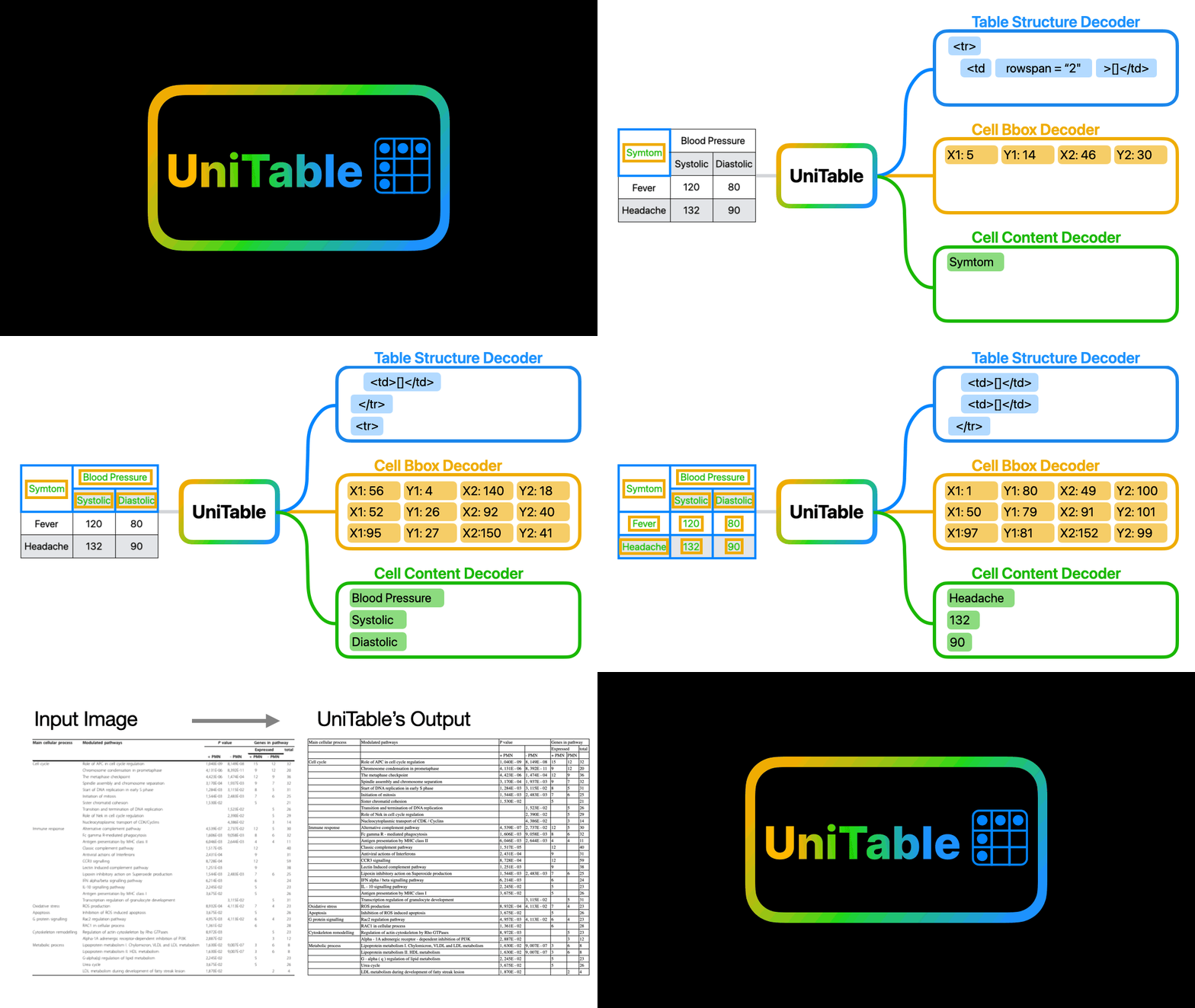
Tables convey factual and quantitative data with implicit conventions created by humans that are often challenging for machines to parse. Prior work on table recognition (TR) has mainly centered around complex task-specific combinations of available inputs and tools. We present UniTable, a training framework that unifies training paradigm, training objective, and model architecture of TR.
Its training paradigm combines the simplicity of purely pixel-level inputs with the effectiveness and scalability empowered by self-supervised pretraining (SSP) from diverse unannotated tabular images. Our framework unifies the training of all three TR tasks — extracting table structure, cell content, and cell bounding box (bbox) — into a unified task-agnostic training objective: language modeling. Extensive quantitative and qualitative analyses highlight UniTable’s state-of-the-art (SOTA) performance on four of the largest TR datasets. To promote reproducible research, enhance transparency, and SOTA innovations, we have released the first-of-its-kind Jupyter Notebook of the entire inference pipeline, fine-tuned across multiple TR datasets, supporting all three TR tasks.
This repo includes code for linear projection Transformers. For convolutional stem (early convolution) Transformers, please check out our tsr-convstem repo.
News
Apr. 2024 - You can fully digitalize your own tabular image in our Jupyter Notebook.
Apr. 2024 - UniTable v1.0.0 is now online with model weights available at HuggingFace.
Feb. 2024 - We presented "Self-Supervised Pretraining" paper at AAAI'24.
Jan. 2024 - "Self-Supervised Pretraining" paper was selected as oral.
Dec. 2023 - "Self-Supervised Pretraining" paper was accepted by AAAI'24 Scientific Document Understanding Workshop.
Dec. 2023 - We presented "Early Convolutions" paper at NeurIPS'23.
Oct. 2023 - "Early Convolutions" paper was selected as oral.
Oct. 2023 - "Early Convolutions" paper was accepted by NeurIPS'23 Table Representation Learning Workshop.
Quick Start
Set up virtual environment (unitable) by running make .done_venv in your terminal.
Download all the model weights from HuggingFace by running make .done_download_weights in your terminal.
Try out our demo Jupyter Notebook with your own tabular image! Remember to select "unitable" as your notebook kernel.
Training
Our code is driven by Makefile targets and configured by Hydra. Experiment names are defined as EXP_<name> in CONFIG.mk Sec. Experiments. We have also provided how to launch the make target in the comment above each experiment.
Dataset annotation format
We provide a tiny portion (20 samples) of PubTabNet as an example for a quick walk through of the training process. The dataset (tabular image and annotation) is available at dataset/mini_pubtabnet. The annotation for all images are in mini_pubtabnet_examples.jsonl. Each line is a json object that corresponds to a png image with the following structure:
"filename": "tabular image filename inside one of the 'train', 'val', or 'test'",
"split": "One of 'train', 'val', or 'test'",
"html": "table structure, cell content, and cell bbox",
    "cells": "Array with all cell content and bbox",
        "tokens": "Array with the content of the cell",
        "bbox": "The bounding bbox of the cell in [x1, y1, x2, y2] format. Only provided when cell is non-empty.",
    "structure": "Dict with table structure",
        "tokens": "Array with html tags that describe the table structure. '[]' represents non-empty cell",
If you want to train on your own dataset, please convert your dataset based on the provided format.
The five datasets we used in the paper are PubTabNet, SynthTabNet, FinTabNet, ICDAR 2019 B2 Modern, and PubTables-1M.
After downloading these datasets, please update the root_dir for each dataset under configs/dataset/.
Tracking your training progress
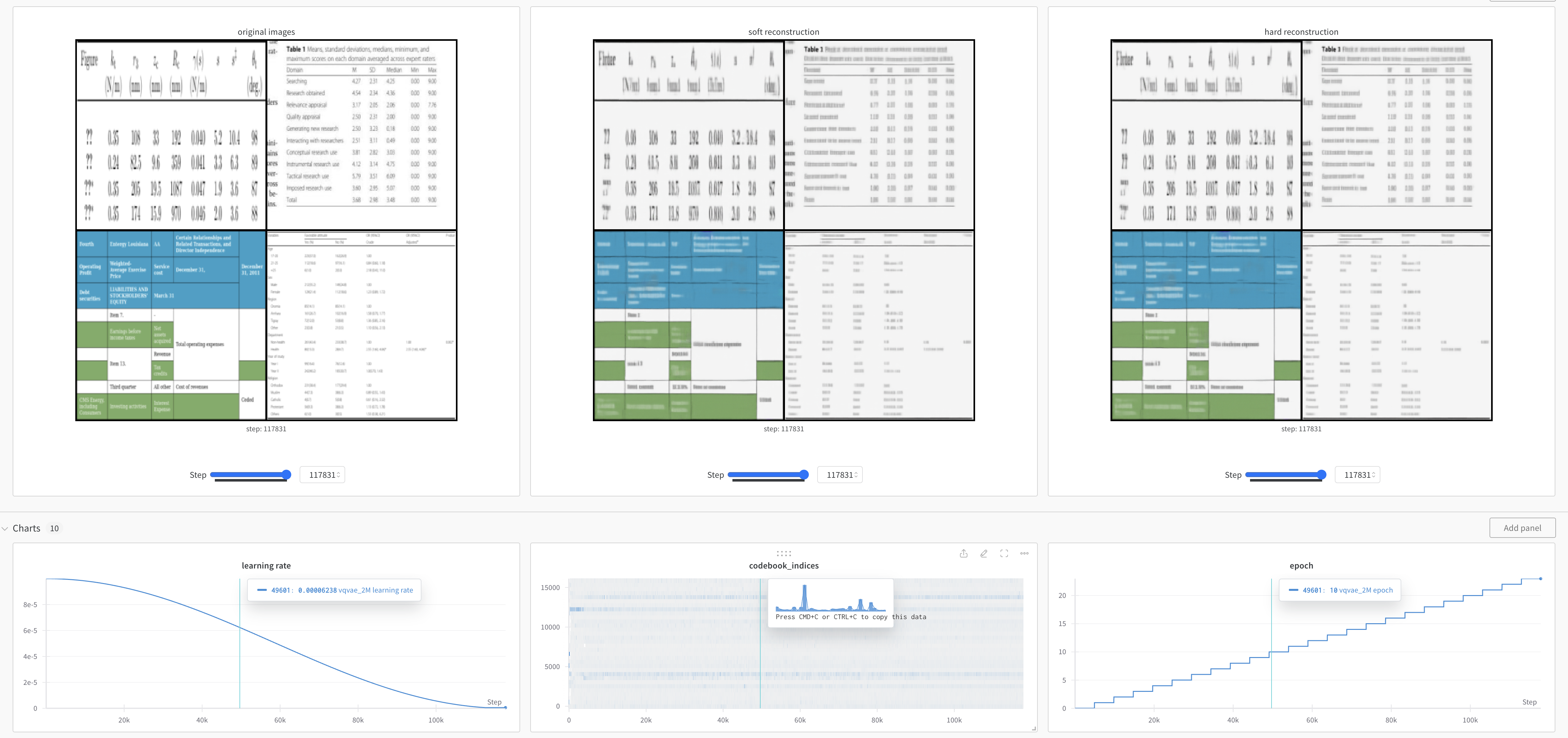
Please register Weights & Biases account if you want to visualize training curves and reconstructed tables (for pretraining VQ-VAE only). An example of reconstructed tables by VQ-VAE:
Finetuning
We present finetuning on the provided mini-PubTabNet. For more details on cross dataset finetuning, please check CONFIG.mk.
# table structure
make experiments/ssp_2m_mini_html_base/.done_finetune

# cell bbox
make experiments/ssp_2m_mini_bbox_base/.done_finetune

# cell content
make experiments/ssp_2m_mini_cell_base/.done_finetune
Pretraining
We present training the VQ-VAE and pretraining the visual encoder on the provided mini-PubTabNet. For more details on cross dataset finetuning, please check CONFIG.mk.
The default setting is a single gpu, i.e., NGPU := 1 in Makefile. To enable multi-GPU, please launch the above command with the following format: CUDA_VISIBLE_DEVICES=0,1,2,3 make NGPU=4 experiment/<exp name>/.done_<training type>.
Citation
@article{peng2024unitable,
  title={UniTable: Towards a Unified Framework for Table Structure Recognition via Self-Supervised Pretraining},
  author={Peng, ShengYun and Lee, Seongmin and Wang, Xiaojing and Balasubramaniyan, Rajarajeswari and Chau, Duen Horng},
  journal={arXiv preprint},
  year={2024}
}

@article{peng2024self,
  title={Self-Supervised Pretraining for Table Structure Recognition Transformer},
  author={Peng, ShengYun and Lee, Seongmin and Wang, Xiaojing and Balasubramaniyan, Rajarajeswari and Chau, Duen Horng},
  journal={arXiv preprint},
  year={2024}
}

@inproceedings{peng2023high,
  title={High-Performance Transformers for Table Structure Recognition Need Early Convolutions},
  author={Peng, Anthony and Lee, Seongmin and Wang, Xiaojing and Balasubramaniyan, Rajarajeswari Raji and Chau, Duen Horng},
  booktitle={NeurIPS 2023 Second Table Representation Learning Workshop},
  year={2023}
}
Contact
If you have any questions, feel free to contact Anthony Peng (CS PhD @Georgia Tech).
TopGit's last sync did not record any GitHub topics for poloclub/unitable. GitHub topics appear in the right sidebar of a repository page; that's the authoritative place to check.
How active is development on poloclub/unitable?
The most recent commit recorded on poloclub/unitable was 4 months ago, based on the GitHub push timestamp. The repository has 39 forks — one of the better signals of community interest.
How many stars does poloclub/unitable have?
poloclub/unitable has 534 GitHub stars — refresh the page for the live number, or check github.com/poloclub/unitable. TopGit mirrors GitHub's count but does not claim minute-by-minute accuracy.
What language is poloclub/unitable written in?
poloclub/unitable is written primarily in Jupyter Notebook. GitHub's language field is based on the largest share of bytes in the default branch.
What license does poloclub/unitable use?
poloclub/unitable is released under the MIT license. Always verify the LICENSE file directly on GitHub for the authoritative terms — license strings can be edited out of sync with a project's actual stance.
Where can I see poloclub/unitable in action?
The project maintains a homepage at https://arxiv.org/abs/2403.04822. The README tab on this page also usually contains screenshots and a quickstart.
Where do I read more about poloclub/unitable?
This TopGit page is a snapshot — the READ ME tab shows the project's own README content (links stripped, images preserved). The GitHub repository at github.com/poloclub/unitable is the definitive source.
Read full README in the tab above.
Curious whether unitable is right for you?
Let ChatGPT, Claude, or Perplexity look into it — click below and see what AI actually says about unitable.
 /unitable