TopGit tracks reactor/reactor-core on GitHub. The project has 5.2k stars. Non-Blocking Reactive Foundation for the JVM
Snapshot summary built from the project's own GitHub metadata — there's no written TopGit review yet. The page will update automatically when a full review is published.
WHY NO REVIEW YET
TopGit writes full reviews for the most-starred, most-requested repositories. This page is a snapshot until then — see the READ ME tab for the original README in full.
Non-Blocking Reactive Streams Foundation for the JVM both implementing a Reactive Extensions inspired API and efficient event streaming support.
Since 3.3.x, this repository also contains reactor-tools, a java agent aimed at helping with debugging of Reactor code.
Getting it
Reactor 3 requires Java 8 or + to run.
With Gradle from repo.spring.io or Maven Central repositories (stable releases only):
repositories {
    mavenCentral()

    // Uncomment to get access to Snapshots
    // maven { url "https://repo.spring.io/snapshot" }
}

dependencies {
    compile "io.projectreactor:reactor-core:3.9.0-RC1"
    testCompile "io.projectreactor:reactor-test:3.9.0-RC1"

    // Alternatively, use the following for latest snapshot artifacts in this line
    // compile "io.projectreactor:reactor-core:3.9.1-SNAPSHOT"
    // testCompile "io.projectreactor:reactor-test:3.9.1-SNAPSHOT"

    // Optionally, use `reactor-tools` to help debugging reactor code
    // implementation "io.projectreactor:reactor-tools:3.9.0-RC1"
}
See the reference documentation
for more information on getting it (eg. using Maven, or on how to get milestones and snapshots).
Note about Android support: Reactor 3 doesn't officially support nor target Android.
However it should work fine with Android SDK 21 (Android 5.0) and above. See the
complete note
in the reference guide.
Trouble building the project?
Since the introduction of Java Multi-Release JAR File
support one needs to have JDK 8, 9, and 21 available on the classpath. All the JDKs should
be automatically detected
or provisioned
by Gradle Toolchain.
However, if you see error message such as No matching toolchains found for requested specification: {languageVersion=X, vendor=any, implementation=vendor-specific} (where
X can be 8, 9 or 21), it means that you need to install the missing JDK:
Installing JDKs with SDKMAN!
In the project root folder run SDKMAN env initialization:
When the installations succeed, try to refresh the project and see that it builds.
Installing JDKs manually
The manual Operation-system specific JDK installation
is well explained in the official docs
Building the doc
The current active shell JDK version must be compatible with JDK17 or higher for Antora to build successfully.
So, just ensure that you have installed JDK 21, as described above and make it as the current one.
Then you can build the antora documentation like this:
./gradlew docs
The documentation is generated in docs/build/site/index.html and in docs/build/distributions/reactor-core-<version>-docs.zip
If a PDF file should also be included in the generated docs zip file, then you need to specify -PforcePdf option:
./gradlew docs -PforcePdf
Notice that PDF generation requires the asciidoctor-pdf command to be available in the PATH.
For example, on Mac OS, you can install such command like this:
brew install asciidoctor
Getting Started
New to Reactive Programming or bored of reading already ? Try the Introduction to Reactor Core hands-on !
If you are familiar with RxJava or if you want to check more detailed introduction, be sure to check
https://www.infoq.com/articles/reactor-by-example !
Flux
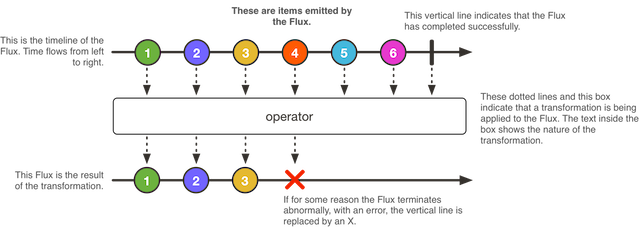
A Reactive Streams Publisher with basic flow operators.
Static factories on Flux allow for source generation from arbitrary callbacks types.
Instance methods allows operational building, materialized on each subscription (Flux#subscribe(), ...) or multicasting operations (such as Flux#publish and Flux#publishNext).
Reactor uses a Scheduler as a
contract for arbitrary task execution. It provides some guarantees required by Reactive
Streams flows like FIFO execution.
You can use or create efficient schedulers
to jump thread on the producing flows (subscribeOn) or receiving flows (publishOn):
ParallelFlux can starve your CPU's from any sequence whose work can be subdivided in concurrent
tasks. Turn back into a Flux with ParallelFlux#sequential(), an unordered join or
use arbitrary merge strategies via 'groups()'.
Mono.fromCallable( () -> System.currentTimeMillis() )
	.repeat()
    .parallel(8) //parallelism
    .runOn(Schedulers.parallel())
    .doOnNext( d -> System.out.println("I'm on thread "+Thread.currentThread()) )
    .subscribe()
Custom sources : Flux.create and FluxSink, Mono.create and MonoSink
To bridge a Subscriber or Processor into an outside context that is taking care of
producing non concurrently, use Flux#create, Mono#create.
Flux.create(sink -> {
         ActionListener al = e -> {
            sink.next(textField.getText());
         };

         // without cancellation support:
         button.addActionListener(al);

         // with cancellation support:
         sink.onCancel(() -> {
         	button.removeListener(al);
         });
    },
    // Overflow (backpressure) handling, default is BUFFER
    FluxSink.OverflowStrategy.LATEST)
    .timeout(Duration.ofSeconds(3))
    .doOnComplete(() -> System.out.println("completed!"))
    .subscribe(System.out::println)
The Backpressure Thing
Most of this cool stuff uses bounded ring buffer implementation under the hood to mitigate signal processing difference between producers and consumers. Now, the operators and processors or any standard reactive stream component working on the sequence will be instructed to flow in when these buffers have free room AND only then. This means that we make sure we both have a deterministic capacity model (bounded buffer) and we never block (request more data on write capacity). Yup, it's not rocket science after all, the boring part is already being worked by us in collaboration with Reactive Streams Commons on going research effort.
What's more in it ?
"Operator Fusion" (flow optimizers), health state observers, helpers to build custom reactive components, bounded queue generator, converters from/to Java 9 Flow, Publisher and Java 8 CompletableFuture. The repository contains a reactor-test project with test features like the StepVerifier.
How active is development on reactor/reactor-core?
The most recent commit recorded on reactor/reactor-core was 1 day ago, based on the GitHub push timestamp. The repository has 1.3k forks — one of the better signals of community interest.
How many stars does reactor/reactor-core have?
reactor/reactor-core has 5.2k GitHub stars — refresh the page for the live number, or check github.com/reactor/reactor-core. TopGit mirrors GitHub's count but does not claim minute-by-minute accuracy.
What language is reactor/reactor-core written in?
reactor/reactor-core is written primarily in Java. GitHub's language field is based on the largest share of bytes in the default branch.
What topics is reactor/reactor-core associated with?
GitHub's repository topics for reactor/reactor-core: "asynchronous", "flow", "flux", "jvm", "mono", "reactive", "reactive-extensions", "reactive-streams". TopGit's editorial category is open-source.
Where do I read more about reactor/reactor-core?
This TopGit page is a snapshot — the READ ME tab shows the project's own README content (links stripped, images preserved). The GitHub repository at github.com/reactor/reactor-core is the definitive source.
Read full README in the tab above.
Curious whether reactor-core is right for you?
Let ChatGPT, Claude, or Perplexity look into it — click below and see what AI actually says about reactor-core.

 /reactor-core