Awesome Node.js: A Curated List of Node.js Packages
 /awesome-nodejs
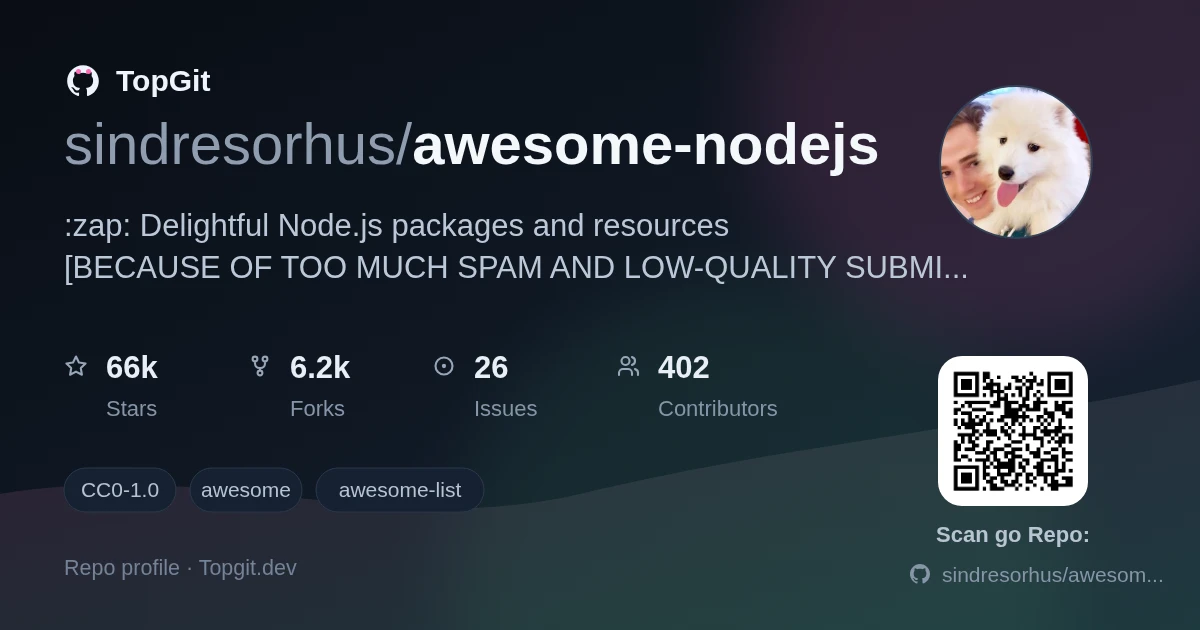
Awesome Node.js is a single-page, hand-picked directory of Node.js packages sorted into categories like HTTP, CLI tooling, and web frameworks. Its real value is a curator, sindresorhus, filtering the noise down to a shortlist you can read in one sitting. Submissions are paused right now because of spam, so the list is stable but not growing. Worth bookmarking as a starting shortlist, not a full catalog.
What is Awesome Node.js?
Awesome Node.js is a curated, CC0-licensed GitHub list that links out to Node.js packages and resources rather than hosting any code of its own. It opens with official links to the Node.js website, docs, and source repo, then sorts third-party packages into categories like HTTP, logging, and command-line utilities. Each entry is one line — a name, a link, and a short description — not a tutorial.
What categories and packages does the list cover?
- ✓An 'Official' section up top links straight to the Node.js website, API docs, and the nodejs/node source repo before any third-party listings start.
- ✓A 'Mad science' category for the odd stuff — BitTorrent clients like webtorrent, a Bitcoin library (BitcoinJS), even NodeOS, an operating system built around npm.
- ✓Command-line apps and command-line utilities are split into two separate categories, from meow (a CLI helper) to chalk (terminal string styling) to full frameworks like oclif.
- ✓A dedicated HTTP category: got, undici, node-fetch, and axios sit side by side, each with a one-line note on what sets it apart.
- ✓Debugging and profiling tools like why-is-node-running and the 0x flamegraph profiler for tracking down what's actually slow.
- ✓Web frameworks from Fastify and Koa to Express and Next.js, each described in a single line rather than compared in depth.
- ✓Narrower categories too — functional programming (Ramda, RxJS), templating engines (Pug, EJS), and hardware libraries for GPIO and serial-port access.
How to navigate and use the list
- •Ctrl+F for a category name like 'Logging' or 'Build tools' rather than scrolling — the list is long and grouped, not searchable within GitHub itself.
- •Treat each entry's one-line description as a filter, not a review: click through to the linked repo to actually judge fit.
- •Use the 'Official' links first if you just need the Node.js docs or source, before digging into curated packages.
- •Bookmark it for category-level decisions — comparing HTTP clients like got, axios, and node-fetch — rather than treating it as a final answer.
Strengths
- ✓One person curating means a consistent bar for what gets in, instead of an open wiki anyone can pad with their own project.
- ✓CC0-1.0 licensing puts the list itself in the public domain — no attribution required to reuse or fork the content.
- ✓Categories map to real decisions developers make (which HTTP client, which logger, which CLI framework), not an abstract taxonomy.
- ✓Opens with official Node.js links before any third-party opinion, so newcomers land on primary sources first.
When Awesome Node.js falls short
- △Submissions are currently paused. The repo's own description cites spam and low-quality submissions as the reason the list isn't growing right now.
- △Entries get a one-line description and nothing else: no version info, no maintenance status, no comparison between similar tools in the same category.
- △It's a flat list of links, not a searchable or filterable index — finding something means reading through a category by eye.
- △Some listed projects point to forks or successor repos (the ipfs entry links to helia, for instance) rather than the original, which can confuse anyone who doesn't check the URL.
Other ways to discover Node.js packages
Frequently asked questions
Awesome Node.js is free to browse and reuse — the repository is licensed CC0-1.0, which puts the list itself in the public domain with no attribution required.
Awesome Node.js groups packages into categories such as HTTP, logging, command-line utilities, build tools, debugging and profiling, templating, web frameworks, functional programming, and hardware access, plus an odds-and-ends 'Mad science' section.
The submission process itself isn't documented in the repo's visible material. Awesome Node.js currently has submissions paused altogether — its own description cites too much spam and too many low-quality entries as the reason.
Awesome Node.js is maintained, but intake is currently restricted — the repo description states submissions are paused until July because of spam and low-quality entries, so existing listings are curated rather than expanding right now.
CC0-1.0 is the license Awesome Node.js is released under. It waives copyright and places the list in the public domain, so anyone can copy, adapt, or redistribute the content without asking permission or crediting the source.
Awesome Node.js links to the official Node.js documentation rather than replacing it. The official docs explain the runtime's own APIs, while Awesome Node.js is a directory of third-party packages built on top of Node.js, organized by category.
Who should try it — and who should skip
Worth a bookmark for a developer who already knows Node.js and wants a fast shortlist when picking a category of package: an HTTP client, a CLI framework, a logger, without wading through npm search results. Skip it if you want an actively growing directory, since submissions are paused and anything shipped recently won't be listed. Skip it too if you want reviews or comparisons instead of one-line pointers — this is an index, not a buyer's guide.
Related repositories
Is awesome-nodejs worth your time?
ChatGPT, Claude and Perplexity can all read this page. Ask one of them what it makes of awesome-nodejs.