Snapshot of Tencent/rapidjson: 15.1k★, C++. A fast JSON parser/generator for C++ with both SAX/DOM style API
Snapshot summary built from the project's own GitHub metadata — there's no written TopGit review yet. The page will update automatically when a full review is published.
WHY NO REVIEW YET
TopGit writes full reviews for the most-starred, most-requested repositories. This page is a snapshot until then — see the READ ME tab for the original README in full.
A fast JSON parser/generator for C++ with both SAX/DOM style API
Tencent is pleased to support the open source community by making RapidJSON available.
Copyright (C) 2015 THL A29 Limited, a Tencent company, and Milo Yip.
RapidJSON GitHub
RapidJSON Documentation
English
简体中文
GitBook with downloadable PDF/EPUB/MOBI, without API reference.
Build status
Linux
Windows
Coveralls
Introduction
RapidJSON is a JSON parser and generator for C++. It was inspired by RapidXml.
RapidJSON is small but complete. It supports both SAX and DOM style API. The SAX parser is only a half thousand lines of code.
RapidJSON is fast. Its performance can be comparable to strlen(). It also optionally supports SSE2/SSE4.2 for acceleration.
RapidJSON is self-contained and header-only. It does not depend on external libraries such as BOOST. It even does not depend on STL.
RapidJSON is memory-friendly. Each JSON value occupies exactly 16 bytes for most 32/64-bit machines (excluding text string). By default it uses a fast memory allocator, and the parser allocates memory compactly during parsing.
RapidJSON is Unicode-friendly. It supports UTF-8, UTF-16, UTF-32 (LE & BE), and their detection, validation and transcoding internally. For example, you can read a UTF-8 file and let RapidJSON transcode the JSON strings into UTF-16 in the DOM. It also supports surrogates and "\u0000" (null character).
More features can be read here.
JSON(JavaScript Object Notation) is a light-weight data exchange format. RapidJSON should be in full compliance with RFC7159/ECMA-404, with optional support of relaxed syntax. More information about JSON can be obtained at
Introducing JSON
RFC7159: The JavaScript Object Notation (JSON) Data Interchange Format
Standard ECMA-404: The JSON Data Interchange Format
Iterating array/object with C++11 Range-based for loop
Reduce memory overhead of each Value from 24 bytes to 16 bytes in x86-64 architecture.
For other changes please refer to change log.
Compatibility
RapidJSON is cross-platform. Some platform/compiler combinations which have been tested are shown as follows.
Visual C++ 2008/2010/2013 on Windows (32/64-bit)
GNU C++ 3.8.x on Cygwin
Clang 3.4 on Mac OS X (32/64-bit) and iOS
Clang 3.4 on Android NDK
Users can build and run the unit tests on their platform/compiler.
Installation
RapidJSON is a header-only C++ library. Just copy the include/rapidjson folder to system or project's include path.
Alternatively, if you are using the vcpkg dependency manager you can download and install rapidjson with CMake integration in a single command:
vcpkg install rapidjson
RapidJSON uses following software as its dependencies:
CMake as a general build tool
(optional) Doxygen to build documentation
(optional) googletest for unit and performance testing
To generate user documentation and run tests please proceed with the steps below:
Execute git submodule update --init to get the files of thirdparty submodules (google test).
Create directory called build in rapidjson source directory.
Change to build directory and run cmake .. command to configure your build. Windows users can do the same with cmake-gui application.
On Windows, build the solution found in the build directory. On Linux, run make from the build directory.
On successful build you will find compiled test and example binaries in bin
directory. The generated documentation will be available in doc/html
directory of the build tree. To run tests after finished build please run make test or ctest from your build tree. You can get detailed output using ctest -V command.
It is possible to install library system-wide by running make install command
from the build tree with administrative privileges. This will install all files
according to system preferences. Once RapidJSON is installed, it is possible
to use it from other CMake projects by adding find_package(RapidJSON) line to
your CMakeLists.txt.
Usage at a glance
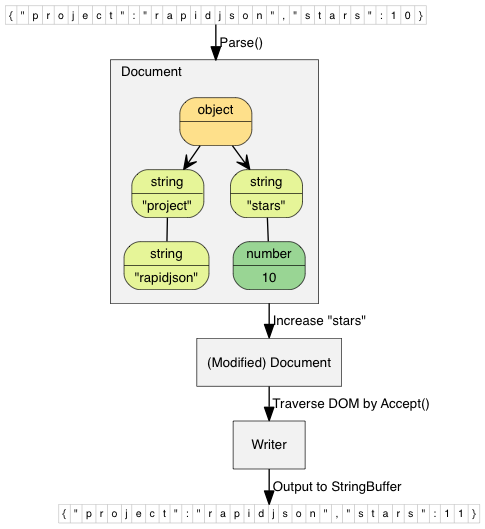
This simple example parses a JSON string into a document (DOM), make a simple modification of the DOM, and finally stringify the DOM to a JSON string.
// rapidjson/example/simpledom/simpledom.cpp`
#include "rapidjson/document.h"
#include "rapidjson/writer.h"
#include "rapidjson/stringbuffer.h"
#include <iostream>

using namespace rapidjson;

int main() {
    // 1. Parse a JSON string into DOM.
    const char* json = "{\"project\":\"rapidjson\",\"stars\":10}";
    Document d;
    d.Parse(json);

    // 2. Modify it by DOM.
    Value& s = d["stars"];
    s.SetInt(s.GetInt() + 1);

    // 3. Stringify the DOM
    StringBuffer buffer;
    Writer<StringBuffer> writer(buffer);
    d.Accept(writer);

    // Output {"project":"rapidjson","stars":11}
    std::cout << buffer.GetString() << std::endl;
    return 0;
}
Note that this example did not handle potential errors.
The following diagram shows the process.
More examples are available:
DOM API
tutorial: Basic usage of DOM API.
SAX API
simplereader: Dumps all SAX events while parsing a JSON by Reader.
condense: A command line tool to rewrite a JSON, with all whitespaces removed.
pretty: A command line tool to rewrite a JSON with indents and newlines by PrettyWriter.
capitalize: A command line tool to capitalize strings in JSON.
messagereader: Parse a JSON message with SAX API.
serialize: Serialize a C++ object into JSON with SAX API.
jsonx: Implements a JsonxWriter which stringify SAX events into JSONx (a kind of XML) format. The example is a command line tool which converts input JSON into JSONx format.
Schema
schemavalidator : A command line tool to validate a JSON with a JSON schema.
Advanced
prettyauto: A modified version of pretty to automatically handle JSON with any UTF encodings.
parsebyparts: Implements an AsyncDocumentParser which can parse JSON in parts, using C++11 thread.
filterkey: A command line tool to remove all values with user-specified key.
filterkeydom: Same tool as above, but it demonstrates how to use a generator to populate a Document.
Contributing
RapidJSON welcomes contributions. When contributing, please follow the code below.
Issues
Feel free to submit issues and enhancement requests.
Please help us by providing minimal reproducible examples, because source code is easier to let other people understand what happens.
For crash problems on certain platforms, please bring stack dump content with the detail of the OS, compiler, etc.
Please try breakpoint debugging first, tell us what you found, see if we can start exploring based on more information been prepared.
Workflow
In general, we follow the "fork-and-pull" Git workflow.
Fork the repo on GitHub
Clone the project to your own machine
Checkout a new branch on your fork, start developing on the branch
Test the change before commit, Make sure the changes pass all the tests, including unittest and preftest, please add test case for each new feature or bug-fix if needed.
Commit changes to your own branch
Push your work back up to your fork
Submit a Pull request so that we can review your changes
NOTE: Be sure to merge the latest from "upstream" before making a pull request!
Copyright and Licensing
You can copy and paste the license summary from below.
Tencent is pleased to support the open source community by making RapidJSON available.

Copyright (C) 2015 THL A29 Limited, a Tencent company, and Milo Yip.

Licensed under the MIT License (the "License"); you may not use this file except
in compliance with the License. You may obtain a copy of the License at

http://opensource.org/licenses/MIT

Unless required by applicable law or agreed to in writing, software distributed
under the License is distributed on an "AS IS" BASIS, WITHOUT WARRANTIES OR
CONDITIONS OF ANY KIND, either express or implied. See the License for the
specific language governing permissions and limitations under the License.
TopGit's metadata for Tencent/rapidjson does not record a license. Most public repositories on GitHub ARE open source, but the exact terms vary — verify by opening the LICENSE file directly.
What is Tencent/rapidjson?
Tencent/rapidjson (Tencent/rapidjson) is a C++ project on GitHub. From the project's own README: A fast JSON parser/generator for C++ with both SAX/DOM style API
Where can I see Tencent/rapidjson in action?
The project maintains a homepage at http://rapidjson.org/. The README tab on this page also usually contains screenshots and a quickstart.
Where do I read more about Tencent/rapidjson?
This TopGit page is a snapshot — the READ ME tab shows the project's own README content (links stripped, images preserved). The GitHub repository at github.com/Tencent/rapidjson is the definitive source.
Read full README in the tab above.
Want a second opinion on rapidjson?
Ask an AI that can read this page — one click and you get its take on rapidjson.
 /rapidjson