thewhiteh4t/seeker is one of the open-source repositories TopGit tracks, currently at 10.3k stars, written primarily in CSS. Accurately Locate Smartphones using Social Engineering
Snapshot summary built from the project's own GitHub metadata — there's no written TopGit review yet. The page will update automatically when a full review is published.
WHY NO REVIEW YET
TopGit writes full reviews for the most-starred, most-requested repositories. This page is a snapshot until then — see the READ ME tab for the original README in full.
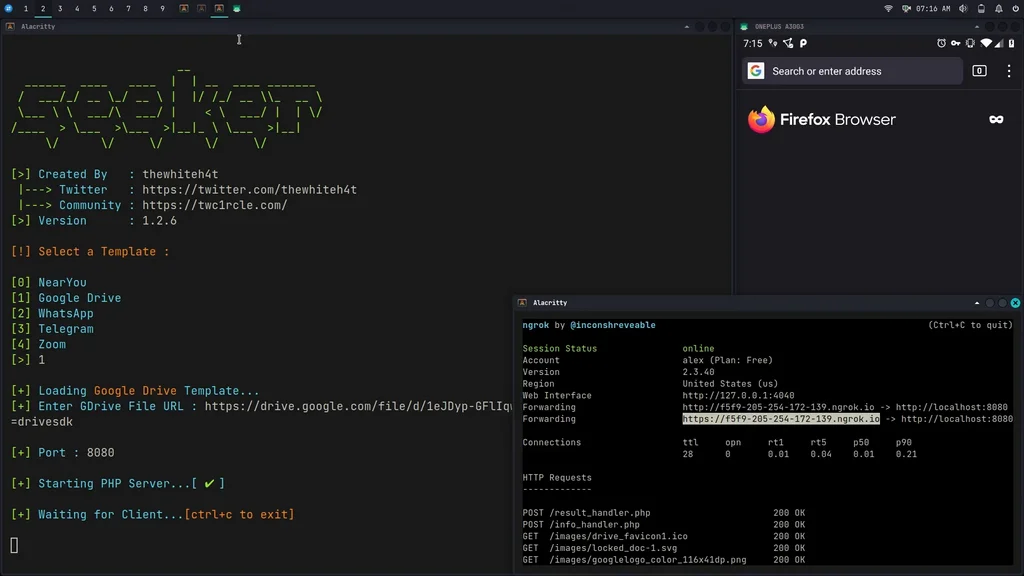
Concept behind Seeker is simple, just like we host phishing pages to get credentials why not host a fake page that requests your location like many popular location based websites. Read more on thewhiteh4t's Blog .Seeker Hosts a fake website which asks for Location Permission and if the target allows it, we can get :
Longitude
Latitude
Accuracy
Altitude - Not always available
Direction - Only available if user is moving
Speed - Only available if user is moving
Along with Location Information we also get Device Information without any permissions :
Unique ID using Canvas Fingerprinting
Device Model - Not always available
Operating System
Platform
Number of CPU Cores - Approximate Results
Amount of RAM - Approximate Results
Screen Resolution
GPU information
Browser Name and Version
Public IP Address
Local IP Address
Local Port
Automatic IP Address Reconnaissance is performed after the above information is received.
This tool is a Proof of Concept and is for Educational Purposes Only, Seeker shows what data a malicious website can gather about you and your devices and why you should not click on random links and allow critical permissions such as Location etc.
How is this Different from IP GeoLocation
Other tools and services offer IP Geolocation which is NOT accurate at all and does not give location of the target instead it is the approximate location of the ISP.
Seeker uses HTML API and gets Location Permission and then grabs Longitude and Latitude using GPS Hardware which is present in the device, so Seeker works best with Smartphones, if the GPS Hardware is not present, such as on a Laptop, Seeker fallbacks to IP Geolocation or it will look for Cached Coordinates.
Generally if a user accepts location permission, Accuracy of the information received is accurate to approximately 30 meters
Accuracy depends on multiple factors which you may or may not control such as :
Device - Won't work on laptops or phones which have broken GPS
Browser - Some browsers block javascripts
GPS Calibration - If GPS is not calibrated you may get inaccurate results and this is very common
Templates
Available Templates :
NearYou
Google Drive (Suggested by @Akaal_no_one)
WhatsApp (Suggested by @Dazmed707)
Telegram
Zoom (Made by @a7maadf)
Google reCAPTCHA (Made by @MrEgyptian)
Create your own template !
Steps to let you create your template is described in this how-to
Once your template is ready, do not forget to propose it to the community via a PR (pull request)
Tested On :
Kali Linux
BlackArch Linux
Ubuntu
Fedora
Kali Nethunter
Termux
Parrot OS
OSX - Monterey v.12.0.1
Installation
Kali Linux / Arch Linux / Ubuntu / Fedora / Parrot OS / Termux
git clone https://github.com/thewhiteh4t/seeker.git
cd seeker/
chmod +x install.sh
./install.sh
BlackArch Linux
sudo pacman -S seeker
Docker
docker pull thewhiteh4t/seeker
OSX
git clone https://github.com/thewhiteh4t/seeker.git
cd seeker/
python3 seeker.py
In order to run in tunnel mode, install ngrok by running this command in the terminal:
brew install ngrok/ngrok/ngrok

ngrok http 8080
Usage
python3 seeker.py -h

usage: seeker.py [-h] [-k KML] [-p PORT] [-u] [-v] [-t TEMPLATE] [-d] [--telegram token:chatId] [--webhook WEBHOOK]

options:
  -h, --help                            show this help message and exit
  -k KML, --kml KML                     KML filename
  -p PORT, --port PORT                  Web server port [ Default : 8080 ]
  -u, --update                          Check for updates
  -v, --version                         Prints version
  -t TEMPLATE, --template TEMPLATE      Auto choose the template with the given index
  -d, --debugHTTP                       Disable auto http --> https redirection for testing purposes
                                        (only works for the templates having index_temp.html file)
  --telegram                            Send info to a telegram bot, provide telegram token and chat to use
                                        format = token:chatId separated by a colon
  --webhook                             Send events to a webhook endpoint to be processed
                                        Note : endpoint must be unauthenticated and accept POST request

#########################
# Environment Variables #
#########################

Some of the options above can also be enabled via environment variables, to ease deployment.
Other parameters can be provided via environment variables to avoid interactive mode.

Variables:
  DEBUG_HTTP            Same as -d, --debugHTTP
  PORT                  Same as -p, --port
  TEMPLATE              Same as -t, --template
  TITLE                 Provide the group title or the page title
  REDIRECT              Provide the URL to redirect the user to, after the job is done
  IMAGE                 Provide the image to use, can either be remote (http or https) or local
                        Note : Remote image will be downloaded locally during the startup
  DESC                  Provide the description of the item (group or webpage depending on the template)
  SITENAME              Provide the name of the website
  DISPLAY_URL           Provide the URL to display on the page
  MEM_NUM               Provide the number of group membres (Telegram so far)
  ONLINE_NUM            Provide the number of the group online members (Telegram so far)
  TELEGRAM              Provide telegram token and chat to use to send info to a telegram bot
                        format = token:chatId separated by a colon
  WEBHOOK               Provide the webhook url to forward the events to
                        Note : endpoint should be unauthenticated and accept POST method


##################
# Usage Examples #
##################

# Step 1 : In first terminal
$ python3 seeker.py

# Step 2 : In second terminal start a tunnel service such as ngrok
$ ./ngrok http 8080

###########
# Options #
###########

# Ouput KML File for Google Earth
$ python3 seeker.py -k <filename>

# Use Custom Port
$ python3 seeker.py -p 1337
$ ./ngrok http 1337

# Pre-select a specific template
$ python3 seeker.py -t 1

################
# Docker Usage #
################

# Step 1
$ docker network create ngroknet

# Step 2
$ docker run --rm -it --net ngroknet --name seeker thewhiteh4t/seeker

# Step 3
$ docker run --rm -it --net ngroknet --name ngrok wernight/ngrok ngrok http seeker:8080
No homepage URL was recorded for thewhiteh4t/seeker in TopGit's last sync. The README tab above frequently contains screenshots and demo links, or check the repository description on GitHub.
Is thewhiteh4t/seeker open source?
Yes — thewhiteh4t/seeker ships under the MIT license, which makes its source code freely readable (and, depending on license terms, forkable and reusable). Source: github.com/thewhiteh4t/seeker.
What is thewhiteh4t/seeker?
thewhiteh4t/seeker (thewhiteh4t/seeker) is a CSS project on GitHub. From the project's own README: Accurately Locate Smartphones using Social Engineering
What license does thewhiteh4t/seeker use?
thewhiteh4t/seeker is released under the MIT license. Always verify the LICENSE file directly on GitHub for the authoritative terms — license strings can be edited out of sync with a project's actual stance.
Where do I read more about thewhiteh4t/seeker?
This TopGit page is a snapshot — the READ ME tab shows the project's own README content (links stripped, images preserved). The GitHub repository at github.com/thewhiteh4t/seeker is the definitive source.
Read full README in the tab above.
Want a second opinion on seeker?
Ask an AI that can read this page — one click and you get its take on seeker.

 /seeker