twitter-archive/diffy is an open-source project on GitHub with 3.8k stars, written primarily in Scala. Find potential bugs in your services with Diffy
Snapshot summary built from the project's own GitHub metadata — there's no written TopGit review yet. The page will update automatically when a full review is published.
WHY NO REVIEW YET
TopGit writes full reviews for the most-starred, most-requested repositories. This page is a snapshot until then — see the READ ME tab for the original README in full.
Twitter has decided to archive this project, as it was built on our outdated tech stack, making it unpractical to maintain it in its current form. Furthermore, we are reinventing in this space internally to accommodate newer use-cases for validating our services. As we mature these new approaches, we will reevaluate how and when to re-release these new solutions as open source software. Thank you for your understanding.
We won't be accepting pull requests or responding to issues for this project anymore.
Note that @puneetkhanduri, this project's original author and a former Twitter employee maintains their own version of this project, called Opendiffy.
Diffy
What is Diffy?
Diffy finds potential bugs in your service using running instances of your new code and your old
code side by side. Diffy behaves as a proxy and multicasts whatever requests it receives to each of
the running instances. It then compares the responses, and reports any regressions that may surface
from those comparisons. The premise for Diffy is that if two implementations of the service return
“similar” responses for a sufficiently large and diverse set of requests, then the two
implementations can be treated as equivalent and the newer implementation is regression-free.
For a more detailed analysis of Diffy checkout this blogpost.
How does Diffy work?
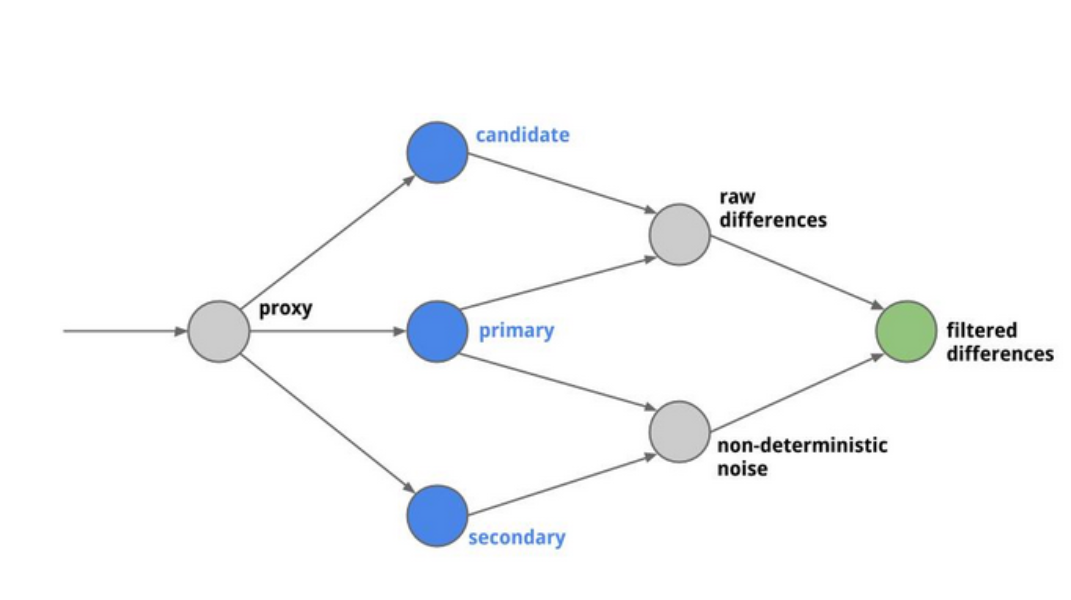
Diffy acts as a proxy that accepts requests drawn from any source that you provide and multicasts
each of those requests to three different service instances:
A candidate instance running your new code
A primary instance running your last known-good code
A secondary instance running the same known-good code as the primary instance
As Diffy receives a request, it is multicast and sent to your candidate, primary, and secondary
instances. When those services send responses back, Diffy compares those responses and looks for two
things:
Raw differences observed between the candidate and primary instances.
Non-deterministic noise observed between the primary and secondary instances. Since both of these
instances are running known-good code, you should expect responses to be in agreement. If not,
your service may have non-deterministic behavior, which is to be expected.
Diffy measures how often primary and secondary disagree with each other vs. how often primary and
candidate disagree with each other. If these measurements are roughly the same, then Diffy
determines that there is nothing wrong and that the error can be ignored.
How to get started?
Running the example
The example.sh script included here builds and launches example servers as well as a diffy instance. Verify
that the following ports are available (9000, 9100, 9200, 8880, 8881, & 8888) and run ./example/run.sh start.
Once your local Diffy instance is deployed, you send it a few requests
like curl --header "Canonical-Resource: Json" localhost:8880/json?Twitter. You can then go to your browser at
http://localhost:8888 to see what the differences across our example instances look like.
Digging deeper
That was cool but now you want to compare old and new versions of your own service. Here’s how you can
start using Diffy to compare three instances of your service:
Deploy your old code to localhost:9990. This is your primary.
Deploy your old code to localhost:9991. This is your secondary.
Deploy your new code to localhost:9992. This is your candidate.
Download the latest Diffy binary from maven central or build your own from the code using ./sbt assembly.
Run the Diffy jar with following command line arguments:
To build from source you can run docker build -t diffy .
FAQ's
For safety reasons POST, PUT, DELETE are ignored by default . Add -allowHttpSideEffects=true to your command line arguments to enable these verbs.
HTTPS
If you are trying to run Diffy over a HTTPS API, the config required is:
-service.protocol=https
And in case of the HTTPS port be different than 443:
-https.port=123
License
Licensed under the Apache License, Version 2.0 (the "License");
you may not use this software except in compliance with the License.
Unless required by applicable law or agreed to in writing, software
distributed under the License is distributed on an "AS IS" BASIS,
WITHOUT WARRANTIES OR CONDITIONS OF ANY KIND, either express or implied.
See the License for the specific language governing permissions and
limitations under the License.
TopGit's last sync did not record any GitHub topics for twitter-archive/diffy. GitHub topics appear in the right sidebar of a repository page; that's the authoritative place to check.
How active is development on twitter-archive/diffy?
The most recent commit recorded on twitter-archive/diffy was 6.1 years ago, based on the GitHub push timestamp. The repository has 360 forks — one of the better signals of community interest.
How many stars does twitter-archive/diffy have?
twitter-archive/diffy has 3.8k GitHub stars — refresh the page for the live number, or check github.com/twitter-archive/diffy. TopGit mirrors GitHub's count but does not claim minute-by-minute accuracy.
What language is twitter-archive/diffy written in?
twitter-archive/diffy is written primarily in Scala. GitHub's language field is based on the largest share of bytes in the default branch.
What license does twitter-archive/diffy use?
twitter-archive/diffy is released under the Apache-2.0 license. Always verify the LICENSE file directly on GitHub for the authoritative terms — license strings can be edited out of sync with a project's actual stance.
Where can I see twitter-archive/diffy in action?
The project maintains a homepage at https://twitter.com/diffyproject. The README tab on this page also usually contains screenshots and a quickstart.
Where do I read more about twitter-archive/diffy?
This TopGit page is a snapshot — the READ ME tab shows the project's own README content (links stripped, images preserved). The GitHub repository at github.com/twitter-archive/diffy is the definitive source.
Read full README in the tab above.
Is diffy worth your time?
ChatGPT, Claude and Perplexity can all read this page. Ask one of them what it makes of diffy.
 /diffy