6.6k GitHub stars and counting — xinntao/ESRGAN is a Python project TopGit is tracking across repositories on the platform. ECCV18 Workshops - Enhanced SRGAN. Champion PIRM Challenge on Perceptual Super-Resolution. The training codes are in BasicSR.
Snapshot summary built from the project's own GitHub metadata — there's no written TopGit review yet. The page will update automatically when a full review is published.
WHY NO REVIEW YET
TopGit writes full reviews for the most-starred, most-requested repositories. This page is a snapshot until then — see the READ ME tab for the original README in full.
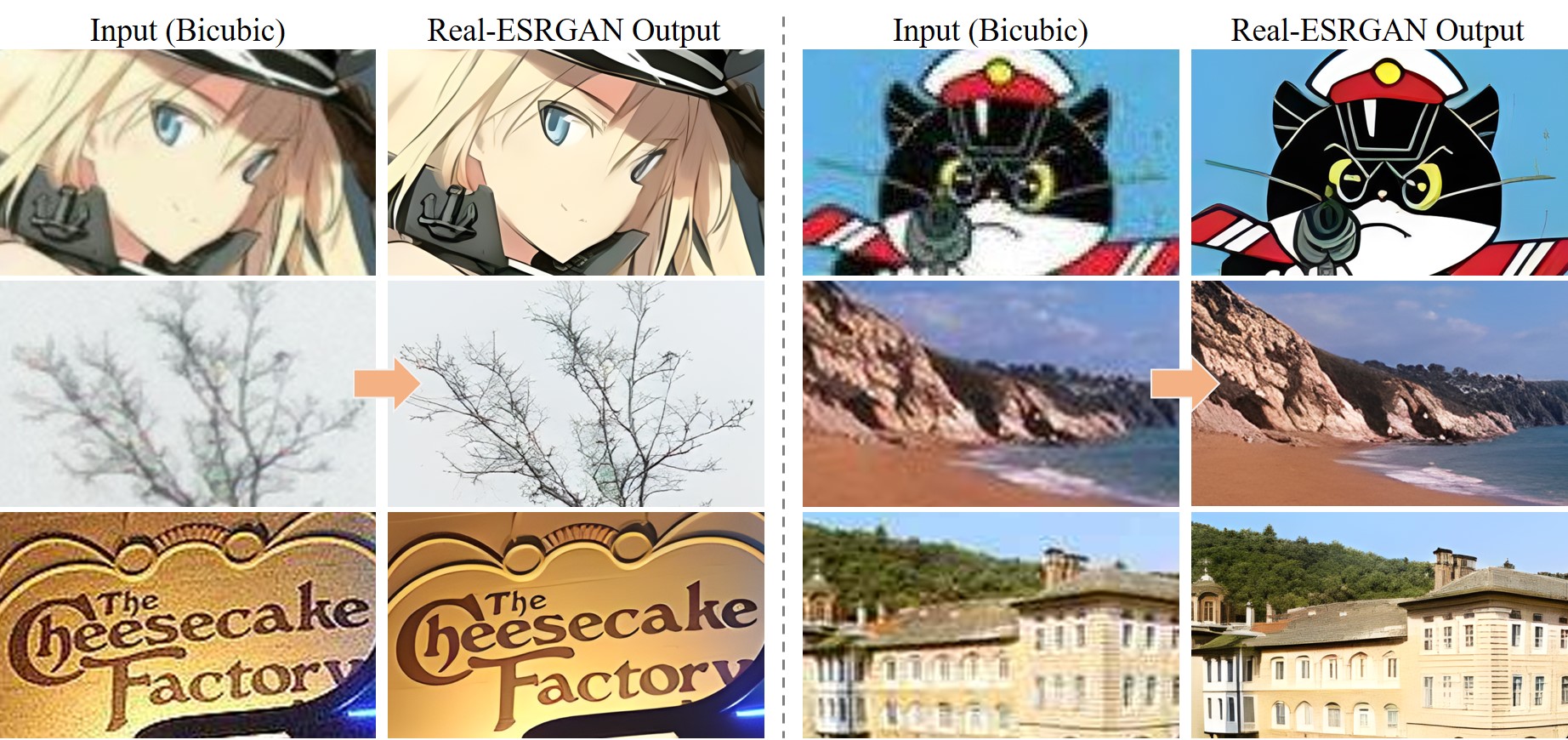
We have extended ESRGAN to Real-ESRGAN, which is a more practical algorithm for real-world image restoration. For example, it can also remove annoying JPEG compression artifacts. You are recommended to have a try :smiley:
In the Real-ESRGAN repo,
You can still use the original ESRGAN model or your re-trained ESRGAN model. The model zoo in Real-ESRGAN.
We provide a more handy inference script, which supports 1) tile inference; 2) images with alpha channel; 3) gray images; 4) 16-bit images.
We also provide a Windows executable fileRealESRGAN-ncnn-vulkan for easier use without installing the environment. This executable file also includes the original ESRGAN model.
The full training codes are also released in the Real-ESRGAN repo.
Welcome to open issues or open discussions in the Real-ESRGAN repo.
If you have any question, you can open an issue in the Real-ESRGAN repo.
If you have any good ideas or demands, please open an issue/discussion in the Real-ESRGAN repo to let me know.
If you have some images that Real-ESRGAN could not well restored, please also open an issue/discussion in the Real-ESRGAN repo. I will record it (but I cannot guarantee to resolve it😛).
Here are some examples for Real-ESRGAN:
:book: Real-ESRGAN: Training Real-World Blind Super-Resolution with Pure Synthetic Data
[Paper]
Xintao Wang, Liangbin Xie, Chao Dong, Ying Shan
Applied Research Center (ARC), Tencent PCG
Shenzhen Institutes of Advanced Technology, Chinese Academy of Sciences
As there may be some repos have dependency on this ESRGAN repo, we will not modify this ESRGAN repo (especially the codes).
The following is the original README:
The training codes are in :rocket: BasicSR. This repo only provides simple testing codes, pretrained models and the network interpolation demo.
BasicSR is an open source image and video super-resolution toolbox based on PyTorch (will extend to more restoration tasks in the future).
It includes methods such as EDSR, RCAN, SRResNet, SRGAN, ESRGAN, EDVR, etc. It now also supports StyleGAN2.
How to reproduce your results in the PIRM18-SR Challenge (with low perceptual index)?
How do you get the perceptual index in your ESRGAN paper?
BibTeX
@InProceedings{wang2018esrgan,
    author = {Wang, Xintao and Yu, Ke and Wu, Shixiang and Gu, Jinjin and Liu, Yihao and Dong, Chao and Qiao, Yu and Loy, Chen Change},
    title = {ESRGAN: Enhanced super-resolution generative adversarial networks},
    booktitle = {The European Conference on Computer Vision Workshops (ECCVW)},
    month = {September},
    year = {2018}
}
The RRDB_PSNR PSNR_oriented model trained with DF2K dataset (a merged dataset with DIV2K and Flickr2K (proposed in EDSR)) is also able to achive high PSNR performance.
Method
Training dataset
Set5
Set14
BSD100
Urban100
Manga109
SRCNN
291
30.48/0.8628
27.50/0.7513
26.90/0.7101
24.52/0.7221
27.58/0.8555
EDSR
DIV2K
32.46/0.8968
28.80/0.7876
27.71/0.7420
26.64/0.8033
31.02/0.9148
RCAN
DIV2K
32.63/0.9002
28.87/0.7889
27.77/0.7436
26.82/ 0.8087
31.22/ 0.9173
RRDB(ours)
DF2K
32.73/0.9011
28.99/0.7917
27.85/0.7455
27.03/0.8153
31.66/0.9196
Quick Test
Dependencies
Python 3
PyTorch >= 1.0 (CUDA version >= 7.5 if installing with CUDA. More details)
Python packages: pip install numpy opencv-python
Test models
Clone this github repo.
git clone https://github.com/xinntao/ESRGAN
cd ESRGAN
Place your own low-resolution images in ./LR folder. (There are two sample images - baboon and comic).
Download pretrained models from Google Drive or Baidu Drive. Place the models in ./models. We provide two models with high perceptual quality and high PSNR performance (see model list).
Run test. We provide ESRGAN model and RRDB_PSNR model and you can config in the test.py.
python test.py
The results are in ./results folder.
Network interpolation demo
You can interpolate the RRDB_ESRGAN and RRDB_PSNR models with alpha in [0, 1].
Run python net_interp.py 0.8, where 0.8 is the interpolation parameter and you can change it to any value in [0,1].
Run python test.py models/interp_08.pth, where models/interp_08.pth is the model path.
Perceptual-driven SR Results
You can download all the resutls from Google Drive. (:heavy_check_mark: included; :heavy_minus_sign: not included; :o: TODO)
HR images can be downloaed from BasicSR-Datasets.
Datasets
LR
ESRGAN
SRGAN
EnhanceNet
CX
Set5
:heavy_check_mark:
:heavy_check_mark:
:heavy_check_mark:
:heavy_check_mark:
:o:
Set14
:heavy_check_mark:
:heavy_check_mark:
:heavy_check_mark:
:heavy_check_mark:
:o:
BSDS100
:heavy_check_mark:
:heavy_check_mark:
:heavy_check_mark:
:heavy_check_mark:
:o:
PIRM (val, test)
:heavy_check_mark:
:heavy_check_mark:
:heavy_minus_sign:
:heavy_check_mark:
:heavy_check_mark:
OST300
:heavy_check_mark:
:heavy_check_mark:
:heavy_minus_sign:
:heavy_check_mark:
:o:
urban100
:heavy_check_mark:
:heavy_check_mark:
:heavy_minus_sign:
:heavy_check_mark:
:o:
DIV2K (val, test)
:heavy_check_mark:
:heavy_check_mark:
:heavy_minus_sign:
:heavy_check_mark:
:o:
ESRGAN
We improve the SRGAN from three aspects:
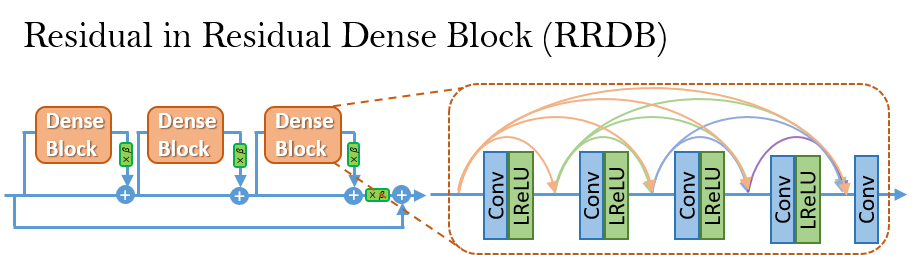
adopt a deeper model using Residual-in-Residual Dense Block (RRDB) without batch normalization layers.
employ Relativistic average GAN instead of the vanilla GAN.
improve the perceptual loss by using the features before activation.
In contrast to SRGAN, which claimed that deeper models are increasingly difficult to train, our deeper ESRGAN model shows its superior performance with easy training.
Network Interpolation
We propose the network interpolation strategy to balance the visual quality and PSNR.
We show the smooth animation with the interpolation parameters changing from 0 to 1.
Interestingly, it is observed that the network interpolation strategy provides a smooth control of the RRDB_PSNR model and the fine-tuned ESRGAN model.
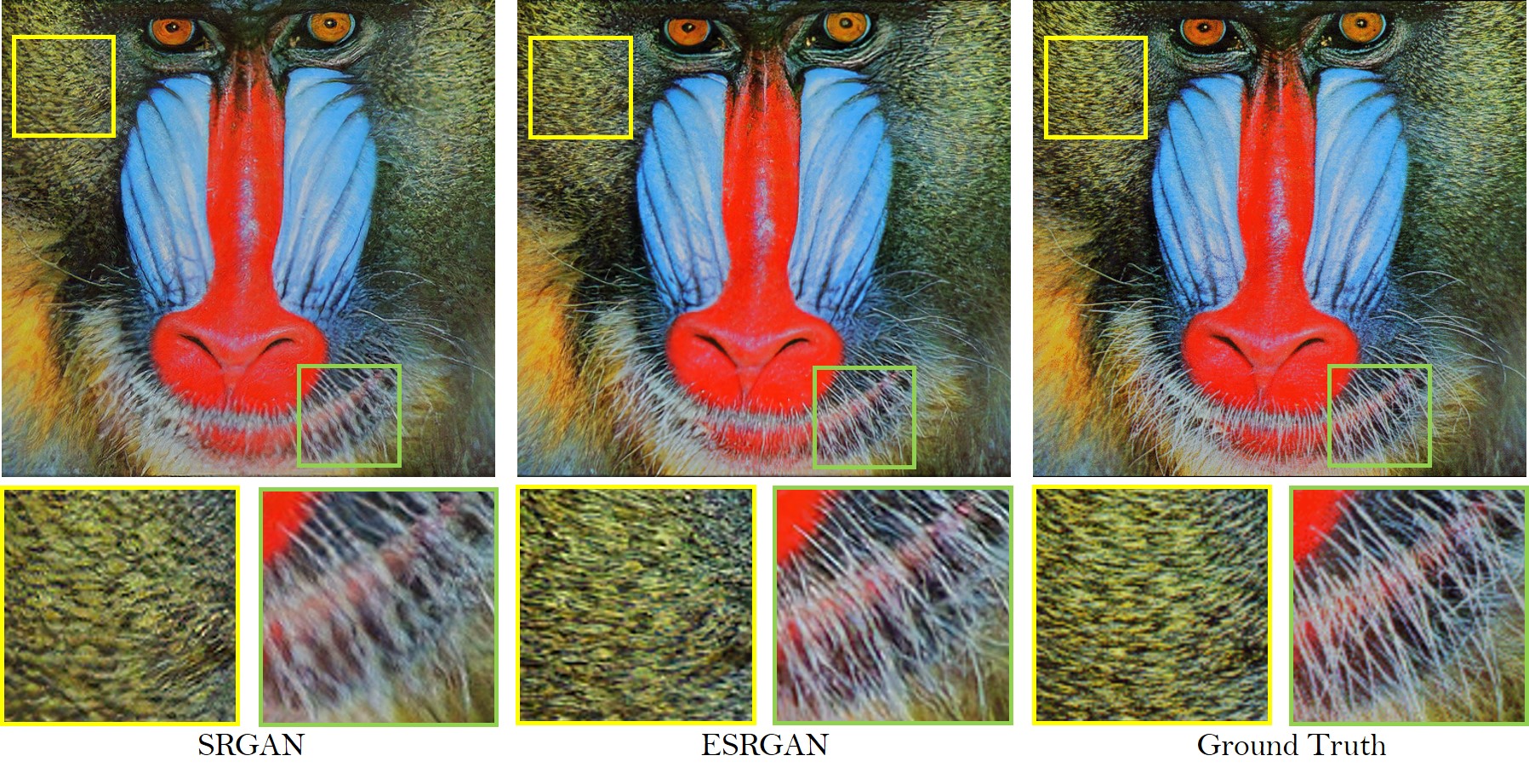
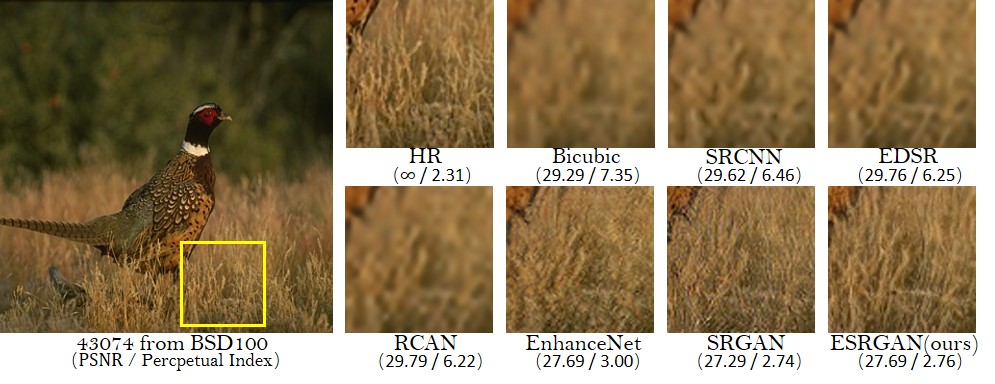
Qualitative Results
PSNR (evaluated on the Y channel) and the perceptual index used in the PIRM-SR challenge are also provided for reference.
Ablation Study
Overall visual comparisons for showing the effects of each component in
ESRGAN. Each column represents a model with its configurations in the top.
The red sign indicates the main improvement compared with the previous model.
BN artifacts
We empirically observe that BN layers tend to bring artifacts. These artifacts,
namely BN artifacts, occasionally appear among iterations and different settings,
violating the needs for a stable performance over training. We find that
the network depth, BN position, training dataset and training loss
have impact on the occurrence of BN artifacts.
Useful techniques to train a very deep network
We find that residual scaling and smaller initialization can help to train a very deep network. More details are in the Supplementary File attached in our paper.
The influence of training patch size
We observe that training a deeper network benefits from a larger patch size. Moreover, the deeper model achieves more improvement (∼0.12dB) than the shallower one (∼0.04dB) since larger model capacity is capable of taking full advantage of
larger training patch size. (Evaluated on Set5 dataset with RGB channels.)
The most recent commit recorded on xinntao/ESRGAN was 4.1 years ago, based on the GitHub push timestamp. The repository has 1.1k forks — one of the better signals of community interest.
How many stars does xinntao/ESRGAN have?
xinntao/ESRGAN has 6.6k GitHub stars — refresh the page for the live number, or check github.com/xinntao/ESRGAN. TopGit mirrors GitHub's count but does not claim minute-by-minute accuracy.
Is xinntao/ESRGAN open source?
Yes — xinntao/ESRGAN ships under the Apache-2.0 license, which makes its source code freely readable (and, depending on license terms, forkable and reusable). Source: github.com/xinntao/ESRGAN.
What is xinntao/ESRGAN?
xinntao/ESRGAN (xinntao/ESRGAN) is a Python project on GitHub. From the project's own README: ECCV18 Workshops - Enhanced SRGAN. Champion PIRM Challenge on Perceptual Super-Resolution. The training codes are in BasicSR.
Where do I read more about xinntao/ESRGAN?
This TopGit page is a snapshot — the READ ME tab shows the project's own README content (links stripped, images preserved). The GitHub repository at github.com/xinntao/ESRGAN is the definitive source.
Read full README in the tab above.
Want a second opinion on ESRGAN?
Ask an AI that can read this page — one click and you get its take on ESRGAN.

 /ESRGAN